
Table of Contents
Frequently Asked Questions
What is activity code 7210.00 and what does it cover in Dubai
Activity code 7210.00 is the formal classification for Research and Experimental Development on Natural Sciences and Engineering in Dubai. It sits within ISIC Division 72 — Scientific Research and Development and covers both basic and applied research across natural sciences such as physics, chemistry, and biology, as well as the full spectrum of engineering disciplines.
The licence is intended for entities whose primary work involves systematic investigation aimed at acquiring new scientific or technical knowledge. It also covers prototype development, proof-of-concept research, and experimental development aimed at producing new materials, devices, or industrial processes.
It does not cover social sciences, humanities, or routine commercial product testing, which fall under separate ISIC classifications and require different licence categories.
Who is eligible to apply for a 7210.00 R&D licence in Dubai
A wide range of entities can apply for this licence, provided their primary activity involves systematic scientific or engineering research. Eligible applicants include:
- Private R&D firms
- University spin-outs
- Engineering consultancies with a formal research mandate
- Multinational corporations establishing a regional R&D subsidiary
The licence is particularly suited to founders looking to commercialise intellectual property, access UAE government research contracts, or anchor a regional centre of excellence, as it provides the formal legal basis to operate in those contexts.
How long does it take to set up a Research and Experimental Development licence in Dubai
The estimated setup timeline for activity code 7210.00 is 5–15 working days, though the exact duration depends on the jurisdiction chosen — mainland or free zone — and the completeness of the documentation submitted.
Free zone incorporations, such as through Meydan Free Zone, are generally faster and more streamlined than mainland setups. The relevant authority overseeing licensing and investment activity is Invest in Dubai.
Can foreign nationals own 100% of an R&D company in Dubai
Yes. 100% foreign ownership is permitted for R&D entities in Dubai through two main routes. In designated free zones, full foreign ownership has long been the standard offering. On the mainland, the 2021 Commercial Companies Law reforms extended 100% foreign ownership across most activity categories, including scientific research and development.
For international founders with no immediate need for mainland client access, a free zone structure is typically the faster and more cost-effective route to achieving full ownership while maintaining operational flexibility.
What are the office and physical space requirements for this licence
Office requirements vary depending on the nature of the research being conducted. In most free zones, a flexi-desk arrangement is acceptable as the registered address for the entity.
However, if the business involves live experiments — such as laboratory work, materials testing, or hands-on engineering development — dedicated physical lab space will be required. Founders should clarify their specific research activities with the relevant authority before selecting a workspace package, as choosing the wrong setup can cause compliance issues later.
What is the corporate tax rate applicable to R&D companies in Dubai
The UAE applies a 9% corporate tax rate on taxable income exceeding AED 375,000, as established by the Federal Tax Authority. Income below this threshold is taxed at 0%, which provides meaningful relief for early-stage R&D entities.
Free zone entities operating under a 7210.00 licence may also be compatible with UAE corporate tax small business relief provisions, depending on their revenue profile and qualifying activities. It is advisable to consult a UAE-registered tax adviser to confirm eligibility before structuring the entity.
What is the difference between a mainland and free zone licence for R&D in Dubai
The choice between mainland and free zone has significant downstream implications for ownership structure, client access, visa allocation, and tax posture. A mainland licence issued through the Dubai Department of Economy and Tourism (DET) is best suited to entities that need direct access to UAE government research contracts, local institutional clients, or on-site research work at third-party premises.
A free zone licence offers 100% foreign ownership as standard, simplified incorporation, full repatriation of profits and capital, and no currency restrictions. The key constraint is that free zone entities cannot conduct physical research directly at client sites on the mainland without a separate mainland presence or a properly structured service agreement.
Before deciding, founders should clarify where their funding will be received, where their IP will be registered, and where their research talent will be based — these three factors typically determine the right jurisdiction more clearly than cost alone.
What are the specific advantages of a free zone structure for R&D entities in Dubai
Free zone structures offer several benefits that are particularly well-suited to research and development businesses. Key advantages include:
- Full repatriation of profits and capital with no restrictions
- Streamlined visa processing for research staff and specialist consultants
- Compatibility with UAE corporate tax small business relief provisions
- Simplified incorporation processes with faster setup timelines
For international founders who do not require immediate access to mainland government contracts or on-site client work, a free zone such as Meydan Free Zone is generally the most efficient and cost-effective starting point for establishing an R&D presence in the UAE.
Research & Experimental Development on Natural Sciences and Engineering License in Dubai
Dubai is actively funding and licensing R&D operations in natural sciences and engineering, and the regulatory path is more direct than most founders expect. The UAE has built real infrastructure around this, from free zone facilities to corporate tax incentives for qualifying research spend. This guide covers what the license covers, who it suits, how to set up, and why Meydan Free Zone is a workable base for this activity.
Key Stats at a Glance
| Activity name | Research & Experimental Development on Natural Sciences and Engineering |
|---|---|
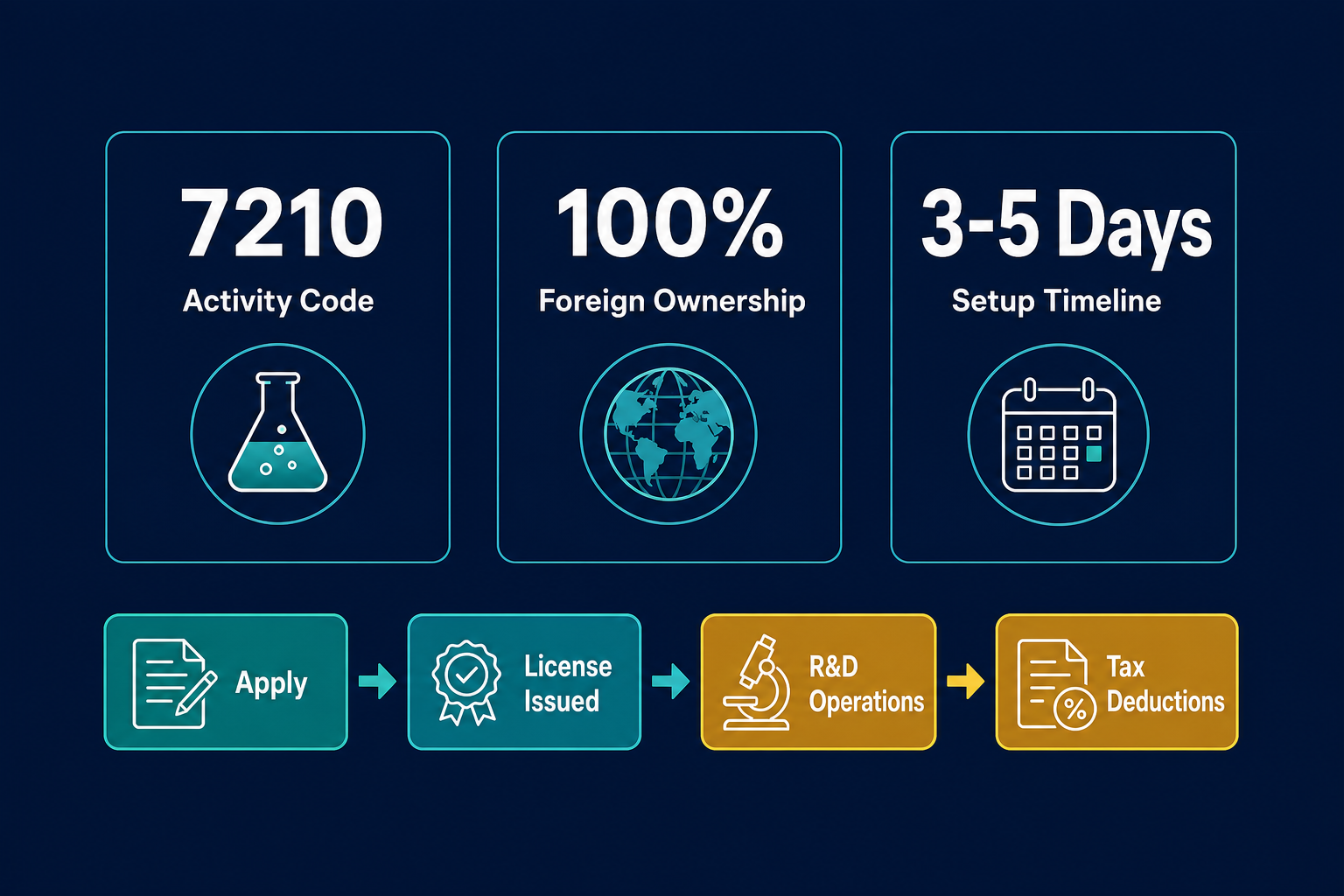
| Activity code | 7210 |
| License category | Professional / Scientific |
| Foreign ownership | 100% available in free zones, including Meydan Free Zone – Invest in Dubai |
| UAE gross expenditure on R&D | Data tracked by the World Bank as part of the UAE's push toward a knowledge-based economy |
| Typical setup timeline | 3 to 5 working days at Meydan Free Zone |
| Corporate tax on qualifying R&D income | Enhanced deductions available under UAE CT rules – Federal Tax Authority |
What This License Covers
This license covers systematic creative work carried out to increase the stock of knowledge in natural sciences and engineering, and the use of that knowledge to develop new applications. In practice, that means laboratory research, applied science, prototype development, and engineering trials all fall within scope.
The Business Activities List at Meydan Free Zone includes this activity under code 7210. It covers both basic research, where the primary aim is to generate new knowledge without a specific commercial application in mind, and applied research, where work is directed toward a practical objective.
What is included
- Laboratory-based research in physics, chemistry, biology, mathematics, and related fields
- Engineering trials and prototype development
- Applied experimental work aimed at solving specific technical problems
- Research conducted under contract for third-party clients
- Collaborative research projects with universities or other institutions
What is excluded
- Manufacturing and commercial production of goods
- Clinical trials and regulated medical research, which need separate approvals from the Dubai Health Authority
- Market research or social science research, which sit under different activity codes
- Routine testing and quality control that does not involve new knowledge generation
Pure research vs applied experimental development
The distinction matters when you are thinking about tax treatment. Pure research, sometimes called basic research, has no specific commercial outcome in mind. Applied experimental development is directed toward a defined product, process, or system. Both are permitted under this license, but the UAE corporate tax framework treats qualifying R&D expenditure in a specific way, and your accountant will need to categorise your spend correctly from the start.
This license does not, by itself, authorise you to sell the products you develop. If your research leads to a product you want to manufacture or distribute commercially, you will need a separate trading or manufacturing license for those activities.
Mainland vs Free Zone: Which Setup Works for You
The choice between a mainland company and a free zone entity shapes how you work, who you can bill directly, and how you hold intellectual property. Neither is automatically better. The right answer depends on your client base and your long-term plans for the IP you generate.
| Factor | Mainland (DET) | Free Zone (Meydan Free Zone) |
|---|---|---|
| Client access | Direct contracts with UAE government bodies and local institutions | Mainly international clients and free zone entities; UAE mainland work via a local agent or branch |
| Foreign ownership | 100% in most activities since 2021 reforms – check DET for your specific code | 100% across all activities |
| Office requirement | Physical office required | Flexi-desk options available |
| IP ownership | Held by the UAE-registered entity | Held by the free zone entity; profits repatriated freely |
| Corporate tax on qualifying R&D | Enhanced deductions available under UAE CT rules | Same CT rules apply; qualifying income from IP may attract further relief |
| Setup cost | Generally higher due to office requirements | Lower entry cost; Dubai Trade License from AED 12,500 |
Mainland via DET
A mainland license from the Department of Economy and Tourism lets you work directly with UAE government bodies and local universities. If your research is funded by a UAE government entity or a semi-government institution, a mainland structure is almost always the cleaner route. Government procurement teams expect a mainland-registered supplier with a physical address.
Meydan Free Zone
Meydan Free Zone gives you 100% foreign ownership, no restrictions on profit repatriation, and a lower cost base to start. If your clients are international, if you are running a research operation funded from outside the UAE, or if you are building an IP holding structure, a free zone entity is the more practical choice. You can always add a mainland branch later if you win a government contract that needs it.
IP ownership and profit repatriation
R&D entities generate intellectual property. Where that IP is held matters for tax, licensing revenue, and future sale of the business. A free zone entity in the UAE lets you hold IP in a jurisdiction with no withholding tax on royalties paid outward, which is a real structural advantage for firms that plan to license their research outputs internationally.
Dual license structures
Some firms set up both a free zone entity to hold IP and manage international contracts, and a mainland entity to bid on local government work. This adds cost and compliance overhead, but it is workable if your revenue mix genuinely splits across both. Do not set up a dual structure speculatively. Set it up when you have a specific contract that needs it.
Free Business Setup Cost Calculator
Calculate NowHow to Set Up: Step-by-Step
The process at Meydan Free Zone is straightforward. Most applicants complete it in three to five working days if their documents are in order before they start.
- Step 1, check your company name: Use the Company Name Check tool to confirm your preferred trade name is available before you submit anything.
- Step 2, confirm your activity code: Make sure activity code 7210 is listed on your license application. If you plan to carry out more than one type of research or add consulting services, list all relevant codes at this stage. Adding codes later costs time and money.
- Step 3, choose your legal structure: Most new entrants set up as an FZ-LLC (Free Zone Limited Liability Company). If you are an established foreign company looking to extend operations into Dubai, a branch of a foreign company is the alternative. The branch route keeps your global entity as the contracting party but limits some local activities.
- Step 4, prepare your documents: You will need passport copies for all shareholders and directors, a completed application form, and a basic business plan. Some activity types, particularly those involving regulated substances or specialist equipment, may need proof of professional qualifications. Check this before you start.
- Step 5, submit your application and pay your fees: Meydan Free Zone handles this through its online portal. You do not need to be in Dubai to complete the setup. Remote business setup is fully supported.
- Step 6, get your license issued: Once approved, your license is issued digitally. You receive your certificate of incorporation and your license document.
- Step 7, open a corporate bank account: This is the step that takes the longest. UAE banks are thorough in their due diligence on new entities, especially those in research and technology. Meydan Free Zone's mCore service includes business banking support to help you navigate this.
- Step 8, arrange your visa allocation: Your license comes with a set number of visa allocations. Apply for your own investor or partner visa first, then add employee visas as you hire. Each visa holder needs a medical fitness test, Emirates ID, and health insurance before they can start work.
Compliance and What You Need in Place
Getting the license is the start, not the finish. There are ongoing duties that apply from the moment you begin operating, and a few that kick in once you cross certain revenue or headcount thresholds.
Corporate tax registration
The UAE introduced a 9% corporate tax on business profits above AED 375,000 from June 2023. You need to register with the Federal Tax Authority once your business is active, whatever your revenue level. Registration is separate from filing. Do not wait until you are profitable to register. The FTA sets the rules on timing, and late registration carries penalties. Check the Federal Tax Authority website for current thresholds and deadlines.
Qualifying R&D expenditure
The UAE corporate tax framework includes provisions for enhanced deductions on qualifying R&D expenditure. This is a real benefit for firms in this sector, but it needs proper documentation from the start. Keep detailed records of what you spend on research activities, separate from general operating costs. Your accountant needs this to make the claim correctly. Meydan Free Zone's accounting services cover this kind of ongoing compliance work.
VAT
VAT registration becomes mandatory once your taxable turnover reaches AED 375,000 in a 12-month period. Research services provided to clients outside the UAE may be zero-rated, but the rules depend on the nature of the supply and where the client is based. Get this confirmed early. The FTA's guidance is detailed, and errors here create real problems.
Staff visas and MOHRE registration
Every employee needs a UAE residence visa, Emirates ID, and a medical fitness test before they start work. If you have employees on your payroll, you must register with the Ministry of Human Resources and Emiratisation. The MOHRE sets the rules on employment contracts, salary protection, and Emiratisation targets for larger firms. Free zone entities have slightly different obligations to mainland companies, but the basics apply across both.
Annual license renewal
Your Meydan Free Zone license renews annually. Renewal requires your fees to be paid and your registered address to be current. If your research involves regulated materials, controlled substances, or activities that need external approvals, those approvals must also be current at renewal time.
Sector-specific approvals
Most natural science and engineering research does not need approvals beyond the free zone license itself. Exceptions include research involving radioactive materials, certain chemicals, or biological agents, all of which need clearance from the relevant UAE authority before you import or use them. If your work falls into any of these areas, identify the approval chain before you set up, not after.
Market Opportunity
The UAE government has made R&D investment a stated national priority. The country's National Innovation Strategy targets a significant increase in R&D spend as a share of GDP, and government-linked entities are actively looking for research partners, not just suppliers. For an R&D entity with real technical capability, Dubai offers access to well-funded clients, a tax environment that rewards qualifying research spend, and a free zone infrastructure that keeps operating costs manageable.
The IMARC Group tracks research and technology investment trends across the GCC, and the data consistently points to the UAE as the most active market in the region for private and institutional R&D spending. Energy transition, advanced manufacturing, life sciences, and digital infrastructure are the sectors attracting the most investment. If your research sits in or adjacent to any of these areas, the commercial pipeline is real.
Conclusion
A Research & Experimental Development on Natural Sciences and Engineering license in Dubai is a legitimate, well-supported commercial structure. The UAE has built real incentives around R&D, from corporate tax treatment to free zone infrastructure that keeps setup costs workable. The license is accessible, the setup process is fast, and the market for research services in the region is growing.
If you are a researcher, an engineering consultancy, or an international firm looking to establish a Gulf-based R&D operation, Dubai is a serious option. Meydan Free Zone gives you 100% ownership, a fast setup process, and ongoing support through mCore, mResidency, and mAccounting services. Speak to the Meydan Free Zone team to confirm your activity code, get a cost breakdown, and move forward without delays.
Ready to Launch Your Business in Dubai?
Let's Connect