
Table of Contents
Frequently Asked Questions
What is activity code 3312.01 and what does it permit in Dubai
Activity code 3312.01 covers Repair and Maintenance of Industrial Machinery and Equipment. It is the designated classification under Dubai's licensing framework for businesses providing professional MRO services to industrial clients.
Permitted work under this code includes mechanical diagnostics and fault analysis, component replacement and overhaul, calibration and performance testing, and scheduled preventive maintenance programmes. The scope is commercially broad while remaining within a defined regulatory category.
Because the activity sits within the manufacturing and repair classification, it carries specific health, safety, and environmental obligations — particularly around the handling of lubricants, solvents, and mechanical waste under Dubai Municipality guidelines.
Can an industrial machinery repair business operate from a Dubai free zone
Yes, but with an important structural consideration. A free zone licence permits operations within the zone itself and internationally, but direct service delivery to clients on the Dubai mainland may require either a mainland licence or a commercial agency arrangement.
Founders should assess their primary client base before committing to a jurisdiction. If most target customers — manufacturers, logistics operators, or construction contractors — are located on the mainland, a mainland structure or a dual-licence approach may be more practical.
Meydan Free Zone is one option highlighted for registration, offering access to Dubai's broader industrial and logistics ecosystem while supporting internationally oriented service models.
What sectors drive demand for industrial machinery repair services in Dubai
Several capital-intensive industries create sustained demand for MRO services in Dubai. The primary sectors include oil and gas, construction, food and beverage processing, logistics and warehousing, and utilities. Each relies on heavy equipment that requires regular servicing, unplanned repair, and periodic overhaul.
Dubai's ongoing infrastructure expansion — including ports, logistics corridors, and industrial zones — creates a long-term pipeline of equipment maintenance requirements. Businesses that establish themselves early with the right technical capability are well positioned to capture recurring contract revenue.
According to IMARC Group, the Middle East MRO market is on a consistent growth trajectory, supported by infrastructure spending and industrial diversification aligned with UAE Vision 2031.
When does VAT registration become mandatory for an industrial machinery repair business in the UAE
VAT registration is mandatory once a business's taxable turnover exceeds AED 375,000 annually, as set out in Federal Tax Authority guidelines. This threshold applies to most businesses operating in the UAE, including those providing industrial repair and maintenance services.
B2B service businesses in the MRO space can reach this threshold relatively quickly, particularly once service contracts and retainer agreements are in place. It is advisable to monitor turnover from the outset and register proactively rather than reactively.
Voluntary registration is available below the mandatory threshold and can be commercially advantageous when dealing with VAT-registered business clients who wish to recover input tax.
What is the typical customer profile for an industrial machinery repair business in Dubai
The service model for activity code 3312.01 is entirely B2B. Primary clients are businesses rather than individual consumers — specifically manufacturers, logistics operators, construction contractors, food producers, and utilities companies.
Engagements are typically structured around service contracts, retainers, and on-call field response agreements rather than one-off transactions. This creates more predictable revenue and deeper client relationships over time.
Targeting clients with large, complex equipment fleets — such as warehousing operators or food processing plants — tends to generate higher contract values and longer engagement durations than serving smaller or more fragmented industrial users.
Is it better to specialise or operate as a generalist industrial machinery repair business
Specialisation is generally the stronger commercial strategy. Businesses that focus on a specific equipment category — such as CNC machinery, conveyor systems, hydraulic equipment, HVAC plant, or generator sets — can command higher service rates and build defensible technical expertise that generalists cannot easily replicate.
Generalist repair operations tend to compete on price, which compresses margins and makes differentiation difficult. Specialists, by contrast, compete on capability, response time, and depth of knowledge — factors that industrial clients prioritise when equipment downtime is costly.
Specialisation also supports more targeted marketing and business development, making it easier to build a reputation within a defined sector or equipment category over time.
How significant is Dubai's industrial machinery market and what growth is projected
Dubai accounts for a significant share of the UAE's non-oil industrial output, with manufacturing contributing over 9% of GDP. The broader UAE industrial machinery market is projected to grow steadily through 2030, driven by manufacturing expansion and continued infrastructure investment.
The global MRO market is valued in the hundreds of billions of dollars, and the Middle East represents one of its fastest-growing regional segments. Dubai's role as a logistics and trade hub — supported by world-class infrastructure through DP World — amplifies local demand for equipment maintenance services.
UAE Vision 2031 and associated industrial diversification programmes are expected to sustain this growth trajectory, creating a long-term opportunity for well-positioned MRO businesses established in the emirate.
What health, safety, and environmental obligations apply to a workshop-based machinery repair operation in Dubai
Workshop-based industrial repair operations carry specific compliance obligations in Dubai. Handling lubricants, solvents, and mechanical waste must comply with Dubai Municipality environmental guidelines, which govern storage, disposal, and containment of hazardous materials.
Health and safety requirements apply to workshop premises, equipment, and staff practices. Businesses should ensure their facility design, waste management procedures, and staff training align with applicable regulations before commencing operations.
Non-compliance in this area can result in fines, licence suspension, or reputational damage with industrial clients who conduct supplier audits. Building environmental and safety compliance into the business from the outset is both a regulatory requirement and a competitive signal to larger B2B customers.
How to Start an Industrial Machinery Repair Business in Dubai
Dubai runs on heavy kit. Factories, building sites, warehouses and utility plants all depend on machines that cannot afford to sit still. When one breaks, the cost of the stoppage is far bigger than the cost of the fix. That is why good repair firms get called back again and again.
This guide covers how to set up a licensed industrial machinery repair business in Dubai under activity code 3312.01. It explains what the license lets you do, who pays for this work, the rules you need to follow, and how to register through Meydan Free Zone.
Key Stats at a Glance
What This License Covers

Activity code 3312.01 is Repair and Maintenance of Industrial Machinery and Equipment. The scope is wide but clear. You can do:
- Mechanical diagnostics and fault finding
- Replacing and overhauling parts
- Calibration and performance testing
- Planned preventive maintenance programmes
The code sits in the manufacturing and repair group. That group brings health, safety and environmental duties with it, mostly around how you store and get rid of oils, solvents and mechanical waste.
Who Your Clients Will Be
Your clients are businesses, not the public. Think manufacturers, logistics operators, building contractors, food producers and utility companies. Every one of them runs machines that need servicing, sudden repair, and periodic overhaul.
Nobody in this market buys one job and disappears. Work is sold as service contracts, retainers, and on-call field response deals. That is good news, because it makes your income much easier to predict.
Picking a niche pays better than being a generalist. Firms that focus on one type of machine, such as CNC machinery, conveyor systems, hydraulic kit, HVAC plant or generator sets, can charge more and build real depth. Generalists compete on price. Specialists compete on skill, and skill wins when a client is losing money every hour the line is down.
Mainland or Free Zone
This is the biggest choice you will make when setting up. Let your clients decide it, not the price.
So work out where your customers are first. If most of them sit on the Dubai mainland, plan for that before you commit to a structure.
[blockCTACostCalculator]
Step-by-Step Setup Guide
Meydan Free Zone supports activity 3312.01 and the process is simple.
- Step 1, pick your activity: Confirm code 3312.01 from the approved activity list. Check the permitted scope covers everything you plan to do.
- Step 2, choose your legal structure: One owner usually registers a Free Zone Establishment (FZE). Two or more shareholders register a Free Zone LLC (FZ-LLC).
- Step 3, book your trade name: Submit the name you want. It must follow UAE naming rules, so no offensive words and no references to regulated bodies.
- Step 4, send your documents: Passport copies and a completed application form are the standard set. Simple applications do not usually need notarisation.
- Step 5, get your license: Once approved, your trade license is issued. That is the document that makes your work legal.
- Step 6, open a bank account: Take your license and setup papers to a UAE bank. Timelines vary, so plan for four to eight weeks.
- Step 7, sort your visas: Your license package sets how many residence visas you can sponsor. Apply for investor and staff visas as you need them.
Founders overseas can do most of this remotely. Meydan Free Zone is built to handle applicants who are not in the UAE yet.
Compliance and What You Need in Place
Waste and chemicals
Oils, solvents and mechanical waste fall under Dubai Municipality environmental rules. Store them and get rid of them properly.
Workshop safety
Staff working with heavy machines or in confined spaces must meet the relevant safety standards.
Staff and visas
The Ministry of Human Resources and Emiratisation (MOHRE) sets the labour rules. Technical staff need proper contracts, valid UAE work permits, and visas tied to your license.
Tax
You must register for VAT once your taxable turnover passes AED 375,000 in a twelve-month period. Register with the Federal Tax Authority before you get there. Most clients in this sector are VAT registered themselves, so VAT on your invoices will not cost you work.
How You Will Work
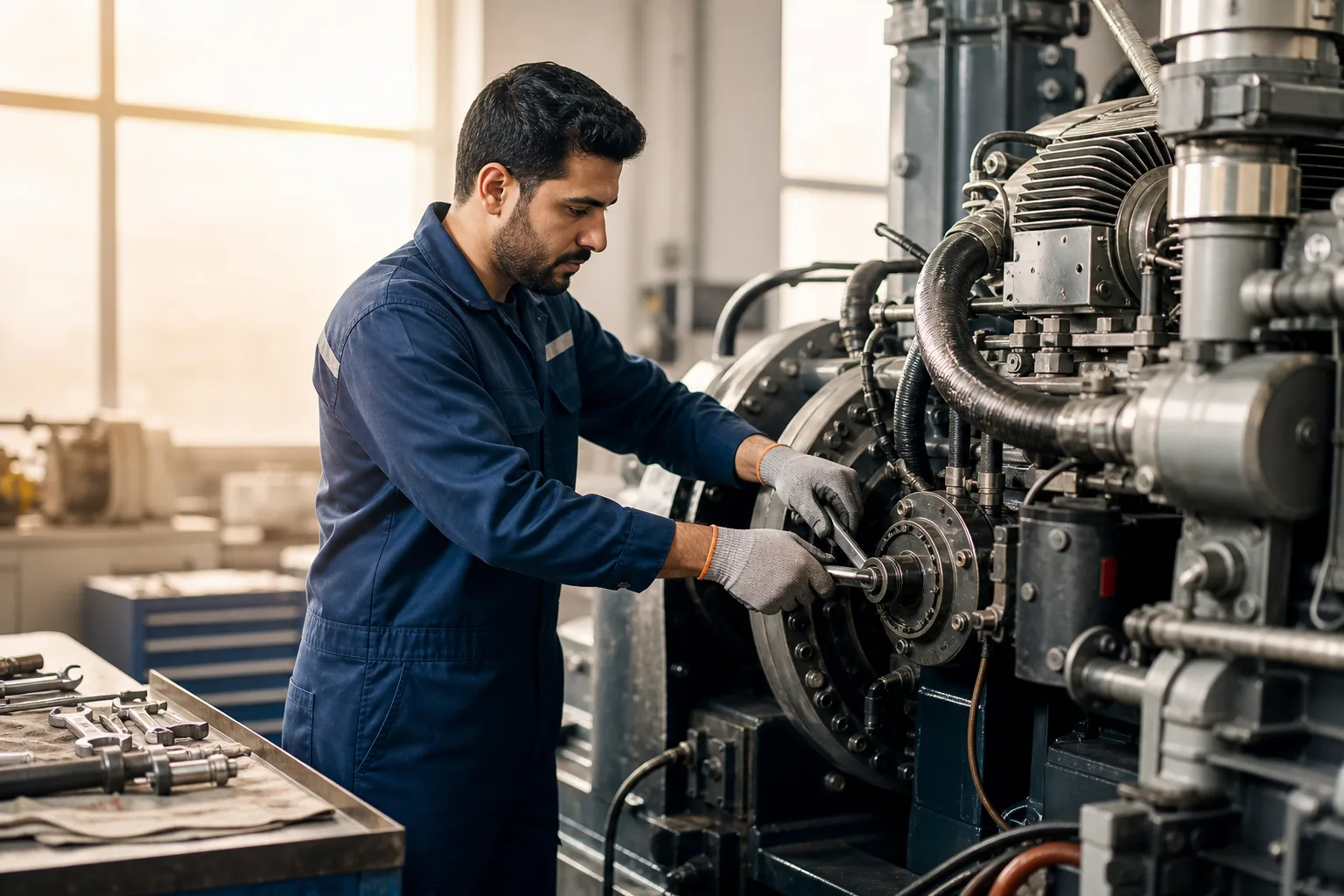
There are two ways to run this. A workshop takes the machine in. Mobile field service sends your people to the client site. A workshop needs space and money for tools. Field service is leaner but harder to run day to day. Plenty of firms do both.
Parts are your main cost. Dubai's logistics network, largely through DP World, makes importing components from global suppliers quick. Local distributors give you speed, direct import gives you margin, and most operators use both depending on how urgent the job is.
Pricing comes in three shapes: time and materials for reactive jobs, a fixed fee for a defined overhaul, and annual maintenance agreements for regular clients. Annual agreements give you the steadiest income, so chase those first.
Market Opportunity
UAE manufacturing and industrial output have grown steadily for a decade, and machines do not maintain themselves. Manufacturing contributes over 9% of GDP. Demand comes from oil and gas, construction, food and beverage processing, logistics and warehousing, and utilities.
IMARC Group reports that the Middle East MRO market keeps growing, helped by infrastructure spending and industrial diversification under UAE Vision 2031. New ports, logistics corridors and industrial zones all add machines that will need looking after. Get in early with the right skills and the right license and you can lock in repeat contracts.
Conclusion
Industrial machinery repair is a solid, demand-led business in Dubai. The market is big, the clients are already there, and the barriers are workable if you have the technical skill and the correct license.
Meydan Free Zone offers a simple path to a license under activity 3312.01. Talk to the setup team to confirm your scope, check your visa allocation, and get your license issued.
[blockCTAContact]