
Table of Contents
Topic Summary
Understand What License Code 4781.95 Covers
Activity code 4781.95 authorizes the retail sale of animal feed and fodder from a market stall or marketplace position. It covers a wide product range including hay, straw, alfalfa, compound feeds, pellets, equine feeds, and camel rations, allowing you to build a multi-tier business under a single license.
Know the UAE Market Size Before You Start
The UAE animal feed market was valued at USD 2.64 billion in 2024 and is projected to reach USD 3.38 billion by 2033, growing at a 2.75% CAGR. The country consumes around 3 million tonnes of feed annually across poultry, ruminant, and equine sectors, signaling strong and consistent demand.
Target the Right Buyer Groups for Better Margins
Livestock breeders and poultry operations form the high-volume base but are price-sensitive, since feed accounts for 60 to 70% of poultry production costs. Equine and camel clients, including racing stables and polo clubs, offer higher margins because they prioritize formulation quality over price.
Choose Between Mainland and Free Zone Setup
A mainland DET license is best if you plan to sell directly from a physical stall inside UAE fodder markets and feed souks. Meydan Free Zone is better suited to import, wholesale, and supply models, and offers 100% foreign ownership with a fully digital, remote setup process.
Secure Approvals Before You Begin Trading
Regardless of whether you choose a mainland or free zone structure, confirming the approvals position with the relevant authority is a required step before you start trading. This applies to both the Department of Economy and Tourism and Meydan Free Zone licensing pathways.
Leverage the UAE's Institutional Fodder Infrastructure
The Abu Dhabi Fodder Market alone serves more than 40,000 breeders supplying five million livestock head, giving stall-based sellers access to an established and active buyer network. The UAE also hosts a world-class thoroughbred racing industry and camel racing circuits, creating specialized demand for premium feed products.
How to Start a Fodder Seller Via Stalls Business in Dubai with Meydan Free Zone
The UAE carries over 2.2 million head of livestock, runs one of the world's great thoroughbred racing industries, and races camels at a level nowhere else matches. All of them eat, every day, and most of that feed is bought commercially. Activity code 4781.95 is the license for selling it from a stall.
This guide covers what the license allows, who buys from you, how mainland and free zone compare, and the steps to get set up. One item needs settling before you trade, and it is the approvals position.
Key Stats at a Glance

What This License Covers
Code 4781.95 sits within ISIC class 4781, which covers retail sale of food, beverages and tobacco products via stalls or markets. Within that class, 4781.95 is designated specifically for Fodder Seller Via Stalls.
It covers the retail sale of animal feed, fodder and livestock nutrition products from a market stall or marketplace position, sold directly to end customers through that stall-based channel.
The product range inside it is wide: hay, straw, alfalfa, compound feeds, pellets, equine feeds, camel rations and specialty livestock nutrition. That breadth lets you build a multi-tier business under a single code, combining high-volume commodity lines with premium performance categories.
Who Your Clients Will Be
Three buyer groups, and the difference between them is margin. Livestock breeders and smallholder farmers are the volume base. They buy roughage feeds, hay, alfalfa and Rhodes grass on a replacement cycle that never stops, because animals eat whether or not the economy is doing well.
Poultry and ruminant operations are the largest segment and the most price-sensitive, since feed accounts for 60 to 70% of poultry production costs. At that share of a customer's cost base, they watch your pricing closely.
Equine and camel clients are where the margin sits. Racing stables, polo clubs, equestrian centres and camel racing circuits buy specialist performance nutrition, and those buyers choose on formulation quality rather than price because feed affects competitive results. Agthia Group launched four specialised camel feed products in February 2025 using precision nutrition technology, which shows the depth of that segment.
Mainland or Free Zone
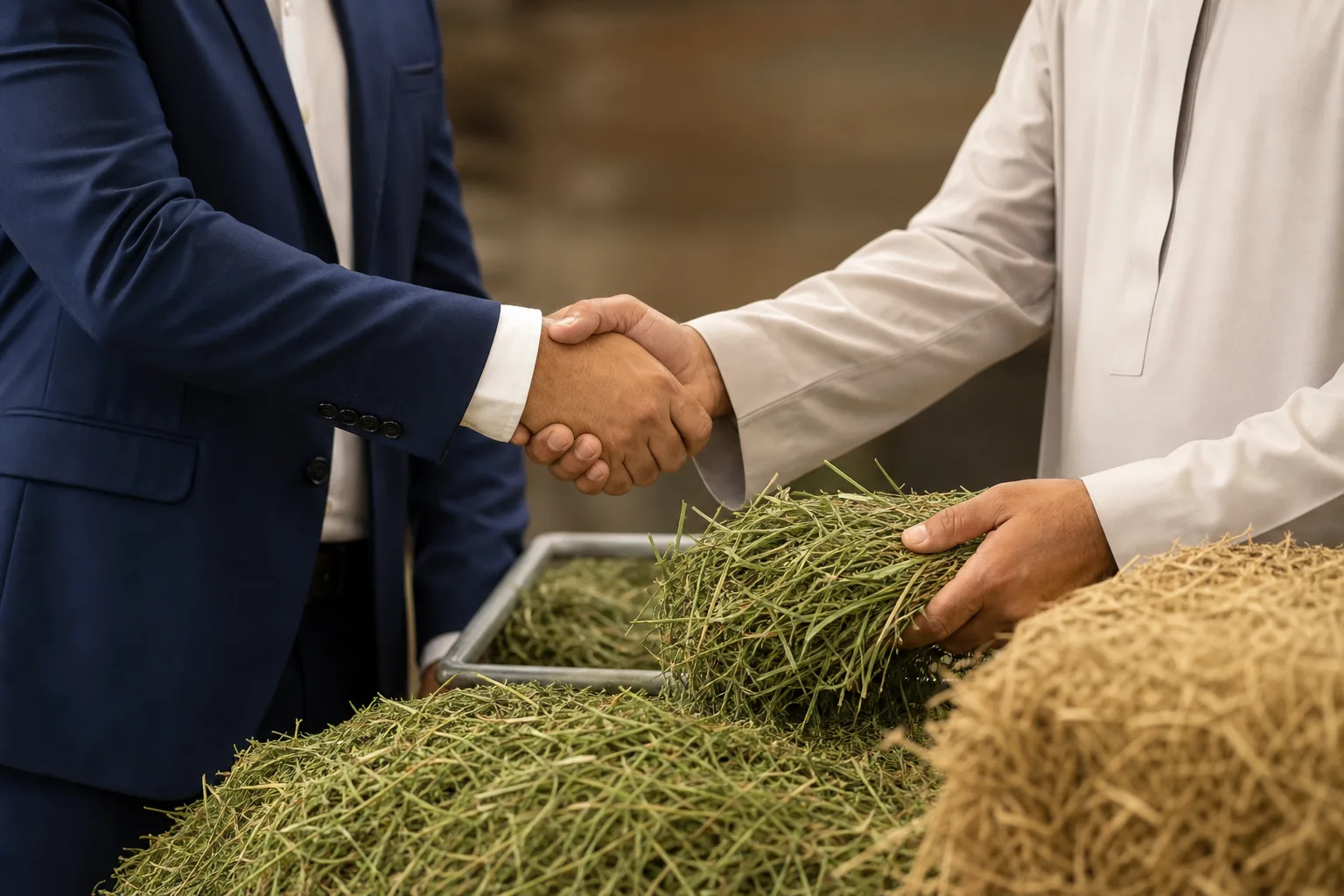
If your model is a physical stall inside the UAE's fodder markets and feed souks, a mainland license from the Department of Economy and Tourism is the practical route. Selling directly to breeders from a market position is what it is built for.
Meydan Free Zone suits a different shape: importing feed and supplying stall operators and retailers rather than serving breeders yourself. Full foreign ownership and a digital setup make that quick to start.
Storage is the constraint either way. Hay and roughage need volume and dry conditions, while compound feeds and pellets degrade in heat and humidity. Sort out where stock sits before you commit to a first order.
[blockCTACostCalculator]
Step by Step Setup Guide
- Step 1, settle the approvals question: Confirm in writing with the licensing authority which feed safety and market permissions apply to your product range and stall position. Do this before committing to stock or a site.
- Step 2, define your product mix: Roughage, compound feed, or specialist equine and camel nutrition. Each carries a different margin, storage need and customer.
- Step 3, choose your jurisdiction: Mainland through DET for a stall operation, or Meydan Free Zone for import and supply models.
- Step 4, book your trade name: Check availability through the DET portal or the Meydan Free Zone portal, following UAE naming conventions. ]
- Step 5, secure your stall position and storage: A pitch at a fodder market gives you access to breeder footfall. Storage keeps the stock saleable once you have it.
- Step 6, build supplier relationships: Feed mill operations concentrate around Abu Dhabi and Dubai, and importing gives you access to the rest.
- Step 7, collect your license, open a bank account and register for VAT: Register with the Federal Tax Authority once taxable turnover passes AED 375,000.
Compliance and What You Need in Place
The approvals gap
The source guidance for code 4781.95 leaves the third-party approval position blank. That silence should not be read as confirmation that nothing applies. Animal feed is an input to the human food chain through livestock, and feed quality is regulated accordingly in most jurisdictions. Get written confirmation of what applies to your range before you trade.
Market and stall permissions
A trade license does not give you the right to occupy a pitch. Fodder markets and animal feed souks control their own space and set their own conditions, and those arrangements sit separately from your license.
Feed quality and storage
Poorly stored feed loses nutritional value and can spoil. A breeder whose animals underperform on your feed does not come back, and tells everyone at the market. Dry, ventilated storage is a commercial asset, not just a compliance item.
Product knowledge
Equine and camel clients expect somebody who can discuss formulation and inclusion rates, not just weigh out a sack. That knowledge moves you from the commodity end of your customer base to the premium end.
Supplier relationships
Abu Dhabi and Dubai are the two core pillars of UAE feed, home to integrated feed mill operations and the highest concentrations of livestock and equestrian facilities. Building relationships there matters as much as importing.
VAT
Register with the Federal Tax Authority once taxable turnover passes AED 375,000.
Market Opportunity
The UAE animal feed market reached USD 2.64 billion in 2024 and is projected to reach USD 3.38 billion by 2033, with annual consumption at 3.00 million tonnes across poultry, ruminant and equine sectors. Globally the market was USD 602.06 billion in 2024 heading for USD 903.16 billion by 2032 at 5.2% CAGR.
The institutional commitment behind that is real. The Abu Dhabi Fodder Market, launched under the Abu Dhabi Agriculture and Food Safety Authority and described as the Middle East's largest dedicated fodder market, serves more than 40,000 breeders supplying five million livestock head, with 85 outlets operated by 30 companies and a connected online trading platform.
The premium tier is what makes this more than a commodity trade. The UAE's equestrian and camel heritage supports a specialist nutrition market most countries do not have, anchored by world-class racing venues and camel racing circuits. Combining commodity lines with those premium categories under one activity code is the opportunity here.
Conclusion
Fodder selling under code 4781.95 sits behind demand that does not pause, in a market underpinned by national food security policy and a livestock population of over 2.2 million head.
The structure of the opportunity is what makes it worth doing. Commodity roughage keeps the stall busy, poultry and ruminant feed carries the volume, and equine and camel nutrition carries the margin, all under one license.
What needs settling before you start is the approvals position, since the guidance for this code leaves it blank and feed sits upstream of the human food chain. Confirm what applies to your range first. Speak to the Meydan Free Zone team to work through it.
[blockCTAContact]