Table of Contents
Topic Summary
Understand Exactly What Code 4669.83 Covers
Activity code 4669.83 licenses the trading of medical-grade gases — oxygen, nitrous oxide, CO2, and nitrogen — supplied to hospitals, clinics, and healthcare facilities. The critical distinction is pharmaceutical specification and batch documentation, not the molecule itself; the same gas sold for welding falls under a completely different trading class.
Confirm Approvals in Writing Before Trading
No third-party approval is explicitly stated on the source page for this activity, but these are clinical-use products going directly into patient care. You must confirm the regulatory position in writing with both the licensing authority and the relevant health authority before you begin trading.
Know the Three Activities Outside This License
Producing gases yourself, supplying medical gas equipment like manifolds and regulators, and dispensing gases through a pharmacy are all separate licensed activities. If your business model combines gas supply with installing hospital pipeline systems, you will need two distinct licenses.
Target the Right Buyer Segments Strategically
Hospitals and ICU networks prioritize emergency delivery reliability above price, making long-term supply contracts the norm. Specialty buyers such as IVF clinics and dermatology centres represent the fastest-growing segment but are the most technically demanding, since cryopreservation failures can destroy irreplaceable biological material.
Weigh Mainland Versus Free Zone Setup Carefully
A Meydan Free Zone license offers 100% foreign ownership and zero corporate tax on qualifying income, but selling direct to UAE hospitals and clinics typically requires working through a mainland distributor or agent. A mainland DET license allows direct local market access but comes with different ownership and cost structures.
Size the Market Before You Commit Capital
The global industrial gases market is projected to reach USD 193.72 billion by 2034, with healthcare representing the dominant segment at nearly 22% of demand in 2026. The Middle East and Africa alone account for over USD 12 billion in 2025, giving a well-positioned Dubai-based trader a substantial regional opportunity.
How to Start a Medical Gas Trading Business in Dubai with Meydan Free Zone
Every operating theatre, every ICU bed, every dental chair and every ambulance in the UAE runs on medical gases. Oxygen for respiratory therapy, nitrous oxide for anaesthesia, carbon dioxide for laparoscopic surgery, nitrogen for cryotherapy and cryopreservation. Activity code 4669.83 is the license for supplying them.
This guide covers what the license allows, who buys from you, the approval position and the steps to get set up. Read the compliance section before you do anything else. These are pharmaceutical-grade products going into clinical use, and the approval position on the source page needs checking rather than trusting.
Key Stats at a Glance
What This License Covers
Code 4669.83 covers trading in medical gases. That means medical-grade oxygen in cylinder, manifold and bulk form, nitrous oxide and medical CO2 for anaesthesia and surgery, and liquid and medical-grade nitrogen for cryotherapy and cryopreservation, supplied to hospitals, clinics and healthcare facilities.
Medical grade is the whole point of the code. The same molecule sold for welding or food processing is an industrial gas in a different trading class. Sold to a pharmaceutical specification with batch documentation for use on patients, it is a medical gas. The specification, not the cylinder, decides which activity you are in.
Three things sit outside the code. Producing gases yourself, through air separation or any other process, is manufacturing with its own license. Medical gas equipment, meaning manifolds, regulators, pipeline systems and delivery devices, is a medical device activity rather than a gas trading one. And dispensing to the public through a pharmacy is separate again. If your plan bundles gas supply with installing hospital pipeline systems, you are looking at two activities, not one.
Who Your Clients Will Be
Hospitals and ICU networks
Medical oxygen in cylinder, manifold and bulk configurations, bought on long-term supply contracts. These buyers care about emergency delivery capability above all else, because running short is a clinical event rather than a commercial one.
Dental, anaesthesia and surgical practices
Nitrous oxide, medical CO2 and anaesthesia gas combinations going to dental networks, anaesthesia service providers and laparoscopic surgical centres. Smaller volumes, more delivery points, and a buyer who needs predictable scheduling.
Specialty and cryopreservation buyers
Liquid nitrogen and medical-grade nitrogen for aesthetic clinics, dermatology centres, IVF and fertility clinics. This is the fastest-growing corner and the most technically demanding, because cryopreservation failures destroy irreplaceable material.
Mainland or Free Zone
Hospitals buy through tenders and long contracts, and they buy locally. A mainland license from the Department of Economy and Tourism is the usual route for supplying UAE hospitals, clinic groups and government healthcare directly.
Meydan Free Zone gives you 100% foreign ownership and a lower cost base, and it suits an import and regional distribution model or an entity holding supply agreements with the global gas majors while a local partner handles clinical delivery.
Storage and logistics sit outside that choice entirely. Compressed and cryogenic gases need approved storage, correct cylinder handling, colour-coded stock control and a delivery operation that can respond in an emergency. A flexi-desk covers your admin, never your cylinders.
[blockCTACostCalculator]
Step by Step Setup Guide
- Step 1, confirm the approval position in writing: Do not rely on a summary page. Ask the licensing authority and the health authority what applies to medical gases before you spend anything else.
- Step 2, fix your gas list: Oxygen, nitrous oxide, medical CO2, nitrogen or a combination. Each carries its own handling and documentation load.
- Step 3, choose your jurisdiction: Mainland through DET for direct hospital and clinic supply, or Meydan Free Zone for import and regional distribution.
- Step 4, book your trade name: Check availability through the DET or Meydan Free Zone portal, following UAE naming conventions.
- Step 5, set up compliant storage and cylinder handling: Approved premises, segregation, colour-coded cylinder management and trained staff.
- Step 6, build emergency delivery capability: Hospitals contract on response times. Without a credible out-of-hours operation you will not hold clinical accounts.
- Step 7, secure supply agreements: Global gas majors or regional producers, with batch documentation that follows every delivery.
- Step 8, collect your license, open a bank account and register for VAT: Register with the Federal Tax Authority once turnover passes AED 375,000.
Compliance and What You Need in Place
Approval position: confirm before you trade
The source page states that no third-party approval is needed for this activity. Do not act on that without checking. Medical gases are pharmaceutical-grade products administered to patients, and nitrous oxide in particular is a substance with known misuse potential. Related trading codes in the same family carry Dubai Police pre-approval for far less sensitive products. Get the position confirmed in writing by the licensing authority and the relevant health authority, and keep that confirmation on file. A page saying nothing is needed is not an approval.
Storage, handling and cylinder control
Compressed and cryogenic gases call for approved storage, ventilation, segregation and correct handling. Colour-coded cylinder management is a patient safety control, not a stock convenience.
Batch documentation
Clinical buyers audit batch records, certificates of conformity and storage history. A correct gas with missing documents is a rejected delivery, and in this sector it is also an incident report.
AML and VAT
This activity is exempt from AML duties. Register with the Federal Tax Authority once turnover passes AED 375,000.
Market Opportunity
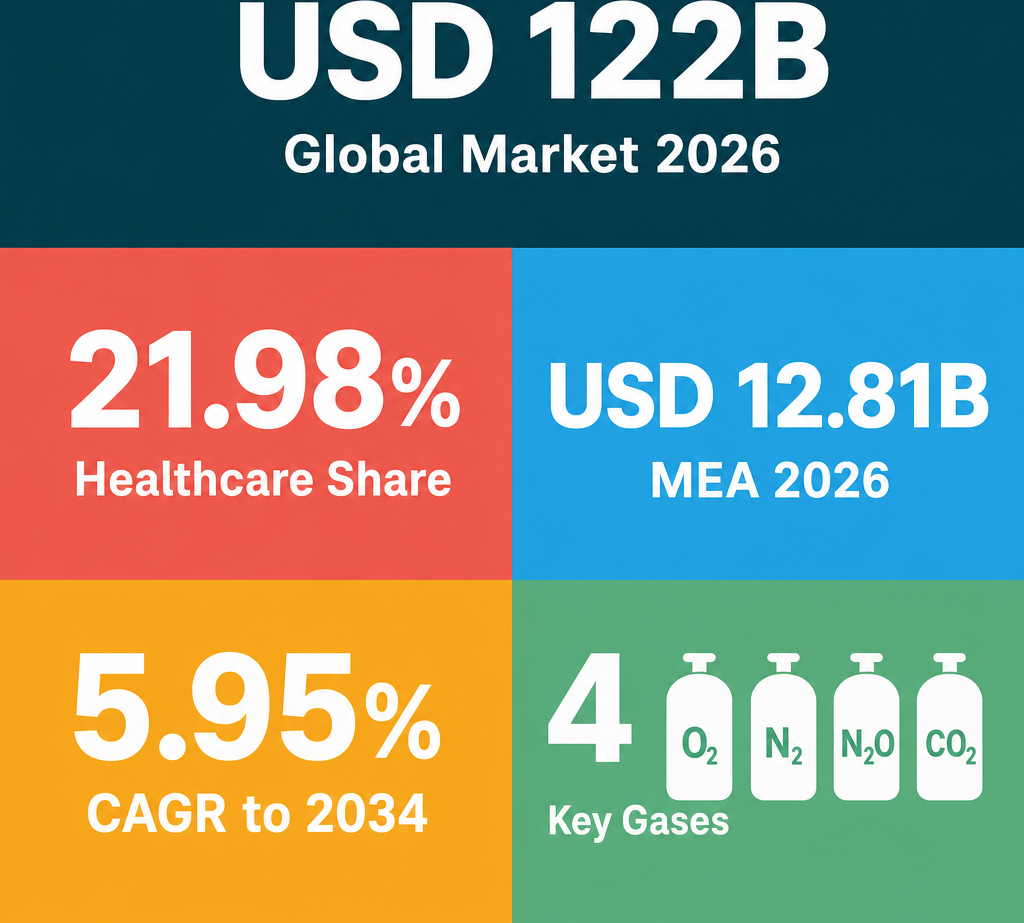
Healthcare is the largest single slice of the gases market. The global industrial gases market is valued at USD 122.01 billion in 2026 and forecast to reach USD 193.72 billion by 2034 at 5.95% CAGR, with healthcare holding a dominant 21.98% share on the back of respiratory therapy, anaesthesia and cryopreservation demand.
The regional picture is steady rather than explosive. The Middle East and Africa industrial gases market stood at USD 12.23 billion in 2025 and is projected at USD 12.81 billion in 2026, which is 10.59% of global demand.
What makes the UAE side of it attractive is the shape of the demand rather than the size. Hospital capacity, medical tourism and specialty clinics all consume gas continuously, and aesthetic, dermatology and fertility clinics have added a whole tier of buyers that barely existed a decade ago.
Conclusion
Medical gas trading under code 4669.83 serves buyers who cannot substitute and cannot wait. That makes contracts sticky and revenue predictable once you are established.
It also makes the entry bar high, and rightly so. Approved storage, cylinder discipline, batch documentation and real emergency response are the cost of holding clinical accounts.
Settle the approval question first. Get the licensing authority and the health authority to confirm in writing what applies to your gas list before you commit to premises or stock. Speak to the Meydan Free Zone team to confirm the right structure once that answer is in hand.
[blockCTAContact]