
Table of Contents
Topic Summary
Understand What Activity Code 4722.99 Actually Covers
This license permits trading in mainstream still water, premium imports, functional and flavoured water, carbonated water, and bulk 5-gallon containers. Critically, wholesale supply to businesses like hotels and supermarkets may fall under a different code, so confirm your customer model in writing with the licensing authority before applying.
Tap Into a Market That Barely Fluctuates
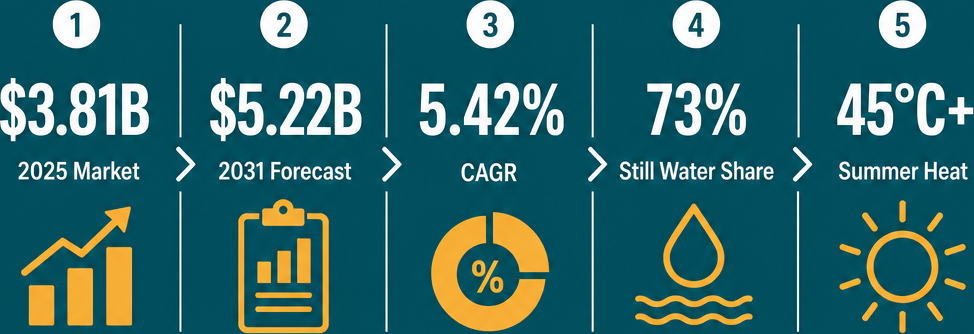
The UAE is the world's highest per-capita bottled water consumer, driven by summers exceeding 45°C, desalination-dependent infrastructure, and deeply ingrained buying habits. The market is valued at USD 3.81 billion in 2025 and is projected to reach USD 5.22 billion by 2031, making demand highly resilient.
Know Which Customer Segment Suits Your Margins
Mainstream still water commands 73% of the category but comes with thin margins and high volume pressure, while the premium and functional segment grows at 6.68% CAGR and offers meaningfully better returns. Choosing your target buyer — retail chains, hotels, or corporate bulk accounts — should shape your license class, storage setup, and logistics model from day one.
Choose Mainland or Free Zone Based on Who You Sell To
A Meydan Free Zone setup offers 100% foreign ownership and zero corporate tax on qualifying income, but selling directly into UAE retail or hospitality typically requires a mainland distributor or agent. A mainland DET license gives you direct local market access but comes with its own compliance and ownership considerations.
Factor In Food Handling Approvals Before You Trade
Bottled water is classified as a food product, meaning storage and handling approvals are required regardless of whether you operate on the mainland or in a free zone. The source page lists no third-party approval as stated, but the article strongly advises confirming this position in writing with the licensing authority to avoid issues at banking or inspection stage.
Treat Bulk and Corporate Supply as a Logistics Business
The 5-gallon home and office delivery segment serves offices, residential buildings, workforce accommodation, and institutional caterers on long-term contracts. This channel is less about product sourcing and more about delivery fleet reliability, route efficiency, and contract retention.
How to Start a Mineral Water Trading Business in Dubai
The UAE is the highest per-capita bottled water consumer in the world. Summers above 45°C, a desalination-based supply and a population that buys bottled by habit rather than by choice have built a market that does not fluctuate much. Activity code 4722.99 is the license for trading in it.
This guide covers what the license allows, who buys from you, the approval position and the steps to get set up. Read the boundary section carefully, because the scope of this code is narrower than the trade it is usually used to describe.
Key Stats at a Glance
What This License Covers
Code 4722.99 covers trading in mineral water. In practice that spans mainstream still water, premium and imported brands, functional lines enriched with electrolytes, vitamins or alkaline formulation, flavoured and carbonated water, and bulk 5-gallon containers for home and office delivery.
Three things sit outside the code. Retail of beverages in non-specialised stores, where many product lines sell under one roof, is a different class. Retail for drinking on the premises falls under food and beverage service. And wholesale trading to other businesses is excluded.
That last exclusion deserves attention before you apply. Most mineral water businesses in this market supply supermarkets, hotels, offices and institutional caterers, and that is business-to-business supply.
If your plan looks like that, the stated exclusion points toward a wholesale class rather than this one. Take your customer list to the licensing authority and get the right code confirmed in writing, because this is the kind of mismatch that surfaces at the bank or at an inspection rather than at licensing.
Who Your Clients Will Be
Mainstream retail buyers
Supermarkets, hypermarkets and convenience networks taking still water in volume on repeating orders. Mainstream still water holds 73.14% of the category, so this is where the volume sits. Margins are thin and reliability of daily supply is the whole proposition.
Premium and hospitality buyers
Hotels, fine dining and premium retail taking imported and premium brands, plus the functional tier. The premium segment is growing at 6.68% CAGR, ahead of the mass market, and it is where margin actually lives.
Bulk and corporate buyers
Offices, residential buildings, workforce accommodation, institutional catering and schools taking 5-gallon home and office delivery. This is a logistics business more than a trading one, and the contracts are long.
Mainland or Free Zone
Water is heavy, low value per unit and sold locally, which makes this a logistics business with a trading license wrapped around it. A mainland license from the Department of Economy and Tourism is the usual route, because the customers, the warehousing and the delivery fleet all sit inside the UAE.
Meydan Free Zone gives you 100% foreign ownership and a lower cost base, and it fits an importer of premium and international brands, or a holding entity that owns the brand agreements while a mainland partner runs delivery.
Whichever route you take, the cost base is warehousing and vehicles rather than the license. Bulk gallon delivery in particular is a fleet operation, and the route density you can build determines whether the margins work.
[blockCTACostCalculator]
Step by Step Setup Guide
- Step 1, confirm the code fits your customers: Specialised retail sits here. Supply to other businesses points elsewhere. Settle this with the licensing authority first.
- Step 2, check the food approval position in writing: Bottled water is a food product. Ask the licensing authority and the municipality what applies to your premises and products.
- Step 3, pick your segment: Mainstream volume, premium and imported, or bulk gallon delivery. Each needs a different cost base, and few operators do all three well at the start.
- Step 4, choose your jurisdiction: Mainland through DET for local distribution, or Meydan Free Zone for import and brand holding.
- Step 5, book your trade name: Check availability through the DET or Meydan Free Zone portal, following UAE naming conventions.
- Step 6, agree brand distribution rights: Local producers, international premium labels, or both. These agreements decide your shelf access.
- Step 7, build warehousing and delivery: Clean dry storage, stock rotation and a delivery operation sized to your route density.
- Step 8, collect your license, open a bank account and register for VAT: Register with the Federal Tax Authority once turnover passes AED 375,000.
Compliance and What You Need in Place
Food approvals: confirm, do not assume
The source page states that no third-party approval is needed. Do not act on that alone. Bottled water is a regulated food product, and storage, handling, labelling and import are controlled accordingly. Get the position confirmed in writing by the licensing authority and Dubai Municipality before you trade, and keep the confirmation on file.
Product labelling and claims
Functional lines making claims about electrolytes, vitamins or alkalinity have to declare accurately, and mineral content statements are part of the label rather than marketing copy. Arabic labelling applies.
Storage and stock rotation
Water has a long shelf life but not an unlimited one, and heat and sunlight degrade plastic packaging. Clean, cool, dry storage and disciplined rotation protect both product and reputation.
AML and VAT
This activity is exempt from AML duties. Register with the Federal Tax Authority once turnover passes AED 375,000.
Market Opportunity
The market is large and structurally supported. UAE bottled water was valued at USD 3.81 billion in 2025 and is projected to reach USD 5.22 billion by 2031 at 5.42% CAGR. A second forecast puts it at USD 3.96 billion in 2026 rising to USD 6.4 billion by 2032 at 8.33% CAGR, so treat the growth rate as a range rather than a single number.
Demand here is not discretionary. Summer temperatures above 45°C, a desalination-based public supply, constant tourism inflows and a large outdoor workforce all mean consumption holds up through economic cycles in a way most beverage categories do not.
The growth is in the upper tiers. Mainstream still water still holds 73.14% of the category, but the premium segment is growing at 6.68% CAGR and functional and flavoured lines are the fastest-moving sub-segments.
Off-trade retail holds 65.28% of channel share while on-trade foodservice grows at 5.84% CAGR, so a trader with both retail and hospitality reach captures the steady base and the faster tier at once.
Conclusion
Mineral water trading under code 4722.99 sits in one of the most dependable consumer categories in the UAE, with a market heading toward USD 5.22 billion by 2031 on the more conservative forecast.
Two questions need answering before you commit. Does your customer base fit this specialised retail code or a wholesale class, and what food approvals apply to your premises and products. Both are cheap to settle now.
After that, this is a distribution business. Brand agreements, warehousing and route density decide the outcome far more than the trading margin does. Speak to the Meydan Free Zone team to confirm the right structure and activity for the model you plan to run.
[blockCTAContact]