
Table of Contents
Topic Summary
UAE Is a Top Global Oriental Carpet Market
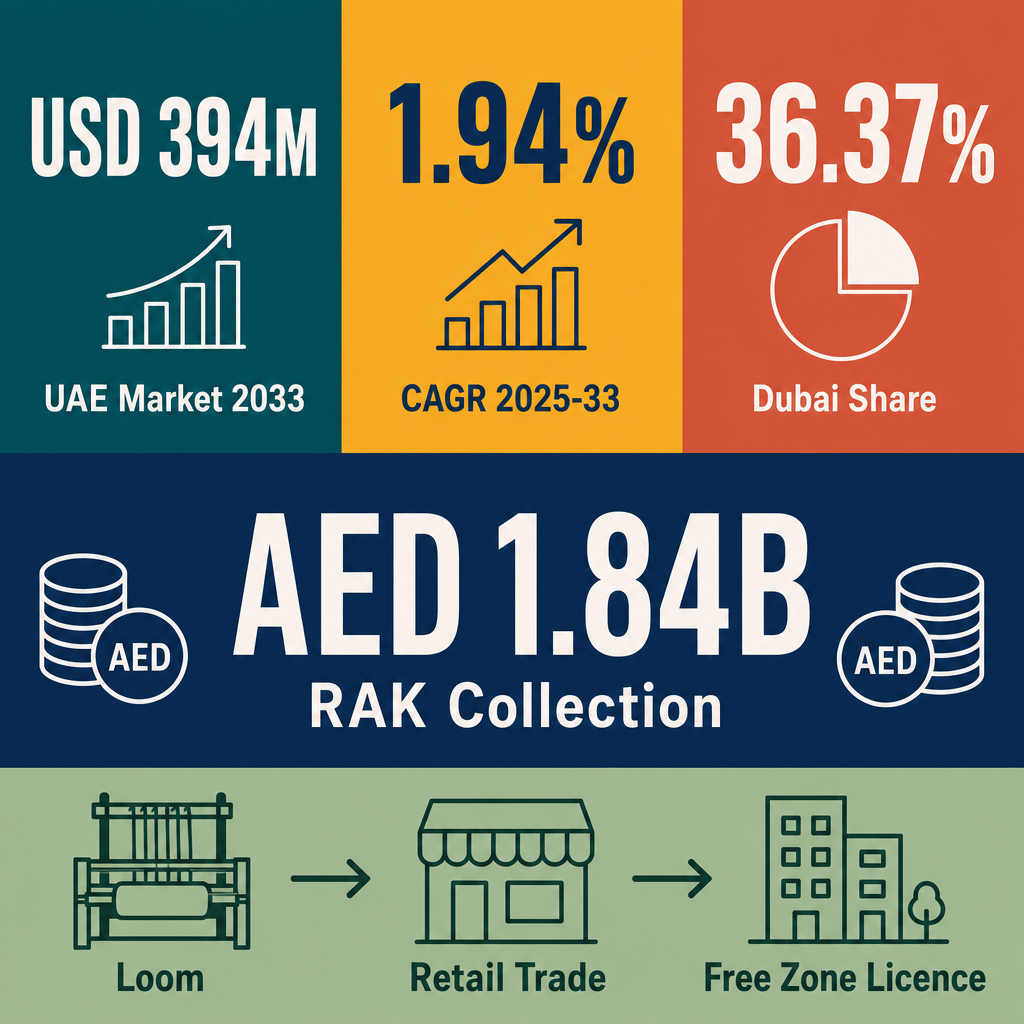
The UAE carpet market is forecast to reach USD 393.91 million by 2033, growing at a 1.94% CAGR. Dubai alone accounts for roughly 36% of total market revenue, making it the most lucrative single city for carpet traders.
Hand-Knotted Pieces Are the Premium Category
Hand-knotted Persian, Turkish, and Kashmiri rugs form the flagship category driving high-value sales across the UAE. Unlike machine-made alternatives, these pieces appreciate over time and attract collectors, penthouse owners, and luxury hotel operators.
Three Distinct Buyer Segments Drive Demand
Oriental carpet traders in Dubai typically serve heritage gallery collectors, luxury residential buyers, or hospitality and interior design clients. Each segment has different sourcing, provenance, and presentation requirements.
Residential Buyers Represent Half the Market
Residential customers account for around 50% of UAE rug and carpet market value. Villa and penthouse owners are key buyers, often seeking one-of-a-kind pieces for majlis rooms, formal sitting rooms, and master bedrooms.
Activity Code 4753.97 Covers Retail Oriental Trading
The specific business activity for this trade is 4753.97 — Oriental Carpets Trading, which permits retail sale of hand-knotted Persian, Turkish, Kashmiri, and Central Asian rugs directly to customers. It does not cover cork floor tiles or machine-made general floor coverings.
Provenance and Authentication Are Core Business Skills
Successful heritage gallery operators document knot density grading, natural dye authentication, and weaving-region sourcing for each piece. Authenticated provenance is a key differentiator when selling antique Safavid, Tabriz, or Kashan carpets to serious collectors.
UAE Leads Middle East Carpet Growth Through 2033
Future Market Insights projects the UAE to be both the fastest-growing and largest carpet market in the Middle East and Africa by 2033. A planned Ras Al Khaimah collection of over 3,000 Persian carpets valued at USD 500 million signals the scale of high-end appetite in the region.
How to Start an Oriental Carpets Trading Business in Dubai with Meydan Free Zone
Oriental carpets are the only floor covering that appreciates. Unlike machine-made rugs, a good hand-knotted Persian or Kashmir piece holds its value, often rising with age, and the UAE has become one of the world's most active retail markets for them.
The country sits at the crossroads of the original weaving regions and the buyers who can afford them, with galleries in Dubai, Sharjah, Abu Dhabi and Ras Al Khaimah moving pieces that range from a few thousand dirhams for tribal Kilims to museum-grade Safavid masterpieces.
IMARC Group1 forecasts the UAE carpet market to reach USD 393.91 million by 2033 at a 1.94% CAGR between 2025 and 2033, with heritage carpet brand Ghanbarinia Carpets scheduled to unveil a collection of more than 3,000 Persian carpets in Ras Al Khaimah valued at 1.84 billion dirhams (USD 500 million), including 17th-century Safavid masterpieces. Ramsha Home2 notes that residential buyers account for around 50% of UAE rugs and carpet market value and Dubai represents approximately 36.37% of total market revenue, with hand-knotted formats a core part of that premium spend.
Future Market Insights3 projects the UAE to remain the fastest-growing rugs and carpet market in the Middle East and Africa and lead the region by market size by 2033, with Oriental and Persian hand-knotted pieces a flagship category. Ramsha Home4 highlights long-established Oriental rug galleries across Dubai, Sharjah and Abu Dhabi specialising in hand-knotted Persian, Kashmir and tribal rugs with authenticated provenance and weaving-region sourcing.
Whether you are running a heritage Oriental carpet gallery, selling hand-knotted Persian rugs to collectors and penthouse owners, or supplying Tabriz and Kashan pieces to hotel lobbies and villa majlis, this activity covers the trade of Oriental carpets directly to customers.
Who is this for?
4753.97 - Oriental Carpets Trading
Under this activity, you can run a specialised retail business trading Oriental carpets directly to customers. Product range spans hand-knotted Persian, Turkish, Kashmir and Central Asian rugs, including Tabriz, Isfahan, Kashan, Qum, Nain, Bakhtiari, Kilim and tribal formats in wool, silk and bamboo silk.
There is one boundary to note. This activity covers the retail sale of oriental carpets directly to customers.
It does not cover the retail sale of cork floor tiles. In short: if you are trading oriental hand-knotted carpets directly to customers, this is your activity.
Traders working with machine-made and general floor coverings rather than hand-knotted pieces should look instead at a retail sale of carpets business in Dubai, which covers the wider retail category.
Third-Party Approval
No third-party approval is required for this business activity.
Anti-Money Laundering Compliance
This business activity is exempt from AML compliance requirements.
References
- ¹ IMARC Group, UAE Carpet Market Size, Share & Trends Forecast 2033. https://www.imarcgroup.com/uae-carpet-market
- ² Ramsha Home, Best Rugs Manufacturers in the UAE 2026 Guide. https://ramshahome.ae/blogs/blog/best-rug-manufacturers-uae
- ³ Future Market Insights, Middle East Flooring and Carpet Market Size 2023-2033. https://www.futuremarketinsights.com/reports/middle-east-flooring-and-carpet-market
- ⁴ Ramsha Home, 5 Best Rug Stores in the UAE. https://ramshahome.ae/blogs/blog/best-rug-stores-in-uae