
Table of Contents
Topic Summary
Tap Into a Booming UAE Handicrafts Market
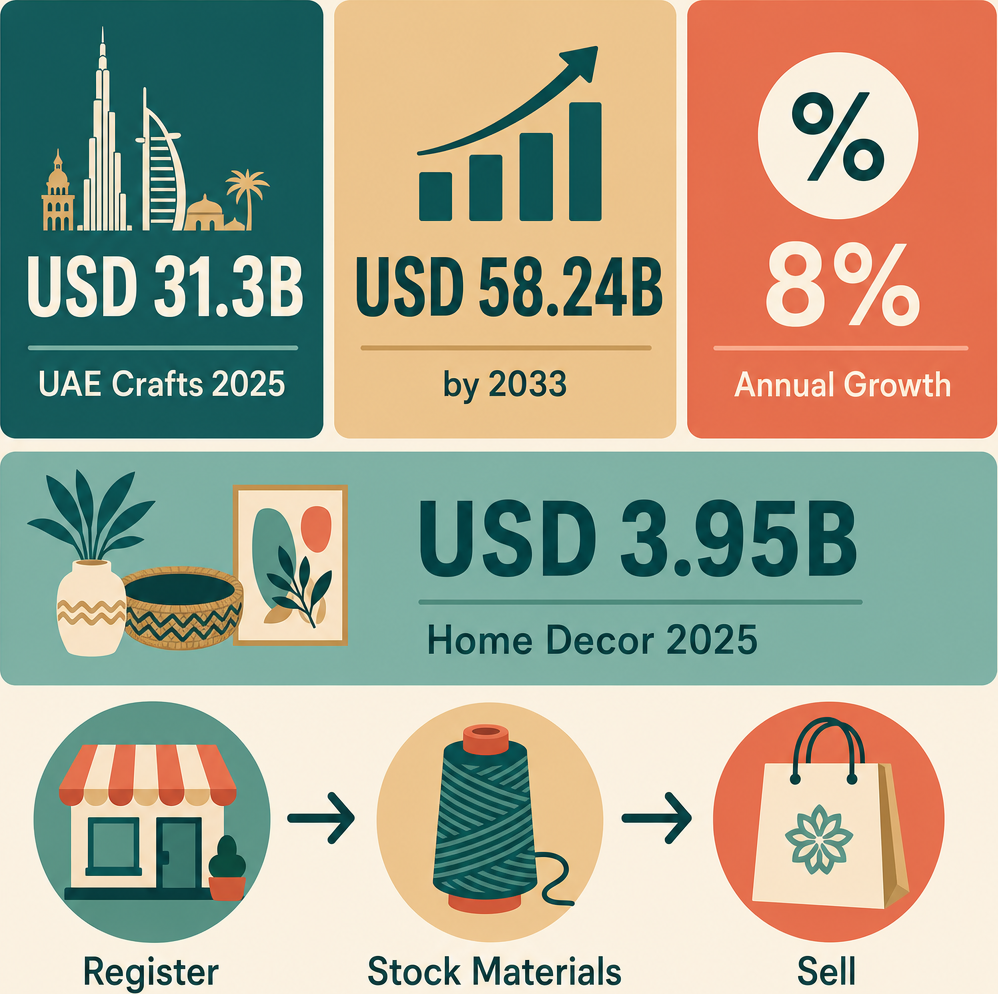
The UAE handicrafts market reached USD 31.3 billion in 2025 and is projected to nearly double to USD 58.24 billion by 2033, growing at 8 percent annually. Textiles are the leading and fastest-growing segment, making craft material retail a well-timed business entry.
Align Your Brand With UNESCO-Recognized Traditions
Al Sadu Bedouin weaving joined UNESCO's Intangible Cultural Heritage list in 2025, while Al Talli Emirati embroidery was inscribed in 2022 and is backed by certified-teacher programmes. Retailers supplying these traditional materials can partner with cultural institutions and heritage festivals for built-in demand.
Understand Exactly What This Business Activity Covers
Activity code 4751.03 covers the specialised retail of foundational materials for rug-making, tapestry, and embroidery — think canvases, yarns, threads, and embroidery bases sold to makers, not finished products. Selling completed clothing or textiles falls under a separate classification entirely.
Serve Three Distinct and Ready Customer Segments
Your potential buyers span hobbyists and DIY makers, professional artisans registered with bodies like the Abu Dhabi Register of Artisans, and interior designers sourcing bespoke materials for hotels and villas. Each segment has different purchasing patterns and volume needs, giving you multiple revenue streams.
Ride Seasonal Demand Spikes Strategically
Embroidery material demand surges ahead of Eid and the summer wedding season, when Al Talli practitioners and boutique designers ramp up production. Planning inventory and promotions around these cultural calendar peaks can significantly boost revenue.
Choose Between Physical, Online, or Hybrid Retail Models
This business activity supports a dedicated brick-and-mortar craft store, a fully online marketplace storefront selling yarn kits and embroidery hoops, or a combined approach. The Meydan Free Zone setup accommodates all three, giving founders flexibility to scale their preferred channel.
Register Through Meydan Free Zone for a Streamlined Start
Meydan Free Zone in Dubai offers a straightforward licensing pathway for retail activities like this one, with benefits including 100 percent foreign ownership and no personal income tax. It is a practical launchpad for both local operations and cross-border e-commerce sellers targeting regional craft markets.
How to Start a Retail Sale of Basic Materials for Rug, Tapestry or Embroidery Making Business in Dubai with Meydan Free Zone
The UAE's craft and home textiles economy is built on two converging forces: a household sector spending billions on interior aesthetics, and a national agenda reviving traditional crafts as part of cultural identity.
According to Deep Market Insights¹, the UAE handicrafts market reached USD 31.3 billion in 2025 and is projected to grow to USD 58.24 billion by 2033 at a compound annual rate of 8 percent, with textiles as the leading and fastest-growing segment. Alongside it, IMARC Group² values the UAE home décor market at USD 3.95 billion in 2025, supported by rising disposable incomes and a residential construction pipeline that continues to expand.
The cultural layer matters too. Al Sadu, the Bedouin geometric weaving tradition, was elevated to UNESCO's Representative List of the Intangible Cultural Heritage of Humanity in 2025³.
Al Talli, the Emirati embroidery technique using cotton, silk and silver threads, was inscribed by UNESCO in 2022⁴ and is now backed by certified-teacher programmes through the Department of Culture and Tourism in Abu Dhabi. This business activity addresses the demand for the raw inputs that feed both worlds.
Who is this for?
4751.03 - Retail Sale of Basic Materials for Rug, Tapestry or Embroidery Making
This activity covers the specialised retail of the foundational materials used to make rugs, tapestries and embroidery work. This applies to selling the raw inputs that craftspeople, hobbyists and designers need to create their own pieces from scratch, rather than the sale of finished textile products.
This activity does not cover the retail sale of clothing, which falls under a separate activity classification.
In short: if you are selling the basic materials used to make rugs, tapestries, or embroidery directly to consumers from a specialised store or online platform, this is your activity. If you are selling finished clothing, that falls under a separate scope.
Third-Party Approval
No third-party approval is required for this business activity.
Anti-Money Laundering Compliance
This business activity is exempt from AML compliance requirements.
References
- ¹ Deep Market Insights, United Arab Emirates Handicrafts Market Size and Share Report By 2033. https://deepmarketinsights.com/vista/insights/handicrafts-market/united-arab-emirates
- ² IMARC Group, UAE Home Décor Market Size, Share & Trends Forecast 2025–2033. https://www.imarcgroup.com/uae-home-decor-market
- ³ UNESCO Intangible Cultural Heritage, Al Sadu, traditional weaving skills in the United Arab Emirates (inscribed 2011, transferred to Representative List 2025). https://ich.unesco.org/en/RL/al-sadu-traditional-weaving-skills-in-the-united-arab-emirates-00517
- ⁴ UNESCO Intangible Cultural Heritage, Al Talli, traditional embroidery skills in the United Arab Emirates. https://ich.unesco.org/en/RL/al-talli-traditional-embroidery-skills-in-the-united-arab-emirates-01712