







Table of Contents
Topic Summary
Why Dubai Is Ideal for Rubber Trading
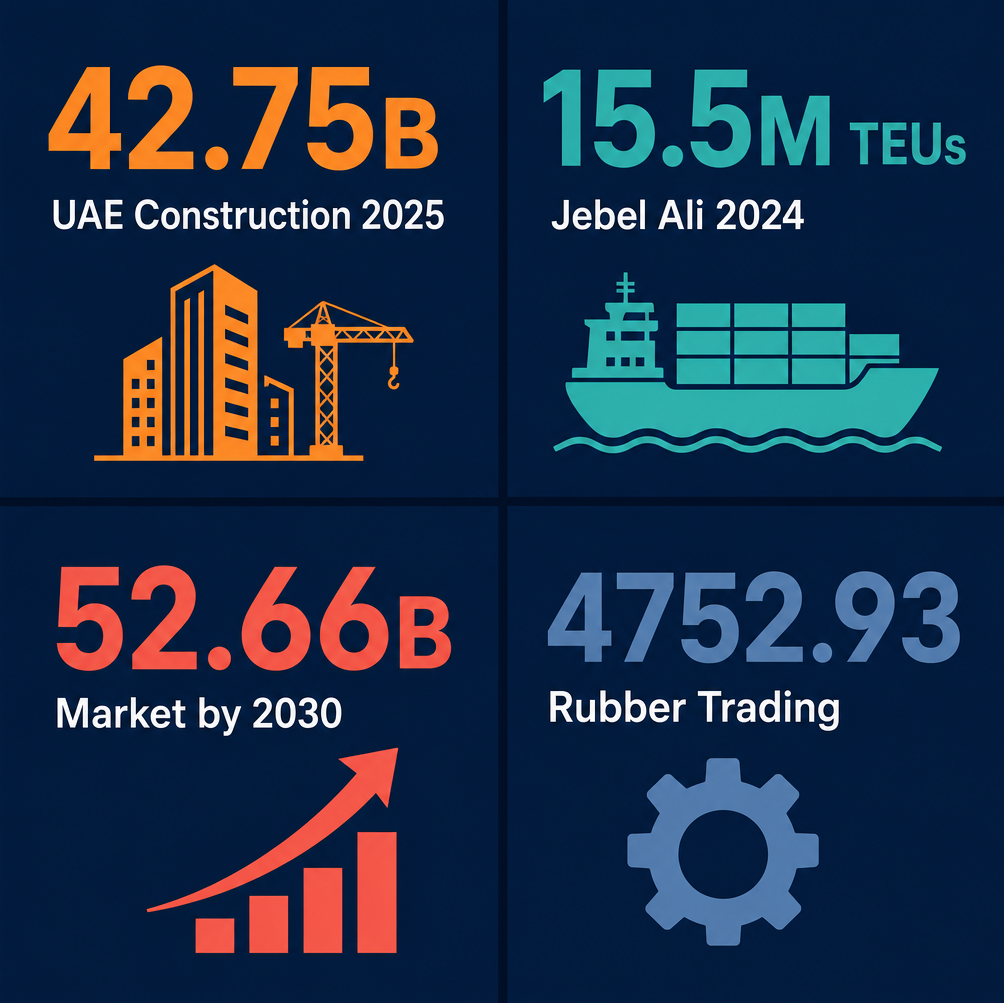
The UAE's construction market hit USD 42.75 billion in 2025 and Jebel Ali Port handled 15.5 million TEUs in 2024, creating sustained demand across industries. This makes Dubai a strategic hub for rubber traders targeting industrial, marine, and MEP buyers.
Key Rubber Products You Can Trade
Eligible products range from EPDM gaskets, neoprene anti-vibration pads, and silicone sheet to conveyor belting, hydraulic hoses, dock bumpers, and custom-moulded components. Natural rubber dominates the market while synthetic variants like nitrile and SBR are growing fast due to industrial demand.
Target the Right Industrial Buyers
Cement plants, quarry operators, and bulk handling terminals are prime customers for conveyor belting, chute liners, and wear-resistant matting. Reaching these procurement teams early can anchor long-term repeat supply contracts.
Serve the MEP and HVAC Sector
MEP contractors and chiller installers across the UAE regularly source EPDM gaskets, rubber mounts, expansion joint connectors, and flange insulation kits. District cooling growth in cities like Dubai makes this one of the most consistent buyer segments.
Tap Marine and Automotive Rubber Demand
Yacht builders, marine service firms, and automotive workshops need UV-resistant EPDM, marine-grade neoprene extrusions, and anti-slip deck matting suited to harsh UAE outdoor conditions. This niche offers strong margins due to specialised product requirements.
Understand Your Licence Scope Clearly
Activity code 4752.93 covers the retail sale of rubber directly to end consumers, not wholesale supply, manufacturing, or installation. Choosing the wrong licence category can create compliance issues, so confirming your business model against the defined scope is essential before applying.
Meydan Free Zone Simplifies Your Setup
Registering a rubber trading business through Meydan Free Zone gives you a structured path to obtain the correct commercial licence for retail rubber sales. The free zone framework supports businesses targeting both UAE-based industrial buyers and regional export markets.
How to Start a Rubber Trading Business in Dubai with Meydan Free Zone
Look at the hidden life of rubber in any UAE working day. The conveyor belts feeding aggregate into a Ras Al Khaimah cement plant, the hose reels handling diesel on an industrial refuelling pad, the anti-vibration pads under rooftop chillers on a Business Bay tower, the rubber gaskets sealing chilled water valve flanges, the door weather strips on aircraft, and the anti-slip matting at the base of a hospital pharmacy.
According to Market Research Future1, the global rubber foam and elastomer market is driven by rising construction activity and noise reduction demand in automotive applications, with natural rubber continuing to dominate the market and synthetic rubber seeing rapid growth due to technological innovations. According to Fortune Business Insights2, the global rubber foam materials market is led by increased application in the insulation industry, with cross-linked polyethylene foam, polyurethane and microcellular urethane all gaining share alongside EPDM and neoprene for chemical, HVAC and industrial use cases.
The UAE consumption base is broad across industry verticals. According to Mordor Intelligence3, the UAE construction market reached USD 42.75 billion in 2025 and is forecast to reach USD 52.66 billion by 2030, sustaining demand for rubber mats, gaskets, anti-vibration pads, expansion joint seals and flooring across MEP and civil work streams.
According to DP World4, Jebel Ali Port handled 15.5 million TEUs and 5.36 million metric tonnes of breakbulk cargo in 2024, with the wider industrial and logistics base driving sustained consumption of conveyor belting, hoses, dock bumpers, hydraulic seals and rubber wear components across UAE ports, yards and manufacturing sites.
Whether you are selling conveyor belt sections to a cement plant maintenance team, EPDM rubber sheet and expansion joint filler to a construction contractor, or anti-vibration pads and mounting pucks to a chiller installer, this activity covers the retail sale of rubber directly to consumers.
Who is this for?
4752.93 - Rubber Trading
Under this activity, you can run a specialised retail business selling rubber directly to consumers, from industrial plant maintenance teams and MEP contractors to yacht builders, cement plant operators, conveyor belt buyers and automotive workshops sourcing natural and synthetic rubber sheet, EPDM, neoprene, nitrile, silicone, SBR, conveyor belting, hoses, gaskets, anti-vibration pads, rubber matting and custom-moulded rubber components.
In short: if you are selling rubber directly to consumers, this is your activity. If you are wholesaling, manufacturing or installing rubber products, those fall under a separate scope.
If your plan involves supplying rubber in bulk to other businesses rather than end users, the dedicated licence is the right fit.
Third-Party Approval
No third-party approval is required for this business activity.
Anti-Money Laundering Compliance
This business activity is exempt from AML compliance requirements.
References
- ¹ Market Research Future, Rubber Foam Market Size, Share & Global Forecast 2035. https://www.marketresearchfuture.com/reports/rubber-foam-market-27290
- ² Fortune Business Insights, Rubber Foam Materials Market Size, Industry Share, Forecast to 2034. https://www.fortunebusinessinsights.com/rubber-foam-materials-market-102946
- ³ Mordor Intelligence, UAE Construction Market Size & Share Analysis. https://www.mordorintelligence.com/industry-reports/uae-construction-market
- ⁴ DP World, Jebel Ali Port Annual Throughput and Breakbulk Volumes. https://www.dpworld.com/en/ports-terminals/uae/jebel-ali-port











.jpeg)
