Table of Contents
Topic Summary
Understand the UAE Sewing Market Landscape
The UAE sewing and embroidery trade is driven by walk-in tailors, hobbyists, and around 150 to 170 garment manufacturers buying industrial consumables. Key retail corridors in Al Satwa, Bur Dubai, and Deira remain active year-round, supported by a growing maker community.
Know Which Business Audiences You Can Serve
This activity covers three main customer segments: sewing machine retailers, haberdashery and supplies shops, and specialist embroidery traders. Each segment has distinct product needs, from domestic machines and spare parts to threads, stabilisers, and digitising software.
Register Under the Correct Activity Code
The official activity code for this trade is 4751.96 – Sewing and Embroidery Requisites Trading. It permits you to sell machines, tools, and consumables through a physical store, showroom, or online platform to home sewers, hobbyists, tailors, and small commercial buyers.
Watch Out for the Finished Clothing Exclusion
This activity code does not cover the retail sale of finished clothing, which falls under a separate licence category. If your business sells both sewing supplies and ready-made garments, you will need to register the appropriate additional activity.
Stock the Right Product Categories from Day One
Permitted stock ranges from domestic and industrial sewing machines and multi-head embroidery units to consumables like needles, bobbins, thread, zippers, scissors, and interlining. Carrying a broad range from the start helps capture both the walk-in tailor and the hobbyist in a single visit.
Tap Into a Growing Global and Regional Market
The global sewing machine market is projected to reach USD 6.14 billion by 2033, while the MEA computerised sewing and embroidery machine segment is growing at a 4.6 percent CAGR through 2034. These figures signal sustained regional demand for both machines and the consumables that keep them running.
Learn from Established UAE Sewing Retailers
Long-standing players like Star Sewing Machine Trading, operating since 1971, and specialist suppliers like Mark Middle East demonstrate that brand loyalty and product depth are key competitive advantages in this market. Studying their positioning can help new entrants identify underserved niches.
How to Start a Sewing and Embroidery Requisites Trading Business in Dubai with Meydan Free Zone
A home sewer in Mirdif needs a replacement presser foot for her sewing machine. A crochet hobbyist in Jumeirah is looking for backing fabric for her first machine-embroidery project.
A tailor in Satwa walks in at 9am for a packet of industrial needles and leaves with thread, bobbins, and a new pair of shears. The UAE's sewing and embroidery requisites trade is a storefront trade, built on walk-in tailors, hobbyists, small studios, and the growing maker community, with garment factories and uniform producers as the larger commercial accounts.
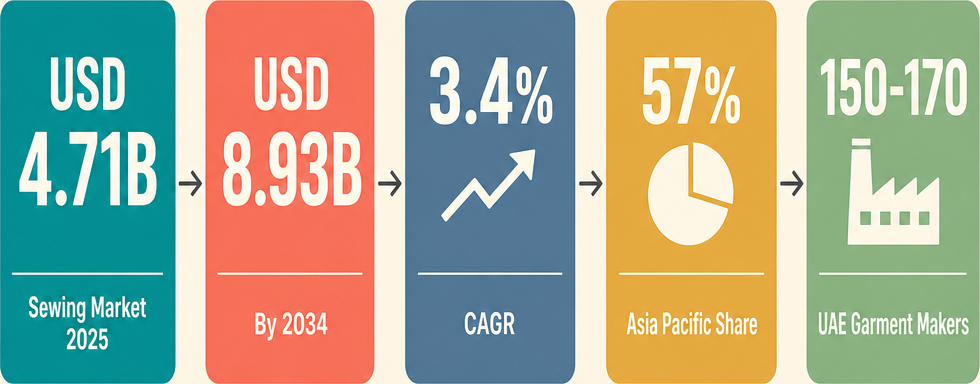
Grand View Research¹ values the global sewing machine market at USD 4.71 billion in 2025, growing at a 3.4 percent CAGR to USD 6.14 billion by 2033, with Asia Pacific holding 57.08 percent of global share. Business Research Insights² values the global sewing and embroidery machine market at USD 6.38 billion in 2025, growing to USD 8.93 billion by 2034.
Global Market Insights³ values the MEA computerised sewing and embroidery machine market at USD 0.2 billion in 2024, growing at a 4.6 percent CAGR through 2034. For the UAE, demand is layered: around 150 to 170 garment manufacturers⁴ buying industrial consumables, a bespoke tailoring tradition that keeps supply shops in Al Satwa, Bur Dubai, and Deira active year-round, and a growing community of hobbyist sewers, crocheters, and embroidery enthusiasts served by dedicated stores and online platforms.
Whether you are opening a sewing machine showroom, running a sewing supplies shop, or building an online store that ships embroidery consumables across the GCC, this activity covers the trade of sewing and embroidery requisites direct to customers.
Who is this for?
4751.96 - Sewing and Embroidery Requisites Trading
Under this activity, you can trade sewing and embroidery requisites in the UAE, selling directly to customers through a physical store, showroom, or online platform. This covers machines, tools, and consumables used in sewing, stitching, and embroidery, sold to home sewers, hobbyists, tailors, craft enthusiasts, and small commercial buyers.
There’s one exclusion to be aware of. This activity does not cover the retail sale of clothing.
In short: if you are selling sewing machines, embroidery machines, or sewing and embroidery consumables to customers through a shop or online platform, this is your activity. If you are selling finished clothing, that falls under a separate code.
Third-Party Approval
No third-party approval is required for this business activity.
Anti-Money Laundering Compliance
This business activity is exempt from AML compliance requirements.
Planning to set up your business in Dubai? Explore our comprehensive guide on Setup Advertising Requisites Trading Business in Dubai UAE, covering licensing requirements, costs, approvals, and the step-by-step business setup process.
References
- ¹ Grand View Research. (2025). Sewing Machine Market Size, Share — Industry Report, 2033. grandviewresearch.com
- ² Business Research Insights. (2025). Sewing and Embroidery Machine Market Size & Share.businessresearchinsights.com
- ³ Global Market Insights. (2025). Computerized Sewing and Embroidery Machine Market Size, 2034 Report.gminsights.com
- ⁴ Kohan Textile Journal. (2025). UAE Textile Market Overview. kohantextilejournal.com




%20Business%20in%20Dubai%20with%20Meydan%20Free%20Zone.webp)