Table of Contents
Topic Summary
Understand Exactly What License Code Covers
Activity code 4722.97 covers trading in carbonated soft drinks, sparkling water, sports drinks, energy drinks, and premium sparkling beverages. Retail sales on premises and wholesale trading to other businesses fall under separate classifications, so verify your model fits before applying.
Factor in Excise Tax From Day One
Free zone status does not exempt you from UAE excise tax obligations on carbonated beverages. Register for excise tax compliance early, as this cost directly affects your pricing and margin calculations across every channel you supply.
Know Your Three Core Customer Groups
Your main buyers will be retail chains seeking volume reliability, foodservice and hospitality operators buying premium sparkling lines at better margins, and fitness-focused retailers supplying the fastest-growing segment at 7.4% CAGR. Each group has distinct order sizes, frequency, and margin expectations.
Choose Between Mainland and Free Zone Carefully
Meydan Free Zone offers 100% foreign ownership and zero corporate tax on qualifying income, but supplying UAE retail directly requires a mainland distributor or agent. A mainland DET license gives direct local market access but comes with 9% corporate tax above AED 375,000 taxable income.
Confirm Third-Party Approvals Before Trading
Soft drinks are food products, and food handling approvals for storage and distribution are required regardless of whether you operate on the mainland or in a free zone. Confirm the full approval position in writing with the licensing authority before you begin trading.
Plan Logistics Around Low Value-to-Weight Ratio
Carbonated beverages are heavy relative to their unit value, making warehousing location, freight costs, and delivery reliability critical to profitability. Thin retail margins mean operational efficiency in storage and last-mile distribution can determine whether the business is viable.
Tap Into a Market Projected at USD 12.94 Billion
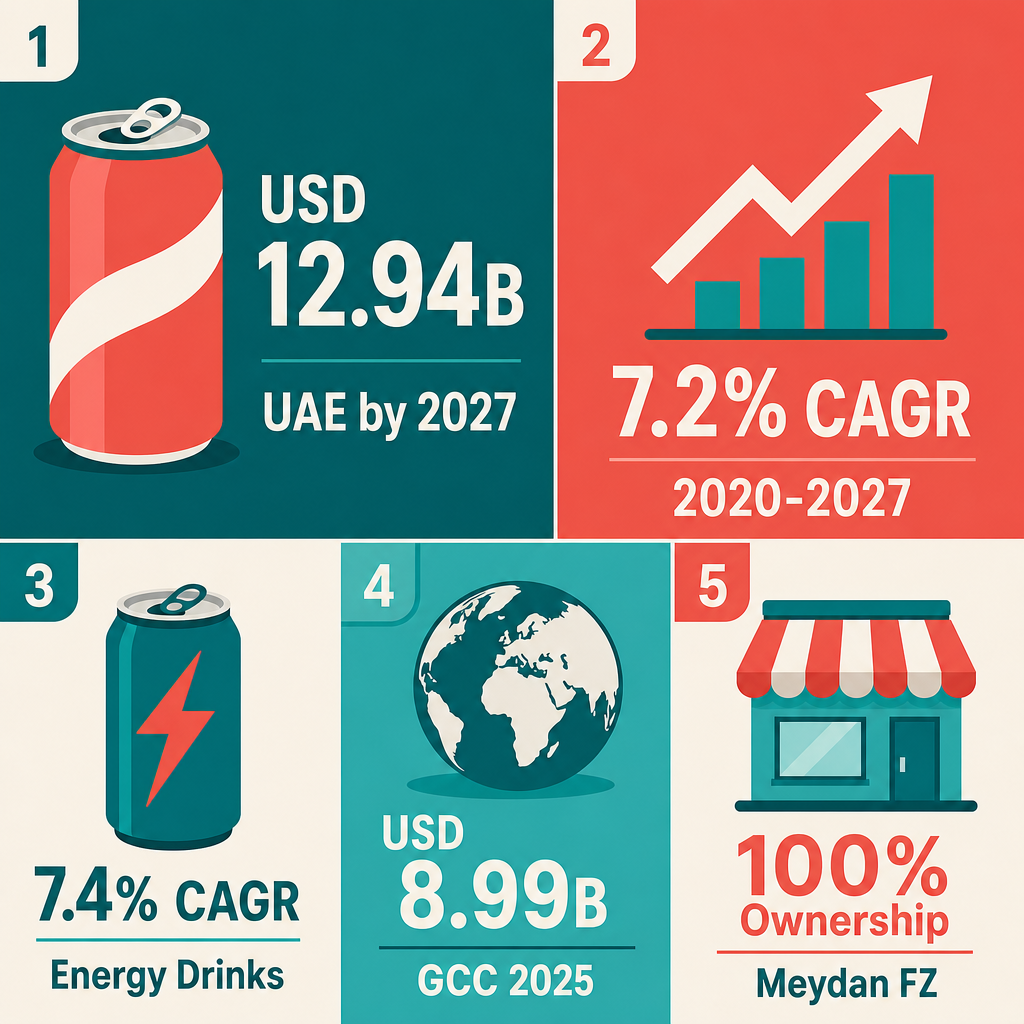
The UAE carbonated beverages market is forecast to reach USD 12.94 billion by 2027 at a 7.2% CAGR, and the UAE holds the position of the fastest-growing carbonated beverages market across the Middle East and Africa region. The GCC soft drinks market is separately projected to grow from USD 8.99 billion in 2025 to USD 10.13 billion by 2030.
How to Start a Soft Drinks and Carbonated Water Trading Business in Dubai with Meydan Free Zone
Carbonated drinks are one of the largest beverage volume categories in the UAE, moving from producers through traders into supermarkets, convenience stores, restaurants, hotels and foodservice every day of the year. Activity code 4722.97 is the license for that trade.
This guide covers what the license allows, who buys from you, the approval position and the steps to get set up. One thing the source page does not mention deserves your attention early, and it is covered in the compliance section: excise tax.
Key Stats at a Glance
What This License Covers
Code 4722.97 covers trading in soft drinks and carbonated water. That spans mainstream carbonated soft drinks, plain and flavoured carbonated water, sports and energy drinks, and the premium sparkling tier sold into hospitality and gourmet retail.
Three things sit outside it. Retail of beverages in non-specialised stores, where many product lines sell under one roof, is a different class. Retail for drinking on the premises falls under food and beverage service. And wholesale trading to other businesses is excluded.
That last exclusion needs checking against your plan. Most of this trade is volume supply to supermarkets, convenience chains and foodservice operators, which is business-to-business by definition.
If that describes your model, take your customer list to the licensing authority and confirm whether this code or a wholesale class applies before you commit.
Who Your Clients Will Be
Retail chains
Supermarkets, hypermarkets and convenience networks taking mainstream carbonated lines in volume on repeating orders. Thin margins, high turnover, and a buyer for whom availability and delivery reliability outrank everything else.
Foodservice and hospitality
Restaurants, hotels and catering operators buying for resale and service. Order sizes are smaller but more frequent, and the premium sparkling tier sells here at margins the supermarket channel will never support.
Fitness and functional buyers
Gyms, fitness retail and specialist stores taking sports and energy drinks. This is the fastest-growing part of the category at 7.4% CAGR, driven by active lifestyles and functional beverage demand rather than by traditional soft drink consumption.
Mainland or Free Zone
Soft drinks are heavy, low value per unit and sold locally, which makes this a distribution business more than a trading one. A mainland license from the Department of Economy and Tourism is the usual route, because the customers, the warehouse and the delivery fleet all sit inside the UAE.
Meydan Free Zone gives you 100% foreign ownership and a lower cost base, and it fits an importer of premium and international brands or a holding entity that owns the brand agreements while a mainland partner runs delivery.
Warehousing and route density decide the economics either way. Cases per drop and drops per route are what determine whether a soft drinks round makes money, and no licensing structure changes that arithmetic.
[blockCTACostCalculator]
Step-by-Step Setup Guide
- Step 1, check the excise position first: Carbonated and energy drinks are excisable goods in the UAE. Confirm registration and treatment with the Federal Tax Authority before you build a price list.
- Step 2, confirm the food approval position in writing: Ask the licensing authority and the municipality what applies to your premises and imported products.
- Step 3, check the retail and wholesale line: Volume supply to businesses may point to a wholesale class rather than this code.
- Step 4, choose your jurisdiction: Mainland through DET for local distribution, or Meydan Free Zone for import and brand holding.
- Step 5, book your trade name: Check availability through the DET or Meydan Free Zone portal, following UAE naming conventions.
- Step 6, secure brand distribution rights: The major beverage houses appoint distributors tightly by territory and channel. These agreements are the business.
- Step 7, build warehousing and delivery: Dry storage, stock rotation and a route plan sized to your customer density.
- Step 8, collect your license, open a bank account and register for VAT: Register with the Federal Tax Authority once turnover passes AED 375,000, separately from excise registration.
Compliance and What You Need in Place
Excise tax is the biggest omission on the source page
Carbonated drinks, energy drinks and sweetened beverages are excisable goods in the UAE, and excise is charged at a different point in the supply chain from VAT. The source activity page says nothing about it.
For a trader in this category that is the single most important fiscal fact of the business, because it affects registration, pricing, stock declarations and record keeping. Confirm your position with the Federal Tax Authority before you set prices or import a first shipment.
Food approvals: confirm rather than assume
The page states that no third-party approval is needed. Do not act on that alone. Soft drinks are regulated food products, and storage, labelling and import all carry conditions. Get the position confirmed in writing by the licensing authority and Dubai Municipality.
Labelling and product claims
Sugar content, additives and functional claims on energy and sports drinks all have to be declared accurately, with Arabic labelling on retail packs. Energy drinks carry further presentation and warning expectations in several markets, so check what applies to yours.
AML and VAT
This activity is exempt from AML duties. Register with the Federal Tax Authority once turnover passes AED 375,000.
Market Opportunity
The UAE is the fastest-growing carbonated beverages market in the Middle East and Africa region, with the market projected to reach USD 12.94 billion by 2027 at 7.2% CAGR across 2020 to 2027.
The wider GCC soft drinks market sits at USD 8.99 billion in 2025, heading for USD 10.13 billion by 2030 at 2.38% CAGR, so UAE growth runs well ahead of the regional average.
Growth is concentrated rather than spread evenly. Carbonated sports and energy drinks are advancing at 7.4% CAGR on the back of fitness culture and functional beverage adoption, while mainstream carbonates deliver volume rather than growth. A trader positioned across both captures the base and the upside.
The structural drivers are hard to argue with: a hot climate, a multicultural population with varied beverage habits, a very large restaurant and hotel sector, and modern retail expanding across the emirates. This is a category where consumption is a daily habit rather than an occasional purchase.
Conclusion
Code 4722.97 covers a high-volume, habit-driven category in the region's fastest-growing carbonated market, with energy and sports drinks providing the growth on top of a dependable mainstream base.
Two things need settling before you trade. Get your excise tax position confirmed with the Federal Tax Authority, since the source page is silent on it, and confirm what food approvals apply to your premises and imports.
After that this is a logistics business. Brand agreements, warehousing and route density decide the margin. Speak to the Meydan Free Zone team to confirm the right structure and activity for the model you plan to run.
[blockCTAContact]