

Table of Contents
Frequently Asked Questions
What does activity code 6410.00 cover in Dubai
Activity code 6410.00 covers monetary intermediation, which includes deposit-taking from retail and corporate clients, credit intermediation (lending funds raised from depositors), interbank lending, liquidity management, and trade finance including letters of credit.
It does not cover insurance, investment management, or securities trading. Those activities carry separate codes and are regulated by different authorities. If your business model includes any of those, you will need additional licenses.
Who regulates monetary intermediation businesses in the UAE
The Central Bank of the UAE (CBUAE) is the primary regulator for all monetary intermediation activity. A trade license alone is not sufficient to operate — you must also obtain a banking or financial institution license from the CBUAE before accepting any deposits or extending credit.
The CBUAE evaluates capital adequacy, corporate governance, and the fitness and propriety of directors and senior managers. These checks run in parallel with your trade license application, so you should plan for both from the outset. More information is available at centralbank.ae.
Can a foreign national own 100% of a monetary intermediation company in Dubai
Yes. 100% foreign ownership is permitted for monetary intermediation businesses set up in a free zone such as Meydan Free Zone. This makes free zones particularly attractive for international founders and investors entering the UAE financial market.
On the mainland under DET licensing, 100% foreign ownership is also permitted for this activity. However, free zones typically offer faster trade license issuance and flexible office options such as flexi-desks, which can reduce initial overhead costs.
What is the difference between a Meydan Free Zone trade license and CBUAE approval
A Meydan Free Zone trade license is your commercial vehicle — it establishes your legal entity in the UAE and allows you to operate as a registered business. It is also the trigger for visa eligibility for you and your staff.
The CBUAE approval is your operating permit. Without it, you cannot legally take deposits or extend credit, regardless of holding a trade license. You need both documents to run a compliant monetary intermediation business. The two applications should be submitted simultaneously to avoid delays.
What are the steps to set up a monetary intermediation business via Meydan Free Zone
The setup process runs on two parallel tracks: the trade license and the CBUAE regulatory application. Starting both at the same time is strongly recommended, as waiting for one before the other can add months to your timeline.
The key steps are: confirm your trade name availability, select activity code 6410.00 from the Business Activities List, submit passport copies, a business plan, and shareholder details to Meydan Free Zone, then receive your trade license. Simultaneously, submit capital proof, governance documents, and fit-and-proper forms to the CBUAE.
Once the CBUAE grants operating approval, you can legally begin taking deposits or extending credit. Visa eligibility begins as soon as the trade license is issued.
What capital requirements apply to monetary intermediation businesses in the UAE
The Central Bank of the UAE sets minimum capital thresholds for entities seeking a banking or financial institution license. These figures are subject to change and should be verified directly at centralbank.ae before you begin your application.
Meeting capital requirements is a mandatory step in the CBUAE approval process. You will need to submit formal proof of capital as part of your regulatory application. Undercapitalisation is one of the most common reasons for application delays, so confirming current thresholds early is essential.
What business model and client types suit a monetary intermediation company in Dubai
Revenue in monetary intermediation typically comes from the interest margin between deposit rates paid to savers and lending rates charged to borrowers, plus fees on trade finance and interbank activity. Your client base generally falls into three groups: retail depositors, corporate borrowers, and financial counterparties.
There is a recognised SME lending gap in the UAE, as larger banks tend to focus on major corporates. Smaller credit institutions can serve SMEs, traders, and regional businesses that need fast, flexible credit lines — making this a viable and underserved niche. The UAE also functions as a financial gateway for regional counterparties requiring FX and treasury services.
What are the main differences between setting up on the mainland versus Meydan Free Zone for this activity
The key differences relate to client access, office requirements, and setup speed. A mainland (DET) license gives you open access to the UAE domestic market, while a Meydan Free Zone license is primarily oriented toward international clients, though this distinction is becoming less rigid over time.
Both structures require CBUAE approval and permit 100% foreign ownership. However, the mainland requires a physical office, whereas Meydan Free Zone offers flexi-desk options that reduce initial costs. Free zone trade license issuance is also generally faster than the mainland process, making it a practical starting point for new entrants to the UAE financial sector.
Start a Monetary Intermediation Business in Dubai
Dubai is one of the most active financial centres in the Middle East. Its banking infrastructure, regulatory clarity, and access to regional capital flows make it a strong base for monetary intermediation. This guide covers what activity code 6410.00 permits, who regulates it, and how to set up through Meydan Free Zone.
What Monetary Intermediation Covers
Activity code 6410.00 covers deposit-taking, credit intermediation, and interbank lending. Banks, credit institutions, and licensed financial intermediaries operate under this code. It permits raising funds from depositors and lending them to borrowers or counterparties.
The code does not cover insurance, investment management, or securities trading. Those activities carry separate codes and separate regulators.
| Activity code | 6410.00 |
|---|---|
| Activity name | Monetary intermediation |
| Licensed banks in UAE | Over 50 banks, including 22 foreign banks – Central Bank of the UAE |
| UAE banking assets | Over AED 4 trillion – Central Bank of the UAE |
| Primary regulator | Central Bank of the UAE (CBUAE) |
| Foreign ownership | 100% permitted in free zones – Invest in Dubai |
- Deposit-taking from retail and corporate clients
- Credit intermediation: lending funds raised from depositors
- Interbank lending and liquidity management
- Trade finance and letters of credit
Who Regulates This Activity
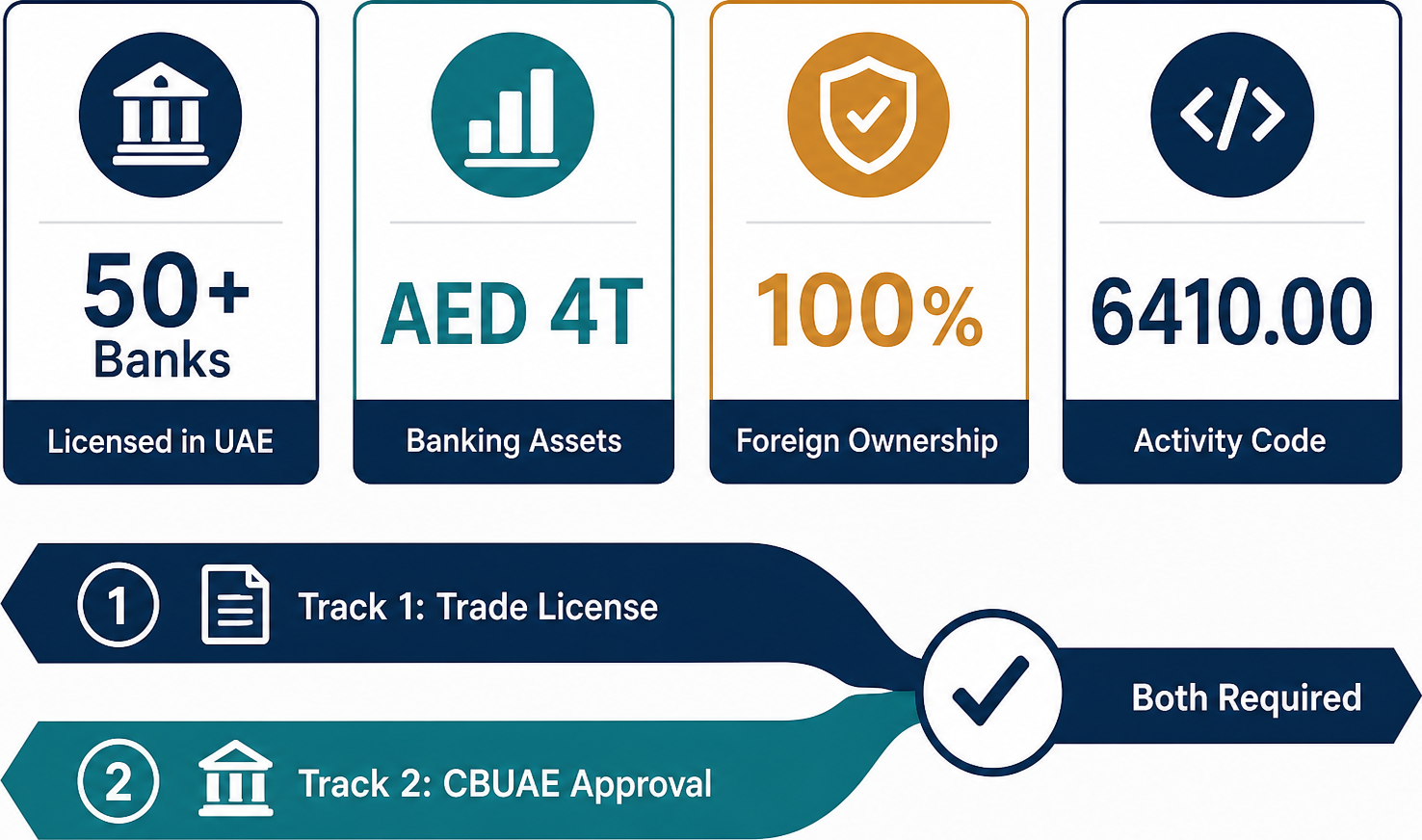
The Central Bank of the UAE sets the rules for all monetary intermediation. A trade license alone is not enough to operate. You also need a banking or financial institution license from the CBUAE before you take a single deposit or extend any credit.
The CBUAE checks capital adequacy, governance, and the fitness of directors and senior managers. These checks run in parallel with your trade license application. Plan for both from day one.
A Meydan Free Zone trade license acts as your commercial vehicle. The CBUAE approval is your operating permit. You need both.
| Factor | Mainland (DET) | Free Zone (Meydan Free Zone) |
|---|---|---|
| Client access | Open UAE market | Mainly international clients |
| Foreign ownership | 100% permitted | 100% permitted |
| CBUAE approval | Required | Required |
| Office requirement | Physical office required | Flexi-desk options available |
| Setup speed | Longer process | Faster trade license issuance |
Free Business Setup Cost Calculator
Calculate NowYour Clients and Business Model
Your clients fall into 3 groups: retail depositors, corporate borrowers, and financial counterparties. Revenue comes from the interest margin between deposit rates and lending rates, plus fees on trade finance and interbank activity.
The UAE has a real SME lending gap. Large banks focus on big corporates. Smaller credit institutions can serve SMEs, traders, and regional businesses that need fast, flexible credit. That is a workable niche.
- Retail depositors seeking returns above savings rates
- SMEs needing working capital or trade finance
- Corporate clients with treasury and FX needs
- Regional counterparties using UAE as a financial gateway
How to Set Up via Meydan Free Zone
The setup runs in 2 tracks: the trade license and the CBUAE application. Start both at the same time. Waiting for one before the other adds months to your timeline.
- Step 1, book your trade name: Use the Company Name Check tool to confirm availability before you apply.
- Step 2, select activity code 6410.00: Confirm the code is listed in the Business Activities List for your chosen setup.
- Step 3, submit your trade license documents: Passport copies, business plan, and shareholder details go to Meydan Free Zone.
- Step 4, receive your trade license: Meydan Free Zone issues the license. This is your legal entity.
- Step 5, apply to the CBUAE: Submit your capital proof, governance documents, and fit-and-proper forms to the Central Bank.
- Step 6, meet capital requirements: The CBUAE sets minimum capital thresholds. Check current figures at centralbank.ae.
- Step 7, get your operating approval: Once the CBUAE approves, you can begin taking deposits or extending credit.
Visa eligibility starts once your trade license is issued. Meydan Free Zone offers flexi-desk options, which keeps your setup cost low in the early stage. You can also start your business remotely if you are not yet based in the UAE.
Compliance and Ongoing Duties
Monetary intermediation carries some of the heaviest compliance duties in UAE commercial law. The rules are not optional and the penalties for breaking them are serious.
AML and CFT You must have a full anti-money laundering and counter-financing of terrorism programme in place before you open. This covers customer due diligence, transaction monitoring, and staff training.
Reporting to regulators You report to the CBUAE and to the UAE Financial Intelligence Unit. Suspicious transactions go to the FIU right away. Routine reports go to the CBUAE on a set schedule.
Corporate tax Register with the Federal Tax Authority for UAE corporate tax. The standard rate is 9% on taxable income above AED 375,000.
Annual renewal and audit Your trade license renews each year. The CBUAE also runs periodic audits. Keep your records clean and your governance documents current.
- Customer due diligence on every account
- Transaction monitoring systems in place
- Suspicious activity reports filed with the FIU
- Annual CBUAE regulatory reporting
- Corporate tax filing with the FTA
- Trade license renewal each year
The Real Opportunity Here
The UAE banking industry holds over AED 4 trillion in assets. But the market is not saturated at every level. SME credit, trade finance for smaller importers, and cross-border lending for regional businesses are all areas where new entrants can build a workable book.
The dual-approval process is demanding. But it also keeps weak operators out. Once you are in, you are in a regulated, credible space with real barriers protecting your position.
Monetary intermediation in Dubai is a high-compliance activity. It rewards operators who are well-capitalised, well-governed, and serious about the regulatory process. The commercial opportunity is real for those who meet the bar.
Ready to Launch Your Business in Dubai?
Let's Connect