Table of Contents
Topic Summary
Three Distinct License Codes Cover AC Business
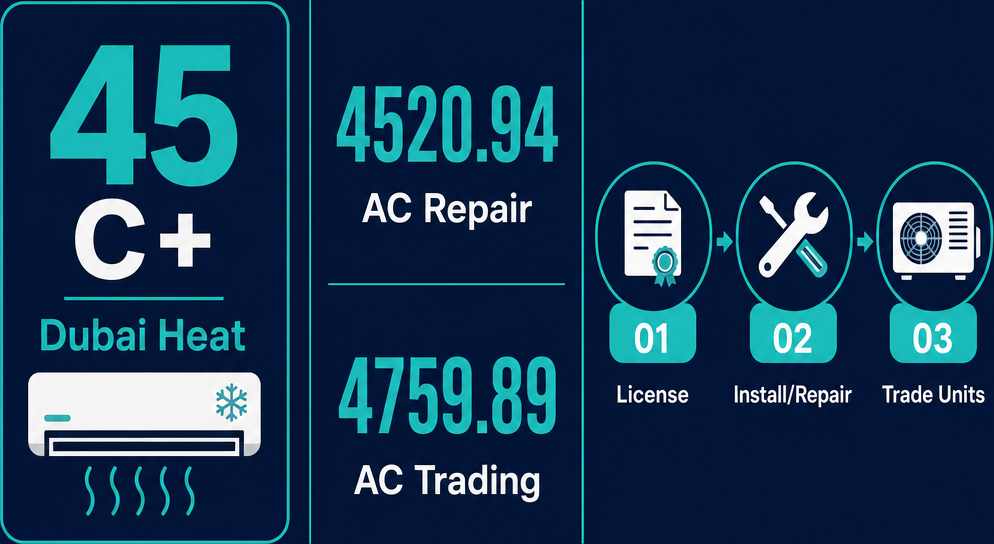
Dubai splits air-conditioning business activities across three separate codes: auto AC repair (4520.94), unit trading (4759.89), and spare parts trading (4773.35). Choosing the wrong code is the most common licensing mistake founders make, so understanding each one before applying is essential.
Auto AC Repair Covers More Than Cars
License 4520.94 goes well beyond fixing vehicle air-conditioning and includes mechanical, electrical, bodywork, tyre fitting, and anti-rust services. However, any parts or refrigerants sold under this license must support the repair work directly and cannot be run as a standalone trading operation.
Unit Trading License Has Surprisingly Broad Scope
The air-conditioning trading license (4759.89) permits selling central, window, and split AC units, but also extends to furniture, lighting, household appliances, musical instruments, and security devices like safes. The catch is that installation and maintenance services are excluded from this code.
Spare Parts Business Reaches Into Full Refrigeration
Code 4773.35 covers far more than AC components, allowing trade in compressors, chillers, ice machines, commercial freezers, and cold storage equipment. This makes it a strong fit for serving contractors, MEP firms, and food or retail businesses with refrigeration needs.
Parts Trading Offers Steadier Cash Flow
Founders often overlook the spare parts business, but technicians purchase components repeatedly and urgently, creating more consistent revenue than unit sales to homeowners who replace systems once a decade. The unglamorous nature of the business is precisely what keeps competition lower.
No Third-Party Approvals or AML Rules Apply
All three activity codes operate without requiring third-party government approvals, and none of them fall under AML compliance regulations. Trading conduct is overseen by the Commercial Compliance and Consumer Protection Sector of DET, keeping the regulatory burden straightforward.
Meydan Free Zone Allows Full Foreign Ownership
Registering any of these three licenses through Meydan Free Zone grants 100% foreign ownership with no local sponsor required. This makes it a practical entry point for international entrepreneurs looking to tap into Dubai's permanent demand for cooling infrastructure.
How to Start an Air-Condition Trading or Air-Conditioning Service Business in Dubai with Meydan Free Zone?
In Dubai, cooling is infrastructure rather than a comfort purchase. Every tower, villa, warehouse and car depends on a system that eventually breaks, and somebody has to sell the unit, supply the part or fix the fault.
That work splits across three activity codes, and picking the wrong one is the most common mistake made here. This guide covers what each permits, what they leave out, and how to license them.
Key Stats at a Glance
What These Licenses Cover
Auto air-conditioning repair, 4520.94
This is the vehicle side: troubleshooting and fixing car air-conditioning, cleaning and replacing filters, repairing faulty components and tuning systems for performance. It also carries general motor vehicle work, from mechanical and electrical repairs and electronic injection systems through servicing, bodywork, painting, repair of screens, windows and seats, tyre fitting and anti-rust treatment.
You can sell materials related to repair and maintenance under this license, but only in non-commercial quantities. Refrigerants and replacement parts support the repair work, they do not run as a trading business alongside it.
Air-conditioning trading, 4759.89
This is the unit side. You buy and sell central air-conditioning units, window units and split units, whether or not they connect to a general central system.
The wider inclusions are broader than the name suggests. The same license covers retail sale of household furniture, lighting, utensils and cutlery, crockery, glassware, china and pottery, wooden and wickerwork goods, household appliances, musical instruments, security systems such as locking devices and safes without installation or maintenance, and other household articles not covered by another code.
Spare parts and components, 4773.35
This is the parts side, and it reaches past air-conditioning into refrigeration generally. It lets you resell compressors, fans, motors, filters, coils, thermostats and control panels, plus ducts, chillers, pumps and air-handling units for central systems, parts for window and split units, cold storage and central water cooling equipment, and refrigeration kit such as ice machines and commercial freezers.
Who Your Clients Will Be
Each code points at a different buyer, which is why the choice matters:
- Vehicle owners and fleet operators, for auto AC repair
- Homeowners and residential developers, for unit trading
- Commercial building operators and facilities managers
- Contractors, MEP firms and refrigeration technicians, for parts
- Cold storage, retail and food businesses
The parts business is the one founders undervalue. It is unglamorous, but technicians buy repeatedly and at short notice, which gives steadier cash flow than selling units to homeowners who replace a system once a decade.
What These Licenses Do Not Cover
Each code has a firm edge. Under 4520.94 you cannot retread or rebuild tyres, even though the license otherwise carries a lot of general vehicle work. Under 4759.89 the exclusions sit around second-hand goods: no retail sale of antiques, second-hand books or other second-hand goods, and no operating as an auctioning house at retail level.
The practical point is that these three codes sit next to each other but do not substitute for one another. Repairing car systems, selling units and supplying parts are three separate licensed activities, so a business intending to do all three needs all three on the license.
[blockCTACostCalculator]
Step by Step Setup Guide
- Step 1, decide which codes you need: 4520.94 for auto repair, 4759.89 for unit trading, 4773.35 for spare parts, or a combination. Settle this before you apply, because adding codes later costs more.
- Step 2, book your trade name: The commercial name on the license must match the name on your signboard, so pick something you intend to keep.
- Step 3, send in your documents: Passport copies for every shareholder and director, plus a short description of the activities you plan to carry out.
- Step 4, take the license: None of these three activities needs third-party approval, so there is no separate regulator to clear first.
- Step 5, sort premises and stock: Trading and parts operations need storage. The activity may only be practised at the location covered by the license, and DET approval is needed before you change or relocate it.
- Step 6, open a bank account and register for VAT: Standard steps, with VAT applying once your taxable turnover reaches the registration threshold.
Compliance and What You Need in Place
Consumer protection rules
The Commercial Compliance and Consumer Protection Sector of DET sets specific trading conduct rules for this activity, and they are more detailed than most. Your sale policy, covering returns, replacement and repair, must be declared to the customer. Customers must receive an invoice and prices must appear on goods. The phrase stating that sold goods are neither returnable nor exchangeable must not appear on an invoice, and no extra fee may be charged for using a credit card.
Real goods only
No counterfeit goods may be promoted, sold or displayed, and no product carrying a fake trademark may be sold. If you find fake products circulating locally, DET is to be informed. Register your own trademark with the Ministry of Economy to protect it.
Product standards
Devices that do not comply with UAE environmental rules must not be sold. Where devices are exported, the buyer has to be notified in writing or by a seal. Country standards regulating the sale and trade of products apply throughout.
Warranties and manuals
If electronics carry a guarantee, tell the buyer in writing or by seal, covering what is guaranteed and what voids it. Where a device has a manual it must be clearly written in Arabic alongside any other language, and handed to the buyer.
Permits and trading hours
No repairs may be undertaken without the relevant permit. Sales, discounts and special offers need permission first, and trading after midnight needs its own permit.
Market Opportunity
The underlying demand here is climatic rather than commercial, which is a rare and useful thing. Dubai's heat means cooling runs year-round across residential communities, commercial towers and industrial operations, and none of those users can defer the spend when a system fails.
The market spans the full chain: installation and repair at one end, unit and spare parts trading at the other. A business holding more than one of the three codes can follow a customer across it rather than handing them on, which is where the margin sits.
Two things are shifting the picture. Infrastructure keeps expanding, adding installed base every year, and energy efficiency is becoming a priority, which pulls demand towards newer systems and the expertise to specify them.
Conclusion
Air-conditioning is one of the steadiest service and trading sectors in Dubai, for the simple reason that the climate does not negotiate. Demand is continuous, the client base spans residential, commercial and industrial, and none of the three activity codes needs third-party approval or carries AML duties.
What decides how well it goes is the combination of codes you license and how closely you follow the consumer protection rules, which are unusually specific here. Get both right and you have a business that can grow across the cooling chain rather than sitting in one corner of it.
[blockCTAContact]