
Table of Contents
Frequently Asked Questions
1. What does an other land transport business do?
Other land transport business provides land-based passenger transport other than rail, running urban and suburban passenger services on scheduled routes with fixed timetables and stops.
2. What modes of transport fall under this activity?
It includes scheduled passenger services by modes such as motorbus, tram, streetcar, and trolleybus, along with town-to-airport and town-to-station lines.
3. What is a feeder service in land transport?
A feeder service is a scheduled passenger service that connects suburban areas and neighbourhoods to transit hubs and main transport routes.
4. Who uses scheduled land transport in the UAE?
Commuting workers, students, and residents making repeated daily journeys between homes, workplaces, campuses, and transit hubs use scheduled land transport.
5. How widely used is public land transport in the UAE?
Dubai's public transport and shared mobility services carried 747.1 million riders in 2024, a 6.4 percent increase, with daily ridership above two million.
Topic Summary
Dubai's Land Transport Demand Is Booming
Dubai's public transport and shared mobility services carried 747.1 million riders in 2024, a 6.4 percent increase over the previous year. Daily ridership has crossed two million, signaling sustained and growing demand for scheduled land transport.
A Network Built for Reliable, Predictable Movement
Dubai's transport authorities set fixed routes, schedules, and standards that all scheduled services must align with. This means operators plug into existing demand rather than building it from scratch, making entry more commercially viable.
Bus Infrastructure Has Grown Dramatically Over Two Decades
Dubai's bus network expanded from 2,095 kilometres in 2006 to 3,974 kilometres in 2024, supported by a modern fleet of around 1,400 low-emission buses. That growth reflects how central scheduled land transport has become to the city's daily function.
Three Core Operator Types Can Enter This Market
The other land transport activity covers scheduled bus route operators, feeder and community transport operators, and staff or institutional transport operators running fixed-route services. Each serves a distinct segment of the city's mobility ecosystem.
Meydan Free Zone Offers a Cost-Efficient Business Base
Licensing through Meydan Free Zone provides 100 percent foreign ownership, zero corporate tax on qualifying income, and full profit repatriation. The fully digital licensing process reduces setup friction for new operators entering the market.
Activity Code 4920 Defines Your Licensed Scope
Under activity code 4920, operators are licensed to provide land-based passenger transport excluding rail, covering urban and suburban scheduled services. This includes motorbuses, trams, and feeder routes operating on fixed timetables with designated stops.
How to Start an Other Land Transport Business in Dubai with Meydan Free Zone
A city the size of Dubai cannot run on private cars alone. Every working day, millions of journeys are made on scheduled land transport: buses on fixed routes, trams, and feeder services connecting neighbourhoods to transit hubs. Other land transport is the activity behind that scheduled movement of people, and ridership in the UAE has been climbing year after year.
Dubai's public transport and shared mobility services carried 747.1 million riders in 2024, a 6.4 percent increase on the 702 million recorded in 2023, according to the Roads and Transport Authority¹. Average daily ridership crossed two million. The bus network alone has expanded from 2,095 kilometres in 2006 to 3,974 kilometres in 2024, supported by a modern fleet of around 1,400 low-emission buses², a measure of how steadily scheduled land transport has grown to match a rising population.
Essential Services for Entrepreneurs and Startups
Explore mCoreA Population That Moves on Scheduled Transport
The UAE has built one of the most heavily used public transport systems in the region. The numbers behind it show how much daily life depends on scheduled land transport.
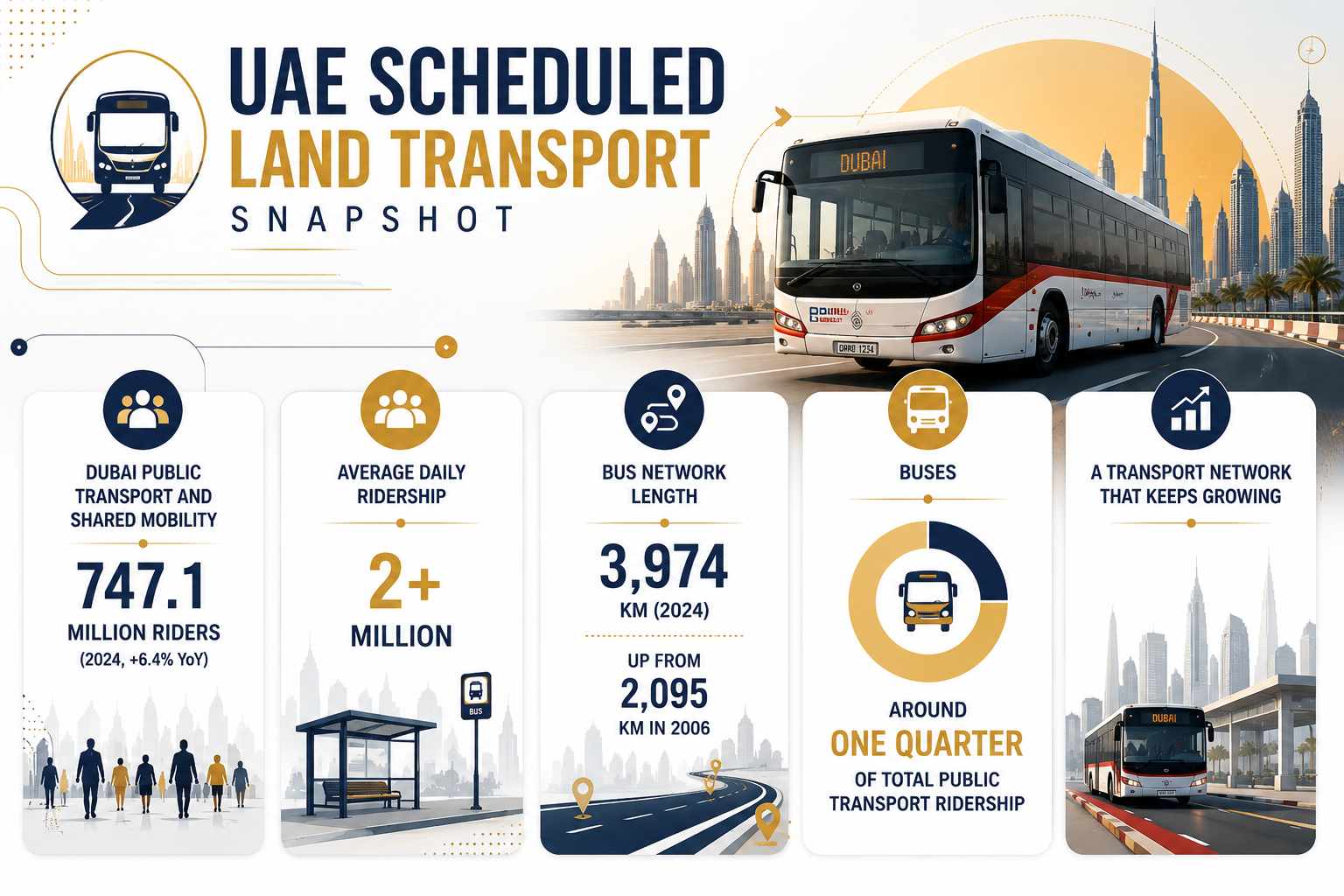
Sources: Roads and Transport Authority (2025); UAE Government Media Office (2025).
Streamlined Residency Solutions for Investors, Employees and Families
Explore mResidencyThe demand for scheduled land transport keeps rising. Dubai's public transport and shared mobility services carried 747.1 million riders in 2024, up 6.4 percent on the year before¹, and daily ridership has crossed two million. Behind those numbers are ordinary, repeating journeys: workers commuting to industrial and commercial districts, students travelling to campuses, and residents moving between neighbourhoods and transit hubs.
A growing population makes the pattern denser every year. Scheduled bus and feeder services, staff transport on fixed routes, and community transport all sit within this activity, and the volume of daily journeys is large enough that demand extends well beyond the main public network.
Land transport in the UAE runs inside a planned, integrated mobility network. Transport authorities set the routes, schedules, and standards that scheduled services are built around, and the network is designed so that buses, feeder services, and transit lines connect into one another. For an operator, that planning is the opportunity: a scheduled service does not have to create demand from nothing, because it plugs into a network that already moves millions of people on predictable patterns every day.
From scheduled bus routes and feeder services to staff and community transport, the UAE rewards land transport operators that move people reliably on fixed routes and timetables.
Tailored Business Support Solutions for Every Size Business
Explore mAssistWho is this for?
- Scheduled bus service operators: Operators running passenger services on fixed routes and timetables across urban and suburban areas.
- Feeder and community transport operators: Operators running services that connect neighbourhoods and communities to transit hubs and main transport routes.
- Staff and institutional transport operators: Operators running scheduled passenger transport on fixed routes for employers, campuses, and institutions.
Meydan Free Zone offers 100% foreign ownership, zero percent corporate tax on qualifying income, full profit repatriation, and a fully digital licensing process, providing a regulated and cost-efficient base from which to operate scheduled land transport services in a fast-growing mobility market.
4920.00 - Other Land Transport
Under this activity, you are licensed to provide land-based passenger transport other than rail transport, in the form of urban and suburban passenger transport services.
| Service | Description |
|---|---|
| Scheduled Urban Passenger Transport | Transport of passengers on scheduled urban routes following a fixed timetable, with passengers picked up and set down at fixed stops, by modes such as motorbus, tram, streetcar, and trolleybus. |
| Suburban and Feeder Services | Scheduled passenger services connecting suburban areas and neighbourhoods to transit hubs and main routes, operated on fixed timetables. |
| Town-to-Airport and Town-to-Station Lines | Scheduled passenger services running between town centres and airports or stations as part of the urban and suburban transport network. |
| Cableway and Funicular Transit | Operation of funicular railways and aerial cableways where they form part of an urban or suburban transit system. |
| Category | Details |
|---|---|
| Ridership Scale | Dubai's public transport and shared mobility services carried 747.1 million riders in 2024, with average daily ridership above two million¹. |
| Who Uses the Service | Commuting workers, students, and residents making repeated daily journeys between homes, workplaces, campuses, and transit hubs. |
| Network Anchor | Scheduled services operate within a planned, integrated mobility network whose routes, schedules, and standards are set by the transport authorities. |
| Growth Drivers | A rising population and a steadily expanding bus network² keep the volume of scheduled daily journeys growing year after year. |
There are clear boundaries on this activity. The classification excludes passenger transport by inter-urban railways, which is classified separately. This activity is land-based passenger transport within urban and suburban areas on scheduled routes; it does not extend to inter-urban rail services.
The line is precise. If your business runs scheduled urban or suburban passenger transport on fixed routes and timetables, you are in. If you operate inter-urban railway passenger services, you are not.
Third-Party Approval: No third-party approval is required for this business activity.
Anti-Money Laundering Compliance: This business activity is exempt from AML compliance requirements.
Footnotes
¹ Roads and Transport Authority. 747 Million Riders Used Public Transport, Shared Mobility, and Taxis in 2024. RTA, February 2025.
² UAE Government Media Office. 747 Million Riders Used Public Transport, Shared Mobility, and Taxis in 2024. UAE Government Media Office, February 2025.