Table of Contents
Topic Summary
Pick the Right Activity Code First
Dubai software licenses are split into five distinct activity families, and choosing the wrong code means your license won't cover what you actually sell. Retail, publishing, development, systems design, and installation are each governed by separate codes with different permissions and exclusions.
Software Retail Covers More Than You Think
Code 4741.00 lets you sell off-the-shelf software and hardware direct to customers, including via e-commerce. Sub-codes cover ready-made apps, system and communication software, and encryption or data protection tools for corporate and government clients.
Publishing Is the Code for Scalable Products
Code 5820.01 allows you to create, license, and distribute software for general use without modifying it per client, making it the right fit for product businesses that want to scale. It excludes software-as-a-service, retail of ready-made programs, and online hosting.
Development Codes Cover Custom and Bespoke Work
Code 6201.01 covers building systems software, applications, databases, and web solutions from scratch, including long-term support. Sub-codes extend this to customisation of pre-built software, communication equipment software, and educational or training tools.
Systems Design and Installation Are Separate Licenses
Code 6202.01 covers planning integrated hardware, software, and communications systems for enterprise clients, while 6209.03 covers the hands-on work of deploying, configuring, and supporting those systems on site or remotely. Neither permits the other's activities, so businesses doing both need to account for that.
No Third-Party Approvals or AML Duties Apply
All five software activity families at Meydan Free Zone require no third-party regulatory approval to set up. They are also fully exempt from anti-money laundering compliance obligations, simplifying the administrative burden considerably.
Meydan Free Zone Offers Strong Baseline Conditions
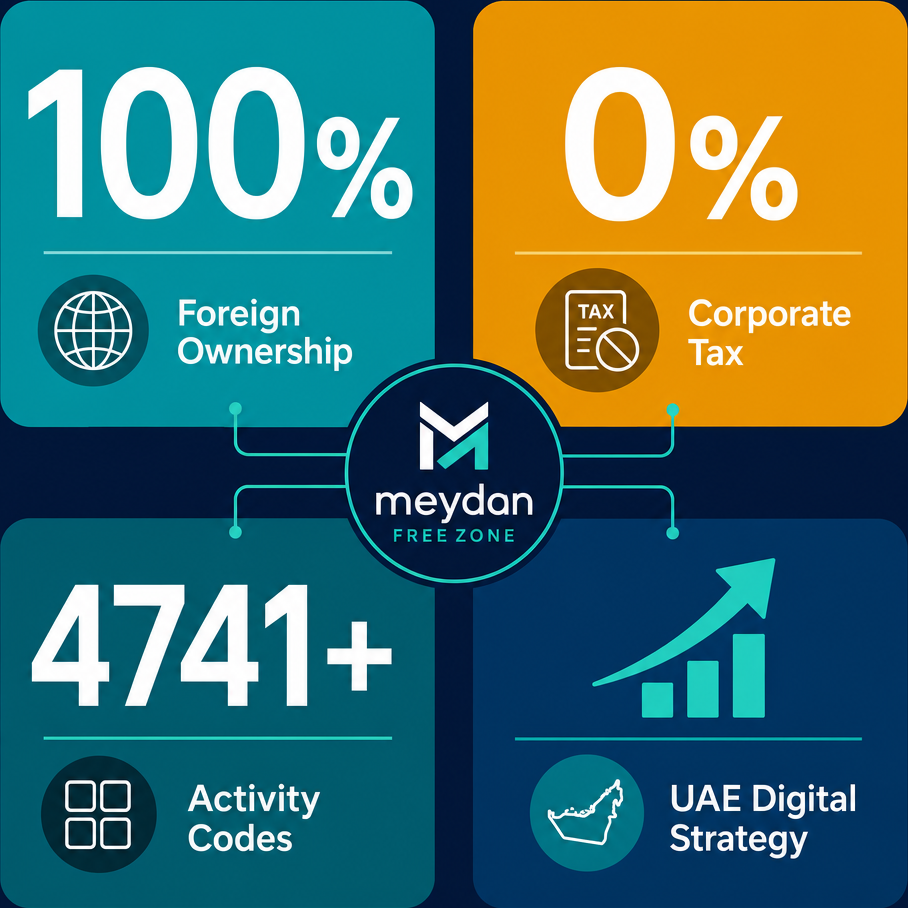
The free zone provides 100% foreign ownership, zero corporate tax on qualifying income, and a fully digital setup process. This sits within the UAE's broader Digital Economy Strategy, which positions software businesses as central to national economic transformation.
How to Start a Software Company in Dubai With Meydan Free Zone
Software is not one business, and that is the first thing to sort out. Selling shrink-wrapped products, publishing your own platform, building systems for clients and installing what someone else built are four different activities with four different codes.
Pick the wrong one and your license will not cover what you actually sell. This guide covers the five activity families, what each permits and excludes, and how to set up. None needs third-party approval.
Key Stats at a Glance
| Software retail | 4741.00, with 4741.04 for ready-made software, 4741.87 for system and communication software, and 4741.96 for encryption and data protection software |
|---|---|
| Software publishing | 5820.00, with 5820.01 for general-use software published without client-specific modification |
| Software development | 6201.01, with 6201.02 for customisation, 6201.94 for systems and communication equipment software, and 6201.99 for educational and training software |
| Systems design | 6202.01, planning and designing systems that integrate hardware, software and communication technologies |
| Software installation | 6209.03, installation, configuration and setup of applications and systems |
| Third-party approval | None needed for any of these activities |
| Anti-money laundering | All of these activities are exempt from AML compliance duties |
| Policy backdrop | UAE Digital Economy Strategy, AI Office, putting software at the centre of national transformation |
| Meydan Free Zone terms | 100% foreign ownership, 0% corporate tax on qualifying income, fully digital setup |
What These Licenses Cover
Software retail, 4741.00
This lets you sell hardware and off-the-shelf software direct to customers, from a specialist store or an e-commerce platform. Code 4741.04 covers ready-made, non-customised software: applications, productivity tools and games across platforms. Code 4741.87 covers system software, communication tools, security programs and embedded software. Code 4741.96 covers trading encryption and data protection software for corporate, government and cybersecurity clients. It excludes blank storage media.
Software publishing, 5820.00
Creating, licensing and distributing software: operating systems, applications and games. Code 5820.01 covers publishing for general use without modifying per client, which is what lets a product business scale. It excludes reproduction of software, retail of ready-made programs, development unrelated to publishing, and online hosting or software-as-a-service.
Software development, 6201.01
Designing and building systems software, applications, databases and web solutions, including updates, patches and long-term support. Code 6201.02 covers customising and configuring pre-built software to fit a client's environment. Code 6201.94 covers software for computer systems and communication equipment. Code 6201.99 covers educational and training software. It excludes publishing packaged software and integrated systems design.
Systems design, 6202.01, and installation, 6209.03
6202.01 covers planning and designing systems that integrate hardware, software and communication technologies, excluding separate sale of hardware or software and standalone installation. 6209.03 covers installing and configuring applications, deploying operating systems and enterprise solutions, managing upgrades and patches, and user support during setup, on site or remotely. It excludes mainframe installation, programming and consultancy, facilities management and data hosting.
Who Your Clients Will Be
The code you choose determines the client. Retail sells to consumers, gamers and small businesses. Publishing sells to a global market through licensing and app distribution. Development sells to organisations needing something built or adapted. Systems design sells to enterprises connecting hardware, software and networks. Installation sells to anyone who has bought software and needs it working.
The security codes deserve separate mention: 4741.87 and 4741.96 point at corporate clients, government bodies and cybersecurity providers, which means a longer sales cycle than consumer software retail.
Most founders end up needing more than one code. A development shop that also resells software, or a publisher that also installs and supports its product, is holding two activities rather than stretching one. Work out your revenue lines before you file.
Mainland or Free Zone
| Factor | Mainland (DET) | Free Zone (Meydan Free Zone) |
|---|---|---|
| Foreign ownership | Set by DET rules for the activity | 100% yours |
| Corporate tax | Standard UAE corporate tax applies | 0% on qualifying income |
| Third-party approval | None for these activities | None for these activities |
| Setup route | Apply through DET | Fully digital, remote setup possible |
| Best suited to | A retail storefront or direct government contracting | Product businesses, development shops and remote teams |
If your model is a physical tech store with walk-in customers, or bidding directly for government work, a mainland license from the Department of Economy and Tourism gives you that reach.
For everything else, and that is most software businesses, Meydan Free Zone fits the way the work happens: full foreign ownership, no corporate tax on qualifying income, and a setup you can complete online without being in the country. Let your clients decide it, not the price.
[blockCTACostCalculator]
Step by Step Setup Guide
- Step 1, map your revenue lines to codes: Retail, publishing, development, systems design and installation are separate activities. List what you will invoice for, then match each line to a code.
- Step 2, add every code you need at application stage: Amending a license later costs time. Check the full list on the business activities list.
- Step 3, book your trade name: Use the free company name check to confirm availability.
- Step 4, send in your setup documents: Passport copies for every shareholder and director, plus a No Objection Certificate if another employer sponsors your UAE visa.
- Step 5, collect your license: No third-party approval applies to any of these activities, so this is one of the faster licensing routes available.
- Step 6, open a corporate bank account: Banks want a clear description of what your software does and projected figures. A short deck saves back and forth with compliance teams.
- Step 7, apply for visas: mResidency covers residency and mAccounting the bookkeeping.
Compliance and What You Need in Place
No third-party approval, on any of them
None of these activities needs third-party approval, and all are exempt from AML compliance duties. That is a light regulatory load, and it means your constraint is commercial rather than procedural.
The exclusions are where codes overlap
Publishing excludes development that is unrelated to publishing. Development excludes publishing packaged software. Systems design excludes selling hardware or software separately. Installation excludes programming and consultancy. Read those as a map: each code stops precisely where the next begins, and a business doing both sides needs both codes.
Hosting and SaaS sit outside publishing
Worth flagging because it catches product founders. Code 5820.00 excludes online hosting and provision of software services. If your product is delivered as a hosted service rather than a licensed download, check the activity scope carefully before you assume publishing covers it.
Encryption software trading
Code 4741.96 covers the commercial trading and distribution of encryption and data protection software. No third-party approval attaches to the activity, but clients in government and cybersecurity will have their own procurement and security conditions, so expect scrutiny from the buyer even where the regulator is quiet.
Intellectual property
For a product business your code is the asset. Document your ownership position and licensing terms properly, particularly if you develop for clients as well as publishing your own software, because the two can conflict.
Market Opportunity
Dubai's digital economy is reshaping how industries here operate, from cloud-based startups to AI-driven enterprises. That is policy as much as market: under the UAE Digital Economy Strategy, AI Office, software sits at the centre of national transformation.
In practice that means demand across smart city solutions, AI ecosystems and enterprise technology. The useful part for a founder is that buyers are local as well as international, so you are not dependent on export revenue alone while you build.
The breadth of available codes is itself an opportunity. A software business here can start as a development shop, add publishing when it has a product, and add installation and support as clients ask for it. Growing by adding activities is cheaper than restructuring, provided you plan the sequence.
Conclusion
Starting a software company in Dubai comes down to matching your actual revenue to the right activity codes across retail, publishing, development, systems design and installation. None needs third-party approval, all are AML-exempt, and Meydan Free Zone provides full ownership with a digital setup.
Three things decide how smoothly this goes: every revenue line mapped to a code before you file, the exclusions understood so you know where each code stops, and intellectual property terms settled if you both build for clients and publish your own product. Sort those and the rest is routine.
[blockCTAContact]
References
- UAE Digital Economy Strategy, AI Office
- Meydan Free Zone business activities list
- Free company name check
- Meydan Free Zone



%20Business.webp)