Table of Contents
Topic Summary
Understand What Activity Code 7500.94 Covers
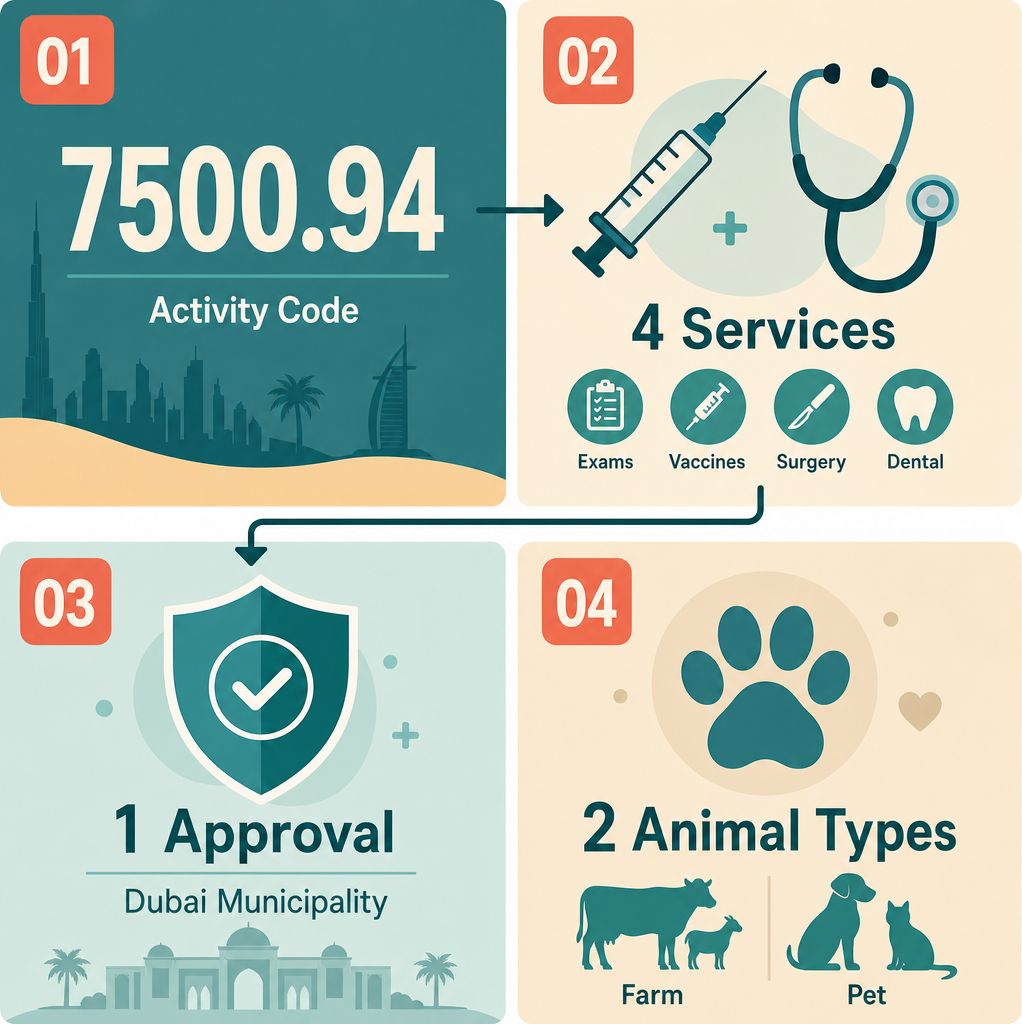
This code licenses you to diagnose, treat, and prevent animal diseases for both pets and farm animals using qualified veterinarians. It also includes physical examinations, vaccinations, surgery, dental care, laboratory tests, and radiology under one activity.
Animal Ambulance Is Already Included
Emergency animal transport is bundled inside the veterinary clinic license rather than requiring a separate standalone activity. This makes offering ambulance services significantly cheaper than most founders expect when planning their clinic.
Know What the License Specifically Excludes
Support activities for animal production are not covered, including boarding without health care, sheep shearing, herd testing, droving, and artificial insemination. Keeping these exclusions in mind helps you avoid compliance issues when designing your service menu.
Secure Dubai Municipality Approval After Licensing
Whether you set up on the mainland or through Meydan Free Zone, you must obtain approval from the Public Health Department of Dubai Municipality after your license is issued. This is a mandatory second step, not an optional add-on.
Choose Meydan Free Zone for Full Foreign Ownership
Setting up through Meydan Free Zone gives you 100% ownership of your business without the restrictions that apply under mainland DET rules. The setup process can also be completed remotely, making it accessible for international founders.
Build Both Fixed and Mobile Service Models
Your license permits care in your own surgery rooms and on visits to farms, kennels, and private homes, so you are not forced to choose one model. Running a mobile service alongside a fixed clinic lets you capture a wider client base from day one.
Tap Into Dubai's Strong Pet Ownership Demand
A large expatriate population, a growing affluent middle class, and city policies creating pet-friendly parks and communities all drive consistent demand for veterinary services. Preventive care is increasingly the norm here, meaning clients visit regularly rather than only in emergencies.
How to Start a Veterinary Clinic in Dubai with Meydan Free Zone?
Dubai's veterinary sector has grown a lot in recent years, and the reason is simple: more people here own pets, and they treat them as family. Regular check-ups, vaccinations and preventive treatment are now normal rather than optional.
Activity code 7500.94 covers running the clinic. This guide covers what the license permits, what it specifically does not, the approval that follows your license, and the one inclusion most people miss. That last point is worth the read on its own.
Key Stats at a Glance
What This License Covers
Apply under Veterinary Activities and select Veterinary Clinic with activity code 7500.94. A veterinary clinic is a specialist medical facility where qualified veterinarians provide care and treatment for animals, covering both farm animals and pets.
Your clinic can diagnose, treat and prevent animal diseases, disorders and injuries. Veterinarians working there should be certified and trained across physical examinations, vaccinations, surgery, dental care, laboratory tests and radiology. You can also advise owners on nutrition, behaviour and general animal care, which is often where the relationship with a client is built.
The inclusion worth knowing about
This license also covers the activities of veterinary assistants, clinicopathological and other diagnostic work, and animal ambulance services. That last one matters commercially: emergency transport sits inside the clinic license rather than needing a separate standalone activity, which is a cheaper route to offering it than most founders assume.
Who Your Clients Will Be
Pet owners are the core of it, and Dubai has a lot of them. A large expatriate population and a growing affluent middle class both push spending towards animal health, and owners here increasingly understand the value of preventive care rather than only turning up in a crisis.
Farm animals are the other half of the code, which widens your market beyond households to stables, farms and animal facilities. Because your license lets you work in your own surgery or on visits to farms, kennels and homes, you can build a mobile service alongside a fixed clinic rather than choosing between them.
There is also a relationship worth cultivating that is not strictly commercial. Working with animal welfare organisations, rescue groups and local authorities on responsible pet ownership builds standing in a market where owners choose a vet on trust and recommendation.
Mainland or Free Zone
A clinic that the public walks into with a sick animal is physical, local and premises-dependent, so a mainland license from the Department of Economy and Tourism is the natural fit if that is the model.
A Meydan Free Zone license gives you full ownership of the company and a setup you can complete remotely, which suits a visiting practice built around farm, kennel and home calls. Either way the Dubai Municipality approval applies and your premises have to satisfy it. Let your clients decide it, not the price.
[blockCTACostCalculator]
Step by Step Setup Guide
- Step 1, confirm your activity: Apply under Veterinary Activities and select 7500.94. Check the full scope against the business activities list for veterinary and related licenses.
- Step 2, decide whether ambulance work is part of the plan: Animal ambulance services sit inside this license, so build the vehicle and fit-out cost into your budget now if you want that line.
- Step 3, line up your veterinarians: Certified, trained clinicians are the substance of the business and of the approval. Recruit before you open, not after.
- Step 4, book your trade name: Use the free company name check to confirm availability.
- Step 5, plan premises that will pass inspection: Consulting and surgery rooms have to meet hygiene and safety standards, so design for the approval rather than retrofitting.
- Step 6, collect your license, then apply to Dubai Municipality: The Public Health Department approval comes after the license and before you treat animals. Fawri is the faster route if speed matters, and the cost calculator gives you a figure first.
- Step 7, set up records and bookkeeping: Clinical records and finances both need proper systems. mAccounting covers the financial side.
Compliance and What You Need in Place
Dubai Municipality approval after the license
Your clinic needs approval from the Public Health Department of Dubai Municipality. It is obtained after the business license is issued and confirms that the clinic meets the specific health and safety standards the municipality sets. Treat it as the gate to opening, not a formality to file afterwards.
Qualified clinicians only
Veterinarians in your clinic should be certified and trained for the procedures they perform, from examinations and vaccinations through to surgery, dental work, laboratory testing and radiology. Your service range is limited by who you actually employ.
Hygiene, safety and ethics
You must follow strict hygiene, safety and ethical standards. In a clinical setting these are operating disciplines rather than policies, and they are what the municipality inspects against.
What the license does not allow
Support activities for animal production sit outside this license. That means no boarding of farm or pet animals without health care, no sheep shearing, herd testing, droving or agistment, no poultry caponizing and no artificial insemination. Boarding is the one that catches clinics out, since it looks like a natural add-on and is not.
Anti-money laundering
AML regulations do not apply to veterinary clinics in Dubai. Those rules exist to prevent and detect money laundering and terrorist financing, and this activity falls outside them.
Market Opportunity
Growth in this sector follows growth in pet ownership, and both are rising. Dubai's large expatriate population and expanding affluent middle class have pushed demand for veterinary services well beyond emergency treatment into routine care, vaccination programmes and preventive medicine.
City policy reinforces it. Dubai has committed to a pet-friendly environment, with pet-friendly spaces built into residential communities, parks and public areas. When a city makes it easier to own an animal, more people do, and each of those animals needs a vet.
Specialisation is where the newer money sits. As the number of specialised veterinary services grows, so does client willingness to travel for expertise rather than convenience. For a new clinic, that means a defined clinical strength earns more than a general offer competing on proximity alone.
Conclusion
A veterinary clinic under code 7500.94 sits in a growing sector supported by rising pet ownership, a pet-friendly city policy and clients who now buy preventive care rather than only emergency treatment. The license covers a wide clinical scope, including diagnostics and animal ambulance work.
Three things decide how smoothly this goes: Dubai Municipality approval secured after the license and before you open, premises and hygiene standards designed for inspection, and a clear line between veterinary care and the animal production support activities the license excludes. Sort those and the rest is routine.
[blockCTAContact]