
Table of Contents
Frequently Asked Questions
What does activity code 7110.53 authorise a consultant to do in Dubai
Activity code 7110.53 authorises the holder to provide advisory and design consultancy services related to vertical and horizontal transportation systems within built environments. This covers feasibility studies, system selection, specification drafting, tender evaluation, and site supervision advisory.
It is a professional service licence, not a contracting or installation licence. The holder cannot undertake physical installation or ongoing maintenance contracts under this activity code.
What is the difference between vertical and horizontal transportation systems under this licence
Vertical systems include lifts, escalators, dumbwaiters, and stair lifts. These are most commonly found in high-rise residential, commercial, and mixed-use towers.
Horizontal systems cover moving walkways, automated people movers, and conveyor transit within buildings, airports, or campuses. Both categories fall within the same activity code, so a single licence covers consultancy across both.
Who are the typical clients for a vertical and horizontal transportation systems consultant in Dubai
Clients typically include real estate developers, main contractors, government infrastructure bodies, and facility managers. Dubai's sustained construction pipeline — spanning high-rise towers and metro expansions — creates consistent demand across all of these client types.
The consultant's advisory role is relevant at multiple project stages, from early feasibility through to tender evaluation and site supervision, making the service applicable to both new builds and existing asset upgrades.
Should I set up this consultancy licence on the mainland or in a free zone
Mainland licences (issued by Dubai Economy and Tourism) allow direct government contracts and broader UAE market access, but may require professional qualification attestation and generally take 2–4 weeks to process.
Free zone licences (for example through Meydan Free Zone) offer 100% foreign ownership from day one, faster setup of 5–10 working days, and typically do not impose professional qualification attestation requirements — making them a faster entry point for international consultants.
What is the step-by-step process for obtaining this licence in Dubai
The process follows seven core steps: choose your jurisdiction (mainland or free zone); reserve a compliant trade name; define your legal structure (sole establishment, civil company, FZE, or FZCO); submit your activity application with passport copies, a business plan summary, and any required NOC.
You then obtain initial approval and pay licence fees, secure office space or a flexi-desk, and finally receive your trade licence. Once issued, you can proceed to visa applications and corporate bank account opening.
Is 100% foreign ownership available for this type of consultancy licence
Yes. 100% foreign ownership is available in free zones from day one, with no local partner or sponsor required. This applies to structures such as a Free Zone Establishment (FZE) for a single shareholder or a Free Zone Company (FZCO) for multiple shareholders.
On the mainland, 100% foreign ownership is also available for eligible professional and consultancy activities under reforms to UAE commercial company law, though the specific eligibility should be confirmed with Dubai Economy and Tourism (DET) at the time of application.
Is there a minimum share capital requirement for this licence
For most free zone setups under this activity, there is no mandatory minimum share capital. This reduces the financial barrier to entry for international consultants and small practices looking to establish in Dubai.
Mainland requirements can vary depending on the legal structure chosen, so it is advisable to confirm current requirements directly with Dubai Economy and Tourism (DET) before proceeding.
What regulatory body governs this activity and what ISIC classification does it fall under
On the mainland, the activity is governed by Dubai Economy and Tourism (DET). In free zones, the relevant free zone authority takes on the regulatory role. The activity is classified under the UAE Federal ISIC framework.
Specifically, activity code 7110.53 sits within ISIC Division 71 — Architectural, Engineering, and Technical Consultancy, under ISIC Category 7110 (Architectural and Engineering Activities). This classification aligns it with other professional engineering consultancy activities regulated at the federal level.
Vertical & Horizontal Transportation Systems Consultant License in Dubai
Dubai keeps building upwards and outwards. Towers, malls, airport terminals, metro stations. Every one of them needs lifts, escalators or moving walkways, and someone has to work out which systems go in, how many, and where they sit. That is the job behind activity code 7110.53.
This is a professional license, not an installation one. You advise, you write the specification, you sit on the tender panel and you supervise on site. You do not fit the kit and you do not run maintenance jobs. This guide covers what the code allows, who pays for the work, how to set up through Meydan Free Zone, and what you need in place once you are licensed.
Key Stats at a Glance
What This License Covers

Activity code 7110.53 sits in ISIC group 7110, Architectural and Engineering Activities. It lets you give advice and design input on the systems that move people around inside a building or across a site.
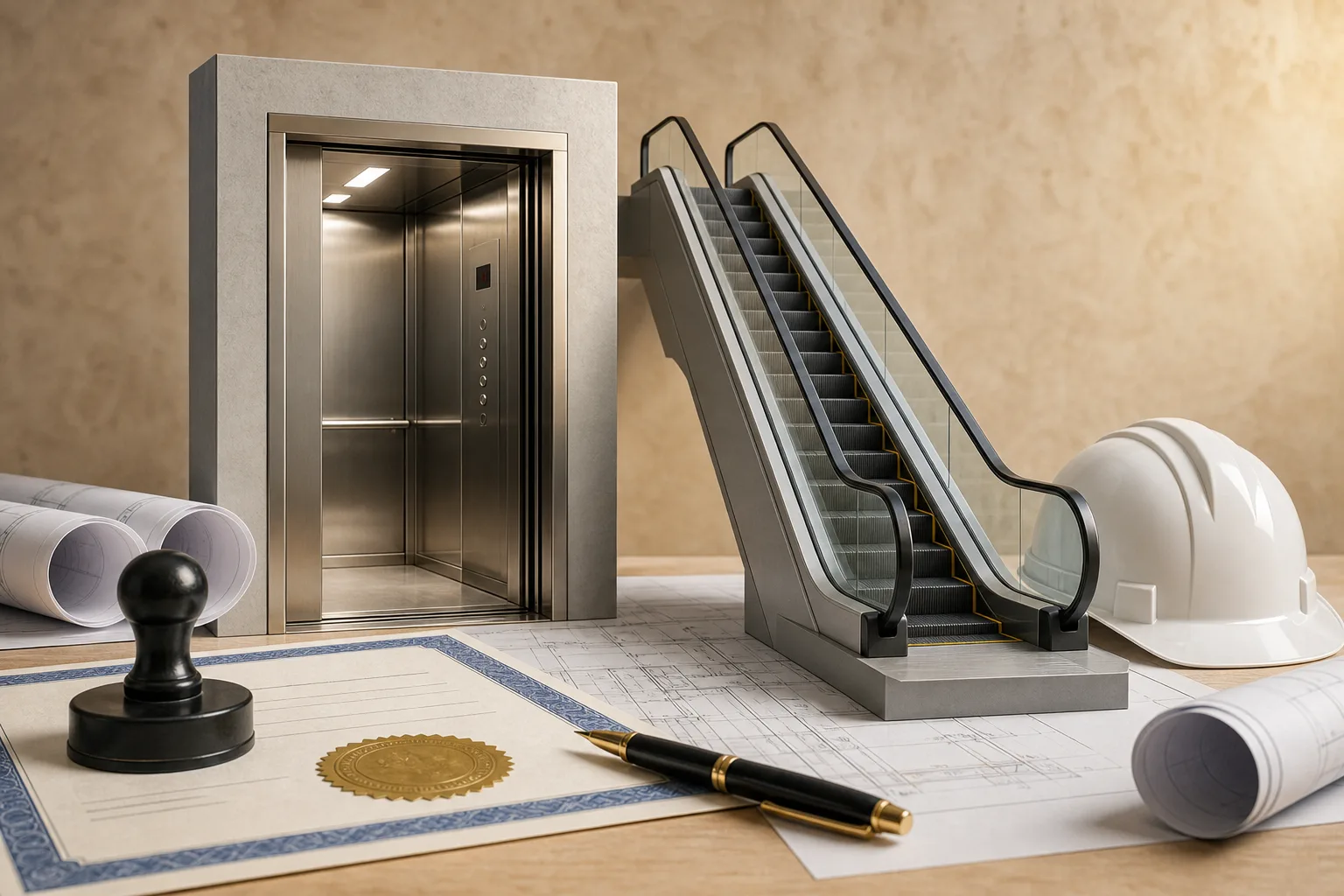
Vertical systems are lifts, escalators, dumbwaiters and stair lifts. You find them in high-rise homes, offices and mixed-use towers. Horizontal systems are moving walkways, automated people movers and conveyor transit inside buildings, airports or campuses. One code covers advice on both.
The work runs from feasibility studies through system selection, writing specifications, judging tenders and advising on site while the job goes in. It stops there. Fitting the kit and holding a maintenance contract are separate activities and need a different license.
Who Your Clients Will Be
Four groups buy this service:
- Real estate developers planning towers and mixed-use schemes
- Main contractors who need a specialist on the design team
- Government infrastructure bodies running transport and public projects
- Facility managers looking after buildings that are already up
Money comes in a few ways. Project retainers tied to the design and build phases. Fees for writing specifications and reviewing tenders. Site supervision through to handover. Advice to facility managers once a building is running. New towers pay well, and the older stock in Dubai needs upgrading too, which is steadier work. Lifts installed twenty years ago are now due replacement, and someone has to say what goes in their place.
Mainland or Free Zone
A free zone license is the faster and cheaper way in, and it suits a consultancy serving developers and contractors. A mainland license from the Department of Economy and Tourism makes sense if you want direct government project work. This is the biggest choice you will make when setting up. Let your clients decide it, not the price. You can start in a free zone and add a mainland branch later if the government work arrives.
[blockCTACostCalculator]
Step by Step Setup Guide
- Step 1, pick your jurisdiction: Mainland through DET, or Meydan Free Zone. Free zone setup is faster and gives you full ownership from day one.
- Step 2, book your trade name: It has to follow UAE naming rules. Avoid generic, religious and politically loaded words.
- Step 3, choose your legal structure: Sole establishment, civil company, or a free zone entity. FZE for one shareholder, FZCO for several.
- Step 4, send in your activity and papers: Passport copies, a short business plan, and an NOC if you are employed or on a sponsored visa here.
- Step 5, get initial approval and pay the license fee: Fees change with the jurisdiction and the structure you picked.
- Step 6, take an office or a flexi-desk: Nearly every jurisdiction wants a workspace on file before it issues the license.
- Step 7, collect your trade license: Then apply for visas and open the company bank account.
Compliance and What You Need in Place
Project registration
Dubai Municipality and other technical bodies may want your firm registered before you can sign off work on a named project. This comes up most on government-linked infrastructure jobs.
Technical body approval
Consultants working on government or semi-government schemes may also need to register with the Dubai Central Laboratory or a similar body. Check this early, because it can hold up your first contract.
Professional indemnity cover
No law forces you to hold it. Developers and main contractors ask for it in their contracts anyway, so treat it as a cost of doing business rather than an optional extra.
Qualification papers
A mainland license may ask you to attest your engineering qualifications through the relevant authorities. Free zones usually do not, which is why many consultants coming from abroad start there.
VAT and books
Register for VAT with the Federal Tax Authority once your taxable turnover passes AED 375,000 a year. Keep clean books from the first invoice. It saves trouble at renewal and in any audit.
Market Opportunity
The Dubai 2040 Urban Master Plan sets out years of spending on dense housing zones, commercial corridors and transport links. Every one of those buildings needs its lifts and walkways specified at the design stage, long before the concrete goes up.
High-rise homes, airports, metro extensions and mixed-use mega-projects all feed the same pipeline. The niche is narrow enough that few firms hold this exact code, so you are not fighting a crowded field. Get onto the right approved lists and the work tends to repeat with the same developers, because a firm that has trusted you on one tower will call you for the next one.
Conclusion
Code 7110.53 is a light, focused license for engineers who already know this kit. There is no factory to build and no stock to carry. Your costs are your time, your insurance and your license.
Free zone setup is the quicker route and keeps the company fully yours. Mainland opens the door to government projects. Either way, get your papers straight before you apply, because half-finished files are what slow these applications down.
Three things decide how well this goes: the jurisdiction you pick, the approvals you line up for your first project, and the indemnity cover your clients will ask to see.
[blockCTAContact]