

Table of Contents
Frequently Asked Questions
Do free zone companies in the UAE have to screen their customers for sanctions?
Yes. Targeted financial sanctions apply to free zone companies as they do to mainland businesses, and businesses in regulated sectors also carry customer due diligence duties under federal AML law. A Meydan Free Zone company should screen its customers, their owners and directors before taking them on, and keep a record of each check.
Which sanctions lists should a UAE business check before accepting a customer?
The baseline is the UAE Local Terrorist List and the United Nations Security Council consolidated list, both implemented through the UAE's targeted financial sanctions framework. Many businesses also check other international lists, because their banks and overseas partners apply them to cross-border payments.
How often should a business re-screen its customers?
Re-screen on a risk-based schedule, with higher-risk customers reviewed more often. Run a fresh check whenever a sanctions list updates, ownership or directors change, or a customer asks to pay through an unrelated third party.
What should a business do if a customer name matches a sanctions list?
Do not proceed with the transaction until the match is resolved. Compare identifiers such as date of birth, nationality, passport number or registration number to confirm whether it is a true match. If it is confirmed, follow the reporting and freezing procedures set by the Executive Office for Control and Non-Proliferation, and record every step.
Who counts as an ultimate beneficial owner when screening a company?
The ultimate beneficial owner is the individual who ultimately owns or controls the customer, often through one or more holding companies. Screen that person, not only the entity you invoice. Unexplained or circular ownership structures are a risk flag and need clarification before onboarding.
Can a business rely on its bank to do its customer screening?
No. Banks screen their own customers and review your transactions, but they do not carry out your counterparty checks. When a bank queries a payment, it expects you to show who the buyer is and what checks you made.
What happens if a business deals with a sanctioned party by mistake?
Funds can be frozen, payments delayed and the bank may review or close the account. Administrative and criminal penalties can also apply under UAE law. Dated screening records show good faith and help you respond quickly to a bank or regulator.
Does a clear sanctions result mean a customer is low risk?
No. Sanctions screening and AML screening answer different questions. A customer can pass a sanctions check but still have a politically exposed owner or adverse media, which calls for enhanced due diligence, source-of-funds evidence and senior approval.
Topic Summary
What Sanctions and AML Screening Means for Business Customers
Sanctions and anti-money laundering (AML) screening for business customers is the process of checking a company, its owners and its directors against sanctions lists, politically exposed person (PEP) records and adverse media, before onboarding and during the relationship. It stops you dealing with restricted parties or channelling illicit funds. Effective AML screening in the UAE starts with knowing which question each check answers. See also the UAE AML and Know Your Customer (KYC) regulations.
Who Regulates Sanctions and AML Screening in the UAE
AML supervision in the UAE is federal and sector-based. The Central Bank of the UAE supervises banks and licensed financial institutions, and other supervisors cover their own sectors. The Executive Office for Control and Non-Proliferation oversees targeted financial sanctions. Free zone status doesn't remove these duties.
What Sanctions Lists Apply to Business Customers
For AML screening in the UAE, the baseline is the UAE Local Terrorist List and the United Nations Security Council consolidated list, both implemented through the UAE targeted financial sanctions framework (Cabinet Decision No. 74 of 2020). Many firms also check other international lists, because their banks and overseas partners apply them.
How to Screen Business Customers in Five Steps
To screen a business customer, collect ownership documents, identify the ultimate beneficial owners, run sanctions and PEP checks, assess risk and record the decision, then monitor and re-screen. Keep records of every check. Here is the workflow in practice:
Ongoing Monitoring and Record Keeping
Screening doesn't end at onboarding. Lists change, owners change and behaviour shifts. Re-screen on a risk-based schedule, after any ownership change and when lists update. Good AML screening in the UAE also means keeping evidence you can show a bank or regulator.
Cost and Risk of Getting Screening Wrong
A missed sanctions match can freeze funds, end banking relationships and bring administrative penalties or criminal liability. Weak AML screening in the UAE also slows account reviews and renewals.
What Screening Means for a Meydan Free Zone Company
A Meydan Free Zone company follows the same federal AML and sanctions duties as any UAE business. Meydan Free Zone issues the Business License, Certificate of Formation, Share Register and Memorandum and Articles of Association (MoA/AoA) digitally. A trader can share the Share Register with a buyer's compliance team, giving a clear ownership record. A defined license activity also helps banks match your customers to your business.
Sanctions and AML Screening for Business Customers
Say a founder signs a trading customer on a Friday, ships goods the next week, and then the bank asks who owns the buyer. Many founders assume customer screening is the bank's job, yet every UAE business must avoid dealing with sanctioned parties. So which checks should you run, and how do you prove you ran them? This guide covers the lists that apply, a five-step screening process and the records to keep.
What Sanctions and AML Screening Means for Business Customers
Sanctions and anti-money laundering (AML) screening for business customers is the process of checking a company, its owners and its directors against sanctions lists, politically exposed person (PEP) records and adverse media, before onboarding and during the relationship. It stops you dealing with restricted parties or channelling illicit funds. Effective AML screening in the UAE starts with knowing which question each check answers. See also the UAE AML and Know Your Customer (KYC) regulations.
Sanctions Screening Compared With AML Screening
Sanctions screening checks names against lists that restrict dealings with named persons or entities. AML screening looks at laundering risk: PEPs, adverse media and source of funds. They run together but answer different questions. A buyer can pass a sanctions check while its owner is a PEP who needs enhanced due diligence.
Who Counts as a Business Customer
- Companies, partnerships and trusts you invoice or supply.
- Distributors, agents and intermediaries acting for the buyer.
- Owners, directors and authorised signatories behind each entity.
A consultancy, for example, checks the corporate client and the individual who signs the engagement letter.
Who Regulates Sanctions and AML Screening in the UAE
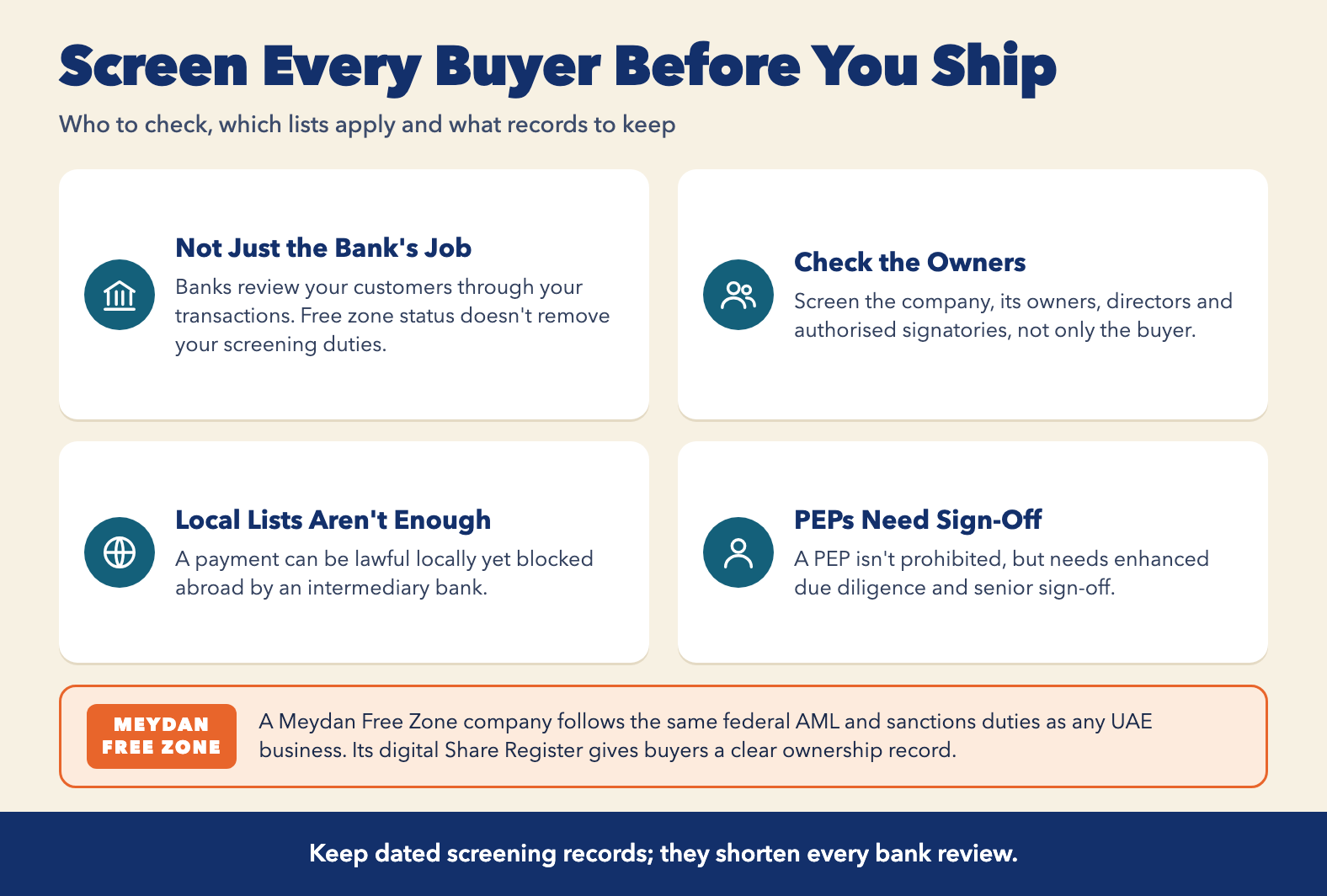
AML supervision in the UAE is federal and sector-based. The Central Bank of the UAE supervises banks and licensed financial institutions, and other supervisors cover their own sectors. The Executive Office for Control and Non-Proliferation oversees targeted financial sanctions. Free zone status doesn't remove these duties.
A free zone trader may assume federal law stops at the zone boundary, but it does not. Banks review your customers when they see your transactions, and unexplained payments from unscreened buyers trigger queries. Your own dated records shorten those reviews. Read more on anti-money laundering in Dubai, and see the Central Bank of the UAE for its supervisory role.
What Sanctions Lists Apply to Business Customers
For AML screening in the UAE, the baseline is the UAE Local Terrorist List and the United Nations Security Council consolidated list, both implemented through the UAE targeted financial sanctions framework (Cabinet Decision No. 74 of 2020). Many firms also check other international lists, because their banks and overseas partners apply them.
That gap matters. A UAE exporter can find a payment held by an intermediary bank even though the buyer isn't on a UAE list. A payment can be lawful locally yet blocked abroad.
Politically Exposed Persons and Adverse Media
- A PEP isn't prohibited, but needs enhanced due diligence.
- Adverse media covers fraud, bribery and financial crime allegations.
- Record why you proceeded, with source of funds and senior sign-off.
How to Screen Business Customers in Five Steps
To screen a business customer, collect ownership documents, identify the ultimate beneficial owners, run sanctions and PEP checks, assess risk and record the decision, then monitor and re-screen. Keep records of every check. Here is the workflow in practice:
- Collect documents. Trade license, constitutional documents, registered address, share register, director details and signatory identification. Ask for the share register before the first invoice.
- Identify beneficial owners. Trace ownership through holding layers to individuals. Treat circular or unexplained structures as a flag. A buyer held through two offshore companies needs the person behind them named. See ultimate beneficial owner UAE rules.
- Run the checks. Screen the entity, owners, directors and signatories. Allow for transliterated names. Clear partial matches with passport number, date of birth or nationality.
- Assess risk. Rate by country, sector, structure and payment pattern. Escalate high-risk files for senior approval.
- Record and monitor. Keep dated results and reasoning, then re-screen on a schedule.
Ongoing Monitoring and Record Keeping
Screening doesn't end at onboarding. Lists change, owners change and behaviour shifts. Re-screen on a risk-based schedule, after any ownership change and when lists update. Good AML screening in the UAE also means keeping evidence you can show a bank or regulator.
Triggers for Re-Screening
- A sanctions list update.
- A change of owner, director or business activity.
- Unusual order size, payment route or a third-party payment request.
Manual Screening Compared With Automated Screening
| Feature | Manual Checks | Automated Screening |
|---|---|---|
| Suitable customer volume | A small number of customers, checked by hand | Hundreds of customers and frequent onboarding |
| List updates | You must check each list source yourself | Lists refresh within the tool |
| Audit trail | Dated screenshots and a spreadsheet log | Automatic time-stamped records per check |
| Handling of name variations | Reviewer tries spellings one by one | Fuzzy matching flags transliterations |
| Ongoing monitoring | Periodic re-checks you diarise | Continuous alerts on list changes |
What Records to Keep and Why
Keep screening results, dates and reviewer names, plus ownership documents and the risk rating. Follow the retention period set in current federal AML law. When a bank asks about a past transaction, you can produce the dated file within a day. Also review penalties for non-compliance in the UAE.
Cost and Risk of Getting Screening Wrong
A missed sanctions match can freeze funds, end banking relationships and bring administrative penalties or criminal liability. Weak AML screening in the UAE also slows account reviews and renewals.
Take a trader whose account goes under review after a shipment involves a restricted party. Supplier payments stall, and future banks ask harder questions at onboarding. Legal penalties sit in federal AML and targeted sanctions law, and a company with no screening records struggles to show good faith when a transaction is queried. Check current penalty amounts with the Central Bank of the UAE or the relevant supervisor.
What Screening Means for a Meydan Free Zone Company
A Meydan Free Zone company follows the same federal AML and sanctions duties as any UAE business. Meydan Free Zone issues the Business License, Certificate of Formation, Share Register and Memorandum and Articles of Association (MoA/AoA) digitally. A trader can share the Share Register with a buyer's compliance team, giving a clear ownership record. A defined license activity also helps banks match your customers to your business.
Through Meydan Plus, mCore includes business bank account support, though approval rests with the bank, and mAccounting covers bookkeeping. Organised books make bank queries on customer payments easier to answer. See free zone company structure for easy bank opening.
Essential Services for Entrepreneurs and Startups
Explore mCoreConclusion
AML screening in the UAE is a working process, not a form. Collect ownership documents, screen before you accept a customer and keep dated records. Before your first invoice, define the lists you check, who approves higher-risk customers and where records sit. Then confirm your license activity matches the customers you plan to serve. A Meydan Free Zone company receives its Share Register digitally, so it is ready to share when a buyer or bank checks your own ownership.
Ready to Launch Your Business in Dubai?
Let's Connect