

Table of Contents
Frequently Asked Questions
What counts as a capital asset for VAT purposes in the UAE?
A capital asset is a business asset costing AED 5,000,000 or more, excluding VAT. It needs a useful life of at least ten years for a building, or five years for other assets. Typical examples are commercial buildings, production lines and large plant. Stock, consumables and smaller equipment fall outside the scheme.
How long does a business have to adjust input tax on a capital asset?
The adjustment period is ten years for buildings and five years for other capital assets. Each year carries an equal share of the original input tax. The period generally starts when the asset is first used.
Do I need to adjust input tax if I sell a capital asset early?
Usually, yes. Selling or disposing of an asset within its adjustment period can trigger an adjustment for the remaining years, depending on how the sale is taxed. Keep the original purchase invoice and your use records ready to support the calculation.
Can a business recover more input tax if an asset's taxable use increases?
Yes. If taxable use rises above the percentage recovered at purchase, the business can recover more in that year. The extra amount is a share of the original input tax, not a new claim on the full purchase.
Does the AED 5,000,000 threshold apply to each asset or to the total purchase?
The test looks at the cost of the business asset, excluding VAT. Costs that together make up one asset, such as a building's construction, may count together. Whether separate purchases combine depends on the facts, so take advice before treating them either way.
What records should I keep for capital assets under UAE VAT?
Keep the supplier tax invoice, the date of first use, the original input tax and the percentage recovered. Add a yearly record of taxable use for each asset. These records support any VAT refund claim and any review by the Federal Tax Authority.
What happens to capital asset adjustments if I deregister for VAT?
Deregistering while you still hold capital assets can trigger an adjustment for the remaining adjustment period. Calculate it before you file the deregistration request. Your asset register should show each asset's original input tax and use history.
Topic Summary
What the Capital Asset Scheme Under UAE VAT Means
The capital asset scheme under UAE VAT requires a business to review input tax recovered on a high-value asset over several years. If the asset's taxable use changes, the business adjusts the original claim. The Federal Tax Authority (FTA) applies this under the VAT Executive Regulation to prevent over-recovery or under-recovery.
How Input Tax Adjustments Work Over Time
Input tax is adjusted by comparing the taxable use recorded at purchase with the taxable use in each later year of the adjustment period. If use has dropped, the business owes tax back. If it has risen, the business can recover more. The adjustment is a share of the original input tax.
Adjustment Periods for Property and Other Assets
The adjustment period is ten years for buildings and five years for other capital assets. Each year carries an equal share of the original input tax. The period generally starts when the asset is first used, so record that date.
How to Calculate a Capital Asset Adjustment
To calculate an adjustment, record the original input tax and divide it across the adjustment period. Compare current taxable use with the original percentage and apply the difference to that year's share. Report the result in your VAT return to the FTA.
Common Mistakes With VAT on Capital Assets
The most common mistakes are treating a capital purchase as a one-time claim and missing first-use dates. Others ignore a change in use or overlook the adjustment on sale. Each can lead to under-declared output tax or lost recovery in a later return.
What This Means for a Founder's Decision
Founders should treat capital purchases as a recurring cost to monitor, not a single VAT claim. Keep an asset register, record first use, and review taxable use every year. Meydan Free Zone's mAccounting service includes bookkeeping and VAT registration support, which helps with this tracking.
Conclusion
The capital asset scheme under UAE VAT turns a single purchase into a multi-year obligation. Execution matters more than theory: record first use, keep an asset register and review taxable use after each year.
Capital Asset Scheme Under UAE VAT: Adjusting Input Tax Over Time
A large asset purchase can tie your VAT position to that asset for years. If you recover input tax on a building or major plant and later change how you use it, part of that claim may need to be repaid.
This guide explains which assets fall under the UAE capital asset scheme, how long the adjustment period runs, and how to calculate and report each yearly adjustment.
What the Capital Asset Scheme Under UAE VAT Means
The capital asset scheme under UAE VAT requires a business to review input tax recovered on a high-value asset over several years. If the asset's taxable use changes, the business adjusts the original claim. The Federal Tax Authority (FTA) applies this under the VAT Executive Regulation to prevent over-recovery or under-recovery.
Which Assets Count as Capital Assets
An asset qualifies if it is a business asset costing AED 5,000,000 or more, excluding VAT. It also needs a useful life of at least ten years for a building, or five years for other assets. Cabinet Decision No. 149 of 2026 restated this test from 1 October 2026.
Say a manufacturer buys a production line for AED 6,000,000. It meets the threshold, so it falls within the scheme. Stock, consumables and smaller equipment such as vans or laptops fall outside it.
Why the Scheme Exists
Input tax recovery depends on use for taxable supplies. A long-life asset can change use after the first claim, for example an asset bought for taxable sales that later supports exempt supplies. The adjustment keeps total recovery in line with actual taxable use. For wider context, see this detailed guide to VAT in the UAE.
How Input Tax Adjustments Work Over Time
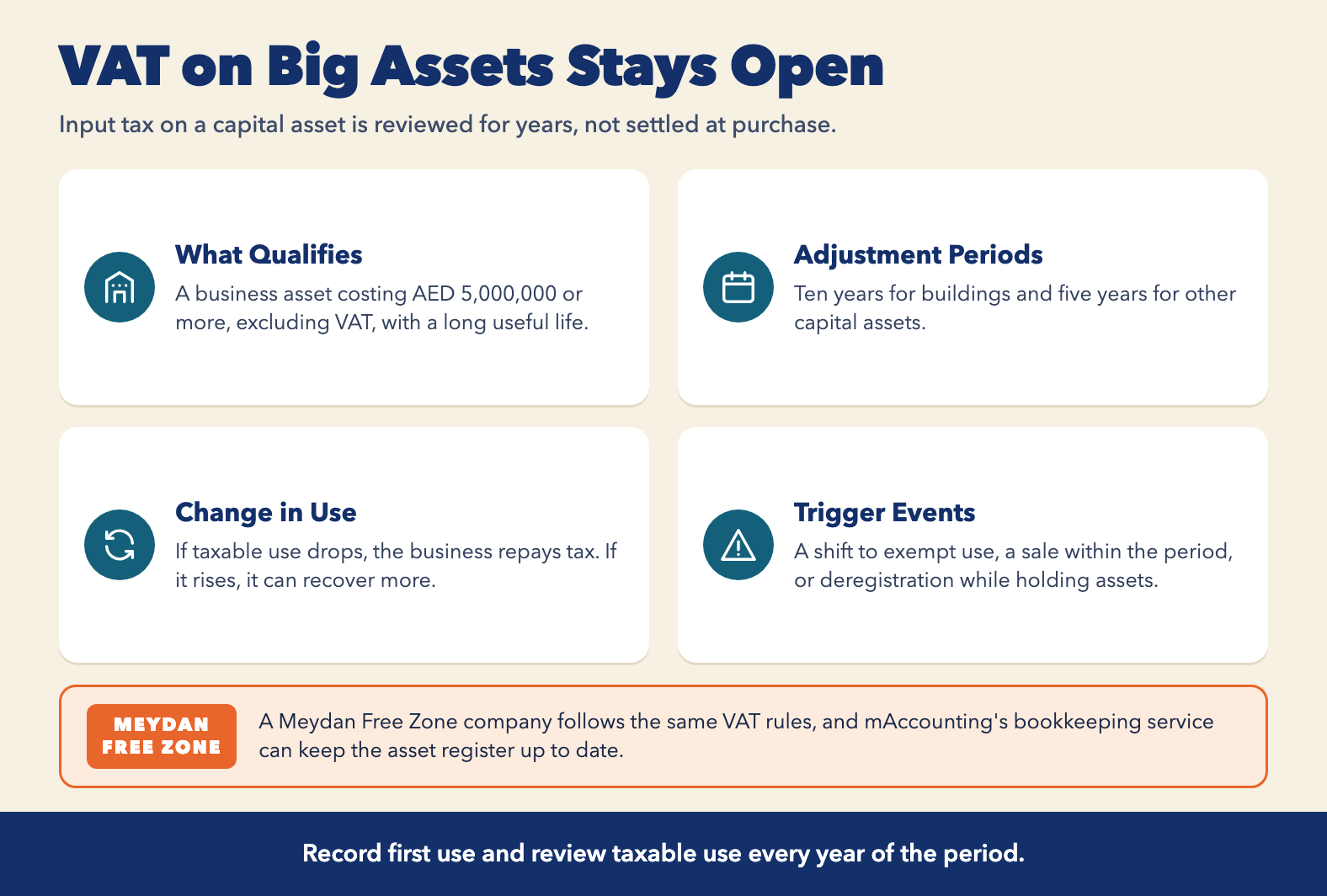
Input tax is adjusted by comparing the taxable use recorded at purchase with the taxable use in each later year of the adjustment period. If use has dropped, the business owes tax back. If it has risen, the business can recover more. The adjustment is a share of the original input tax.
Initial Recovery and Later Review
You recover input tax at purchase based on intended taxable use. Each later year, you compare actual use with that original percentage. The difference is applied to that year's share of the period.
Picture a company that recovers all input tax on a production line, then starts making exempt supplies in year three. From that year, the scheme reduces how much of the original claim it can keep.
Adjustment Periods by Asset Type
| Feature | Buildings | Other Capital Assets |
|---|---|---|
| Adjustment period | 10 years | 5 years |
| Annual share of original input tax | One-tenth (10%) | One-fifth (20%) |
| Typical examples | Office building or warehouse costing AED 5,000,000 or more | Production lines, heavy plant or machinery costing AED 5,000,000 or more |
| Record keeping horizon | Use history for the full ten years | Use history for the full five years |
| Event on sale within the period | Remaining years are adjusted based on the sale's VAT treatment | Remaining years are adjusted based on the sale's VAT treatment |
Events That Trigger an Adjustment
- A shift between taxable, exempt or non-business use.
- Sale or disposal within the adjustment period, such as selling a production line in year four.
- Deregistration while still holding capital assets.
Adjustment Periods for Property and Other Assets
The adjustment period is ten years for buildings and five years for other capital assets. Each year carries an equal share of the original input tax. The period generally starts when the asset is first used, so record that date.
Ten Years for Buildings
This covers commercial buildings and related capital works. A business that buys an office building tracks use for the full ten years, which means keeping the original purchase input tax and use history for a decade.
Five Years for Other Capital Assets
Plant, machinery and other non-building assets that meet the threshold fall here. Each year carries one-fifth of the original input tax. The review runs for the full five years, so a production line recovered in full in year one is still reviewed in year three.
How to Calculate a Capital Asset Adjustment
To calculate an adjustment, record the original input tax and divide it across the adjustment period. Compare current taxable use with the original percentage and apply the difference to that year's share. Report the result in your VAT return to the FTA.
Five Steps to Calculate an Adjustment
- Confirm the asset qualifies and note its first use date.
- Record the original input tax and percentage recovered.
- Divide the input tax by the adjustment period for the annual share.
- Measure taxable use for the current year.
- Apply the difference to the annual share and record the result.
Here's an illustration, not an official figure. A business recovers AED 300,000 of input tax on equipment costing AED 6,000,000, with a five-year period. The annual share is AED 60,000. If taxable use falls from 100% to 60% in year three, the adjustment is 40% of AED 60,000, or AED 24,000 payable.
Filing Adjustments and Keeping Records
- Include the adjustment in the VAT return for the first tax period after the end of each tax year.
- Keep purchase invoices, asset registers and use records.
- Show purchase date, input tax and yearly use percentage in the register.
- Check how the adjustment affects any VAT refund for companies position.
Common Mistakes With VAT on Capital Assets
The most common mistakes are treating a capital purchase as a one-time claim and missing first-use dates. Others ignore a change in use or overlook the adjustment on sale. Each can lead to under-declared output tax or lost recovery in a later return.
Weak Asset Registers
Some businesses book assets as expenses and keep no record of the original claim. The gap surfaces at sale, deregistration or an FTA review. A founder who sells a machine three years later and can't show the original claim has little defence.
Missing a Change in Use
- Starting exempt or non-business use without updating the calculation.
- Private use of company assets.
- Leasing part of a property in a way that changes taxable use.
What This Means for a Founder's Decision
Founders should treat capital purchases as a recurring cost to monitor, not a single VAT claim. Keep an asset register, record first use, and review taxable use every year. Meydan Free Zone's mAccounting service includes bookkeeping and VAT registration support, which helps with this tracking.
Plan Purchases Before You Claim
Decide the intended use before recovering input tax. For a large purchase, compare buying the asset outright with leasing it. Model the potential adjustment next to cash flow.
Support Through Meydan Free Zone
mAccounting, part of Meydan Plus, offers bookkeeping, Corporate tax support and VAT registration support. A Meydan Free Zone company can use its bookkeeping records to maintain the asset register.
Free Business Setup Cost Calculator
Calculate NowConclusion
The capital asset scheme under UAE VAT turns a single purchase into a multi-year obligation. Execution matters more than theory: record first use, keep an asset register and review taxable use after each year.
Before your next major purchase, set up the register and review expected taxable use with your accountant. For a Meydan Free Zone company, the mAccounting bookkeeping service can keep that register up to date alongside the rest of the accounts.
Ready to Launch Your Business in Dubai?
Let's ConnectReferences
- Federal Tax Authority (FTA), UAE: VAT legislation and guidance, including Federal Decree-Law No. 8 of 2017 and its Executive Regulation, 2026.