
Table of Contents
Frequently Asked Questions
How many accounts does a small business in the UAE usually need?
A solo consultant can often run on about 40 accounts. A trading company with several revenue streams, stock and multiple tax treatments usually needs far more. Start lean, leave gaps in the numbering, and add accounts only when a report or tax return requires them.
Can I change my account codes after the financial year has started?
Yes, but it creates risk. Renaming or renumbering accounts mid-year breaks comparisons and weakens the audit trail unless you keep a clear mapping record. It is better to add new accounts and make structural changes at year end.
Which accounts do I need to prepare a VAT return in the UAE?
You need output VAT, input VAT and a VAT payable or refundable account. Sales should also be split by tax treatment: standard-rated, zero-rated, exempt and out of scope. This lets you reconcile each return directly to the ledger. According to the Federal Tax Authority, VAT registration is mandatory once annual taxable supplies exceed AED 375,000.
Does a free zone company need a different ledger structure for Corporate Tax?
The core structure is the same, but a free zone company should add accounts to track qualifying and non-qualifying income. It should also tag related-party transactions separately. Qualifying income can be taxed at 0%, while non-qualifying income is taxed at 9%, so clear separation makes the computation faster.
Is it better to use a software template or build a ledger from scratch?
Use a template as a starting point, then adapt it. Generic templates often lack VAT, Corporate Tax and deferred revenue accounts, and they carry many unused accounts. Test the adjusted structure with sample transactions before going live.
How often should I review my list of accounts?
Review it at least once a year, and again when the business adds a new revenue stream or tax registration. Check for duplicate accounts and unused codes. Limit who can create accounts so changes stay controlled and documented.
What is the difference between a general ledger and a chart of accounts?
The chart of accounts is the list of accounts, each with a code, name and type. The general ledger is the record of every transaction posted to those accounts. The chart sets the structure, and the ledger holds the entries that reports draw from.
Who can set up accounting records for a Meydan Free Zone company?
A founder can draft the structure, but a qualified accountant should review it before the first filing. Meydan Free Zone's mAccounting covers bookkeeping, VAT registration support and Corporate Tax support. A company can therefore keep day-to-day records and tax support with one provider.
Topic Summary
What a Chart of Accounts Means for an SME
A chart of accounts is the structured list of every ledger account a business uses to record transactions. In the UAE, it sorts assets, liabilities, equity, revenue and expenses under a numbering system. It also feeds VAT returns, Corporate Tax filings and financial statements, so its design affects compliance directly.
How a Chart of Accounts in the UAE Supports Tax Compliance
A well-built chart of accounts separates taxable, zero-rated, exempt and out-of-scope activity, and isolates items that affect taxable income. This lets an SME prepare VAT returns and Corporate Tax computations from the ledger directly. Both taxes are administered by the Federal Tax Authority, which can request supporting records.
Steps to Build a Chart of Accounts for Your SME
Build the structure in three steps: define your business model and reporting needs, choose a numbering scheme, then add VAT and Corporate Tax accounts and test them with sample transactions before going live. Keep it lean and expand only when reporting needs it.
Core Account Categories and Numbering Logic
Most UAE SMEs need five account classes: assets, liabilities, equity, revenue and expenses. Numbering them in ranges keeps the ledger readable. Financial statements under International Financial Reporting Standards (IFRS), or IFRS for SMEs where a business is eligible, depend on this classification.
VAT and Corporate Tax Accounts Every SME Needs
At minimum, include output VAT, input VAT, VAT payable or refundable, Corporate Tax expense, Corporate Tax payable and a clearing account for non-deductible costs. These let you reconcile returns to the ledger quickly and show the FTA a clear audit trail.
Common Mistakes When Setting Up Your Ledger
The most common errors are copying a generic template, mixing personal and business spending, combining VAT categories in one revenue account, creating too many accounts, and changing codes mid-year. Each forces reclassification before a filing and weakens the audit trail.
Who Should Build and Maintain the Ledger
A founder can design the structure, but a qualified accountant should review it before the first filing. Meydan Free Zone's mAccounting covers bookkeeping, VAT registration support and Corporate Tax support, so day-to-day records and tax support can sit with one provider.
Setting Up a Chart of Accounts for a UAE SME
Many founders open their books with whatever accounts the software suggests, then have to restructure everything when the first Value Added Tax (VAT) return or Corporate Tax filing falls due. How should an SME lay out its accounts so the ledger works for tax from day one? This guide covers the structure, numbering, tax accounts and common mistakes, so bankers, auditors and the Federal Tax Authority (FTA) can follow your records.
What a Chart of Accounts Means for an SME
A chart of accounts is the structured list of every ledger account a business uses to record transactions. In the UAE, it sorts assets, liabilities, equity, revenue and expenses under a numbering system. It also feeds VAT returns, Corporate Tax filings and financial statements, so its design affects compliance directly.
How the Ledger Structure Works
Each account has a code, a name and a type. Transactions post to accounts, and reports draw from them. A trading company records a customer receipt against a bank account and sales revenue, while the output VAT goes to a separate liability account.
Why Default Software Templates Fall Short
- Generic templates ignore VAT and Corporate Tax needs.
- Unused accounts add noise to every report.
- Missing accounts force reclassification at year end.
A consultancy on a retail template, for instance, has no deferred revenue account for training fees billed in advance.
How a Chart of Accounts in the UAE Supports Tax Compliance
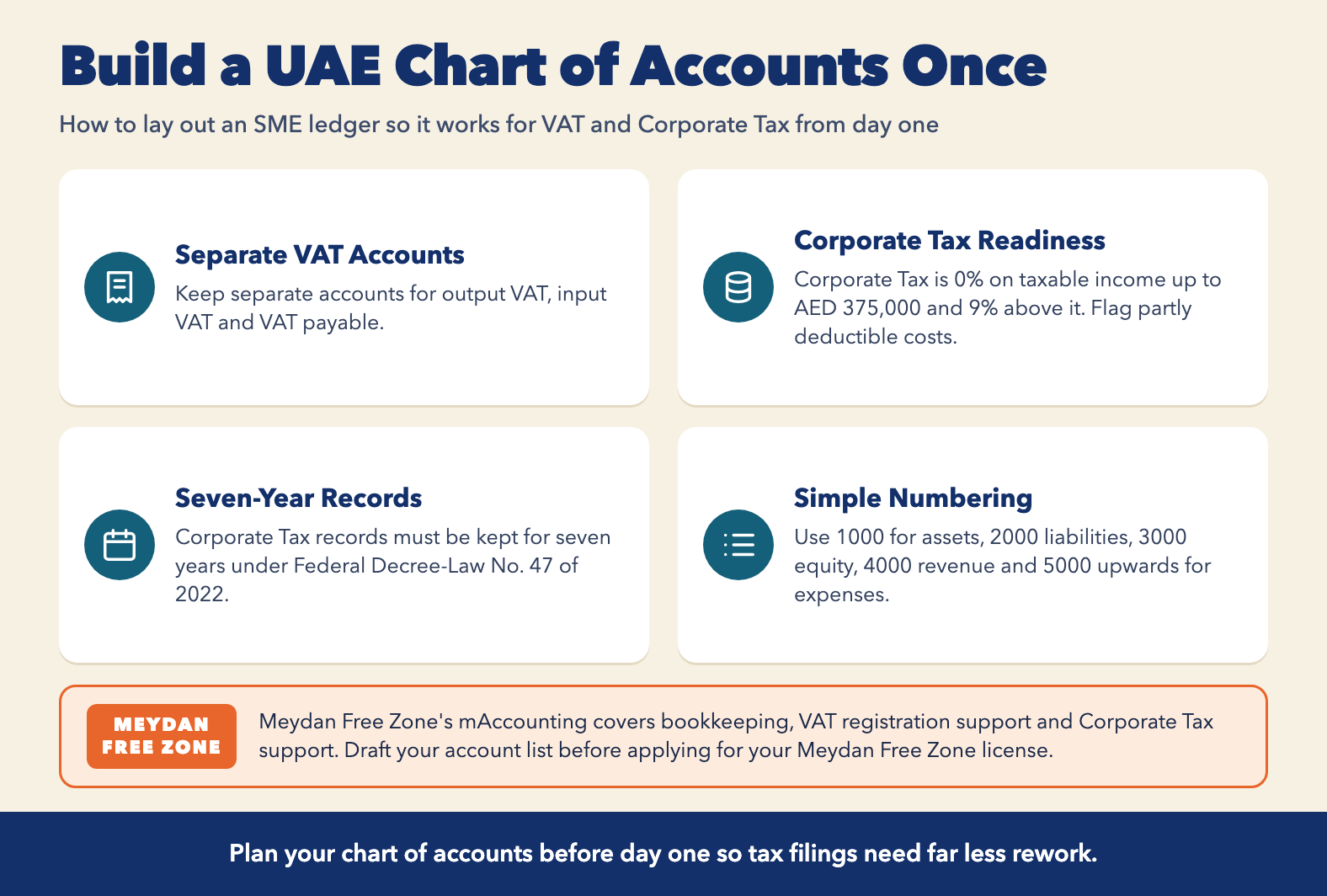
A well-built chart of accounts separates taxable, zero-rated, exempt and out-of-scope activity, and isolates items that affect taxable income. This lets an SME prepare VAT returns and Corporate Tax computations from the ledger directly. Both taxes are administered by the Federal Tax Authority, which can request supporting records.
VAT Reporting Needs
Keep separate accounts for output VAT, input VAT and VAT payable. Track supplies by tax treatment. According to the Federal Tax Authority, VAT registration is mandatory once annual taxable supplies exceed AED 375,000. An e-commerce seller, for example, maps standard-rated sales and zero-rated export sales to different revenue accounts.
Corporate Tax Readiness
- Corporate Tax is 0% on taxable income up to AED 375,000 and 9% above it.
- Flag partly deductible costs, such as entertainment.
- Give related-party transactions their own accounts.
- A Qualifying Free Zone Person must separate qualifying from non-qualifying income.
Record-Keeping Expectations
Corporate Tax records must be kept for seven years under Federal Decree-Law No. 47 of 2022. Consistent codes keep the audit trail simple. They also cut queries when a bank asks for management accounts during a facility review.
Steps to Build a Chart of Accounts for Your SME
Build the structure in three steps: define your business model and reporting needs, choose a numbering scheme, then add VAT and Corporate Tax accounts and test them with sample transactions before going live. Keep it lean and expand only when reporting needs it.
Step 1: Define Your Business Model and Reporting Needs
- List revenue streams and cost centres.
- Decide which management reports you need.
- Consider bank and investor reporting.
A services firm with consulting and training income should split them into two revenue accounts.
Step 2: Choose a Numbering Scheme
- Use 1000 for assets, 2000 liabilities, 3000 equity, 4000 revenue and 5000 upwards for expenses.
- Leave gaps for future accounts.
- Name accounts consistently: cash and bank 1100, receivables 1200, prepaid expenses 1400.
Lean Versus Detailed Account Structures for an SME
| Feature | Lean Structure | Detailed Structure |
|---|---|---|
| Typical business size | Solo consultant or small service firm | Trading firm with a growing team |
| Number of accounts | About 40 | Several hundred |
| Revenue tracking | One account per income stream | Sub-accounts by product, client type and tax treatment |
| Tax mapping | Core VAT and Corporate Tax accounts only | Separate accounts for reverse charge, non-deductible costs and related-party items |
| Maintenance effort | Annual review is usually enough | Quarterly review with an approval process |
Step 3: Add Tax Accounts and Test the Structure
- Include VAT, Corporate Tax payable and deferred tax where relevant.
- Post sample sales, purchases and payroll entries.
- Run a test month of invoices before the first VAT period.
Core Account Categories and Numbering Logic
Most UAE SMEs need five account classes: assets, liabilities, equity, revenue and expenses. Numbering them in ranges keeps the ledger readable. Financial statements under International Financial Reporting Standards (IFRS), or IFRS for SMEs where a business is eligible, depend on this classification.
Balance Sheet Accounts
- Current assets: bank, receivables, prepayments, VAT input.
- Fixed assets, with accumulated depreciation held separately.
- Liabilities: payables, accruals, VAT payable, end-of-service gratuity provision.
Income Statement Accounts
Split revenue by stream and tax treatment. Keep cost of sales apart from operating expenses. Group expenses so they map to Corporate Tax adjustments, with license renewal, visa costs and office rent in separate accounts.
VAT and Corporate Tax Accounts Every SME Needs
At minimum, include output VAT, input VAT, VAT payable or refundable, Corporate Tax expense, Corporate Tax payable and a clearing account for non-deductible costs. These let you reconcile returns to the ledger quickly and show the FTA a clear audit trail.
VAT Account Mapping
- Link a tax code to each account.
- Separate standard-rated, zero-rated and exempt sales.
- Book reverse charge on both sides when importing services.
Corporate Tax and Small Business Relief
Small Business Relief is available to resident persons with revenue of AED 3 million or less, for tax periods ending on or before 31 December 2026. A startup considering Small Business Relief should track revenue by month and keep a separate account for tax adjustments.
Common Mistakes When Setting Up Your Ledger
The most common errors are copying a generic template, mixing personal and business spending, combining VAT categories in one revenue account, creating too many accounts, and changing codes mid-year. Each forces reclassification before a filing and weakens the audit trail.
Structural Errors
- Overloading the ledger with accounts.
- Coding owner drawings as expenses, such as personal travel paid from the company account.
- Using one revenue account for every tax treatment.
Process Errors
Renaming accounts mid-year without a mapping record breaks comparisons. So does letting several people create accounts unchecked: two staff members can easily open duplicate software subscription accounts. Review the list at least once a year.
Who Should Build and Maintain the Ledger
A founder can design the structure, but a qualified accountant should review it before the first filing. Meydan Free Zone's mAccounting covers bookkeeping, VAT registration support and Corporate Tax support, so day-to-day records and tax support can sit with one provider.
In-House Versus Outsourced Bookkeeping
In-house teams suit high transaction volumes. Lean teams, such as a three-person trading company, often do better outsourcing bookkeeping and keeping approvals internal. Setting the ledger up before your first return keeps it aligned with VAT registration timing.
Free Business Setup Cost Calculator
Calculate NowConclusion
A sound chart of accounts is a working tool, not paperwork. Build it around VAT and Corporate Tax from the first transaction, keep it lean, and review it annually. Draft your account list early and confirm it with an accountant before your first filing. For a Meydan Free Zone company, mAccounting offers bookkeeping, VAT registration support and Corporate Tax support once the ledger is in place.
Ready to Launch Your Business in Dubai?
Let's Connect