

Table of Contents
Frequently Asked Questions
Who counts as a connected person for UAE Corporate Tax?
Under Federal Decree-Law No. 47 of 2022, a connected person is an owner of the taxable person, a director or officer, or a related party of either, including relatives up to the fourth degree. Article 36 of the law sets out the full definition. A founder who owns 100% of a company and also acts as its sole director falls into two categories at once.
Can a company deduct a salary paid to its owner?
Yes, if the salary is for services actually performed and does not exceed what an unrelated party would pay for the same role. Any amount above market value can be disallowed as a deduction when taxable income is calculated. A signed employment contract, a role description and payroll records support the deduction.
Are director fees treated differently from salaries?
The same tests apply to both. The fee must serve a business purpose, reflect market rates and be supported by records. Director fees should also have board or shareholder approval on file, because the Federal Tax Authority can ask for evidence of how the amount was agreed.
Does a Qualifying Free Zone Person still need to follow connected person rules?
Yes. Qualifying Free Zone Person status affects the rate on qualifying income, which is 0% when the conditions are met. It does not remove the connected person or transfer pricing rules. A Meydan Free Zone company still needs market pricing and records for payments to owners, directors and their relatives.
What happens if a payment to a relative exceeds market value?
The excess can be disallowed as a deductible expense, which increases the company's taxable income. The relative needs a genuine role, evidence of work performed and pay in line with the market. Fees paid to a company owned by a relative face the same test.
How should loans from a company to its shareholder be handled for tax?
Document the loan with a written agreement and set terms that an unrelated lender would accept, including interest at a market level. Interest-free or below-market loans to owners can draw scrutiny from the Federal Tax Authority. Track the owner's current account balance and reconcile it every month.
Which documents support a payment to a director?
Keep a written agreement stating role, scope and amount, plus the board or shareholder resolution approving it. Add invoices or payslips, evidence of services performed, bank records and notes on how market value was set. These records let the company support the deduction if the Federal Tax Authority reviews the return.
Topic Summary
What Connected Persons Mean Under UAE Corporate Tax
Under UAE Corporate Tax, a connected person is an owner of the taxable person, a director or officer, or a related party of either, which includes relatives. The label matters because payments to them face extra tests. Deductions are limited to amounts that match market value and are incurred wholly and exclusively for the business.
Connected Persons vs Related Parties
Related parties cover wider relationships such as group companies and shared control. Connected persons are a narrower set tied to ownership, directorship and family. Both fall under the arm's length principle, but connected person payments carry a specific deduction rule for owners, directors and relatives.
Payments to Owners and Directors the FTA Will Examine
The FTA looks closely at salaries, director fees, bonuses, loans, benefits in kind and expense reimbursements paid to owners and directors. Each must serve a business purpose, be supported by records and match what an unrelated party would accept.
Arm's Length Standard and Market Value
The arm's length standard asks whether independent parties would have agreed the same price and terms. For Corporate Tax purposes, you show this by comparing market rates, keeping invoices and agreements, and recording why the amount was set.
Documents to Keep for Owner and Director Payments
Keep a written agreement, approval records, invoices or payslips, proof of services and bank records for every payment to a connected person. These let you support the deduction if the FTA reviews the return.
What This Means for Meydan Free Zone Companies
A Meydan Free Zone company is subject to the same connected person rules as any UAE taxable person. Qualifying Free Zone Person status does not remove them. Payments to owners and directors still need market pricing and records.
Next Steps for Founders
The connected person rules turn on who receives the payment. Owners, directors and relatives face a market value test, so execution matters more than theory: set the amount from evidence, sign the agreement, approve it and keep the records.
Connected Persons Under UAE Corporate Tax: Payments to Owners and Directors
Paying yourself through your own company feels routine, but under UAE Corporate Tax the person who receives the money changes how the payment is tested. Salaries, director fees and payments to family members can lose their deduction if they exceed market value or lack a business purpose. If you own or direct a UAE company, the real question is which of these payments the Federal Tax Authority (FTA) will accept. This guide explains who counts as a connected person, how the market value test works and which records support the deduction.
What Connected Persons Mean Under UAE Corporate Tax
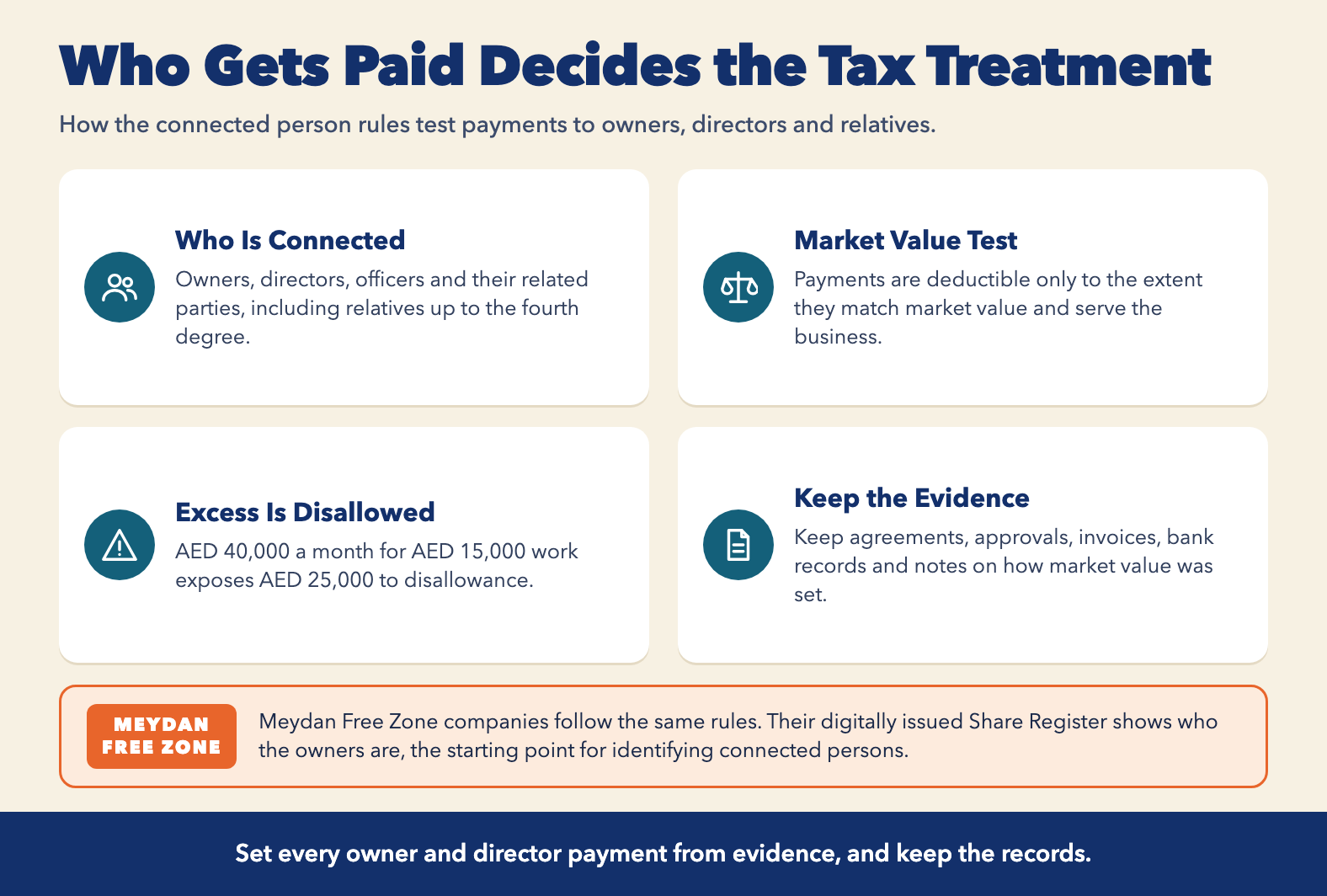
Under UAE Corporate Tax, a connected person is an owner of the taxable person, a director or officer, or a related party of either, which includes relatives. The label matters because payments to them face extra tests. Deductions are limited to amounts that match market value and are incurred wholly and exclusively for the business.
Who Falls Within the Definition
Article 36 of Federal Decree-Law No. 47 of 2022 sets the core categories. An owner is any natural person who directly or indirectly holds an ownership interest in the company, or controls it, whatever the percentage. Directors and officers are covered too. So are their related parties, such as relatives up to the fourth degree of kinship and companies they own 50% or more of or control.
Say a founder holds 100% of a Meydan Free Zone company and acts as its sole director. That person sits in two connected categories at once.
Why the Label Changes the Tax Treatment
Payments to a connected person are deductible only to the extent they match the market value of what was provided and serve the business. The excess can be disallowed when you calculate taxable income. Under Article 36, the rule does not apply to companies listed on a recognised stock exchange or to those under the regulatory oversight of a UAE competent authority.
Illustratively, a company pays its director AED 40,000 a month for work a market hire would cost AED 15,000. The AED 25,000 difference is exposed to disallowance. For wider context, see UAE corporate tax explained.
Connected Persons vs Related Parties
Related parties cover wider relationships such as group companies and shared control. Connected persons are a narrower set tied to ownership, directorship and family. Both fall under the arm's length principle, but connected person payments carry a specific deduction rule for owners, directors and relatives.
Where the Two Terms Overlap
Many owners and directors are also related parties, so both rules can apply to one payment. A shareholder's holding company lending to the operating company is a related party transaction. A salary to the shareholder's spouse is a connected person payment.
Common Payments to Owners and Directors and How They Are Treated
| Payment Type | Key Test or Risk |
|---|---|
| Owner or director salary | Must match services performed and market pay for the role |
| Director fees | Needs board or shareholder approval on record |
| Loans to shareholders | Interest-free or below-market terms draw scrutiny |
| Personal expenses paid by the company | Non-deductible unless recharged or treated as a benefit |
| Payments to relatives | Needs a genuine role, evidence of work and market-level pay |
Why Founders Confuse Them
Both use market value as the test, so they look identical. Documentation duties differ, though. A founder who papers a group loan but leaves a relative's consulting fee undocumented has a gap the FTA can find.
Payments to Owners and Directors the FTA Will Examine
The FTA looks closely at salaries, director fees, bonuses, loans, benefits in kind and expense reimbursements paid to owners and directors. Each must serve a business purpose, be supported by records and match what an unrelated party would accept.
Salaries, Director Fees and Bonuses
- Pay must relate to services actually performed.
- Amounts must match market rates for the role.
- Director fees need approval on record.
- Excess amounts risk disallowance.
A consulting company paying its owner-director a fixed salary, backed by a signed employment agreement and a role description, is on solid ground.
Loans, Drawings and Personal Expenses
- Interest-free or below-market loans to owners attract scrutiny.
- Personal costs need to be recharged or treated as a benefit.
- Reconcile owner current accounts every month.
A family holiday paid from the company account and booked as a business expense is a non-deductible personal cost.
Payments to Relatives
A relative on the payroll needs a genuine role, evidence of work and market-level pay. Fees paid to a relative's company face the same test. A spouse paid for bookkeeping should have monthly invoices and deliverables on file. Getting this wrong adds to the penalties for non-compliance in the UAE.
Arm's Length Standard and Market Value
The arm's length standard asks whether independent parties would have agreed the same price and terms. For Corporate Tax purposes, you show this by comparing market rates, keeping invoices and agreements, and recording why the amount was set.
How to Support a Market Value Figure
Use salary surveys, comparable quotes or invoices from unrelated suppliers. Record the basis at the time of the decision, not at filing. A founder who collects three quotes for management services before setting the director's fee has a defensible figure.
When Transfer Pricing Documentation Applies
Related party and connected person transactions may need to be reported in a transfer pricing disclosure form filed with the Corporate Tax return. Only larger businesses must keep a Master File and Local File. The thresholds are revenue of AED 200 million or more, or group revenue of at least AED 3.15 billion (Ministerial Decision No. 97 of 2023). Check the current FTA guidance for your case.
Documents to Keep for Owner and Director Payments
Keep a written agreement, approval records, invoices or payslips, proof of services and bank records for every payment to a connected person. These let you support the deduction if the FTA reviews the return.
- A service agreement stating role, scope and amount.
- A signed shareholder or board resolution.
- Invoices, timesheets or deliverables.
- Bank transfers matching the invoiced amount.
- Notes on how market value was set.
Keep records for seven years after the end of the tax period they relate to, as the Corporate Tax Law requires. Store them so you can produce them on request. A digital folder for each financial year works well. Review each agreement annually.
What This Means for Meydan Free Zone Companies
A Meydan Free Zone company is subject to the same connected person rules as any UAE taxable person. Qualifying Free Zone Person status does not remove them. Payments to owners and directors still need market pricing and records.
Qualifying Free Zone Person Status and Connected Payments
Qualifying income is taxed at 0% only when the conditions are met, and other taxable income is taxed at 9%. A Meydan Free Zone trading company that pays its owner a fee must still show market value. See qualifying vs non-qualifying income for how the two categories work.
Record-Keeping Through mAccounting
mAccounting, part of Meydan Plus, offers bookkeeping, VAT registration support and Corporate Tax support. Clean bookkeeping keeps owner drawings, salary and expense claims separate. Meydan Free Zone issues the Business License, Certificate of Formation, Share Register and Memorandum and Articles of Association digitally. These documents show who owns the company, which is the starting point for identifying connected persons.
Free Business Setup Cost Calculator
Calculate NowNext Steps for Founders
The connected person rules turn on who receives the payment. Owners, directors and relatives face a market value test, so execution matters more than theory: set the amount from evidence, sign the agreement, approve it and keep the records.
Review every payment made to owners, directors and relatives this year. Check each against market value and documentation, and fix gaps before filing the return. For a Meydan Free Zone company, the digitally issued Share Register is a practical place to start, because it shows who the owners are.
Ready to Launch Your Business in Dubai?
Let's ConnectReferences
- Federal Tax Authority (FTA), UAE: Corporate Tax guidance on connected persons and related parties.