

Table of Contents
Frequently Asked Questions
Can a non-resident open a corporate bank account in the UAE without visiting?
Banks set their own onboarding rules, so this depends on the bank and the company profile. Some banks complete parts of the process through video or compliance calls, while others may ask for an in-person meeting. A digitally issued Business License, Certificate of Formation, Share Register and Memorandum and Articles of Association from Meydan Free Zone lets you share company documents with a bank without waiting for couriered copies.
Do I need a residence visa to bank a free zone company in Dubai?
It depends on the bank. Some banks onboard companies whose owners live abroad, while others need the authorised signatory to hold a UAE residence visa and Emirates ID before they activate the account. Banks also focus on ownership, business activity and source of funds. Confirm the bank's residency rules before you apply.
Which documents from abroad need attestation for a UAE bank application?
Documents issued outside the UAE, such as corporate records of a foreign shareholder, usually need notarisation and attestation. Personal documents such as proof of residential address may also need to be notarised or attested, depending on the bank.
Can a bank reject a company even if the trade license is valid?
Yes. A license confirms the company exists, but each bank makes its own compliance and risk decision. Common causes of rejection include unclear ownership, vague business activity, unexplained source of funds, high-risk counterparties and inconsistent documents. Matching license activities to the real business reduces this risk.
Is there a minimum balance for a non-resident company account?
Minimum balances are set by each bank, not by law, and they vary by bank and account type. Some banks also charge monthly maintenance fees or low-balance penalties. Compare fee schedules before applying and treat any quoted figure as indicative until the bank confirms it in writing.
Does a guaranteed IBAN mean the bank account is approved?
No. Meydan Free Zone describes a guaranteed IBAN once the license is issued, but account approval remains subject to the chosen bank's own policies and due diligence. The bank still completes its own Know Your Customer checks and decides whether to open the account. Through mCore, Meydan Free Zone provides business bank account support, but the final decision stays with the bank.
Who regulates banks that open accounts for foreign-owned companies?
The Central Bank of the UAE supervises licensed banks and sets the anti-money laundering framework they follow. Each bank then applies its own risk appetite, so two banks can reach different decisions on the same company. Free zone authorities issue the license but do not approve bank accounts.
Topic Summary
What a Corporate Bank Account for Non-Residents Involves
A non-resident corporate bank account is a business account held by a UAE company whose owners or directors live outside the UAE. The account belongs to the company, not the individual. Banks regulated by the Central Bank of the UAE verify the entity, its owners and its business model before approval.
What Banks Assess Before Approving a Non-Resident Company
Banks run customer due diligence on the company, its shareholders and its ultimate beneficial owners (UBOs). They review the business activity, source of funds, expected transaction volumes and counterparties. A coherent trade profile and transparent ownership matter in every review, alongside the bank's own residency rules.
Documents Banks Ask Non-Resident Founders to Provide
Banks typically request the Business License, Certificate of Formation, Memorandum and Articles of Association, Share Register, passports for all shareholders and directors, proof of address, and a business plan. Documents issued abroad usually need notarisation and attestation. The exact list differs by bank.
How to Open a Corporate Account as a Non-Resident Step by Step
Incorporate the company, prepare the documents, choose banks that fit your trade profile, submit with a clear business plan, complete the compliance interview and fund the account. Sequence matters because banks review the company before the founder. Preparation pays off at every stage.
How Meydan Free Zone Supports Bank Account Applications
Meydan Free Zone issues the Business License, Certificate of Formation, Share Register and Memorandum and Articles of Association digitally. Through mCore, part of Meydan Plus, it provides business bank account support. That doesn't guarantee approval, because each bank makes its own credit and compliance decision on a free zone company bank account.
Costs and Compliance Points to Plan For
Plan for bank-set minimum balances, maintenance fees, transfer charges and possible dormancy or low-balance penalties. These vary by bank and aren't fixed by law. Banks also expect ongoing compliance, such as Corporate Tax registration, after the account opens.
Why Non-Resident Applications Get Rejected and How to Avoid It
Rejections usually come from unclear ownership, vague business activity, unexplained source of funds, high-risk counterparties or inconsistent documents. Applications go more smoothly when you keep the structure simple and present a coherent file the first time.
Corporate Bank Account for Non-Residents in the UAE
A UAE company with owners abroad still needs a corporate account to invoice clients, pay suppliers and keep tax records clean. Founders often ask whether a trade license is enough, or whether they must hold a residence visa first. The answer depends on the bank, which assesses the people, structure and trade flows behind the company and sets its own residency rules. This guide covers that assessment, the documents, the sequence and the costs to plan for.
What a Corporate Bank Account for Non-Residents Involves
A non-resident corporate bank account is a business account held by a UAE company whose owners or directors live outside the UAE. The account belongs to the company, not the individual. Banks regulated by the Central Bank of the UAE verify the entity, its owners and its business model before approval.
Company Account Versus Personal Account
The company is the account holder, but banks still verify the people who own and run it. Some banks onboard companies whose owners live abroad, while others need the authorised signatory to hold a UAE residence visa and Emirates ID before they activate the account.
Take a UK consultant who incorporates a free zone company from abroad. Whether she can open the account remotely, or only after obtaining a residence visa, depends on the bank she chooses. For personal banking options, see this guide to a bank account in Dubai for foreigners.
Who Regulates Banks and Account Opening
The Central Bank of the UAE supervises licensed banks and sets anti-money laundering expectations. Each bank then applies its own risk appetite. Two banks can review the same Meydan Free Zone company and reach different decisions. Free zone authorities issue the license, but they don't approve bank accounts.
What Banks Assess Before Approving a Non-Resident Company
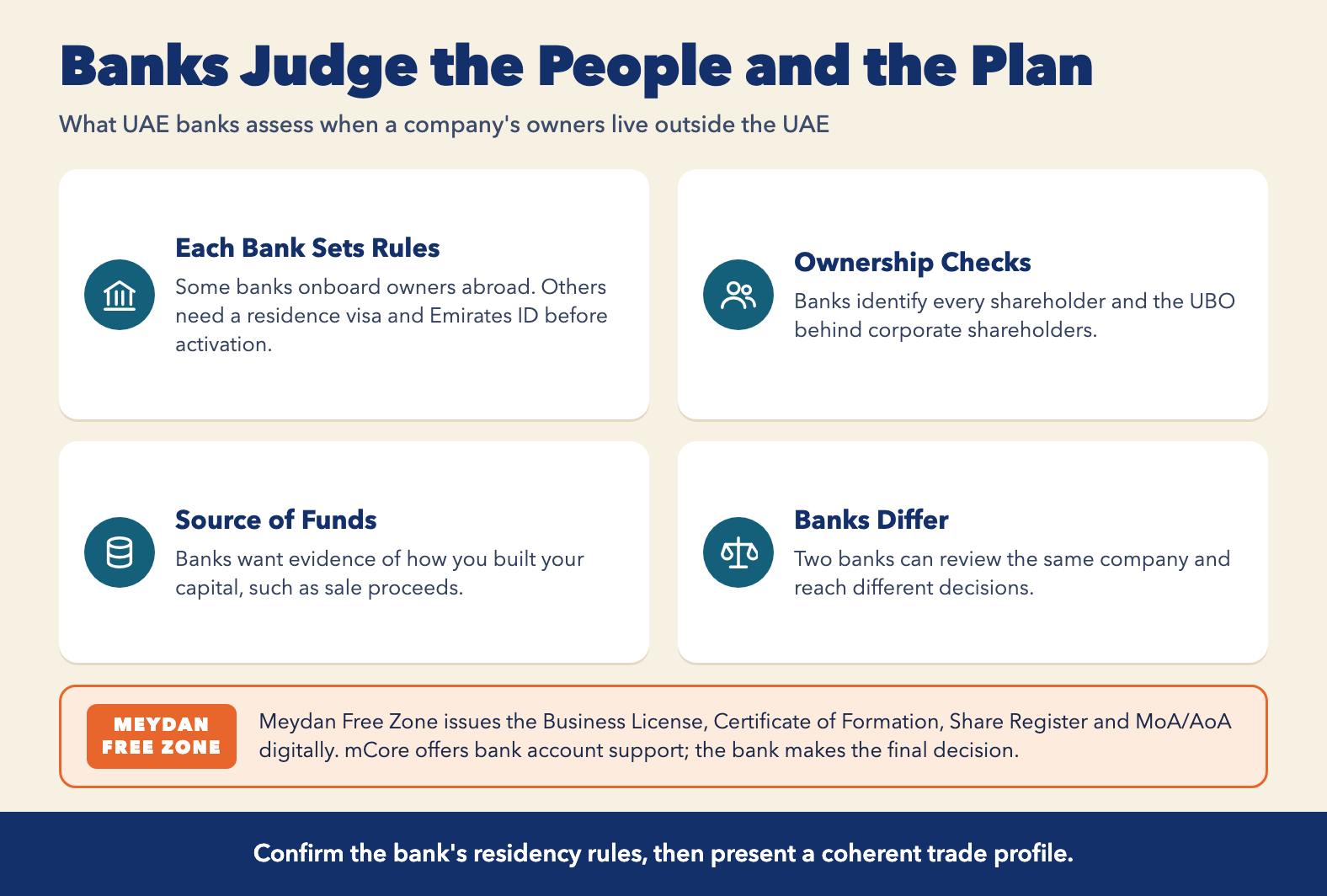
Banks run customer due diligence on the company, its shareholders and its ultimate beneficial owners (UBOs). They review the business activity, source of funds, expected transaction volumes and counterparties. A coherent trade profile and transparent ownership matter in every review, alongside the bank's own residency rules.
Ownership and Beneficial Owner Checks
- Banks identify every shareholder and the UBO behind corporate shareholders.
- Layered holding structures lengthen review time.
- Politically exposed persons face enhanced checks.
- A founder holding shares through an offshore entity should expect requests for the full ownership chain.
Documents Banks Commonly Request From Non-Resident Founders
| Document | Purpose |
|---|---|
| Business License and Certificate of Formation | Confirms the company exists and its licensed activities |
| Memorandum and Articles of Association and Share Register | Shows shareholders, share split and company governance |
| Passports of shareholders and directors | Verifies the identity of every owner and signatory |
| Proof of residential address | Confirms where each owner lives, usually via a recent utility bill |
| Business plan and source of funds evidence | Explains the trade model and how starting capital was built |
Business Activity and Trade Profile
License activities must match the real business. Banks ask for customers, suppliers and target markets, and vague descriptions trigger delays. A trading company that lists suppliers in Turkey and buyers in East Africa, backed by sample invoices, gives a reviewer something concrete.
Source of Funds and Wealth
Banks want evidence of how you built your capital, such as sale proceeds or prior business income. Initial deposit expectations vary by bank. A founder who supplies financial statements from a prior business sale answers the question before it's asked. Inconsistent explanations are a common cause of rejection.
Documents Banks Ask Non-Resident Founders to Provide
Banks typically request the Business License, Certificate of Formation, Memorandum and Articles of Association, Share Register, passports for all shareholders and directors, proof of address, and a business plan. Documents issued abroad usually need notarisation and attestation. The exact list differs by bank.
Company Documents Issued in the UAE
- Meydan Free Zone issues the Business License, Certificate of Formation, Share Register and Memorandum and Articles of Association digitally.
- Lease or workspace documentation.
- A board resolution authorising account opening.
A founder can download the digital set and forward it to the bank without waiting for paper copies.
Personal and Supporting Documents From Abroad
- Passport copies and proof of residential address from your home country.
- Professional references or bank reference letters where requested.
- Notarisation and attestation for foreign-issued corporate documents.
- Some banks also require a UAE residence visa and Emirates ID for the signatory before they activate the account.
A German shareholder, for example, might submit a notarised utility bill and a reference letter from a home-country bank.
How to Open a Corporate Account as a Non-Resident Step by Step
Incorporate the company, prepare the documents, choose banks that fit your trade profile, submit with a clear business plan, complete the compliance interview and fund the account. Sequence matters because banks review the company before the founder. Preparation pays off at every stage.
Step 1: Set Up the Company With a Bankable Structure
- Choose activities that match the real business.
- Keep the shareholding simple. This guide on a free zone company structure for easy bank opening explains why.
- Register digitally before approaching banks. Fawri, Meydan Free Zone's digital licensing solution for single-shareholder companies, issues a Business License in under 60 minutes.
Step 2: Prepare the Bank File
- Business plan, trade flow summary and source of funds evidence.
- Attested documents ready before submission.
- Consistent figures across every document.
- A one-page trade profile listing buyers, suppliers and expected monthly volumes works well for traders.
Step 3: Submit, Respond and Fund
- Answer bank queries quickly and consistently.
- Expect a compliance call, a video interview or an in-person meeting, depending on the bank.
- Fund the account and maintain the activity you described.
How Meydan Free Zone Supports Bank Account Applications
Meydan Free Zone issues the Business License, Certificate of Formation, Share Register and Memorandum and Articles of Association digitally. Through mCore, part of Meydan Plus, it provides business bank account support. That doesn't guarantee approval, because each bank makes its own credit and compliance decision on a free zone company bank account.
Digital Documents Banks Can Review Quickly
Digital issuance removes courier delays for founders abroad, and the documents arrive in a format banks recognise. A founder overseas can share the file with a bank the same day the company is registered.
What mCore Covers
mCore covers business bank account support, the Company Stamp, Business Card and E-commerce Starter. Meydan Free Zone describes a guaranteed IBAN once the license is issued, but account approval remains subject to the chosen bank's own policies and due diligence. A founder might use mCore to prepare the application alongside company stamps.
Essential Services for Entrepreneurs and Startups
Explore mCoreCosts and Compliance Points to Plan For
Plan for bank-set minimum balances, maintenance fees, transfer charges and possible dormancy or low-balance penalties. These vary by bank and aren't fixed by law. Banks also expect ongoing compliance, such as Corporate Tax registration, after the account opens.
Bank Fees and Balance Requirements
Treat any figure you see as indicative, since each bank sets its own. Compare fee schedules before applying. One bank may charge a recurring fee for low balances while another doesn't. The Cost Calculator shows the licensing side of running costs.
Ongoing Tax and Reporting Duties
Corporate Tax registration is handled through the Federal Tax Authority. Banks may ask for tax registration details and updated financial statements during periodic reviews. mAccounting offers bookkeeping, VAT registration support and Corporate Tax support.
Why Non-Resident Applications Get Rejected and How to Avoid It
Rejections usually come from unclear ownership, vague business activity, unexplained source of funds, high-risk counterparties or inconsistent documents. Applications go more smoothly when you keep the structure simple and present a coherent file the first time.
Common Causes of Rejection
- Complex holding structures without clear explanation.
- Mismatch between license activity and described trade, such as consulting on the license but commodity trading in the bank interview.
- Counterparties in high-risk jurisdictions without supporting evidence.
What to Do After a Decline
Ask the bank which gap triggered the decision, if it is willing to say. Correct the file before applying elsewhere, and avoid parallel applications with differing details. A founder who revises the trade profile and reapplies to a bank whose appetite fits the sector improves the odds. More detail is in this guide to business bank account rejection in the UAE.
Conclusion
A corporate account for a non-resident-owned company depends on structure, documentation and a credible trade profile, and on each bank's own residency rules. Define your trade profile and ownership structure first, then confirm what your chosen bank needs. With Meydan Free Zone, mCore offers bank account support, but the bank still makes the final decision.
Ready to Launch Your Business in Dubai?
Let's Connect