Table of Contents
Frequently Asked Questions
Can a newly licensed company get a corporate credit card in the UAE?
It is possible, but approval is not automatic. Banks treat a card limit as a separate credit decision. A company with little trading history is often offered a low limit, or asked for a personal guarantee from the owner. Consistent turnover through the corporate account usually improves the limit over time.
Do banks ask for a personal guarantee on company cards?
Many banks do, particularly for newer companies with limited financial records. Each bank sets its own criteria, so requirements differ. Some rely on account turnover instead of a guarantee. Check the guarantee terms before applying, because late repayment can affect the guarantor's personal credit record.
Which documents do banks usually ask for when issuing a company card?
Banks typically ask for the trade license, Certificate of Formation, Memorandum and Articles of Association, and the signatory's passport and Emirates ID. They also request recent corporate bank statements and a completed application form. Some add financial statements, a workspace agreement, or attested overseas documents. Meydan Free Zone issues the Business License, Certificate of Formation, Share Register and Memorandum and Articles of Association digitally.
Is a corporate bank account required before a card can be issued?
In most cases, yes. Banks generally assess a card request against an active corporate account and its activity. Meydan Free Zone offers business bank account support through mCore, part of Meydan Plus. This helps put the account in place first, though it does not guarantee approval.
Can a non-resident owner hold a company credit card?
It is harder. Banks generally find resident signatories with an Emirates ID easier to assess, and may ask a non-resident owner to nominate one. mResidency, within Meydan Free Zone's Meydan Plus, covers residence visa services, including the medical test and Emirates ID. Visa services are priced separately from the license.
Are company card expenses deductible for Corporate Tax?
Card spend can support a deduction only if it is incurred for business purposes and properly documented. Keep invoices and receipts for every transaction, and separate owner and company expenses. The Federal Tax Authority administers Corporate Tax, and a missing receipt can weaken a deduction at year-end.
What is the difference between a charge card and a credit card for a company?
A credit card allows a revolving balance, with interest charged on unpaid amounts. A charge card requires full repayment each billing cycle. Prepaid cards are a third option, suited to controlled team spending because they need no credit approval.
Does a Meydan Free Zone license guarantee card approval?
No. A free zone license gives a bank a clear corporate identity, but the bank still assesses activity, ownership, residency and account behaviour independently. Card limits are the bank's own credit decision, within the credit regulation set by the Central Bank of the UAE.
Topic Summary
What a Business Credit Card in the UAE Is
A business credit card in the UAE is a revolving credit line issued by a bank to a licensed company, or to its owner on the company's behalf. It covers business spending, carries a limit set by the bank's credit assessment, and is billed monthly with interest on unpaid balances.
Who Qualifies for a Company Credit Card
Banks usually require a valid trade license, an active corporate account, resident signatories with an Emirates ID, and proof of company activity. Newer companies often need a trading history or a personal guarantee. Each bank sets its own criteria, so approval is never automatic.
Documents Banks Ask For
Typical documents include the trade license, Certificate of Formation, Memorandum and Articles of Association, the signatory's passport and Emirates ID, recent bank statements and the bank's form. Some banks also ask for financial statements, a workspace agreement, and notarisation of foreign documents.
How to Apply for a Corporate Card in the UAE
To apply, confirm your license and account are active, compare terms, prepare documents, submit the bank's form, complete credit and Know Your Customer (KYC) checks, then activate the card. Timelines and outcomes vary by bank and company profile.
Costs, Limits and Compliance Risks to Plan For
A company credit card usually carries an annual fee, interest on unpaid balances, and charges for cash advances or foreign-currency spend. Fees are set by each bank, so treat them as a recurring cost. Card spend must also be recorded properly for Corporate Tax and VAT.
How a Free Zone Structure Affects Card Approval
A free zone license gives banks a clear corporate identity, but it doesn't secure approval. Banks assess activity, ownership, residency and account behaviour independently. Meydan Free Zone's mCore, part of Meydan Plus, includes business bank account support, which helps founders set up the corporate account before a card request.
Conclusion
A company credit card in the UAE is the bank's credit decision, not a licensing benefit. Companies with a current license, an active account, clean records and resident signatories typically secure workable limits. With Meydan Free Zone, the Business License, Certificate of Formation and Share Register are issued digitally, so the core document set is ready when the bank asks.
Corporate Card for a UAE Company: Eligibility and Application Process
Most founders assume a company credit card follows automatically once the trade license is issued and the account is open. It doesn't: banks treat a card limit as a separate credit decision, and new companies often need a trading record or a personal guarantee first.
This guide covers who qualifies, which documents banks ask for, how the application runs and what it costs, plus how a Meydan Free Zone company can prepare its paperwork before it applies.
What a Business Credit Card in the UAE Is
A business credit card in the UAE is a revolving credit line issued by a bank to a licensed company, or to its owner on the company's behalf. It covers business spending, carries a limit set by the bank's credit assessment, and is billed monthly with interest on unpaid balances.
Corporate Cards Versus Personal Cards Used for Business
A corporate card is assessed on the company's license and financials. A personal card is tied to individual income. Some banks issue company cards against an owner guarantee, others rely on account turnover.
Say a consultancy owner pays for software and flights on a personal card. At year-end, they spend hours separating those costs for Corporate Tax records.
Corporate and Personal Cards Side by Side
| Feature | Corporate card | Personal card used for business |
|---|---|---|
| Credit assessment basis | License, company financials and account turnover | Owner's salary or personal income |
| Expense separation and bookkeeping | Statements contain only company spend | Business and personal items mixed on one statement |
| Spending controls for staff | Supplementary cards with set limits | Staff use the owner's card, with no separate limits |
| Liability for repayment | Company, sometimes with an owner guarantee | The individual cardholder alone |
| Suitability for tax records | Clean trail for Corporate Tax and VAT claims | Costly to reconcile and harder to defend |
Credit, Charge and Prepaid Business Cards
- Credit cards allow revolving balances with interest.
- Charge cards require full repayment each cycle.
- Prepaid cards need no credit approval. A trading company might issue two to sales staff with fixed travel top-ups.
For startup-specific options, see the guide to best business credit cards for startups in the UAE.
Who Qualifies for a Company Credit Card
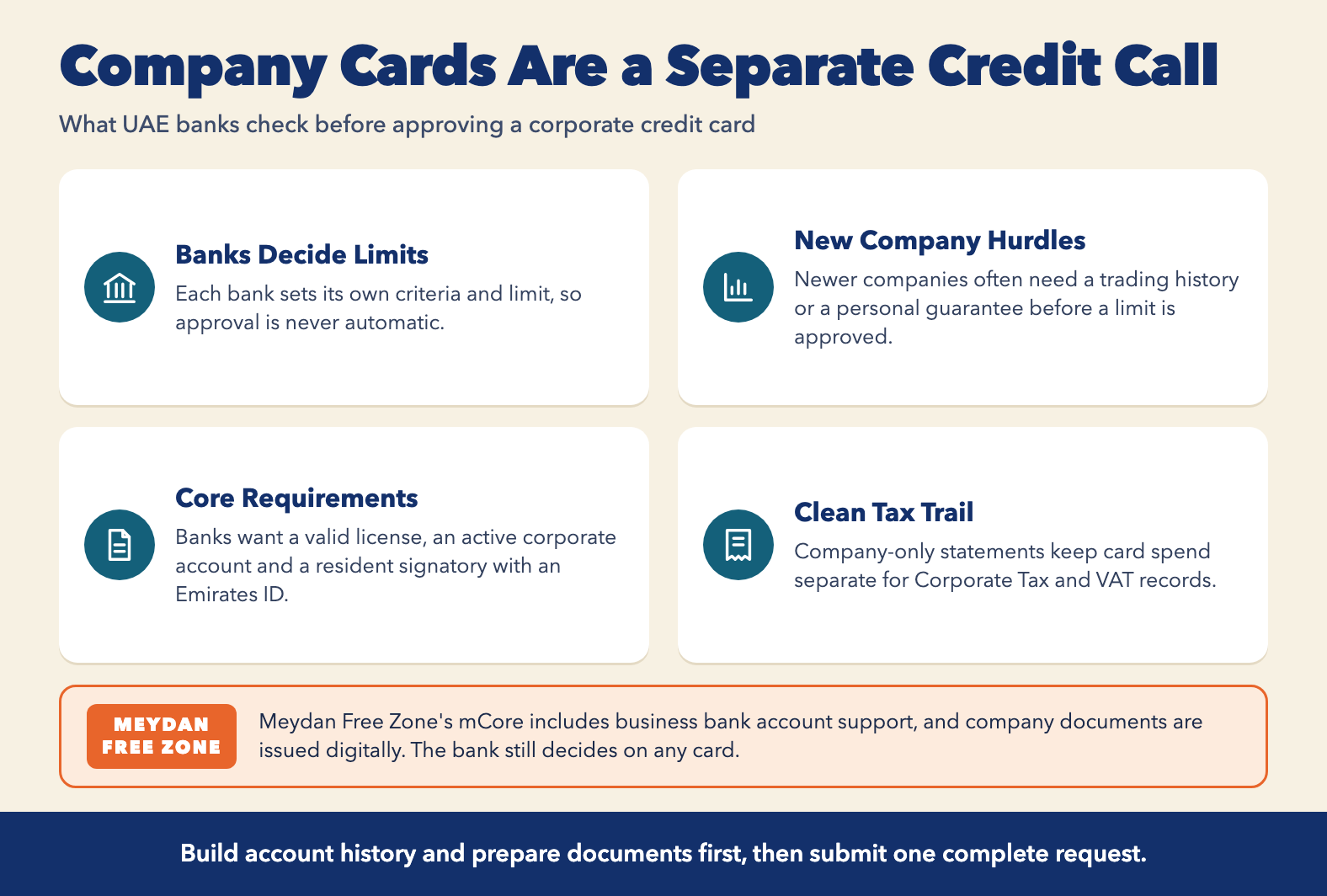
Banks usually require a valid trade license, an active corporate account, resident signatories with an Emirates ID, and proof of company activity. Newer companies often need a trading history or a personal guarantee. Each bank sets its own criteria, so approval is never automatic.
Core Eligibility Criteria Banks Apply
- A license whose activities match actual operations.
- A corporate account, often with a minimum period of operation.
- A resident signatory with an Emirates ID and a clean credit record.
The Central Bank of the UAE regulates credit, but limits are each bank's own decision. A six-month-old e-commerce company, for example, might be offered a low limit secured by the owner's guarantee.
Why New Companies Face Lower Limits
Limited history means limited evidence of repayment capacity. Banks weigh account inflows, customer base and sector risk. A startup that routes client payments through its account for several months is in a stronger position to request an increase. If you've been declined before, read why business bank account applications get rejected.
Documents Banks Ask For
Typical documents include the trade license, Certificate of Formation, Memorandum and Articles of Association, the signatory's passport and Emirates ID, recent bank statements and the bank's form. Some banks also ask for financial statements, a workspace agreement, and notarisation of foreign documents.
Company and Ownership Documents
- Business License, Certificate of Formation, Share Register and Memorandum and Articles of Association, issued digitally by Meydan Free Zone.
- Shareholder and beneficial owner details.
- Notarisation or attestation for overseas documents.
Prepare one folder and reuse it across every bank request.
Financial and Activity Evidence
Provide six months of statements where available, plus invoices or contracts supporting your activity. Keep the activity description identical across license, website and bank form. If invoices don't match the licensed activity, the bank may query them and the request can stall.
How to Apply for a Corporate Card in the UAE
To apply, confirm your license and account are active, compare terms, prepare documents, submit the bank's form, complete credit and Know Your Customer (KYC) checks, then activate the card. Timelines and outcomes vary by bank and company profile.
Step 1: Confirm Your Account and Company Standing
- Check the license is current and the account is active.
- Make sure activity descriptions match real operations.
- Wait until first client payments have cleared through the account.
Step 2: Compare Card Terms Across Banks
- Compare annual fees, interest rates, limits and rewards.
- Ask whether a personal guarantee is required.
- Treat published figures as indicative until the bank confirms them.
Two banks may offer similar limits while only one waives the annual fee against minimum spend. For bank selection, read how to choose the right bank for your startup.
Step 3: Submit and Complete Credit Checks
- Submit documents with the signed form.
- Expect questions on source of funds and expected spend.
- Answer follow-ups quickly. A bank may ask for a supplier contract before releasing a limit.
Step 4: Activate the Card and Set Internal Controls
- Set rules for who spends and on what.
- Reconcile card statements against receipts every month.
- Review spend against invoices on a fixed date.
Costs, Limits and Compliance Risks to Plan For
A company credit card usually carries an annual fee, interest on unpaid balances, and charges for cash advances or foreign-currency spend. Fees are set by each bank, so treat them as a recurring cost. Card spend must also be recorded properly for Corporate Tax and VAT.
Fees and Interest Mechanics
- Check the annual fee, interest-free period, late charges and foreign transaction fees.
- Rely on the bank's official schedule, not marketing estimates.
- Expect limits tied to turnover and risk profile.
A company that carries a balance across cycles can find interest outweighs the rewards.
Tax Records and Spending Discipline
Keep invoices and receipts to support deductions in the Corporate Tax return filed with the Federal Tax Authority (FTA). A missing receipt for a software subscription weakens a deduction at year-end. Separate owner and company expenses. Late repayment can also affect the company's and the guarantor's credit record.
How a Free Zone Structure Affects Card Approval
A free zone license gives banks a clear corporate identity, but it doesn't secure approval. Banks assess activity, ownership, residency and account behaviour independently. Meydan Free Zone's mCore, part of Meydan Plus, includes business bank account support, which helps founders set up the corporate account before a card request.
Preparing the Corporate Account First
Card requests follow an active corporate account. mCore provides bank account support, but the bank alone decides on approval. Because company documents are issued digitally, a founder can gather them quickly and submit account and card paperwork in sequence. For account basics, see how to open a bank account in the UAE.
Residency and Signatory Considerations
Resident signatories with an Emirates ID are generally easier for banks to assess. mResidency covers residence visa services, including the medical test and Emirates ID. Visa services are priced separately from the trade license. A non-resident owner may be asked to nominate a resident signatory.
Free Business Setup Cost Calculator
Calculate NowConclusion
A company credit card in the UAE is the bank's credit decision, not a licensing benefit. Companies with a current license, an active account, clean records and resident signatories typically secure workable limits. With Meydan Free Zone, the Business License, Certificate of Formation and Share Register are issued digitally, so the core document set is ready when the bank asks.
Review your account activity and document set, shortlist banks by fees and guarantee requirements, then submit one complete request.
Ready to Launch Your Business in Dubai?
Let's ConnectReferences
- Central Bank of the UAE, credit and banking regulation
- Federal Tax Authority (FTA), UAE, Corporate Tax and VAT record-keeping