

Table of Contents
Frequently Asked Questions
When should I renew my Emirates ID?
Around 30 days before it expires. For expatriates, the Emirates ID renewal is tied to your residence visa, so you renew the card when your visa is renewed or reissued, not independently. UAE nationals can renew up to six months ahead. The ICP sends an SMS reminder when your card is due.
How much does Emirates ID renewal cost?
The card fee is AED 100 per year of validity, plus an ICP service fee of around AED 70 to 100 and a delivery charge. A two-year renewal comes to roughly AED 300 to 350 all in. An urgent express option adds around AED 150. Fees can change, so confirm with the ICP.
Do I need a medical test to renew my Emirates ID?
Usually yes, but through the visa. Because Emirates ID renewal is tied to your residence visa, and the visa renewal requires a medical fitness test for adults, you will generally complete one as part of the process. Biometrics for the ID itself are often not repeated if your data is already on file.
Is there a fine for renewing my Emirates ID late?
Guidance commonly describes a 30-day grace period after expiry, then a fine of AED 20 per day, capped at AED 1,000, which must be cleared before renewal. Because the grace period is often misunderstood, the safest approach is to renew before your card expires.
Can Meydan Free Zone handle my Emirates ID renewal?
If your residency runs through Meydan Free Zone, mResidency coordinates your residence visa renewal, and the Emirates ID that renews alongside it, managing the medical, application and new card together. The card is still issued by the ICP, but the renewal is kept on track so nothing lapses.
Topic Summary
Expats Renew the Card With Their Visa
For expatriate residents, the Emirates ID is tied to your residence visa. You cannot renew the card on its own — the renewal happens alongside your visa renewal, not as a separate process.
Start Around 30 Days Before Expiry
Residents should begin the renewal process roughly 30 days before their card expires. UAE nationals have more flexibility and can renew up to six months early. Watch for the ICP SMS reminder.
The Fee Is AED 100 Per Year of Validity
The card fee is calculated at AED 100 per year of your visa's validity, plus service and delivery charges. An urgent express option adds around AED 150 on top of the standard fee.
Apply Through ICP, GDRFA, or a Typing Centre
The renewal process runs through ICP Smart Services, the UAEICP app, or an accredited typing centre. Using UAE Pass speeds up the online route considerably and reduces re-entry of your details.
A 30-Day Grace Period Applies — But Fines Stack Up
Guidance commonly describes a 30-day grace period after expiry. After that, a fine of AED 20 per day applies, capped at AED 1,000. Any outstanding fines must be cleared before renewal can proceed.
The Card Is Delivered to Your Door
Once biometrics are complete and the application is approved, the physical Emirates ID is printed and delivered through Emirates Post — usually within a few working days of the residence visa being finalised.
Medical Tests May Be Required Again
The residence visa renewal requires a medical fitness test for adults, which is a standard part of the residency process. Biometrics for the ID itself are often not repeated if your existing data is recent and on file.
How to Renew Your Emirates ID: Step-by-Step for Residents
Your Emirates ID is the most important document you hold as a UAE resident, so letting it expire is not an option. Emirates ID renewal is mostly online and straightforward, but one thing trips residents up. For expatriates, your Emirates ID is tied to your residence visa, so you renew it when your visa is renewed, not on its own. This guide walks through Emirates ID renewal step by step: when to start, the fees, the medical test, and how to avoid late fines.
In short, you renew your Emirates ID alongside your visa, apply through the ICP, pay the fee, and receive a new card in a few days. Here is how it works.
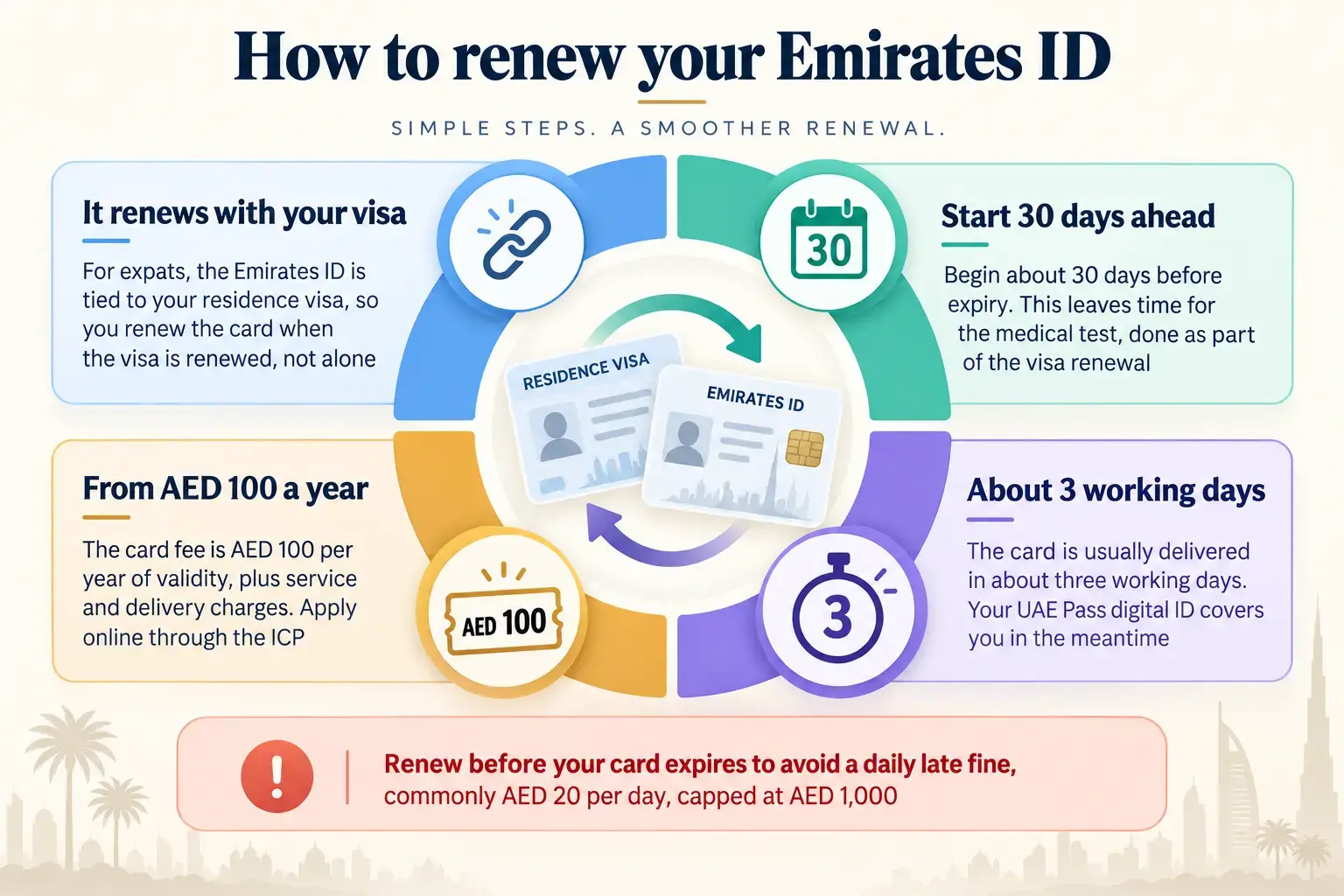
Key Facts at a Glance
When to Renew Your Emirates ID
Timing is the first thing to get right, because it is driven by your visa, not just the card. This trips up many residents.
For an expatriate resident, the Emirates ID is linked to your residence visa, so you renew the card when your visa is renewed or reissued. You cannot renew the Emirates ID on its own if your visa has not been renewed. The best time to begin is around 30 days before expiry, giving room for the medical test, processing and any delays. UAE nationals have more flexibility and can renew up to six months ahead. The ICP also sends an SMS reminder when your card is due, so watch for it.
The Step-by-Step Renewal Process
Once your visa renewal is underway, the Emirates ID renewal follows a clear, mostly digital path. Here are the steps.
- Renew your visa first, or together: For expats, the Emirates ID renewal rides on the residence visa, so this comes first or runs alongside it.
- Complete the medical fitness test: Required as part of the visa renewal for adults, at an approved centre in the UAE.
- Apply through the ICP: Use ICP Smart Services, the UAEICP app, or an accredited typing centre.
- Give biometrics if asked: Often not needed if your existing data is recent, but the ICP may request an update.
- Pay the fees: Settle the renewal fee, plus any late fine, online or at the centre.
- Receive your card: It is delivered by Emirates Post, usually within a few working days.
Signing in with UAE Pass speeds the online route, as it pre-fills your details.
Do You Need a Medical Test Again?
A common question is whether the medical fitness test is needed at renewal. For most residents, the answer is yes, but through the visa.
Emirates ID renewal is tied to your residence visa, and the visa renewal requires a medical fitness test for adults. So you generally complete a medical as part of the process. It involves a blood test and chest X-ray at an approved centre. The results are valid only briefly, so time it close to your application. Biometrics for the ID itself are usually not repeated if your fingerprints and photo are already on file.
What Emirates ID Renewal Costs
The fees for Emirates ID renewal are set by the ICP and depend on how long your card will be valid. Here is the breakdown.
A two-year renewal comes to roughly AED 300 to 350 all in, while a one-year card is less. An urgent express option costs around AED 150 more, issuing the card in a couple of working days. Fees can change, so confirm the current amounts with the ICP before paying.
The Grace Period and Late Fines
This is the part that costs residents money, so it is worth being clear, though the rules are often misunderstood. Renewing on time avoids all of it.
Guidance most commonly describes a 30-day grace period after expiry, after which a late fine of AED 20 per day applies, capped at AED 1,000. Any fine must be cleared before the renewal can be completed. Because interpretations of the grace period vary, the safest approach is to renew before your card expires, ideally 30 days ahead. Beyond the fine, an expired Emirates ID can cause friction at banks, tenancy renewals and other checks, so there is little upside to leaving it.
How Long It Takes
Timing on the card itself is quick, especially online. Most renewals are now fully digital.
Once your application and payment are in, the standard card is usually delivered within about three working days by Emirates Post. Most renewals are completed entirely online, with no need to visit a centre unless biometrics are requested. If you need the card faster, the urgent express service issues it within a couple of working days. In the meantime, your digital Emirates ID in the UAE Pass app is accepted by most services, so you keep proof of identity.
How Meydan Free Zone Fits In
Because your Emirates ID renews alongside your residence visa, this is a step Meydan Free Zone can handle for you, through mResidency, just as it does when the visa is first issued.
- Renewal handled with your visa: mResidency coordinates your residence visa renewal, and the Emirates ID that renews with it, managing the medical, the application and the new card in one process.
- Deadlines tracked: Renewal timelines are managed through your portal, so the process starts in good time rather than slipping past expiry.
- The same support as issuance: The visa, medical and Emirates ID are handled end to end at renewal, the same way they were when you first set up.
So while the Emirates ID card itself is issued by the ICP, Meydan Free Zone keeps the visa-and-ID renewal on track, so nothing lapses.
Conclusion
Emirates ID renewal is straightforward once you know the key rule. For expatriates, the card renews with your residence visa, not on its own. Start around 30 days before expiry, complete the medical with the visa renewal, apply through the ICP, and pay from AED 100 per year of validity. Your new card arrives in about three working days.
Renew before your Emirates ID expires to avoid the daily late fine. Use your UAE Pass digital ID in the meantime, and confirm the current fees with the ICP before you pay. And if your residency runs through Meydan Free Zone, mResidency can handle the visa-and-ID renewal together, so nothing slips past its deadline.