

Table of Contents
Frequently Asked Questions
Who gets paid first when a company is liquidated in the UAE?
Liquidation costs and secured creditors are paid first. Secured creditors, such as banks holding a pledge or mortgage, recover from the asset that secures their debt. Privileged debts, such as employee dues and government liabilities, come next, then unsecured creditors. Shareholders receive funds only after every valid claim is settled.
Are employee salaries and end-of-service dues paid before suppliers?
Yes. Unpaid salaries and end-of-service gratuity are priority claims and are cleared before trade suppliers. Private-sector employment is governed by Federal Decree-Law No. 33 of 2021. For a Meydan Free Zone company, staff dues are settled as part of the closure process before the license is cancelled.
What happens if a creditor submits a claim after the notice period?
A late claim is harder to recover once distribution has started. The liquidator may still consider it if funds remain, but is not obliged to reopen payments already made. Creditors should submit written claims with supporting documents within the period stated in the notice.
Can a founder be personally liable for company debts after liquidation?
Yes, in certain situations. Personal guarantees and post-dated cheques signed by a founder survive the company's closure. Preferential payments to friendly creditors or transfers of assets to related parties can also be challenged and lead to claims against the founder or manager.
Does cancelling a trade license cancel the company's debts?
No. Cancelling a license ends the right to trade, not the company's obligations. Creditors keep their claims, and the liquidator must settle them in the legal order of priority. Founders should settle or resolve debts before cancellation, not after.
Do tax liabilities have to be cleared before a company can be deregistered?
Yes. VAT and Corporate Tax balances owed to the Federal Tax Authority must be settled or reconciled before deregistration can be completed. An unfiled final VAT return, for example, holds up the process until the liability is resolved.
Can a creditor challenge the liquidator's decision on a claim?
Yes. A liquidator can admit, reject or partly admit a claim. A creditor whose claim is rejected can take the dispute to the courts. Contingent claims, such as pending refunds, may lead the liquidator to hold a reserve and delay the final distribution.
Do free zone companies follow the same creditor priority as other UAE companies?
Creditor rights come mainly from federal law, so the priority of claims is generally the same for a free zone company. The free zone authority manages the closure workflow and license cancellation. For a Meydan Free Zone company, Meydan Free Zone handles license cancellation but does not decide creditor priority.
Topic Summary
What Creditor Claims Mean in a UAE Liquidation
A creditor claim is a formal demand for money a company owes when it begins winding up. In a UAE liquidation, the liquidator collects these claims, checks them against company records, and pays valid debts from company assets in the order the law sets.
How a UAE Liquidation Handles Creditors
The liquidator takes control of company assets, notifies creditors, checks claims, settles debts in legal priority, and distributes any surplus to shareholders. The company can't trade normally during this period. The liquidator acts for the company, not for the founders.
Order of Payment in a UAE Liquidation
Creditors are generally paid in priority order: liquidation costs and secured creditors first, then privileged debts such as employee dues and government liabilities, then unsecured creditors. Shareholders are paid only after every valid claim is settled in full. The exact ranking depends on the governing law and the claim type, so confirm it with a legal adviser.
Timelines for Creditor Claims in a UAE Liquidation
Timelines depend on the company's assets, the number of creditors and any disputes. Free zone companies follow their licensing authority's closure requirements alongside federal law. No single fixed duration applies.
How Liquidation Works for a Meydan Free Zone Company
A Meydan Free Zone company still owes creditors in the same priority order. Federal law governs the debts, while Meydan Free Zone handles license cancellation. Its mAccounting pillar covers bookkeeping, VAT registration support and Corporate Tax support, which helps keep the records a liquidation depends on. The wider closure route is outlined in liquidating a free zone company.
Mistakes That Create Personal Liability for Founders
The most common mistakes are paying friendly creditors first, cancelling the license before settling debts, ignoring tax filings, and leaving personal guarantees unaddressed. Each can lead to a claim against the founder or manager personally, even after closure.
Conclusion
A UAE liquidation rewards preparation. Creditor claims follow a legal order, with costs and secured debts first, privileged debts such as employee dues and tax next, and unsecured creditors and shareholders last. Founders who keep accurate records and settle in sequence close cleanly. Those who improvise carry the exposure personally.
Creditor Claims in a UAE Liquidation: Order and Timelines
When a company winds down, the hardest question is rarely how to close the license. It's who gets paid first, and what happens when the money runs short. Cancelling the license does not end a founder's exposure to company debts. This guide explains how creditor claims work in a UAE liquidation, the usual order of payment and the timelines to plan around.
What Creditor Claims Mean in a UAE Liquidation
A creditor claim is a formal demand for money a company owes when it begins winding up. In a UAE liquidation, the liquidator collects these claims, checks them against company records, and pays valid debts from company assets in the order the law sets.
What Counts as a Creditor Claim
Any sum the company owes qualifies: suppliers, landlords, lenders, employees, tax authorities, and customers holding refunds or deposits. Each claim needs support, such as an invoice, a signed agreement, a judgment or a ledger entry.
Say a Dubai trading company owes a supplier for one unpaid shipment and a landlord for the final quarter of rent. Both are creditors, and both go on the list. Disputed claims aren't ignored either. The liquidator has to assess them.
Why the Order of Claims Matters Commercially
Paying a lower-ranking creditor first can expose the liquidator and managers to challenge. Picture a founder who repays a friendly supplier from the company account, then finds the bank had a stronger claim over the same cash.
Voluntary liquidation suits solvent companies. An insolvent company moves to a court-supervised track under Federal Decree-Law No. 51 of 2023 on Financial Restructuring and Bankruptcy, covered in startup bankruptcy laws in Dubai. And founders who signed personal guarantees stay liable after closure.
How a UAE Liquidation Handles Creditors
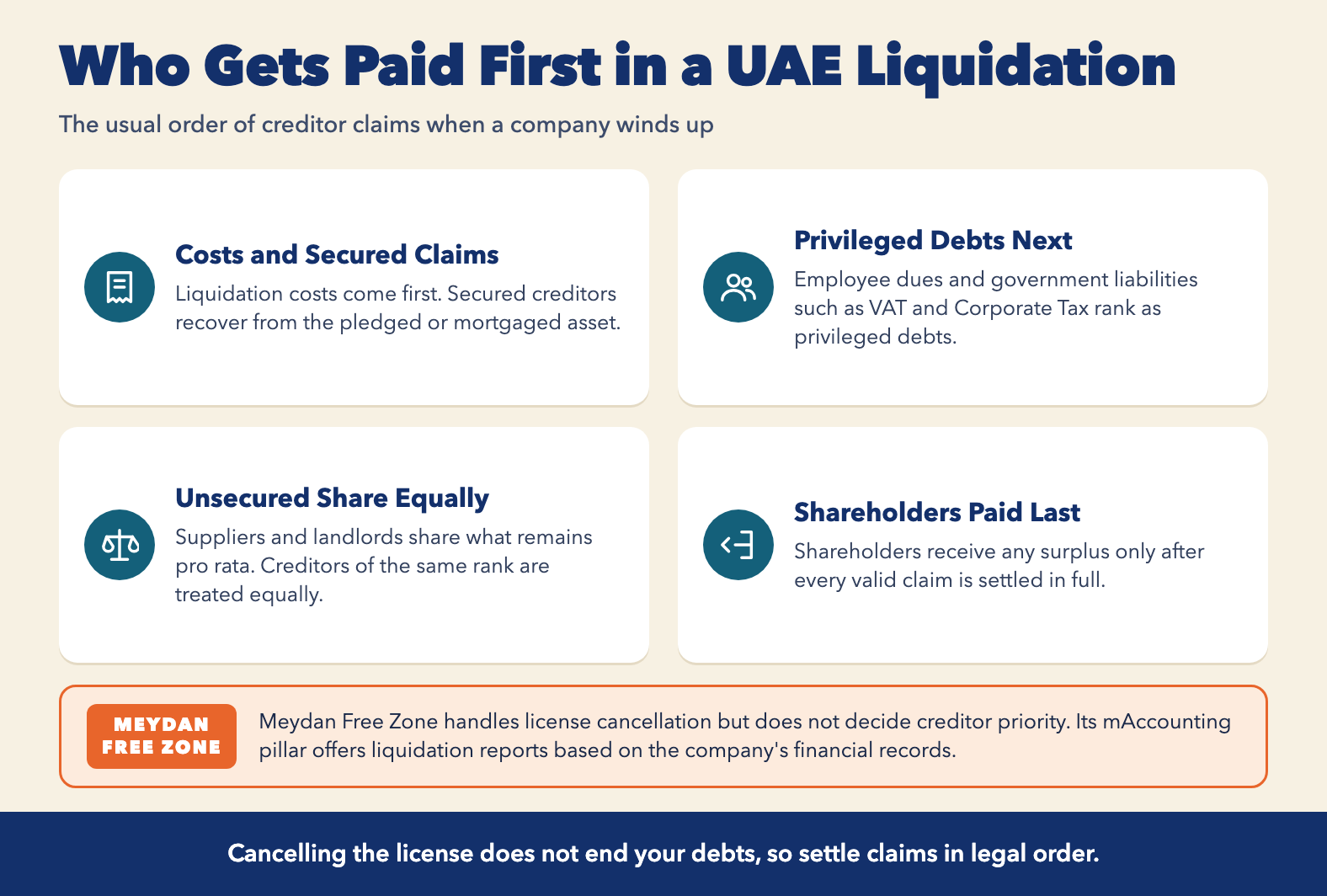
The liquidator takes control of company assets, notifies creditors, checks claims, settles debts in legal priority, and distributes any surplus to shareholders. The company can't trade normally during this period. The liquidator acts for the company, not for the founders.
The Liquidator's Role and Duties
Shareholders appoint the liquidator in a voluntary liquidation. A court does so in a compulsory one. The liquidator inventories assets, reviews contracts, and prepares a statement of debts. Before any payment, a liquidator might review a lease, three supplier contracts and a bank facility. Creditors of the same rank must be treated equally.
Notifying Creditors and Receiving Claims
Creditors are notified directly and by public notice, as the Commercial Companies Law and the competent authority require. They submit written claims with supporting documents within the period the notice sets. Late claims can be hard to recover once distribution starts. A freelancer who invoiced the company and missed the window may find they need to negotiate directly with the liquidator.
Creditor Priority Order in a UAE Liquidation
| Claim Type | Priority Rank | Typical Basis |
|---|---|---|
| Liquidation costs and administration expenses | 1 | Liquidator fees and administration costs, met from the estate first |
| Secured creditors (pledge or mortgage holders) | 2 | Banks recovering from the pledged or mortgaged asset |
| Employee wages and end-of-service dues | 3 | Unpaid salaries and gratuity, a privileged debt; confirm statutory order |
| Tax and government liabilities | 3 | VAT, Corporate Tax, fines and licensing fees, a privileged debt; confirm statutory order |
| Unsecured creditors, then shareholders | 4 | Suppliers and landlords share pro rata; shareholders receive any surplus last |
Disputed and Contingent Claims
- The liquidator can admit, reject or partly admit a claim.
- Rejected creditors can go to court if disputes escalate further.
- Contingent liabilities, such as warranty claims, can delay the final distribution.
- If a customer claims a refund for a faulty product, the liquidator holds a reserve until it's resolved.
Order of Payment in a UAE Liquidation
Creditors are generally paid in priority order: liquidation costs and secured creditors first, then privileged debts such as employee dues and government liabilities, then unsecured creditors. Shareholders are paid only after every valid claim is settled in full. The exact ranking depends on the governing law and the claim type, so confirm it with a legal adviser.
Step 1: Cover Liquidation Costs and Secured Claims
- Liquidator fees come out of the estate first.
- A bank with a pledge over a vehicle fleet recovers from those vehicles first.
- Any shortfall becomes an unsecured claim.
Step 2: Settle Employee Wages and End-of-Service Dues
- Private-sector employment is governed by Federal Decree-Law No. 33 of 2021.
- A six-person company owing two months of salary clears that before trade suppliers.
- Free zone staff follow the free zone's own process, not assumed mainland procedures. MOHRE sets the mainland rules.
Step 3: Pay Tax and Government Liabilities
- VAT and Corporate Tax owed to the Federal Tax Authority must be settled or reconciled.
- Fines or fees owed to the licensing authority are cleared before cancellation.
- An unfiled final VAT return blocks deregistration.
Step 4: Pay Unsecured Creditors Then Return Surplus
- Unsecured creditors share remaining funds proportionally.
- If cash covers 70% of trade debts, each supplier receives 70% of its claim.
- Shareholders receive any surplus last.
Timelines for Creditor Claims in a UAE Liquidation
Timelines depend on the company's assets, the number of creditors and any disputes. Free zone companies follow their licensing authority's closure requirements alongside federal law. No single fixed duration applies.
Key Milestones From Appointment to Cancellation
- Shareholder resolution and liquidator appointment.
- Public notice and creditor claim window.
- Claim review, payment and the liquidator's final report.
- Tax deregistration and license cancellation.
A solo-owner company with two creditors and no disputes moves faster than one with a contested lease claim. For help with reports, see company liquidation services in Dubai.
What Delays a Liquidation
- Unfiled VAT or Corporate Tax returns.
- Unresolved employee dues or visa cancellations.
- Frozen or dormant bank accounts.
- Disputed claims that reach court.
- A missing liquidation or audit report, where one is required.
How Liquidation Works for a Meydan Free Zone Company
A Meydan Free Zone company still owes creditors in the same priority order. Federal law governs the debts, while Meydan Free Zone handles license cancellation. Its mAccounting pillar covers bookkeeping, VAT registration support and Corporate Tax support, which helps keep the records a liquidation depends on. The wider closure route is outlined in liquidating a free zone company.
Records the Liquidator Will Need
- Up-to-date ledgers, bank statements and a creditor list.
- VAT and Corporate Tax filings that reconcile with the books.
- Payroll records showing salary and end-of-service balances.
A consultancy with clean monthly bookkeeping can prepare its creditor schedule in days instead of weeks.
Where Meydan Free Zone Fits In
mAccounting offers liquidation reports based on the company's financial records. Meydan Free Zone handles license cancellation, but it doesn't decide creditor priority. Its own pages differ on whether a liquidation report is always required, so confirm this with Meydan Free Zone early. A founder closing a trading company cancels visas, settles creditors, then submits the final documents for license cancellation.
Free Business Setup Cost Calculator
Calculate NowMistakes That Create Personal Liability for Founders
The most common mistakes are paying friendly creditors first, cancelling the license before settling debts, ignoring tax filings, and leaving personal guarantees unaddressed. Each can lead to a claim against the founder or manager personally, even after closure.
Preferential Payments and Asset Transfers
Moving assets to a related party shortly before closure invites challenge. A founder who sells equipment to a relative at a discount may see creditors contest the sale. Equal-rank creditors must be treated the same.
Personal Guarantees and Post-Dated Cheques
Personally signed guarantees survive company closure. So does a post-dated cheque a landlord holds. Returned cheques can trigger separate legal exposure, so resolve them before deciding to close. The Central Bank of the UAE sets the wider banking and credit framework.
Conclusion
A UAE liquidation rewards preparation. Creditor claims follow a legal order, with costs and secured debts first, privileged debts such as employee dues and tax next, and unsecured creditors and shareholders last. Founders who keep accurate records and settle in sequence close cleanly. Those who improvise carry the exposure personally.
List every creditor, rank each claim, and reconcile your books before you start. Meydan Free Zone's mAccounting pillar offers liquidation reports, so ask early whether your company needs one before cancellation.
Ready to Launch Your Business in Dubai?
Let's Connect