

Table of Contents
Frequently Asked Questions
Who publishes EIBOR in the UAE?
The Central Bank of the UAE administers and publishes the Emirates Interbank Offered Rate. It is built from rates submitted by a panel of UAE banks for lending dirhams to one another. The fixings run from overnight to twelve months, including one, three and six months.
Which EIBOR period do most business loans reference?
The loan agreement names the period, and the three-month fixing is the one most commonly written into floating-rate facilities. Some lenders use one-month or six-month fixings instead. Check the offer letter, because the chosen period decides how often your base rate resets.
How often does the interest on a floating business loan change?
It changes at each reset date set out in the facility agreement. A loan tied to three-month EIBOR resets its base every quarter. A policy rate move reaches your instalment at the next reset, not on the day the Central Bank of the UAE announces it.
Does a rise in EIBOR affect an existing fixed-rate loan?
No. A fixed rate holds for the agreed period, so benchmark movements do not change your instalment. Hybrid facilities fix the rate for an initial period and then float on EIBOR, so the exposure begins when that period ends.
How does EIBOR differ from the Central Bank of the UAE base rate?
The base rate is a policy rate set by the Central Bank of the UAE. EIBOR is the market rate at which banks lend to each other. EIBOR tends to follow the base rate, but liquidity conditions and the chosen period can move it independently.
Can a business negotiate the margin above EIBOR?
Yes. The margin is the negotiable part of the rate, while EIBOR moves with the market. Credit profile, collateral, trading history, loan size and tenor all influence it. A share pledge or guarantee can also affect the margin a bank offers.
Why do two banks quote different rates when EIBOR is the same?
Banks add their own margin, and they may reference different EIBOR periods. Rate floors, processing fees and early settlement charges also change the real cost. Compare offers on the same basis: period, margin, floor, fees and total repayment over the term.
Does a Meydan Free Zone company pay a different loan rate from other UAE businesses?
Meydan Free Zone does not set lending rates. A Meydan Free Zone company borrows from UAE banks on terms the lender prices on EIBOR plus a margin. Through mCore, Meydan Free Zone supports business bank account setup, and mAccounting provides bookkeeping that lenders may review.
Topic Summary
What the EIBOR Rate in the UAE Is
EIBOR, the Emirates Interbank Offered Rate, is a daily reference rate built from the rates a panel of UAE banks submit for lending dirhams to one another. It is fixed for set periods from overnight to twelve months, including one, three and six months. The Central Bank of the UAE administers and publishes it, and banks use it as the benchmark for floating-rate business loans.
Base Rate and the EIBOR Rate in the UAE
The Central Bank of the UAE sets a base rate that anchors short-term interbank lending. EIBOR tends to follow base rate moves, because banks price lending to each other around it. The dirham is pegged to the US dollar, so UAE rates broadly track US Federal Reserve decisions.
How Banks Build a Business Loan Rate on EIBOR
Banks price a floating business loan as EIBOR plus a margin. The margin reflects credit risk, loan size, security offered, tenor and business strength. EIBOR moves with the market. The margin is negotiated once and usually stays fixed for the life of the facility.
Floating Versus Fixed Rates for UAE Business Borrowers
A floating rate moves with EIBOR, so repayments rise or fall at each reset. A fixed rate holds for an agreed period, giving certainty but often a higher starting cost and tighter exit terms. The better choice depends on your cash flow tolerance and how long you plan to hold the debt.
Cost and Compliance Risks Linked to EIBOR
The main risks are repayment shocks after a reset, a rate floor that blocks falls, undisclosed fees and covenants tied to cash flow. Model repayments under a higher EIBOR, read the benchmark clause, and confirm what happens if EIBOR is replaced or unavailable.
What the EIBOR Rate in the UAE Means for a Meydan Free Zone Founder
A Meydan Free Zone company borrows from UAE banks on the same EIBOR-based terms as other licensed businesses. Meydan Free Zone does not set lending rates. Its mCore pillar supports business bank account setup, and its mAccounting pillar offers bookkeeping, which produces the records lenders review.
Next Steps for Borrowers
The EIBOR rate in the UAE is the moving part of a floating business loan. The margin is the part you can negotiate. Borrowers who read the tenor, reset date, floor and fees before signing control their cost better than those who compare headline rates.
EIBOR Explained: How UAE Business Loan Interest Rates Are Set
Most founders assume the bank sets their whole loan rate, then wonder why a repayment moved after the Central Bank of the UAE changed its base rate. EIBOR sits between the two, and it drives more of your borrowing cost than the headline margin does. This guide explains how the benchmark works, how banks price business loans on it, and how to compare facilities on the same basis.
What the EIBOR Rate in the UAE Is
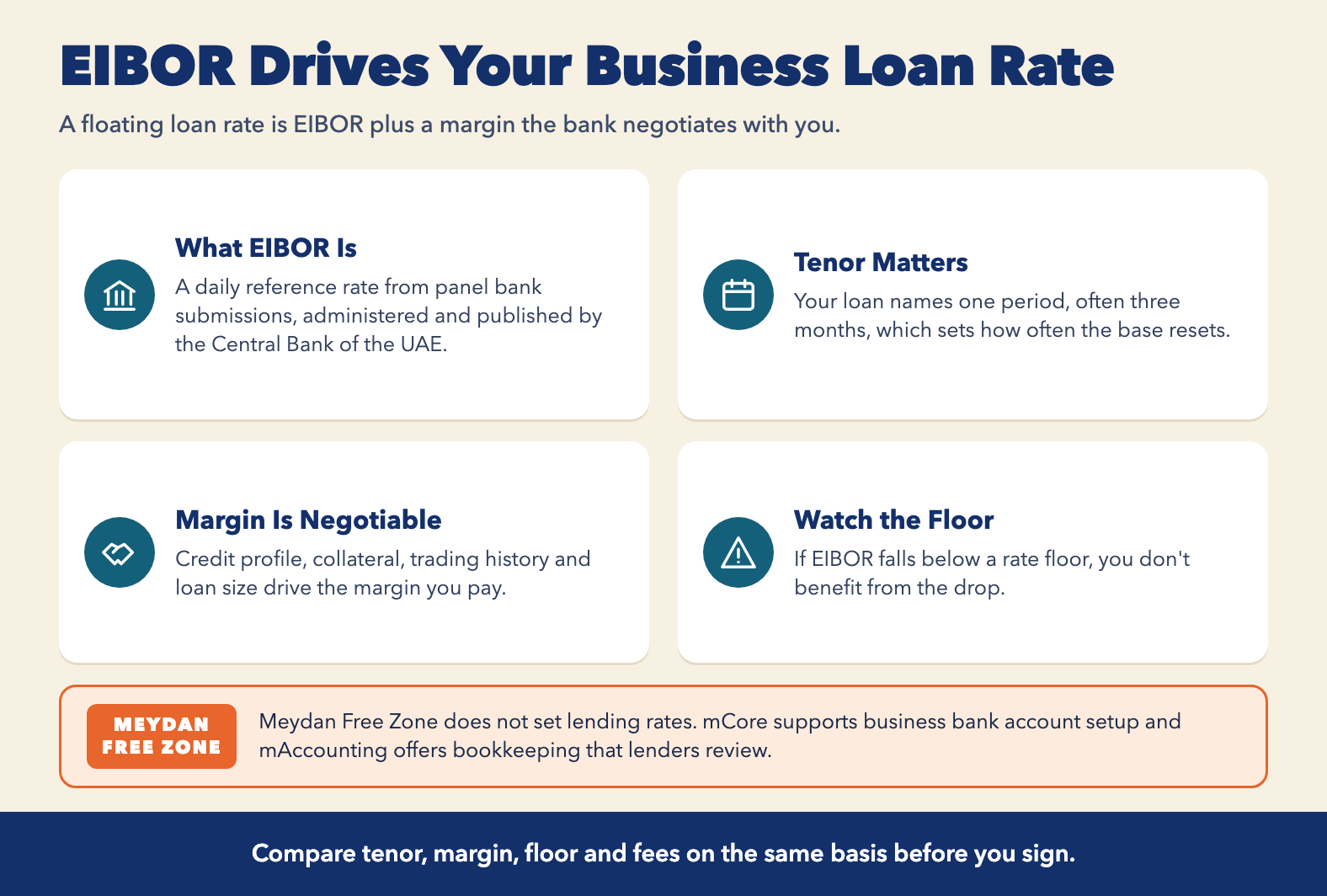
EIBOR, the Emirates Interbank Offered Rate, is a daily reference rate built from the rates a panel of UAE banks submit for lending dirhams to one another. It is fixed for set periods from overnight to twelve months, including one, three and six months. The Central Bank of the UAE administers and publishes it, and banks use it as the benchmark for floating-rate business loans.
How EIBOR Is Published and Used
The Central Bank of the UAE publishes the fixings by tenor on its website. Your loan agreement names one tenor, most often three months. A clause reading "three-month EIBOR plus a fixed margin" means the base resets every quarter.
Why Founders Misread the Benchmark
The common belief is that the bank sets the whole rate. In reality, the benchmark moves independently of your lender. EIBOR isn't what you pay. It's the base before the margin.
That means a lender can negotiate the margin but can't waive a benchmark move. Two quotes with the same margin can also cost differently if one references one-month EIBOR and the other three-month.
Base Rate and the EIBOR Rate in the UAE
The Central Bank of the UAE sets a base rate that anchors short-term interbank lending. EIBOR tends to follow base rate moves, because banks price lending to each other around it. The dirham is pegged to the US dollar, so UAE rates broadly track US Federal Reserve decisions.
The Dirham Peg and Rate Direction
After a US rate change, the Central Bank of the UAE adjusts its base rate and EIBOR fixings follow over the next days. Policy isn't the only input, though. EIBOR also reflects liquidity conditions in the banking system.
Liquidity and Interbank Demand
Tight liquidity can lift EIBOR even when the base rate is unchanged. Longer tenors also price in expectations of future moves. Say a founder holds a floating facility: the instalment changes at the next reset date, not on the day the policy rate moves. Coverage in The National is a useful way to follow these shifts.
How Banks Build a Business Loan Rate on EIBOR
Banks price a floating business loan as EIBOR plus a margin. The margin reflects credit risk, loan size, security offered, tenor and business strength. EIBOR moves with the market. The margin is negotiated once and usually stays fixed for the life of the facility.
Step 1: Identify the Benchmark Tenor
- Confirm whether the facility uses one, three or six-month EIBOR.
- Check the reset frequency in the offer letter.
- A six-month tenor smooths movement but resets less often.
Step 2: Review the Margin and Its Drivers
- Margin depends on credit profile, collateral, trading history and sector.
- A share pledge or guarantee can influence pricing.
- A trading company with two years of bank statements may get a lower margin than a newly licensed one.
Step 3: Check for a Rate Floor and Fees
- Some facilities set a minimum all-in rate regardless of EIBOR.
- If EIBOR falls below the floor, you don't benefit from the drop.
- Processing, early settlement and insurance charges sit outside the rate.
- Ask for the effective rate in writing.
Step 4: Compare Offers on the Same Basis
- Compare tenor, margin, floor, fees and balance method side by side.
- Treat quoted figures as indicative until a formal offer arrives.
- Offer A has a lower margin and higher fees. Offer B has a higher margin and no fees. Total cost over the term decides.
Floating Versus Fixed Rates for UAE Business Borrowers
A floating rate moves with EIBOR, so repayments rise or fall at each reset. A fixed rate holds for an agreed period, giving certainty but often a higher starting cost and tighter exit terms. The better choice depends on your cash flow tolerance and how long you plan to hold the debt.
Floating Rate Versus Fixed Rate Business Loans
| Feature | Floating Rate (EIBOR plus Margin) | Fixed Rate |
|---|---|---|
| How the rate changes | Resets to the chosen EIBOR tenor at each reset date | Stays the same for the agreed fixed period |
| Repayment predictability | Instalments can change every reset | Instalments are known in advance, which helps budgeting |
| Exposure to rate rises | Fully exposed from the next reset | Protected until the fixed period ends |
| Benefit when rates fall | Cost falls with EIBOR, unless a floor applies | No benefit during the fixed period |
| Early settlement terms | Usually simpler, though fees can apply | Break costs are possible on early exit |
Hybrid structures fix the rate for an initial period, then float on EIBOR.
Matching the Structure to the Business
Short working capital lines suit floating pricing. A trading business financing six months of seasonal stock carries little rate risk. Long equipment loans may justify a fixed or hybrid period. Whichever you pick, stress-test repayments against a higher EIBOR. More options are covered in the business funding in UAE guide.
Cost and Compliance Risks Linked to EIBOR
The main risks are repayment shocks after a reset, a rate floor that blocks falls, undisclosed fees and covenants tied to cash flow. Model repayments under a higher EIBOR, read the benchmark clause, and confirm what happens if EIBOR is replaced or unavailable.
Repayment Shock After a Reset
Instalment increases hit cash flow before revenue adjusts. A modest benchmark rise on a larger facility adds a visible amount to every monthly instalment. Keep a buffer sized to a realistic rate rise. The World Bank tracks how rate cycles affect corporate borrowers.
Covenants, Guarantees and Bank Scrutiny
- Banks review beneficial ownership and company documents before pricing.
- A lender may ask for UBO details and audited figures before a final margin.
- Personal guarantees and share pledges raise your risk if repayments slip.
- Clean records support a lower margin.
What the EIBOR Rate in the UAE Means for a Meydan Free Zone Founder
A Meydan Free Zone company borrows from UAE banks on the same EIBOR-based terms as other licensed businesses. Meydan Free Zone does not set lending rates. Its mCore pillar supports business bank account setup, and its mAccounting pillar offers bookkeeping, which produces the records lenders review.
Preparing Records Before Applying for a Loan
Banks look at the Business License, Certificate of Formation, Share Register and Memorandum and Articles of Association, all issued digitally by Meydan Free Zone. mAccounting offers bookkeeping, VAT registration support and Corporate Tax support, which helps produce the financial records a lender requests. Present both sets when asking for a margin quote. The process is outlined in how to apply for a business loan in Dubai.
Banking Support Through mCore
mCore provides business bank account support. It doesn't guarantee approval or a loan. A new company can open an account first, build transaction history, then approach lenders with a stronger credit request.
Essential Services for Entrepreneurs and Startups
Explore mCoreNext Steps for Borrowers
The EIBOR rate in the UAE is the moving part of a floating business loan. The margin is the part you can negotiate. Borrowers who read the tenor, reset date, floor and fees before signing control their cost better than those who compare headline rates.
List the tenor, margin, floor and fees of each offer, then test the repayment against a higher EIBOR. Meydan Free Zone does not set lending rates, so for a Meydan Free Zone company the levers are the same as for any borrower: a well-prepared company file and a negotiated margin.
Ready to Launch Your Business in Dubai?
Let's Connect