

Table of Contents
Frequently Asked Questions
Is an audit mandatory before a company can be closed in the UAE?
Often, yes. Many licensing authorities expect audited accounts or a liquidation report before cancellation, and the figures also support the final tax and bank steps. Meydan Free Zone lists an audited financial statement among its liquidation documents and states that a liquidation report is mandatory. Requirements differ by authority, so confirm them before you start.
Who can carry out the final audit for a free zone company?
A registered, independent audit firm must carry out the review, and it must be acceptable to the license authority. The liquidator manages settlement of the company's affairs but does not audit its own work. Confirm the auditor's acceptance before engaging them, so the report is not rejected at submission.
What financial period does the closing audit cover?
It covers the period from the end of the last audited financial year to the cut-off date set by the closure decision. A company with a December year-end that closes in June needs accounts audited to the June cut-off. The prior December statements alone are not enough.
Can a company close if it still has unpaid liabilities?
Not through simple voluntary liquidation. Creditors, employees and tax liabilities must be settled before remaining funds go to shareholders. If liabilities exceed assets, insolvency or bankruptcy rules may apply instead of a standard closure.
Do Corporate Tax and VAT deregistration happen before or after license cancellation?
They are separate processes with the Federal Tax Authority, and the audited figures support the final returns for both. Settle tax positions before the closure record is final. Cancelling the license first can leave an open return that is hard to file cleanly.
What documents does the auditor need to start the review?
Expect to provide the general ledger, bank statements, signed contracts, tax and VAT filings with payment confirmations, and the shareholder resolution approving closure. Missing bank statements are a common cause of delay. Gather them before the auditor begins.
What happens to the company bank account after liquidation?
Banks generally expect the audit report, the cancellation documents and a zero-liability position before closing the account. Keep the account open until the final tax and creditor payments have cleared. Closing it early can force you to reopen a file to settle remaining items.
Topic Summary
What the Final Audit Before Closing a UAE Company Means
A final audit before closing a UAE company is an independent review of the books from the last audited period to the cut-off date. It confirms assets, liabilities, tax positions and shareholder balances, so the liquidator can settle creditors, distribute remaining funds and support cancellation of the business license.
Why the Final Audit Matters When a UAE Company Closes
The final audit protects shareholders and directors from unresolved claims after closure. It gives the licensing authority, the Federal Tax Authority and the bank one verified set of numbers. Without it, cancellation requests can be returned for missing or inconsistent financial details.
What the Final Audit Before Closing Covers
The audit covers the statement of financial position at cut-off, outstanding liabilities, tax positions, bank balances, fixed assets, shareholder accounts and staff end-of-service obligations. It also reviews the distribution plan, so shareholders receive funds only after creditors are paid.
Steps in the Final Audit Process
The process runs in order: pass the closure resolution, set a cut-off date, appoint a liquidator and registered auditor, reconcile the books, settle liabilities, complete the audit, then submit the report with the cancellation request. Each step depends on the one before it.
Tax Clearance Checks Before Deregistration
Before closing, you must settle Corporate Tax and VAT positions and apply to the Federal Tax Authority (FTA) for deregistration. The audited closing figures support the final returns, so filings, audit report and ledger must agree.
How Meydan Free Zone Companies Handle the Closing Audit
Meydan Free Zone states that a liquidation report is mandatory before a license can be cancelled. The audited financial statement is on its list of documents for liquidation, alongside bank statements and invoices. mAccounting covers financial audit reports, liquidation reports, bookkeeping, VAT and Corporate Tax support.
Common Gaps That Delay Closure and How to Avoid Them
Closures commonly stall because of unreconciled bank accounts, unfiled tax returns, unsettled staff entitlements and shareholder balances that don't match the ledger. Fix these before the auditor starts, and the report is far less likely to draw queries.
The Final Audit Before a UAE Company Closes
Closing a UAE company means proving it owes nothing, and that its books support the claim. The licensing authority, the Federal Tax Authority, the bank and immigration each close their records separately, and each expects the same numbers. This guide explains what the closing audit covers, where it fits in the liquidation sequence and what to prepare before you start.
What the Final Audit Before Closing a UAE Company Means
A final audit before closing a UAE company is an independent review of the books from the last audited period to the cut-off date. It confirms assets, liabilities, tax positions and shareholder balances, so the liquidator can settle creditors, distribute remaining funds and support cancellation of the business license.
Definition and Purpose
The output is a closing audit report. The licensing authority, tax authority and bank can rely on it as evidence of the company's final position. It is not a routine annual check.
Say a trading company with a December year-end decides to close in June. It needs accounts audited to the June cut-off, not just the prior December statements.
How It Differs From an Annual Audit
Your closure decision sets the cut-off date, not the financial year-end. The auditor tests realisable asset values, final liabilities, end-of-service benefits and lease exits. An annual audit signs off a going concern. The closing audit signs off a company that is ceasing to operate.
Why the Final Audit Matters When a UAE Company Closes
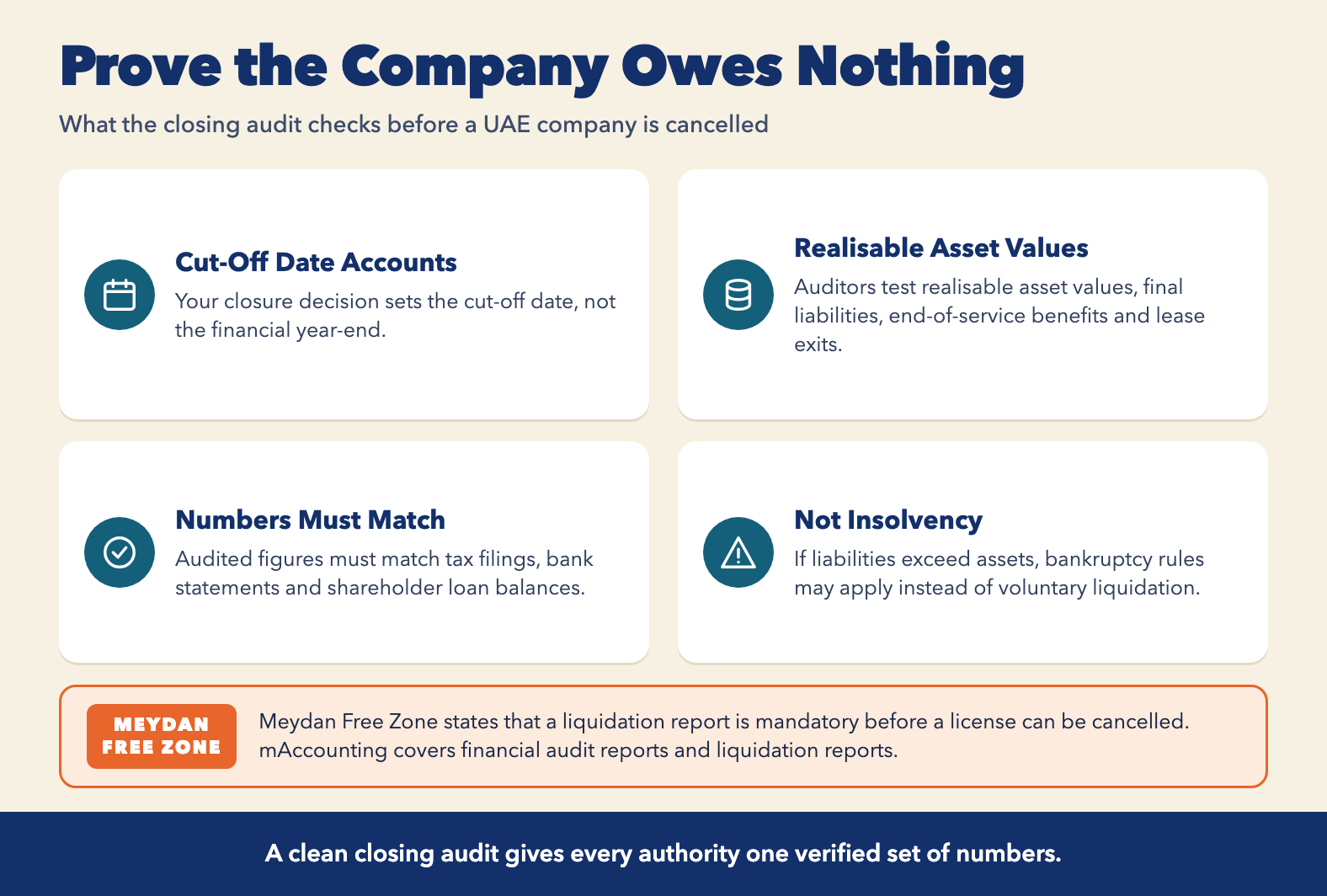
The final audit protects shareholders and directors from unresolved claims after closure. It gives the licensing authority, the Federal Tax Authority and the bank one verified set of numbers. Without it, cancellation requests can be returned for missing or inconsistent financial details.
Commercial Risk of Skipping It
Unpaid liabilities can follow managers or shareholders when the closure record is incomplete. A consultancy that cancels its license may later receive a tax query for a period with no reconciled ledger. Rework costs more than preparing the file once.
What Authorities and Banks Look For
- Audited figures that match tax filings and bank statements.
- Proof that creditors and employees are settled.
- Clear treatment of shareholder loans and remaining cash.
A bank will question a shareholder loan balance that differs between the audit report and the ledger.
Link to Wider Insolvency Rules
Voluntary liquidation is not insolvency. If liabilities exceed assets, bankruptcy rules may apply instead. A startup with unpaid suppliers and no cash cannot close by simple liquidation. Read the startup bankruptcy laws in Dubai guide for that route.
What the Final Audit Before Closing Covers
The audit covers the statement of financial position at cut-off, outstanding liabilities, tax positions, bank balances, fixed assets, shareholder accounts and staff end-of-service obligations. It also reviews the distribution plan, so shareholders receive funds only after creditors are paid.
Assets, Liabilities and Shareholder Accounts
- Cash, receivables, inventory and fixed assets at realisable value.
- Payables, accruals, lease obligations and loans.
- Shareholder current accounts, reconciled and documented.
An e-commerce company, for instance, writes unsold inventory down to disposal value before cut-off.
Employee and Visa Obligations
Book end-of-service benefits before the cut-off date. A founder with two sponsored employees should confirm gratuity is recorded. Visa cancellations run through the free zone licensing authority process. Don't assume mainland Ministry of Human Resources and Emiratisation (MOHRE) procedures apply to a Meydan Free Zone company.
Records Auditors Expect to See
- General ledger, bank statements and signed agreements.
- Tax returns, VAT filings and payment confirmations.
- Shareholder resolution approving closure.
Missing statements for one quarter will hold up sign-off until the bank reissues them.
Steps in the Final Audit Process
The process runs in order: pass the closure resolution, set a cut-off date, appoint a liquidator and registered auditor, reconcile the books, settle liabilities, complete the audit, then submit the report with the cancellation request. Each step depends on the one before it.
Step 1: Approve Closure and Set the Cut-Off Date
- Pass a shareholder resolution to dissolve.
- Fix the cut-off date so later entries are tested against it.
- A single-shareholder company can record both in one signed document.
Step 2: Appoint the Liquidator and Auditor
- The liquidator manages settlement. The auditor stays independent.
- Confirm the license authority accepts your auditor.
Closure Checks and the Body That Receives Each Record
| Feature | Closure item | Where the audited record is used |
|---|---|---|
| License cancellation: free zone authority | Signed closing audit report with the cancellation request | Free zone authority confirms the company owes nothing |
| Corporate Tax deregistration: Federal Tax Authority | Final return up to the cut-off date | Audited profit supports the final taxable income figure |
| VAT deregistration: Federal Tax Authority | Final VAT return, including stock held at closure | Audit flags any deemed supply on remaining assets |
| Bank account closure: bank compliance team | Audit report, cancellation documents, zero-liability position | Bank matches final balances to the audited ledger |
| Shareholder distribution: liquidator and shareholders | Distribution plan and reconciled shareholder accounts | Funds are released only after creditors are settled |
Step 3: Reconcile Books and Settle Liabilities
- Close open invoices, supplier balances and payroll.
- Reconcile every bank account to the cut-off date.
Step 4: Complete the Audit and File the Report
The auditor issues the report on the closing position. You then use it for license cancellation, tax deregistration and bank closure. Meydan Free Zone's mAccounting team offers company liquidation services in Dubai, including liquidation reports.
Tax Clearance Checks Before Deregistration
Before closing, you must settle Corporate Tax and VAT positions and apply to the Federal Tax Authority (FTA) for deregistration. The audited closing figures support the final returns, so filings, audit report and ledger must agree.
Corporate Tax Final Return and Deregistration
The final return covers the period to the cut-off date. File it using audited profit, not an estimate. Check the FTA site for current deadlines and penalties.
VAT Deregistration and Final Return
VAT-registered companies file a final return and apply for deregistration. Stock held at closure can create a deemed supply. A trader with unsold goods accounts for VAT on them in that return. Check the FTA's deregistration conditions and deadlines for your case.
Bank Account Closure and Final Balances
Banks expect the audit report, cancellation documents and a zero-liability position. Keep the account open until final payments clear. A founder who closes it early may need the bank's help again to settle the last tax payment. The Central Bank of the UAE sets banking compliance expectations.
How Meydan Free Zone Companies Handle the Closing Audit
Meydan Free Zone states that a liquidation report is mandatory before a license can be cancelled. The audited financial statement is on its list of documents for liquidation, alongside bank statements and invoices. mAccounting covers financial audit reports, liquidation reports, bookkeeping, VAT and Corporate Tax support.
Free Zone Closure Route
Cancellation runs through the free zone, while tax deregistration runs separately with the FTA. Meydan Free Zone lists regulatory clearances, including FTA notification and visa cancellation, before final license cancellation. The guide to liquidating a free zone company sets out the wider sequence.
Support From mAccounting
Regular bookkeeping gives your auditor a reconciled ledger on day one, which shortens the audit. mResidency handles residence visas, which matters when you cancel staff and owner visas.
Free Business Setup Cost Calculator
Calculate NowCommon Gaps That Delay Closure and How to Avoid Them
Closures commonly stall because of unreconciled bank accounts, unfiled tax returns, unsettled staff entitlements and shareholder balances that don't match the ledger. Fix these before the auditor starts, and the report is far less likely to draw queries.
Bookkeeping and Reconciliation Gaps
- Missing months of bookkeeping.
- Bank statements that don't match the ledger.
- Undocumented shareholder transfers.
A founder who paid personal expenses from the company account must classify them as shareholder loans before audit.
Timing and Sequencing Errors
Don't cancel the license before settling tax and staff items. A company that cancels first can find an open return it can't file cleanly. Don't close the bank account early either. If the company still has assets, debts or staff, plan for a full liquidation rather than a quick cancellation.
Conclusion
The closing audit is the document every other closure step relies on. It fixes the numbers once, so the licensing authority, the FTA and the bank work from the same record. Reconcile your books, set the cut-off date and gather your tax and bank records before you start. For a Meydan Free Zone company, a liquidation report is mandatory before the license can be cancelled, so plan the audit and the report together.
Ready to Launch Your Business in Dubai?
Let's Connect