
Table of Contents
Frequently Asked Questions
1. What is the difference between a flexi-desk and a virtual office?
A virtual office is usually built around a registered business presence without shared workspace access as the core feature. A flexi-desk is a shared workspace model that gives founders access to a desk arrangement within the office setup while still covering the office requirement linked to the license.
2. Does Meydan Free Zone offer a virtual office option?
No. Meydan Free Zone does not offer a virtual office option. The office model attached to the trade license is the flexi-desk, and it is built into the license from the start.
3. Is the flexi-desk mandatory in Meydan Free Zone?
The flexi-desk is included with the Meydan Free Zone trade license, and is reflected in the final invoice, rather than offered as an optional add-on or alternative.
4. What does the Meydan Free Zone flexi-desk include?
The flexi-desk setup includes a registered business address linked to the trade license, shared workspace access instead of a dedicated private office, and access to shared desks, meeting rooms, internet, and office amenities. It gives founders a compliant office arrangement without requiring a full private office from day one.
5. Can I choose a virtual office instead of a flexi-desk in Meydan Free Zone?
No. That is not an available route in Meydan Free Zone. The flexi-desk is provided with the license, so the real decision is whether that included setup fits the way the business plans to start or whether you need an upgrade.
6. Can the Meydan Free Zone flexi-desk setup be upgraded later?
Yes. In Meydan Free Zone, the flexi-desk is included with the license as the coworking desk option, and founders can later upgrade to a physical office if the business needs a larger on-site presence. That makes it easier to start lean and scale the office setup only when it becomes necessary.
Topic Summary
1. Physical Presence Requirement
Flexi-Desk offers a dedicated workspace within Meydan Free Zone where you can meet clients and work onsite, while a Virtual Office provides a business address and mail handling without a physical desk.
2. Cost Considerations
Virtual Offices are generally more cost-effective since they don’t include a physical workspace, whereas Flexi-Desks come at a higher price due to the provision of a physical desk and facilities.
3. Professional Image and Networking
A Flexi-Desk allows for face-to-face networking and a more traditional office experience, which can be beneficial for building client trust. Virtual Offices focus on maintaining a professional business address without physical interaction.
4. Flexibility and Commitment
Virtual Offices offer maximum flexibility with no need for daily office attendance. Flexi-Desks require occasional or regular use of the physical space, making it less flexible but more structured.
5. Business Scale and Growth
If your business requires a physical workspace for staff or client meetings, a Flexi-Desk is suitable. For startups and small businesses focused on minimizing overhead and operating remotely, a Virtual Office is a practical choice.
Flexi-Desk vs Virtual Office In Meydan Free Zone: What Should You Choose?
The office question comes up in nearly every founder inquiry. And it usually sounds the same: do I need a physical office, or can I start lighter? That question makes sense. The UAE ranks first globally for entrepreneurship for the fourth consecutive year, according to the Global Entrepreneurship Monitor 2024–2025.
SMEs now account for 94 per cent of all businesses in the country, and the ecosystem is built to support lean, scalable setups. Founders are not wrong to look for cost-efficient entry points.
The structural pull-through is striking. Nearly 250,000 new companies were registered in the UAE in 2025, taking the total active company base to more than 1.4 million, according to the UAE Ministry of Economy and Tourism¹. And of that activity, free zones now account for nearly 41% of all new business registrations in the UAE, with non-oil sectors contributing more than 75% of national GDP, based on 2025 data from Dubai DET².
The implication for founders weighing workspace options is straightforward: free zones are doing more of the heavy lifting, and the workspace model attached to a free zone licence increasingly shapes how lean an entry actually is.
If you’re setting up a business in Dubai, you’ll face one practical requirement: the company needs a registered office address backed by the relevant lease, Ejari, or office arrangement to support license issuance. That is a compliance baseline, not an optional extra. For many setups, this means sourcing and budgeting for office space separately.
With Meydan Free Zone, that step is already handled. The flexi-desk is included in every license package, built into the setup and reflected in the final invoice. There is no separate decision to make, no additional contract to sign, and no extra line item to budget for. The office requirement is met from day one.
That makes Meydan Free Zone simpler to navigate than most founders expect. The flexi desk vs virtual office question does not apply here the way it does elsewhere. Founders can focus on what actually matters: choosing the right business activity, getting the company registered, and moving into operations.
[blockCTABizActivityList]
Dubai SME Backed 3,461 New Emirati Businesses in a Single Year
Dubai SME, the SME arm of Dubai DET, supported 3,461 new Emirati businesses in 2024 and trained 5,498 entrepreneurs over the same period, more than triple the 1,627 trained in 2023. That scale of activity, much of it concentrated in service, consultancy, and trading ventures, sits at the heart of why workspace decisions matter so early in the setup conversation.
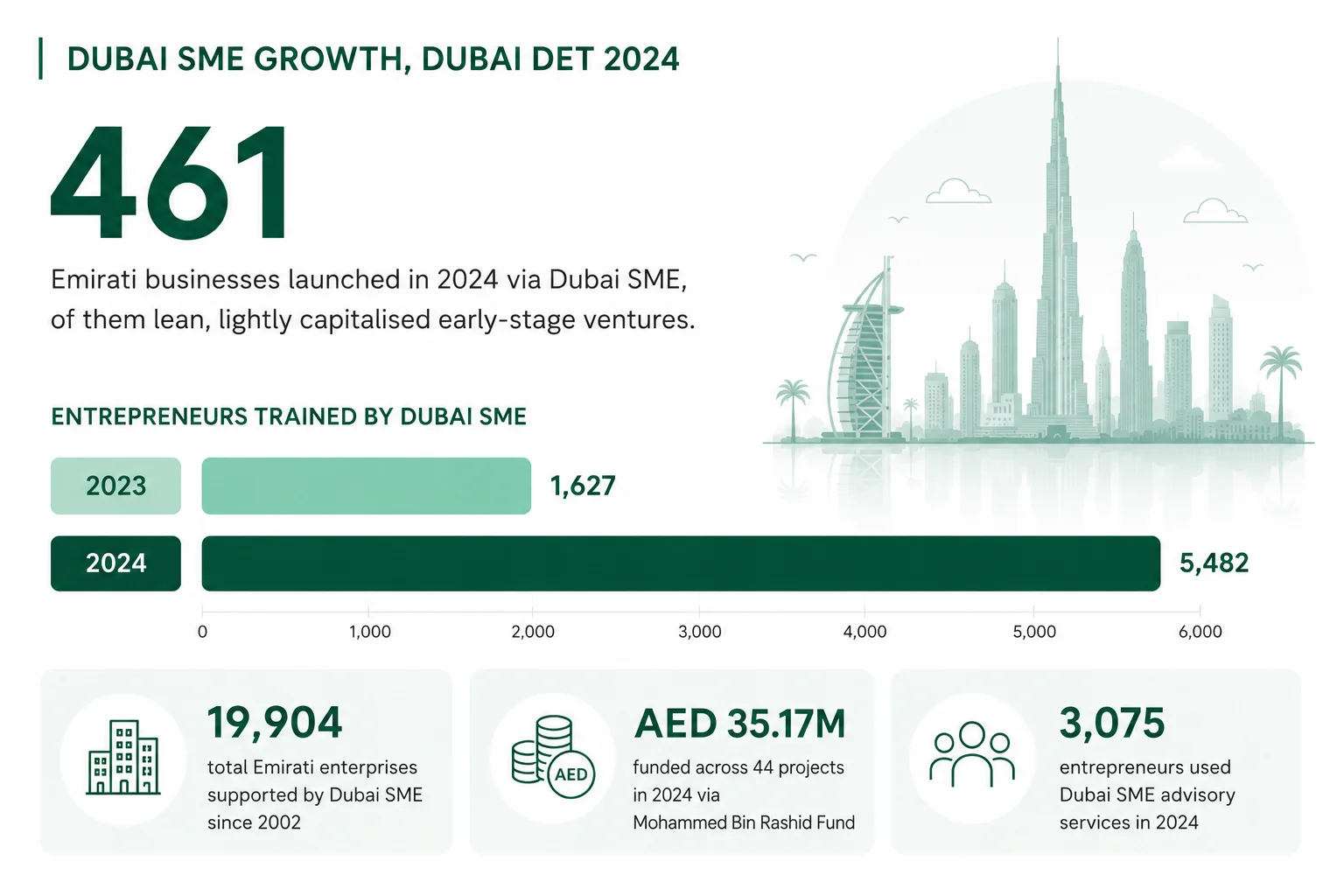
Sources: Dubai SME (Mohammed Bin Rashid Establishment for SME Development), Dubai DET, Dubai SME Achieves Remarkable Milestones, Transforms Entrepreneurial Landscape in 2024, 2025.
Difference Between a Flexi-Desk and a Virtual Office
A virtual office usually refers to a business setup built around a registered address and remote business presence, without shared desk access as the main feature. It is often understood as a lighter administrative model for founders who want a business address and formal presence without using workspace as part of day-to-day operations.
A virtual office typically includes:
- a registered business address for licensing and correspondence
- mail handling and forwarding services
- a contact number or call answering included in some packages
- no physical desk or workspace access as a core feature
A flexi-desk is different. It is a shared workspace model that gives founders access to a desk arrangement within the office ecosystem, rather than just a registered business presence on paper. In other words, it sits closer to a real office setup, just in a lighter and more flexible format than taking a private office.
In simple terms:
- a virtual office is usually about address-based presence and remote administration
- a flexi-desk is about shared workspace access within a compliant setup model
That distinction matters because the two solve different founder needs. A virtual office is usually chosen when workspace is not part of the requirements. A flexi-desk is more relevant when the business needs a lighter office model but still one tied to shared workspace access.
Flexi-Desk vs Virtual Office: A Side-by-Side Comparison
[blockExpertOpinion]
[blockCTATradeLicense]
The Office Model Included With Every Meydan Free Zone License
This is the point founders usually need clarified before they proceed.
In Meydan Free Zone, there is no virtual office option. Instead, the flexi-desk is model provided with the trade license.
That means it is:
- included as part of the business license package
- reflected in the final invoice
- not offered as an optional add-on
- not available as an alternative to a virtual office
Many founders assume the office component will be optional, removable, or interchangeable. In Meydan Free Zone, the flexi-desk is built into the license model from the start to satisfy the Ejari requirement.
But here is the part worth understanding: the flexi-desk already includes everything a virtual office would offer and more. Founders still get a registered business address and the compliance box ticked. But they also get access to a physical workspace, meeting rooms, and business lounge facilities when needed. For founders who planned to operate remotely, nothing changes. For those who occasionally need a professional space, it is already there.
The flexi-desk is a fuller starting point.
What the Meydan Free Zone Flexi-Desk Model Includes
In practical terms, the flexi-desk model gives founders a compliant office arrangement attached to the license, without requiring them to take on a full private office from day one. It is designed for businesses that want to start lean while still operating within a proper office structure.
That usually means a setup built around:
- a registered business address linked to the trade license
- shared workspace access instead of a dedicated private office
- a lighter office footprint for early-stage businesses
- the ability to start without committing to full office overheads immediately
- access to shared desks, meeting rooms, internet and office amenities
- a compliant starting point that can scale later if needed
So while it is not a virtual office, it is also not the same as taking a traditional office lease. It sits in the middle: more structured than a purely address-led model, but lighter than a dedicated office.
For founders, that also keeps the setup flexible over time. Starting with a flexi-desk does not mean staying there permanently. If the business grows and needs a larger physical presence later, you can upgrade to a physical office at the Business Centre when needed.
Can You Choose a Virtual Office Instead of a Flexi-Desk in Meydan Free Zone?
This is not an available route. Meydan Free Zone does not offer a virtual office as an alternative to the flexi-desk. If you are setting up here, the flexi-desk is the office model attached to your license.
That changes the question founders should actually be asking. Not whether to choose between a virtual office or a flexi-desk, but whether the included flexi-desk model works for how they want to start the business.
For most founders, especially those running service-based, remote, or early-stage businesses, it does. The flexi-desk meets the compliance requirement, keeps costs predictable, and removes one more decision from the setup process.
Think of it this way: what most founders actually want is a compliant address without the overhead of a traditional office. The flexi-desk gives them that, plus a workspace they can use when it matters.
Who the Meydan Free Zone Flexi-Desk Model Suits Best
The flexi-desk model makes the most sense for founders who want to start lean without taking on a full private office from day one.
That usually includes:
- solo founders
- consultants
- service-based businesses
- early-stage startups
- remote-first businesses entering the UAE market
For example, a founder in Bangalore setting up before relocation, a founder in London opening a UAE company to serve GCC clients, or a founder already in Dubai formalising a new venture may all want a lighter setup than a dedicated office. In those cases, the flexi-desk works because it covers the office requirement without forcing the business into a larger office commitment too early.
With Meydan Free Zone, founders are not just getting a prestigious Meydan Hotel business/work address. The flexi-desk is included on top of that, making the setup more practical than a purely address-led model. So even for businesses that might otherwise consider a virtual office, the founder still starts with access to a compliant workspace arrangement from day one.
In Conclusion
Two founders. Same question. Different setups.
One spends weeks comparing virtual office providers, weighing address-only packages against workspace add-ons, and budgeting separately for office compliance. The other opens the Meydan Free Zone portal, selects a business license, and moves forward knowing the office piece is already sorted.
Both end up with a registered business address. Both can operate remotely. Both tick the compliance box. But only one walked away with workspace access included, without an extra line item or a second contract.
That is the difference the flexi-desk makes. It bundles cost efficiency and practical utility into the license from the start. Founders searching for a virtual office are usually trying to keep things lean. The flexi-desk solves the same problem, just with more features built-in.
For founders operating from Dubai, a professional space is always available when needed. For founders running the business remotely from London, Singapore, or São Paulo, nothing changes. The setup still works. The address still holds. The compliance still stands.
The flexi-desk is not something founders need to add. It is something they start with.
Citations
¹ Gulf News (citing UAE Ministry of Economy and Tourism). How UAE Free Zone Businesses Can Operate in the Mainland: New Laws Explained. Gulf News, 2026.
² Gulf News (citing Dubai Economy and Tourism). How Free Zones Advance the UAE’s Economic Ascent. Gulf News, 2025.
³ Dubai SME (Mohammed Bin Rashid Establishment for SME Development), Dubai DET. Dubai SME Achieves Remarkable Milestones, Transforms Entrepreneurial Landscape in 2024. Government of Dubai, 2025.
⁴ UAE Ministry of Economy. UAE Ranks First Globally in Global Entrepreneurship Monitor 2024–2025 Report for Fourth Consecutive Year. Government of the UAE, 2025.
⁵ The Official Portal of the UAE Government. Small and Medium Enterprises. Government of the UAE, 2025.