
Table of Contents
Frequently Asked Questions
Can a free zone company sell products to customers across Dubai online?
In many cases, yes, if its license includes a suitable e-commerce or trading activity. How goods reach mainland customers, including customs clearance, depends on the products and delivery route, so confirm it with your free zone. Products in regulated categories may need extra approvals before listing.
Does a mainland e-commerce company need a physical shop in Dubai?
A mainland license is issued by the Dubai Department of Economy and Tourism (DET), and premises are generally part of mainland licensing. The requirement depends on the activity selected. Founders who sell only online should confirm the premises rules for their specific activity with DET before applying.
Who issues a free zone business license in Dubai?
The free zone authority issues the license, not DET. For Meydan Free Zone companies, Meydan Free Zone issues the Business License, Certificate of Formation, Share Register, and Memorandum and Articles of Association digitally after registration.
Do free zone e-commerce companies have to register for VAT?
Yes, free zone status does not remove tax duties. The Federal Tax Authority (FTA) administers VAT, and registration is mandatory when taxable supplies exceed AED 375,000 over the previous 12 months, or are expected to within the next 30 days. Every company, including a free zone company, must also register for Corporate Tax.
Is an e-commerce license different from a general trading license?
Yes. An e-commerce license covers selling goods or services online, while a general trading license usually allows a wider range of trading activities. The right choice depends on whether you sell only online or also trade through other channels.
Can an online seller get residency visas through a free zone company?
Yes, a Meydan Free Zone company can arrange residency visas, and visa services are priced separately from the trade license. mResidency covers residency visas, the medical fitness test, Emirates ID, medical insurance, dependent visas and return permits.
Does a free zone license help with opening a business bank account?
A license is a required starting point, but it does not guarantee approval, which is always the bank's decision. Banks assess the business model, ownership and compliance records. mCore provides business bank account support to help founders prepare their applications.
Topic Summary
What an E-commerce License Is and Who Issues It
An e-commerce license in Dubai is a business license that permits a company to sell goods or services online. Mainland licenses come from the Dubai Department of Economy and Tourism (DET). Free zone licenses come from the free zone authority, such as Meydan Free Zone, under its own rules.
Key Differences for Online Sellers
The core differences are licensing authority, selling scope, ownership structure, premises and visas. Free zone companies suit online-first sellers who want digital setup and a lean structure. Mainland companies suit sellers needing physical retail, government contracts or direct local trading. For a free zone seller, how goods reach mainland customers, including customs clearance and whether a mainland distributor is needed, depends on the products and route.
Tax, Compliance and Running Costs Compared
Both routes fall under UAE VAT and Corporate Tax rules administered by the Federal Tax Authority (FTA). Every company, including a free zone company, must register for Corporate Tax. VAT registration is mandatory once taxable supplies exceed AED 375,000 over the previous 12 months, or are expected to within the next 30 days. An online seller crossing that threshold in its first year must register, whichever license it holds.
Banking and Payment Gateway Considerations
Banks assess e-commerce companies on business model, ownership and compliance records, whatever the license type. Payment gateways add their own checks. Approval is always the bank's decision, and requirements for non-resident owners vary by bank. mCore provides business bank account support to help founders prepare applications.
How a Free Zone Setup Works for Online Sellers
A free zone setup for online sellers is largely digital. You select an e-commerce activity, submit documents online and receive your license documents electronically. Single-shareholder companies using Fawri can be licensed in under 60 minutes.
How to Choose Between Free Zone and Mainland in 4 Steps
Define your sales channels, match your activity to your products, compare ownership, premises and visas, then model tax and recurring costs.
What the Choice Means for Your E-commerce Business
The right structure depends on how you sell, not on prestige. Decide on your operating model first, then compare costs.
Free Zone vs Mainland for an E-commerce Business: Key Differences
Customers, couriers and marketplaces all sit on the mainland, so many founders assume an online store needs a mainland license. That isn't always true, and the wrong choice can mean paying for premises an online business doesn't use. Which route fits how you actually sell? This guide compares free zone and mainland licensing for e-commerce on authority, selling scope, premises, tax, banking and visas.
What an E-commerce License Is and Who Issues It
An e-commerce license in Dubai is a business license that permits a company to sell goods or services online. Mainland licenses come from the Dubai Department of Economy and Tourism (DET). Free zone licenses come from the free zone authority, such as Meydan Free Zone, under its own rules.
Mainland Licensing Through DET
DET issues mainland trade licenses, and your chosen activity decides which approvals and trade scope apply. Mainland licensing generally involves physical premises. Say a seller ships homeware to Dubai retailers and consumers and wants wholesale contracts. That seller may reasonably choose a mainland license. Confirm current fees and activity lists on the Invest in Dubai portal.
Free Zone Licensing Through the Zone Authority
The free zone authority issues the license, not DET. After registration, Meydan Free Zone issues the Business License, Certificate of Formation, Share Register, and Memorandum and Articles of Association digitally. Fawri, its fully digital route for single-shareholder companies, issues a Business License in under 60 minutes. A solo founder launching an online store receives the full document set electronically.
Free Zone vs Mainland for an E-commerce Business
| Feature | Free Zone (Meydan Free Zone) | Mainland (DET) |
|---|---|---|
| Issuing authority | The free zone authority issues the license | DET issues the trade license |
| Premises requirements | Every Meydan Free Zone license includes a flexi desk as the registered address | Physical premises generally form part of licensing |
| Setup process | Digital registration, documents issued electronically | Activity approvals and premises set the sequence |
| Selling scope | Suited to online-first selling | Suited to showrooms and direct local trading |
| Visa and residency arrangements | Residency through mResidency; visa services priced separately | Visas follow the mainland licensing framework |
Key Differences for Online Sellers
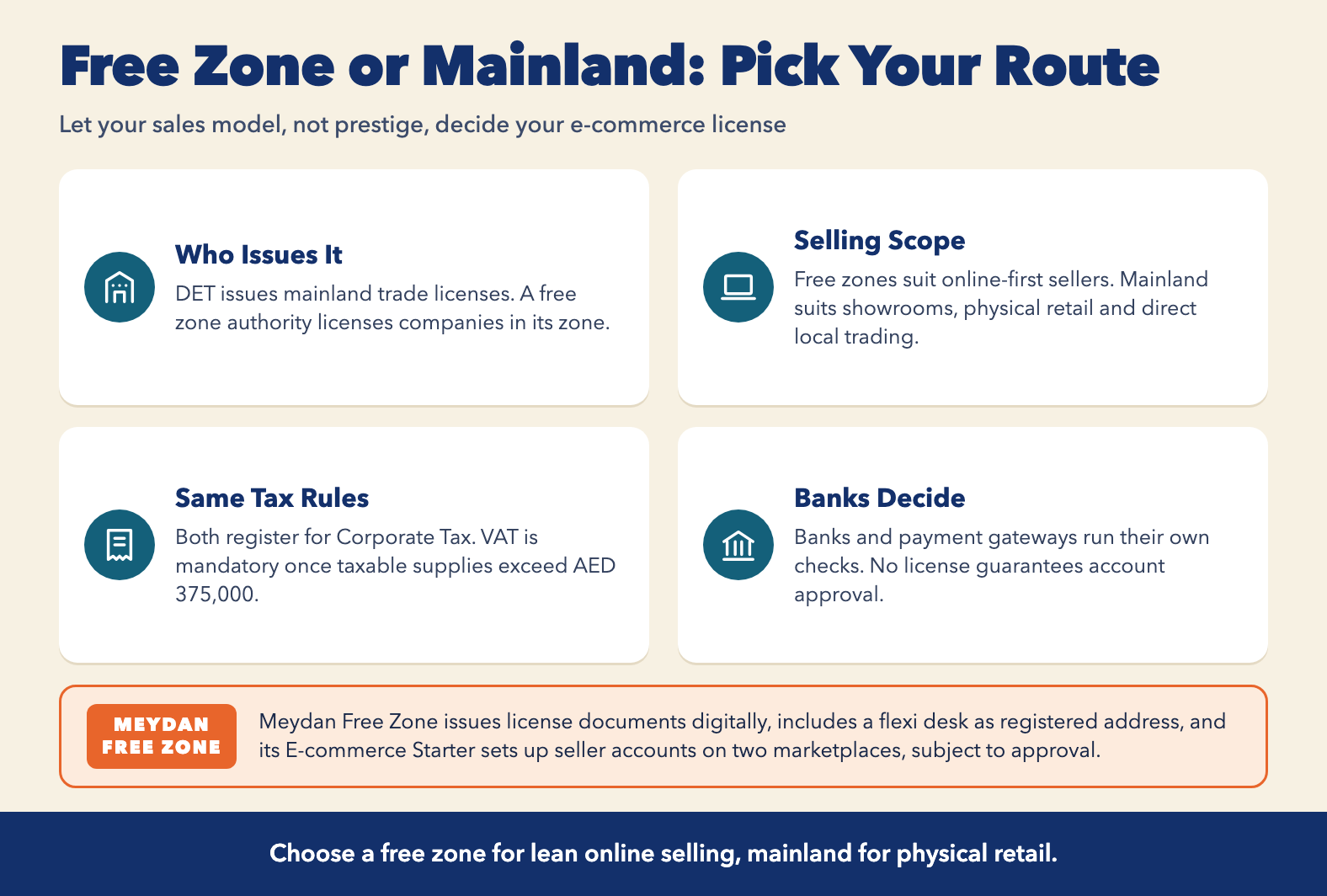
The core differences are licensing authority, selling scope, ownership structure, premises and visas. Free zone companies suit online-first sellers who want digital setup and a lean structure. Mainland companies suit sellers needing physical retail, government contracts or direct local trading. For a free zone seller, how goods reach mainland customers, including customs clearance and whether a mainland distributor is needed, depends on the products and route.
Ownership and Selling Scope
Compare ownership structures before applying, and rely only on rules the licensing authority publishes. An online fashion seller using a website and marketplaces has different needs from one who also wants a showroom. If your activities extend beyond online sales, a general trading vs e-commerce license comparison is worth reading first.
Premises, Visas and Workspace Compliance
- Free zone: every Meydan Free Zone license includes a flexi desk that serves as the registered address.
- Mainland: premises requirements form part of licensing.
- Visas: visa services are priced separately from the trade license, so budget for each one.
- mResidency covers residency visas, Emirates ID, medical fitness test and insurance.
A two-person team should plan residency visas after the license is issued, not before.
Tax, Compliance and Running Costs Compared
Both routes fall under UAE VAT and Corporate Tax rules administered by the Federal Tax Authority (FTA). Every company, including a free zone company, must register for Corporate Tax. VAT registration is mandatory once taxable supplies exceed AED 375,000 over the previous 12 months, or are expected to within the next 30 days. An online seller crossing that threshold in its first year must register, whichever license it holds.
Costs differ by license fees, premises and visas. Separate official fees from estimates before committing.
- License renewal is a recurring cost.
- Premises, visas and accounting add to annual spend.
- mAccounting covers bookkeeping, VAT registration support and Corporate Tax support.
- Meydan Free Zone's Cost Calculator helps a one-person store estimate setup costs.
Banking and Payment Gateway Considerations
Banks assess e-commerce companies on business model, ownership and compliance records, whatever the license type. Payment gateways add their own checks. Approval is always the bank's decision, and requirements for non-resident owners vary by bank. mCore provides business bank account support to help founders prepare applications.
Banks apply rules set by the Central Bank of the UAE (CBUAE). Prepare supplier invoices, a live website and a clear source of funds before applying.
Marketplace seller accounts need a valid license. mCore also covers e-commerce seller account setup. Its E-commerce Starter service sets up seller accounts on two online marketplaces and lists one product on each, subject to marketplace approval. It does not build an online store.
How a Free Zone Setup Works for Online Sellers
A free zone setup for online sellers is largely digital. You select an e-commerce activity, submit documents online and receive your license documents electronically. Single-shareholder companies using Fawri can be licensed in under 60 minutes.
Meydan Plus adds support through four pillars: mCore, mAssist, mResidency and mAccounting. For online sellers, mCore is the most relevant, covering bank account support, company stamps, business cards and E-commerce Starter marketplace seller-account setup. The full process is outlined in how to get an e-commerce license.
Free Business Setup Cost Calculator
Calculate NowHow to Choose Between Free Zone and Mainland in 4 Steps
- Define your sales channels. A website plus two marketplaces and no showroom points towards a free zone.
- Match activity to products. A cosmetics seller should check approval requirements before choosing a route.
- Compare ownership, premises and visas. A three-person team planning residency visas should map workspace and visa needs first.
- Model tax and recurring costs. Project turnover against the AED 375,000 VAT threshold and estimate setup costs with the Cost Calculator.
What the Choice Means for Your E-commerce Business
The right structure depends on how you sell, not on prestige. Decide on your operating model first, then compare costs.
When a Free Zone Fits
A solo founder selling through marketplaces and a website usually fits a free zone. Digital setup and a lean team are the draw.
When Mainland May Be Necessary
A seller opening a brick-and-mortar outlet in Dubai, or needing direct local trading, should assess mainland licensing through DET.
In practice, an e-commerce license works best when the structure follows the sales model. Map your channels and product categories before you decide. If marketplaces are your main channel, Meydan Free Zone's E-commerce Starter can set up seller accounts on two marketplaces once the license is issued, subject to marketplace approval.
Ready to Launch Your Business in Dubai?
Let's Connect