

Table of Contents
Frequently Asked Questions
What is a GIBAN and who issues it in the UAE?
A GIBAN is a Government IBAN, a unique account number in IBAN format. The Federal Tax Authority generates it for a taxpayer to use as the beneficiary account when settling VAT, Corporate Tax or other FTA liabilities. It is separate from your company's own business bank account IBAN.
Where can I find my GIBAN number in EmaraTax?
Log in to your EmaraTax account, open My Payments and use Select and Pay to choose the liabilities. EmaraTax generates a payment reference and shows the GIBAN and beneficiary details. Copy these exactly as displayed rather than retyping them.
Can I pay VAT and Corporate Tax in one GIBAN transfer?
Each transfer should match a payment reference generated in EmaraTax for the liabilities you selected. Paying VAT and Corporate Tax separately keeps balances easy to reconcile. If you're unsure how a combined payment will be allocated, check the current EmaraTax guidance before you send it.
When must a VAT payment reach the FTA?
VAT returns and payments are due within 28 days after the end of the tax period. Bank cut-off times and weekends can delay credit, so authorise the transfer a few working days before the deadline.
When is Corporate Tax payable after the financial year ends?
The Corporate Tax return and payment are due within nine months after the end of the tax period. A company with a 31 December year-end therefore has until 30 September. Qualifying Free Zone Persons still file a return even where the rate is 0%.
What happens if a tax payment goes to the wrong GIBAN?
The liability in EmaraTax stays unpaid, and late penalties can accrue while the deadline passes. Contact your bank and the Federal Tax Authority promptly with the transfer confirmation. A mistyped digit can also cause the bank to return the transfer.
Can a Meydan Free Zone company pay the FTA by GIBAN?
Yes. VAT and Corporate Tax are federal taxes administered by the Federal Tax Authority, so a Meydan Free Zone company pays through EmaraTax and a GIBAN like any other UAE taxpayer. Meydan Free Zone does not collect these payments. Its mAccounting pillar within Meydan Plus offers bookkeeping, VAT registration support and Corporate Tax support.
Should I keep the bank confirmation after paying the FTA?
Yes. Save the bank advice with the return file so you can show the payment if credit is missing or an audit follows. Also check that EmaraTax shows the payment against the correct tax period.
Topic Summary
What a GIBAN Is and How It Works for FTA Payments
A GIBAN is a Government IBAN, a unique bank account number that the Federal Tax Authority generates for each taxpayer. You use it as the beneficiary account in a bank transfer to settle VAT, Corporate Tax or other FTA liabilities, together with a payment reference generated in EmaraTax.
Where to Find Your GIBAN Number and FTA Details
Log in to your EmaraTax account, open My Payments and use Select and Pay to choose the liabilities you want to settle. EmaraTax then generates a unique payment reference number, and the screen shows the GIBAN and beneficiary details for the transfer.
How an FTA GIBAN Payment Works for VAT
After you file the VAT return in EmaraTax, the amount due appears on screen. You generate the payment reference and transfer the balance from a UAE bank account. Under FTA rules, VAT returns and payments are due within 28 days after the end of the tax period, so the transfer should clear before that date.
Steps to Complete an FTA GIBAN Payment
To pay the FTA with a GIBAN, log in to EmaraTax, confirm the amount due and retrieve the payment details. Add the FTA as a beneficiary at your bank, transfer the exact amount and keep the confirmation. Then check that the credit appears against the correct tax period.
How an FTA GIBAN Payment Works for Corporate Tax
Corporate Tax follows the same route. After filing the return in EmaraTax, generate the payment reference and transfer the balance. The return and payment are due within nine months after the end of the tax period, and the FTA applies the 9% rate to taxable income above AED 375,000.
Common GIBAN Payment Errors and How to Avoid Them
The most common errors are using the wrong GIBAN, omitting the payment reference and paying a different amount from the one tied to that reference. Sending the transfer too close to the deadline is another. Each can delay or block the payment and trigger penalties, so match every detail to EmaraTax before approving the transfer.
What This Means for a Meydan Free Zone Founder
A Meydan Free Zone company pays the FTA the same way as any UAE taxpayer, through EmaraTax and a GIBAN, because tax is federal. Meydan Free Zone does not collect these payments. Its mAccounting pillar, part of Meydan Plus, offers bookkeeping, VAT registration support and Corporate Tax support.
Paying the FTA Using a GIBAN: How VAT and Corporate Tax Payments Work
Paying the Federal Tax Authority (FTA) looks simple until a transfer lands without the right reference and the liability still shows as unpaid. Many founders assume any bank transfer clears a VAT or Corporate Tax balance, but the payment must carry the right GIBAN, payment reference and amount.
This guide explains what a GIBAN is, how to generate the payment details in EmaraTax, and which errors delay or block a payment.
What a GIBAN Is and How It Works for FTA Payments
A GIBAN is a Government IBAN, a unique bank account number that the Federal Tax Authority generates for each taxpayer. You use it as the beneficiary account in a bank transfer to settle VAT, Corporate Tax or other FTA liabilities, together with a payment reference generated in EmaraTax.
GIBAN Meaning and Purpose
The GIBAN is an IBAN-format account issued for tax payments. It routes the transfer to the FTA and ties it to the right taxpayer. It is separate from your company's own business bank account IBAN.
That distinction causes real problems. A trading company that pastes its own IBAN into the payment field will see no change in its FTA balance, and tracing the error takes days.
Why the FTA Uses Government IBANs
A GIBAN gives each payment a traceable route to a taxpayer account. It reduces manual matching of transfers to liabilities. It also works through UAE banks using standard transfer channels, so you don't need a special banking product.
Where to Find Your GIBAN Number and FTA Details
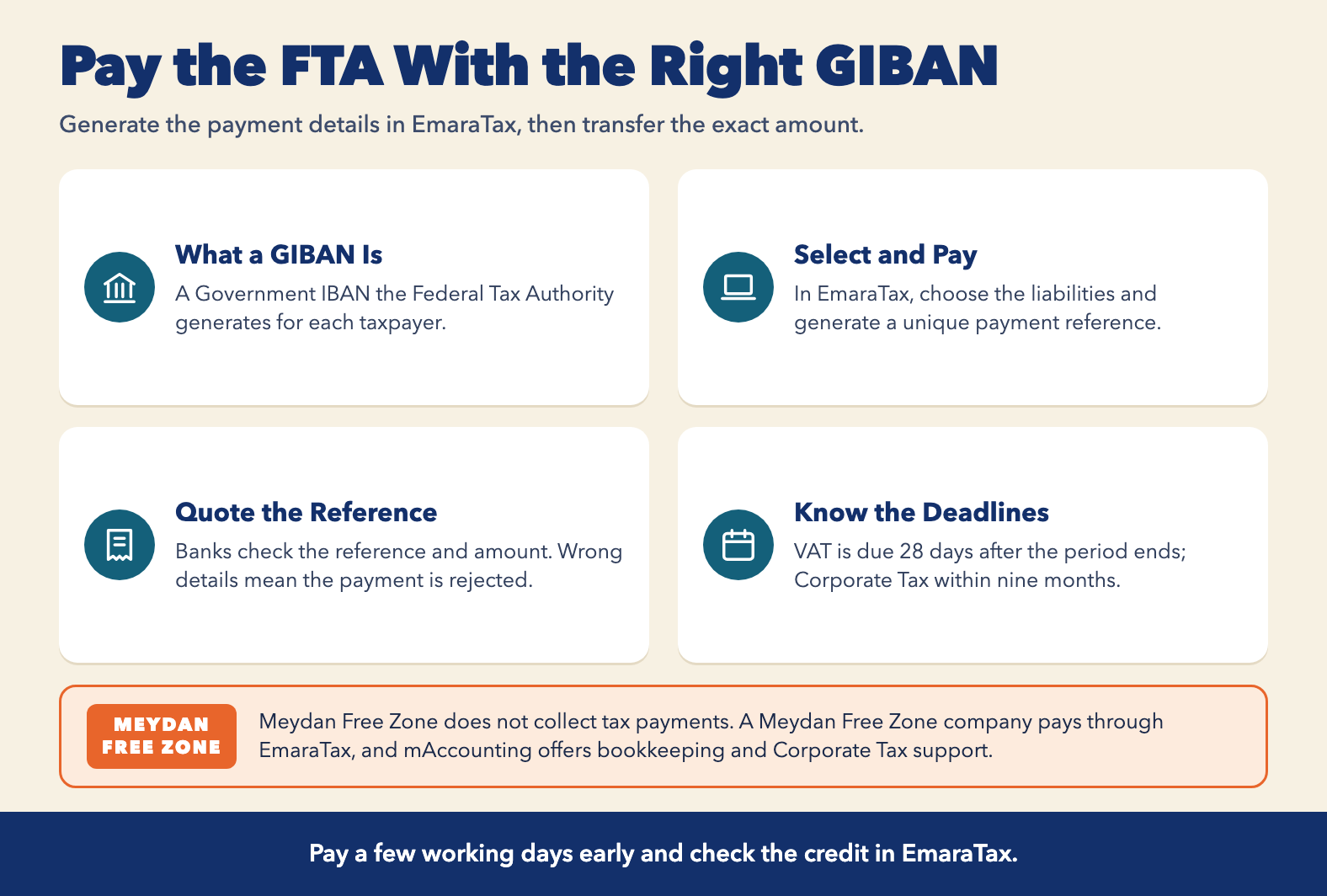
Log in to your EmaraTax account, open My Payments and use Select and Pay to choose the liabilities you want to settle. EmaraTax then generates a unique payment reference number, and the screen shows the GIBAN and beneficiary details for the transfer.
Retrieving the GIBAN in EmaraTax
Sign in with the account tied to your Tax Registration Number (TRN) or Corporate Tax registration. Select the payment option for the liability you're settling. Copy the beneficiary details exactly as displayed. A finance manager who pastes the GIBAN number and FTA details straight into the bank's beneficiary form avoids retyping errors altogether. For a new registration, the FTA notes that a GIBAN can take a couple of hours to be activated.
Details to Match Before You Send
- Beneficiary name, GIBAN and the six-digit payment reference.
- Your TRN or Corporate Tax number.
- The tax period or liability being paid.
- The exact amount shown in EmaraTax.
Check the tax period against the return before authorising the transfer. Screens and fields can change, so confirm against current FTA instructions.
How an FTA GIBAN Payment Works for VAT
After you file the VAT return in EmaraTax, the amount due appears on screen. You generate the payment reference and transfer the balance from a UAE bank account. Under FTA rules, VAT returns and payments are due within 28 days after the end of the tax period, so the transfer should clear before that date.
VAT Return Timing and Payment Deadlines
Bank cut-off times and weekends affect when credit posts. Say a quarterly filer submits on day 26 and pays on day 28. The credit can post after the deadline. A filed return with an unpaid balance can still attract penalties.
Paying VAT and Reconciling the Credit
Keep the bank confirmation with the return file. Confirm the payment shows against the correct period in EmaraTax. An accountant should match the bank advice to the VAT ledger before closing the quarter. If your books need review first, VAT filing services in Dubai can prepare the return before you pay.
Steps to Complete an FTA GIBAN Payment
To pay the FTA with a GIBAN, log in to EmaraTax, confirm the amount due and retrieve the payment details. Add the FTA as a beneficiary at your bank, transfer the exact amount and keep the confirmation. Then check that the credit appears against the correct tax period.
- Confirm the liability. Open the filed return or assessment. Note the exact amount and period.
- Retrieve the details. Copy the beneficiary name, GIBAN and payment reference. Each reference is tied to the liabilities you selected, so don't reuse an old one.
- Transfer from your bank. Use online banking or a branch. Enter the exact amount and reference. Authorise it a few working days before the deadline.
- Keep proof and check the credit. Save the bank advice next to the return for audit readiness. Confirm EmaraTax shows the payment.
How an FTA GIBAN Payment Works for Corporate Tax
Corporate Tax follows the same route. After filing the return in EmaraTax, generate the payment reference and transfer the balance. The return and payment are due within nine months after the end of the tax period, and the FTA applies the 9% rate to taxable income above AED 375,000.
Corporate Tax Deadlines and Payment Timing
A company with a 31 December year-end has until 30 September. A free zone company with that year-end should plan its transfer for mid-September. Qualifying Free Zone Persons still file a return even where the rate is 0%.
Separating Corporate Tax From VAT Payments
Each tax has its own return and liabilities in EmaraTax. The payment reference ties a transfer to the liabilities you selected, and a transfer with incorrect details can be rejected. Paying VAT and Corporate Tax separately keeps the records easy to reconcile. For the wider picture, read Corporate Tax vs VAT in Dubai.
Common GIBAN Payment Errors and How to Avoid Them
The most common errors are using the wrong GIBAN, omitting the payment reference and paying a different amount from the one tied to that reference. Sending the transfer too close to the deadline is another. Each can delay or block the payment and trigger penalties, so match every detail to EmaraTax before approving the transfer.
Wrong Account or Missing Reference
- A mistyped digit in the GIBAN returns the transfer, and the deadline passes.
- An old payment reference reused for a new liability can lead to rejection or misallocation.
- A missing or wrong reference can cause the bank to reject the transfer.
Timing and Bank Processing Risks
A Friday afternoon transfer can clear on Monday, after the due date. Pay at least a few working days early. If credit is missing, contact your bank and the FTA with proof of payment. Banking rules and settlement context sit with the Central Bank of the UAE.
What This Means for a Meydan Free Zone Founder
A Meydan Free Zone company pays the FTA the same way as any UAE taxpayer, through EmaraTax and a GIBAN, because tax is federal. Meydan Free Zone does not collect these payments. Its mAccounting pillar, part of Meydan Plus, offers bookkeeping, VAT registration support and Corporate Tax support.
Federal Tax, Free Zone Company
The Federal Tax Authority administers VAT and Corporate Tax, not the free zone authority. Paying from the company's UAE business bank account keeps records clean. Meydan Free Zone issues the Business License, Certificate of Formation, Share Register and Memorandum and Articles of Association digitally. A solo founder licensed through Fawri registers for VAT once taxable supplies pass AED 375,000, then pays each return by GIBAN transfer from the company account.
Support Through mAccounting
If you'd rather not run the books yourself, mAccounting offers bookkeeping and Corporate Tax support, so the figures behind each return are in order before the deadline. mCore supports business bank account setup, though approval remains the bank's decision. See UAE corporate tax services for the Corporate Tax side.
Free Business Setup Cost Calculator
Calculate NowConclusion
An FTA GIBAN payment is a controlled routine, not a one-off task. Retrieve the details from EmaraTax, pay the exact amount from a UAE bank account, keep the confirmation and check the credit. Founders who build this into each filing calendar avoid late penalties and unclear balances.
Set a payment date a few working days before each VAT and Corporate Tax deadline, and decide who generates the reference and who approves the transfer. For a Meydan Free Zone company the routine is the same as anywhere in the UAE, and mAccounting's bookkeeping support can keep the figures behind each transfer ready.
Ready to Launch Your Business in Dubai?
Let's Connect