Table of Contents
Frequently Asked Questions
Which Incoterm is safest for a first-time importer bringing goods into Dubai?
FCA or FOB usually suits a first-time importer who has a trusted freight forwarder, because the buyer controls freight and customs clearance in the UAE. DAP gives more certainty on delivery cost, since the seller carries risk to the named destination. Avoid DDP unless the seller can act as importer in the UAE.
Does the Incoterm change how customs value is calculated in the UAE?
The Incoterm does not change UAE customs rules, but it changes what the invoice price includes. Customs value is generally assessed on a CIF basis at the point of entry. If the invoice is on FOB terms, the importer adds freight and insurance to reach the declared value.
Can a UAE exporter use EXW if the buyer cannot clear export formalities?
It is not advisable. Under EXW the buyer is responsible for export clearance, so a buyer without local capability can leave the shipment stuck. FCA is the safer option because the seller clears the goods for export and hands them to the buyer's carrier.
Who pays for demurrage if cargo sits at the port under a DAP sale?
The contract decides, so it should be stated clearly. Under DAP the seller carries cost and risk to the named destination, and the buyer is responsible for import clearance. Detention charges caused by the buyer's delay in clearing are commonly allocated to the buyer, but only if the sales contract says so.
Why do banks check the Incoterm on a letter of credit?
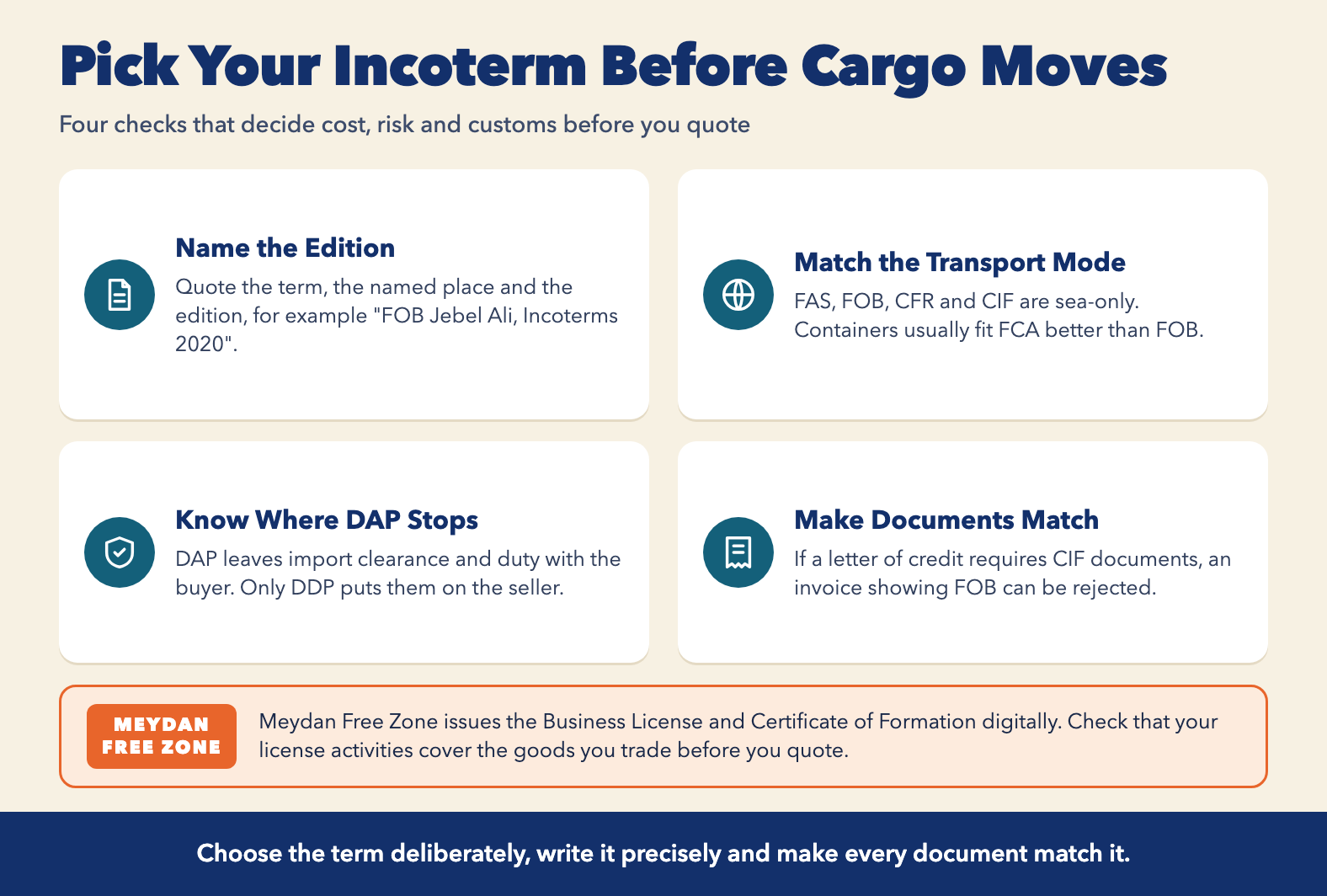
Banks examine whether the documents presented match the credit exactly. If the letter of credit requires CIF documents, an invoice showing FOB can be rejected as a discrepancy. The term also shows whether freight and insurance documents are expected.
Is DDP practical for a free zone company selling into the mainland?
Rarely. DDP makes the seller responsible for import clearance, duty and any VAT due. A free zone company needs the right registrations and customs arrangements to take on that role. DAP, with the buyer clearing the goods, is usually simpler.
Do Incoterms transfer ownership of the goods to the buyer?
No. Incoterms cover delivery, costs and the point where risk passes. Transfer of title and payment terms are set in the sales contract. A buyer can therefore bear the risk of loss before legally owning the goods.
Which edition of the rules should a UAE contract cite?
Cite Incoterms 2020, the current edition published by the International Chamber of Commerce, which has eleven terms. Parties may agree to use an older edition, but the contract must say so. Write the term, the named place and the edition together, for example 'DAP Jebel Ali, Incoterms 2020'.
Topic Summary
What Incoterms Mean in UAE Trade
Incoterms are standardised trade terms published by the International Chamber of Commerce (ICC). They define who arranges transport, who pays freight and insurance, who clears customs, and where risk passes. They apply to a UAE sale only when the sales contract names them, because they are contractual, not statutory.
How the Main Incoterms Compare
EXW places almost all cost and risk on the buyer, while DDP places almost all of it on the seller. Under the Incoterms 2020 rules, FAS, FOB, CFR and CIF are for sea and inland waterway transport only. The other seven terms (EXW, FCA, CPT, CIP, DAP, DPU and DDP) suit any mode, including containers and air.
Incoterms and Customs Clearance in Dubai
The Incoterm decides who acts as importer or exporter of record and who supplies documents. Under DDP, the seller handles import clearance. Under EXW, the buyer handles export clearance. Whatever the contract says, duty and customs valuation in Dubai still follow UAE customs rules.
How to Choose the Right Incoterm for Your Shipment
Follow a set order. Confirm the transport mode, decide how much freight control you want, check insurance needs, review who can clear customs, then match your buyer's capability and payment method. Write the term with its named place and edition. This order gives you a term your trading partners will recognise.
Cost and Risk Mechanics Under Each Term
Cost and risk split at different points. Under FOB, the seller pays until goods are on board. Under DAP, the seller pays and bears risk until arrival. Insurance, handling and duty add to every shipment, so price them before agreeing a term. The point where risk transfers also decides who files the insurance claim.
What Your Incoterm Choice Means for a Meydan Free Zone Trader
A Meydan Free Zone company trading goods needs a license with the right trading activities, plus the documents customs and banks expect. Choose the term your company can actually handle, including customs registration, freight and payment flows. The term you quote only works if your license covers the goods and your role.
Conclusion
Choosing an Incoterm is a commercial decision, not paperwork. The right term follows the cargo, the buyer's capability and the cost of carrying risk. Name the term, the place and the edition in every contract and invoice.
Incoterms for UAE Importers and Exporters: Choosing the Right Term
A single three-letter term on a quotation decides who pays for freight and insurance, who carries the risk at each stage and who clears the goods through customs. Many UAE traders only find this out after cargo is damaged or held at port. This guide compares the main Incoterms 2020 rules and shows how to match one to your cargo, your buyer and your appetite for risk.
What Incoterms Mean in UAE Trade
Incoterms are standardised trade terms published by the International Chamber of Commerce (ICC). They define who arranges transport, who pays freight and insurance, who clears customs, and where risk passes. They apply to a UAE sale only when the sales contract names them, because they are contractual, not statutory.
Who Publishes the Rules and Which Version Applies
The ICC's current edition is Incoterms 2020, which has eleven terms. Parties can cite an older edition if the contract says so. A Dubai trader should therefore quote "FOB Jebel Ali, Incoterms 2020" to leave no doubt.
What Incoterms Do Not Cover
- Title transfer, payment method and dispute resolution sit in the contract.
- Duty rates and permits follow UAE customs rules.
- Vague wording such as "delivered" invites disputes.
Say a buyer assumes DAP covers import duty. It doesn't. DAP leaves import clearance and duty with the buyer.
Why the Term Matters Commercially
The term shapes price, insurance cover and who can claim against the carrier. Banks also read it against your documents. If a letter of credit requires CIF documents, an invoice showing FOB can be rejected as a discrepancy. Courts then read the contract's wording as written, so see our guide to UAE contract law for the clauses that matter.
How the Main Incoterms Compare
EXW places almost all cost and risk on the buyer, while DDP places almost all of it on the seller. Under the Incoterms 2020 rules, FAS, FOB, CFR and CIF are for sea and inland waterway transport only. The other seven terms (EXW, FCA, CPT, CIP, DAP, DPU and DDP) suit any mode, including containers and air.
Sea Freight Terms: FOB, CFR and CIF
Under FOB, CFR and CIF, risk passes once the goods are on board the vessel at the loading port. CIF obliges the seller to buy only minimum insurance cover. An exporter shipping machinery from Jebel Ali under CIF controls the freight booking, but the buyer carries the risk once the cargo is loaded. Containers usually fit FCA better than FOB.
Where Buyers and Sellers Usually Disagree
- Insurance level under CIF versus CIP.
- Who pays demurrage and detention.
- DDP for sellers with no local import presence.
Detention charges accrue daily at port when a DAP buyer delays clearance. Write who bears them into the contract.
Incoterms and Customs Clearance in Dubai
The Incoterm decides who acts as importer or exporter of record and who supplies documents. Under DDP, the seller handles import clearance. Under EXW, the buyer handles export clearance. Whatever the contract says, duty and customs valuation in Dubai still follow UAE customs rules.
Customs Responsibility and Documentation
In Dubai, Dubai Customs handles clearance, not the Federal Tax Authority, although the FTA administers VAT on imports. Your commercial invoice, packing list and bill of lading must match the stated term. An invoice showing CIF with a freight-collect bill of lading triggers queries. Our guide to key documents needed for an import-export business in Dubai lists the full set.
Customs Value, Ports and VAT
Dubai Customs assesses customs value on a CIF basis, under the GCC Common Customs Law. An FOB importer therefore adds freight and insurance to reach the declared value, and should keep those records. Port handling at Jebel Ali runs under DP World. Goods entering a free zone and goods released into the mainland are treated differently for customs and VAT. The Federal Tax Authority requires VAT registration once taxable supplies and imports exceed AED 375,000 a year.
How to Choose the Right Incoterm for Your Shipment
Follow a set order. Confirm the transport mode, decide how much freight control you want, check insurance needs, review who can clear customs, then match your buyer's capability and payment method. Write the term with its named place and edition. This order gives you a term your trading partners will recognise.
Step 1: Confirm Transport Mode and Named Place
- Use sea-only terms for bulk cargo, any-mode terms for containers and air.
- Name a precise place: a named forwarder's warehouse address in Dubai, not just "FCA Dubai".
Step 2: Decide How Much Control You Need
- Sellers wanting the carrier choice use CIF, CIP or DAP.
- Buyers with a negotiated forwarder insist on FOB or FCA.
Cost and Responsibility Split Across Common Incoterms
| Feature | Seller Responsibility | Buyer Responsibility |
|---|---|---|
| Export clearance | FCA, FOB, CIF, DAP, DDP | EXW |
| Main freight | CIF, DAP, DDP | EXW, FCA, FOB |
| Cargo insurance | CIF (minimum cover) and CIP (higher cover) | EXW, FCA, FOB, and DAP or DDP if wanted for own interest |
| Import clearance | DDP only | EXW, FCA, FOB, CIF, DAP |
| Import duty and VAT | DDP only | All other terms, including DAP |
Step 3: Check Insurance and Payment Terms
- Under Incoterms 2020, CIP requires a higher level of cover than CIF, which suits high-value electronics.
- Align the term with your letter of credit.
Step 4: Confirm Customs Capability and Record the Term
- Avoid DDP unless the seller can act as importer in the UAE.
- Write "DAP Jebel Ali, Incoterms 2020" in the contract and invoice.
Cost and Risk Mechanics Under Each Term
Cost and risk split at different points. Under FOB, the seller pays until goods are on board. Under DAP, the seller pays and bears risk until arrival. Insurance, handling and duty add to every shipment, so price them before agreeing a term. The point where risk transfers also decides who files the insurance claim.
Where Risk Transfers and Why It Matters
Risk passes at loading, at first carrier handover or at destination, depending on the term. Cargo damaged at sea after FOB loading is the buyer's loss, and the claim runs through the buyer's insurer. That holds even if title hasn't passed.
Settling Disputes Before They Escalate
Document condition at handover with survey reports and photos. Name the governing law and venue, so any dispute that escalates does so on agreed terms. A signed handover report helps settle rejected-shipment claims quickly. Where banks or insurers are involved, they are regulated by the Central Bank of the UAE.
What Your Incoterm Choice Means for a Meydan Free Zone Trader
A Meydan Free Zone company trading goods needs a license with the right trading activities, plus the documents customs and banks expect. Choose the term your company can actually handle, including customs registration, freight and payment flows. The term you quote only works if your license covers the goods and your role.
Licensing the Right Trading Activities
Your license activities should cover the goods and your import or export role. A founder should align the activity with the commodity before signing a DAP sale. Meydan Free Zone issues the Business License, Certificate of Formation, Share Register and Memorandum and Articles of Association digitally. Our guide to an import export license in Dubai covers the options.
Banking and Accounting Support
mCore covers business bank account support, a company stamp and business cards. Bank approval itself rests with the bank. mAccounting covers bookkeeping, VAT registration support and Corporate Tax support, so a trader can reconcile CIF invoices and freight costs against VAT and Corporate Tax records.
Free Business Setup Cost Calculator
Calculate NowConclusion
Choosing an Incoterm is a commercial decision, not paperwork. The right term follows the cargo, the buyer's capability and the cost of carrying risk. Name the term, the place and the edition in every contract and invoice.
Before your next quotation, list who handles freight, insurance and customs, then pick the matching term. With Meydan Free Zone, the Business License and Certificate of Formation are issued digitally, so the remaining check is that your license activities cover the goods you quote on.
Ready to Launch Your Business in Dubai?
Let's Connect