Table of Contents
Frequently Asked Questions
How much of its annual profit must an LLC set aside as a legal reserve?
A mainland LLC transfers 5% of its net profit each year to the legal reserve under the Commercial Companies Law. The transfer is calculated on net profit for the financial year after expenses. For example, net profit of AED 250,000 means a transfer of AED 12,500, leaving AED 237,500 for possible distribution.
When can an LLC stop transferring profit to the legal reserve?
Shareholders may stop the transfers once the reserve equals 50% of the company's share capital. An LLC with AED 200,000 in share capital can stop at a reserve of AED 100,000. Check the Memorandum and Articles of Association for whether transfers restart if the reserve later falls.
Can shareholders receive the legal reserve as a dividend?
No. The legal reserve is a restricted equity balance that protects creditors, so it is not available for distribution as dividends. Only the distributable profit remaining after the reserve transfer can be paid out to shareholders.
Does an LLC that makes a loss still have to fund the reserve?
No. The transfer is based on net profit, so a loss-making year produces no transfer. A start-up that reports a loss in its first year simply makes no allocation. The reserve is not refunded to shareholders while the company continues to operate.
Is the legal reserve held in a separate bank account?
No. The legal reserve is an accounting entry within equity, not a cash fund. It appears as a separate line on the balance sheet alongside share capital and retained earnings. The company's cash stays in its normal operating accounts.
Who approves the transfer to the legal reserve?
Shareholders approve the transfer through a resolution that is based on the annual financial statements. The resolution should record the reserve amount and any dividend declared. Keep it with the accounts, as auditors and banks often ask to see it.
Does the legal reserve reduce an LLC's taxable income?
No. The reserve is an appropriation of profit after it has been calculated, not a business expense. The transfer therefore does not create a Corporate Tax deduction. It is shown in the statement of changes in equity and on the balance sheet.
What happens if an LLC pays dividends before funding the reserve?
The distribution can be challenged by co-shareholders and questioned by auditors and banks. It may also expose those who approved it to liability. Fund the reserve and record it in the accounts before declaring any dividend.
Topic Summary
What the Statutory Reserve for an LLC in the UAE Means
The statutory reserve for an LLC in the UAE is a mandatory fund built from annual net profit. Under the Commercial Companies Law, a mainland LLC sets aside 5% of net profit each year. Shareholders may stop the transfers once the reserve reaches 50% of share capital. The reserve stays in the company as a buffer for creditors rather than being paid out as dividends.
How the 5% Rule and the 50% Cap Work
Each year, a mainland LLC deducts 5% of net profit and transfers it to the legal reserve. Shareholders may stop the deductions once the reserve equals 50% of share capital. The reserve can only be used in the ways the law and the constitutional documents allow.
How to Calculate and Record the Reserve Each Year
To record the statutory reserve for a mainland LLC, finalise net profit, deduct 5% until the cap is met, pass a shareholders' resolution, post the transfer to equity and only then declare dividends.
Tax and Accounting Treatment of the Legal Reserve
The legal reserve is an equity appropriation of profit, not an expense. The transfer does not by itself reduce taxable income for Corporate Tax. Check current treatment on the Federal Tax Authority website.
How a Meydan Free Zone Company Applies the Legal Reserve
A Meydan Free Zone company follows its Memorandum and Articles of Association and the Meydan Free Zone Companies and Licensing Regulations. Those regulations state that the federal Commercial Companies Law does not apply within the free zone. They allow distributions only out of accumulated, realised profits, approved by Special Resolution. Check whether your Articles require a reserve, and confirm the position with Meydan Free Zone before the first dividend decision.
Risks of Ignoring the Statutory Reserve
Skipping the statutory reserve for a mainland LLC can make a dividend open to challenge, create friction with co-shareholders, draw audit questions and may expose directors to liability. The risk grows when profits are distributed before the transfer is recorded.
Conclusion
For a mainland LLC, the statutory reserve is simple but binding: 5% of net profit until the reserve reaches 50% of share capital, recorded before any dividend. Build it into your year-end routine and you avoid disputes and audit queries.
Statutory Reserve for an LLC in the UAE: How the Legal Reserve Works
Most founders treat annual profit as cash they can take home. Then a bank, an auditor or a co-shareholder asks for the accounts, and the legal reserve line is missing. For a mainland LLC, the statutory reserve decides how much profit can be distributed, while a Meydan Free Zone company follows different rules. This guide explains how the reserve works, how to record it and what it means for dividends.
What the Statutory Reserve for an LLC in the UAE Means
The statutory reserve for an LLC in the UAE is a mandatory fund built from annual net profit. Under the Commercial Companies Law, a mainland LLC sets aside 5% of net profit each year. Shareholders may stop the transfers once the reserve reaches 50% of share capital. The reserve stays in the company as a buffer for creditors rather than being paid out as dividends.
Definition and Legal Basis
The reserve is a profit-funded capital buffer. The law in force is Federal Decree-Law No. 32 of 2021 on Commercial Companies, which replaced Federal Law No. 2 of 2015 and cut the LLC transfer from 10% to 5%.
The reserve sits in equity. It is not a separate bank account, so the cash stays in the business while the equity line becomes restricted. That is where the belief that profit equals cash breaks down. An LLC that earns AED 400,000 net profit transfers AED 20,000 to the reserve before declaring any dividend.
Statutory Reserve Rules at a Glance
| Rule (mainland LLC) | Requirement |
|---|---|
| Annual transfer rate | 5% of net profit; AED 20,000 on AED 400,000 profit |
| Cap | 50% of share capital; transfers may stop at AED 150,000 on AED 300,000 capital |
| Timing | Transfer is made before any dividend is declared |
| Distribution | Not available as dividends while the company operates |
| Recorded in | Equity section of the financial statements, as a separate line |
Why the Reserve Exists
It keeps a minimum capital cushion inside the company for creditors. It also limits how much profit shareholders can withdraw in the early years. A bank reviewing audited accounts may read the reserve line as evidence of statutory compliance.
Which Companies Must Hold One
The rule applies to mainland LLCs under the Commercial Companies Law. Listed public joint stock companies, overseen by the Capital Market Authority (formerly the Securities and Commodities Authority), have their own reserve provisions. Free zone companies follow their own regulations and constitutional documents, covered below. Take a two-shareholder mainland LLC with AED 300,000 share capital: the reserve cap is AED 150,000. For background on the structure, read why start an FZE LLC in Dubai.
How the 5% Rule and the 50% Cap Work
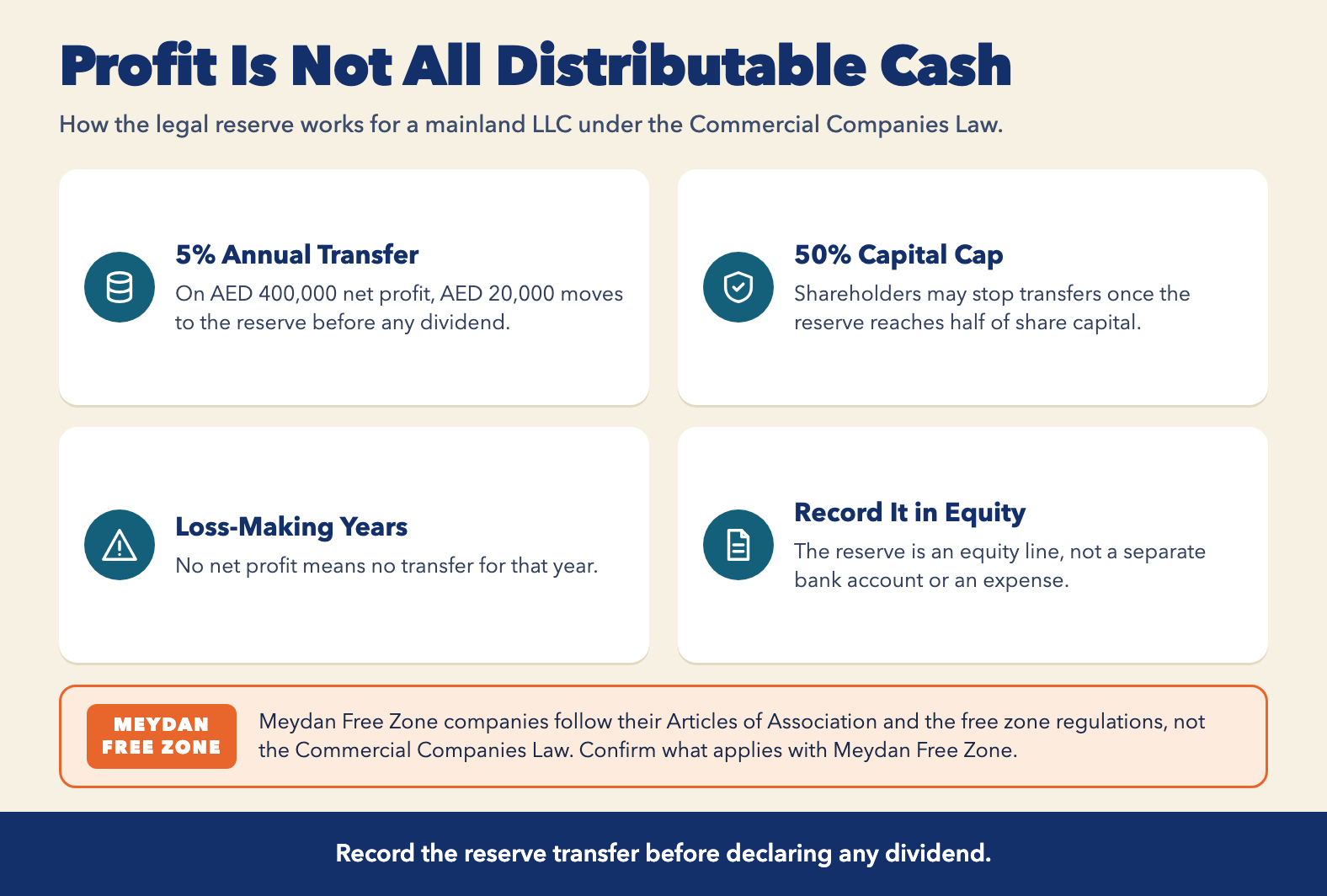
Each year, a mainland LLC deducts 5% of net profit and transfers it to the legal reserve. Shareholders may stop the deductions once the reserve equals 50% of share capital. The reserve can only be used in the ways the law and the constitutional documents allow.
The Annual 5% Deduction
The deduction is calculated on net profit after expenses for the financial year. Net profit of AED 250,000 produces an AED 12,500 transfer, leaving AED 237,500 available for distribution, subject to other legal limits. The shareholders' resolution should record the transfer.
When the Cap Is Reached
The cap is 50% of share capital. With AED 200,000 capital, the cap is AED 100,000. After several profitable years the reserve reaches that figure and shareholders may stop the transfers. Check your Memorandum and Articles of Association for whether transfers restart if the reserve later falls.
What Happens in a Loss-Making Year
No net profit means no transfer. A start-up that reports a loss in year one simply makes none. The reserve is not refunded to shareholders while the company operates.
How to Calculate and Record the Reserve Each Year
To record the statutory reserve for a mainland LLC, finalise net profit, deduct 5% until the cap is met, pass a shareholders' resolution, post the transfer to equity and only then declare dividends.
- Finalise net profit. Close the books and use the annual financial statements figure, not a management estimate. Say a company closes at AED 180,000.
- Apply the 5% transfer. Check the reserve balance against the cap. Transfer the lower of 5% of profit or the amount left to reach the cap. Here, that is AED 9,000.
- Approve and document. A written resolution signed by shareholders records, for example, AED 9,000 to reserve and a AED 100,000 dividend. Keep it with the accounts for banks and auditors. Your shareholders' agreement should say how this is decided.
- Declare dividends after the transfer. Dividends come from distributable profit after the reserve. A dividend paid before the reserve was funded may be open to challenge.
Tax and Accounting Treatment of the Legal Reserve
The legal reserve is an equity appropriation of profit, not an expense. The transfer does not by itself reduce taxable income for Corporate Tax. Check current treatment on the Federal Tax Authority website.
In practice, the profit and loss statement shows AED 180,000 profit, and the AED 9,000 transfer appears in the statement of changes in equity. The balance sheet then shows share capital, legal reserve and retained earnings as separate lines. Banks and auditors will look for that reserve line.
How a Meydan Free Zone Company Applies the Legal Reserve
A Meydan Free Zone company follows its Memorandum and Articles of Association and the Meydan Free Zone Companies and Licensing Regulations. Those regulations state that the federal Commercial Companies Law does not apply within the free zone. They allow distributions only out of accumulated, realised profits, approved by Special Resolution. Check whether your Articles require a reserve, and confirm the position with Meydan Free Zone before the first dividend decision.
Meydan Free Zone does not handle the reserve for you. Year-end records are your responsibility. mAccounting, a Meydan Plus pillar offering bookkeeping, VAT registration support, Corporate Tax support and financial audit reports, can support them. A solo founder, for instance, can prepare year-end profit figures from those bookkeeping records.
Free Business Setup Cost Calculator
Calculate NowRisks of Ignoring the Statutory Reserve
Skipping the statutory reserve for a mainland LLC can make a dividend open to challenge, create friction with co-shareholders, draw audit questions and may expose directors to liability. The risk grows when profits are distributed before the transfer is recorded.
Picture two partners who split profit, then one finds the reserve was never funded. The dispute is about the distribution itself, and a clear shareholders' agreement is the best protection. Auditors may also flag missing reserve entries and could qualify accounts that lack a required legal reserve. Banks expect a compliant equity structure. For wider exposure, see penalties for non-compliance in the UAE.
Conclusion
For a mainland LLC, the statutory reserve is simple but binding: 5% of net profit until the reserve reaches 50% of share capital, recorded before any dividend. Build it into your year-end routine and you avoid disputes and audit queries.
A Meydan Free Zone company works from its own Articles of Association and the free zone's regulations instead. Confirm with Meydan Free Zone what applies to you before you decide how profits will be distributed.
Ready to Launch Your Business in Dubai?
Let's Connect