Table of Contents
Frequently Asked Questions
Does open finance change how a business opens a bank account in the UAE?
No. Open finance governs how financial details are shared after an account exists. Banks still carry out their own onboarding, AML and KYC checks, so the documents and ownership information they require remain the same. A business should expect no faster approval simply because open finance exists.
Who regulates data sharing between banks and third-party providers in the UAE?
The Central Bank of the UAE issued the Open Finance Regulation and licenses the providers that take part. Securities and investment products fall under the Capital Market Authority, which replaced the Securities and Commodities Authority in January 2026. Check which regulator covers a provider before connecting any accounts.
Can a company withdraw consent after sharing its financial details?
Yes. Consent under the framework is specific, time-bound and revocable. A company can limit what a provider may access and end the connection when it no longer needs the service, for example after changing accountants. Reviewing active consents regularly keeps control with the business.
Is a free zone company covered by the UAE open finance framework?
Yes, through its bank. A Meydan Free Zone company holds accounts with licensed UAE financial institutions, so open finance applies through those institutions rather than through the free zone. Meydan Free Zone issues the Business License and corporate documents digitally, and mCore supports business bank account setup, though the bank makes the final decision.
Which financial products can fall under open finance rules?
Open finance extends beyond payment accounts, which are the focus of open banking. It can also cover products such as insurance and credit. The scope available to a business depends on what its financial institutions and authorised providers offer.
How can a business check that a provider is authorised?
Confirm the provider's authorisation with the relevant regulator, such as the Central Bank of the UAE, before connecting any accounts. Then review the consent scope and expiry the provider requests. Finally, decide which people inside the company can approve access.
Does open finance affect VAT and Corporate Tax reporting?
It does not change tax obligations, which remain with the Federal Tax Authority (FTA). It can make records cleaner, because live transaction feeds reduce manual entry and support reconciliation. Meydan Free Zone's mAccounting offers bookkeeping, VAT registration support and Corporate Tax support.
Does connecting accounts guarantee faster loan approval?
No. Sharing verified account activity gives a lender reliable cash flow data, which can speed up assessment. Approval still depends on the lender's own criteria, and no outcome is guaranteed.
Topic Summary
What Open Finance in the UAE Means
Open finance in the UAE lets customers, including businesses, share their financial details securely with licensed third-party providers through consent-based digital connections. It extends beyond bank accounts to insurance and credit products, under a framework overseen by the Central Bank of the UAE.
How the UAE Open Finance Framework Works
The framework relies on standardised APIs, customer consent and licensed participants. A business grants permission, a provider requests specific details from a financial institution, and the institution releases only what the consent covers. Consent can be limited in scope, time-bound and withdrawn.
Practical Business Uses of Open Finance
Businesses can use open finance for automated bookkeeping, faster credit assessments, consolidated cash flow views and easier tax reporting. Each use depends on the provider's authorisation and the consent given. The benefit is practical only when your records are already clean.
Compliance and Risk Mechanics for Business Owners
Open finance does not relax compliance. You must still meet AML and KYC obligations, protect access credentials and grant consent only to authorised providers. The main risks are over-broad consent, unlicensed providers and weak internal control over who approves data sharing.
How to Prepare Your Business for Open Finance
Preparing involves six actions: organise corporate records, open a business bank account, appoint authorised signatories, choose a licensed provider, set consent limits and review connections regularly. Each reduces onboarding friction and keeps control of your details with the company.
What Open Finance in the UAE Means for a Meydan Free Zone Company
A Meydan Free Zone company banks with licensed UAE institutions, so open finance applies through those banks, not through the free zone. Meydan Free Zone issues the Business License, Certificate of Formation, Share Register and Memorandum and Articles of Association digitally.
Conclusion
Open finance in the UAE rewards businesses that keep clean records and clear control over who approves access. Execution matters more than the technology: consent, provider checks and tidy documents. With Meydan Free Zone, your Business License and corporate documents are issued digitally, so they are ready to share with your bank from day one.
Open Finance in the UAE: What It Means for Businesses
Your business already shares bank statements and financial details with accountants, lenders and software platforms, usually by email and PDF. Open finance changes how that sharing is controlled, and it is more than a retail banking upgrade. This guide explains how the UAE framework works, where it helps day to day and what to set up so your company keeps control of its data.
What Open Finance in the UAE Means
Open finance in the UAE lets customers, including businesses, share their financial details securely with licensed third-party providers through consent-based digital connections. It extends beyond bank accounts to insurance and credit products, under a framework overseen by the Central Bank of the UAE.
Open Banking Versus Open Finance
Open banking covers payment accounts. Open finance widens the scope to other financial products. The business owns the details, and providers access them only with consent. It's a regulated data-sharing framework, not a bank feature.
Say a trading company authorises an accounting platform to read its bank balances, so no statements need to be emailed.
Who Regulates the Framework
The Central Bank of the UAE issued the Open Finance Regulation and licenses the providers that take part. The Capital Market Authority (formerly the Securities and Commodities Authority) regulates securities and investment products, so check which regulator covers any provider you plan to use. Free zone companies take part through the licensed banks and insurers they already use.
Common Founder Misconceptions
- It isn't a new bank account type.
- It doesn't move funds without consent.
- It doesn't replace KYC checks, so onboarding rules still apply.
Manual Sharing Versus Consent-Based Open Finance
| Feature | Manual Sharing | Open Finance |
|---|---|---|
| Method of sharing details | PDF statements sent by email | Standardised API connection |
| Control over access | Files stay with recipients indefinitely | Consent is time-bound and revocable |
| Reconciliation effort | Manual entry by your bookkeeper | Transactions feed in automatically |
| Lender assessment | Self-prepared statements to verify | Verified account activity from the source |
| Security exposure | Documents sit in inboxes and shared folders | Access limited to authorised providers and scope |
How the UAE Open Finance Framework Works
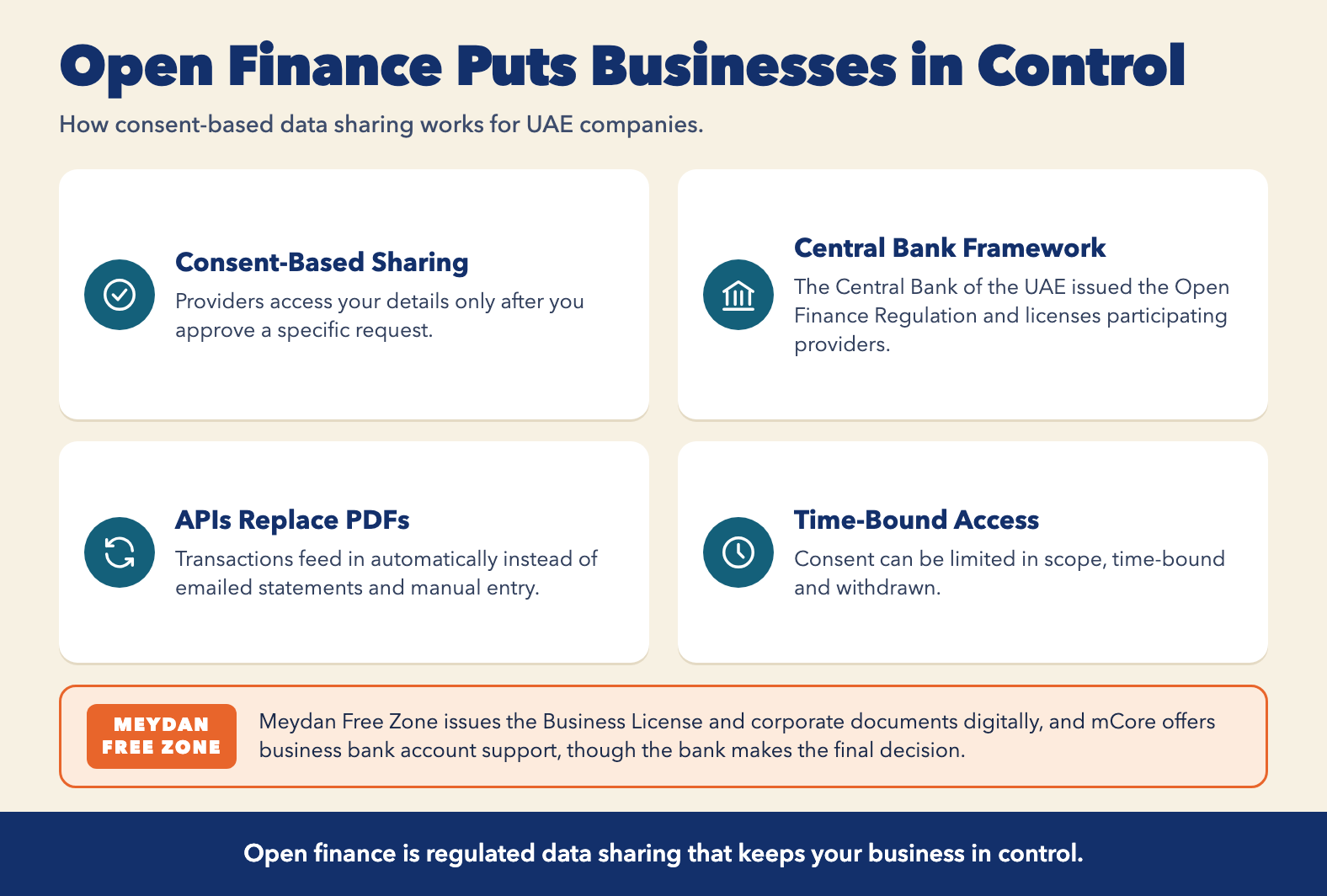
The framework relies on standardised APIs, customer consent and licensed participants. A business grants permission, a provider requests specific details from a financial institution, and the institution releases only what the consent covers. Consent can be limited in scope, time-bound and withdrawn.
Consent, APIs and Data Scope
APIs replace manual statement sharing. Scope defines which account or product details move. A lender might read six months of transaction history after the owner approves a single request, and nothing beyond it.
Roles of Banks and Third-Party Providers
- Banks and insurers release the details they hold.
- Providers use them to deliver a service.
- Providers must be licensed or authorised.
- Your business stays in control.
Where Digital Identity Fits
Strong authentication supports consent, and each bank sets how customers confirm an approval. UAE PASS is the national digital identity used for sign-in and signing across many UAE services.
Practical Business Uses of Open Finance
Businesses can use open finance for automated bookkeeping, faster credit assessments, consolidated cash flow views and easier tax reporting. Each use depends on the provider's authorisation and the consent given. The benefit is practical only when your records are already clean.
Bookkeeping and Tax Reporting
Live transaction feeds cut manual entry. A trading company can reconcile monthly sales against bank receipts automatically. Cleaner records support filings with the Federal Tax Authority. VAT registration is mandatory once taxable supplies exceed AED 375,000 over 12 months.
Credit and Financing Access
An SME can share twelve months of verified account activity with a lender. That's stronger evidence than self-prepared statements. How quickly it's assessed depends on the lender's own criteria, and no approval is guaranteed.
Payments and Treasury Visibility
- One view across several accounts.
- Gateway payouts and bank balances shown together.
- Simpler reconciliation for e-commerce founders.
Compliance and Risk Mechanics for Business Owners
Open finance does not relax compliance. You must still meet AML and KYC obligations, protect access credentials and grant consent only to authorised providers. The main risks are over-broad consent, unlicensed providers and weak internal control over who approves data sharing.
AML and KYC Still Apply
Banks continue onboarding checks. A bank may request updated ownership documents despite an existing data connection, so keep UBO details current. Read the UAE AML KYC regulations before you connect any provider.
Provider Due Diligence
- Confirm the provider's authorisation with its regulator.
- Check consent scope and expiry.
- Review who inside the company can approve access.
Cybersecurity and Access Control
Limit approvers, use strong authentication and review active consents regularly. A small company should remove an old consent after changing accountants.
How to Prepare Your Business for Open Finance
Preparing involves six actions: organise corporate records, open a business bank account, appoint authorised signatories, choose a licensed provider, set consent limits and review connections regularly. Each reduces onboarding friction and keeps control of your details with the company.
Steps to Prepare Your Finance Setup
- Keep your Business License, Share Register and ownership details current.
- Open a business bank account with a licensed bank.
- Define authorised signatories and approvers.
- Select a provider with confirmed authorisation.
- Set narrow consent scope and expiry.
- Review active connections regularly.
Banking Readiness
Clear documents reduce rejection risk. A founder with inconsistent address details will face onboarding questions. Review the common reasons accounts get rejected before you submit.
What Open Finance in the UAE Means for a Meydan Free Zone Company
A Meydan Free Zone company banks with licensed UAE institutions, so open finance applies through those banks, not through the free zone. Meydan Free Zone issues the Business License, Certificate of Formation, Share Register and Memorandum and Articles of Association digitally.
Digital Documents and Banking Support
A founder can use those digital documents for bank onboarding. mCore, part of Meydan Plus, provides business bank account support. It doesn't guarantee account approval.
Accounting Alignment
mAccounting offers bookkeeping, VAT registration support and Corporate Tax support. Monthly books can then reconcile against connected bank activity, which keeps records ready for filings.
Free Business Setup Cost Calculator
Calculate NowConclusion
Open finance in the UAE rewards businesses that keep clean records and clear control over who approves access. Execution matters more than the technology: consent, provider checks and tidy documents. With Meydan Free Zone, your Business License and corporate documents are issued digitally, so they are ready to share with your bank from day one.
Ready to Launch Your Business in Dubai?
Let's Connect