Table of Contents
Frequently Asked Questions
How do I know if my services are treated as supplied inside the UAE?
Start with the default rule: a service is generally supplied where the supplier is resident. Then check the exceptions for land-related, transport, telecommunications, electronic and B2B services, which can move the place of supply to the recipient's location. The outcome decides whether UAE VAT applies, so record the recipient's location and keep the contract that shows it.
Do I charge VAT when I invoice a client outside the UAE?
Not automatically. A B2B service to an overseas client can be zero-rated in some cases. The recipient must have no place of residence in the UAE and be outside the UAE when the service is performed. Services linked to UAE property or goods in the UAE do not qualify. If the conditions are not met, the standard 5% rate applies. Keep the contract and proof of the client's establishment to support the treatment.
What is the difference between zero-rated and outside-scope supplies?
A zero-rated supply is taxable at 0%. It stays within the VAT system, appears on your return, and allows input tax recovery. An outside-scope supply is treated as made outside the UAE, so UAE VAT does not apply and it is reported differently. Mixing the two on a return is a common error.
Does a free zone company charge VAT on goods shipped abroad?
A free zone company is generally within the UAE VAT system. Goods exported outside the UAE and the GCC Implementing States can be zero-rated if proof of export is held, such as a customs export declaration and shipping documents. Designated Zone treatment applies only to specific goods supplies and depends on the location and goods involved.
When must a UAE business apply the reverse charge on foreign invoices?
A UAE VAT-registered business applies the reverse charge when it buys taxable goods or services from a non-resident supplier and the place of supply is the UAE. The business reports output VAT on its return and, where entitled, claims the matching input VAT. Treating the foreign invoice as VAT-free without self-accounting is a frequent mistake.
How are sales to customers in other GCC countries treated for VAT?
Treatment depends on whether the destination state has implemented VAT, and on whether the supply is goods or services. Implementing States and non-Implementing States are treated differently, so the answer for a customer in Saudi Arabia may differ from one in a state without VAT. Check the current list of Implementing States on the Federal Tax Authority website before invoicing.
What records support a zero-rated export of services?
Keep a signed contract or engagement letter, tax invoices, and evidence that the client is established outside the UAE, such as incorporation documents. Payment records also help show the transaction is genuine. These records support the zero-rating if the Federal Tax Authority reviews your return.
Topic Summary
Place of Supply Rules Under UAE VAT Explained
Place of supply rules decide whether a supply of goods or services is treated as made inside the UAE or outside it. If the place of supply is in the UAE, UAE VAT applies, usually at 5%. If it falls outside, the supply is outside the scope of UAE VAT.
How the UAE Decides Where a Supply Takes Place
The UAE decides place of supply by supply type. Goods follow their physical location at the time of supply, or the movement of the goods. Services follow the supplier's place of residence by default, with exceptions for land-related, transport, telecommunications and certain B2B services.
Place of Supply Rules for Goods in the UAE
For goods, the place of supply is the UAE if the goods are in the UAE when supplied without transport, or when transport starts in the UAE. Exports outside the UAE and GCC Implementing States can qualify for zero-rating if evidence conditions are met. Goods are usually the easier half of the topic.
Place of Supply for Services Across Borders
For services, the default place of supply is the supplier's place of residence. Specific rules override this for land-related, transport, telecommunications and certain B2B services. A UAE supplier's service to an overseas client therefore usually stays a UAE supply, but it can be zero-rated as an export if conditions are met. The detailed tests sit in the Decree-Law and its Executive Regulation.
Steps to Work Out the Place of Supply
To determine place of supply, classify the supply, identify the supplier and recipient locations, apply the relevant rule, decide the VAT treatment, and record evidence.
Reverse Charge and Recording Cross-Border Supplies
The reverse charge shifts VAT accounting to the UAE recipient when taxable goods or services come from a non-resident supplier. You report output VAT and, where entitled, claim matching input VAT on the same return. For fully taxable businesses the net cash effect is often nil. This is where place of supply meets your VAT return.
What This Means for a Meydan Free Zone Company
A Meydan Free Zone company follows the same federal VAT rules as any UAE business, so it applies the place of supply tests to each sale and purchase. Designated Zone treatment applies only to listed zones and certain goods supplies. Meydan Free Zone's mAccounting, part of Meydan Plus, offers bookkeeping and VAT registration support.
Place of Supply Rules Under UAE VAT: Goods and Services
Many founders assume that invoicing a foreign client means no UAE VAT, or that a UAE supplier always charges 5%. Neither is safe. Under Federal Decree-Law No. 8 of 2017, VAT depends on where a supply is treated as taking place, not where you invoice or get paid. This guide explains how those rules work for goods and services, so you can invoice your first cross-border sale correctly.
Place of Supply Rules Under UAE VAT Explained
Place of supply rules decide whether a supply of goods or services is treated as made inside the UAE or outside it. If the place of supply is in the UAE, UAE VAT applies, usually at 5%. If it falls outside, the supply is outside the scope of UAE VAT.
What the Rules Determine
Place of supply sets the VAT jurisdiction. It is separate from the supplier's location or invoice address. Goods and services have separate tests. Note that "outside scope" differs from zero-rating: a zero-rated supply is still taxable, at 0%, and stays on your return.
Take a Dubai consultancy invoicing a client in Germany. The invoice is issued in the UAE, yet the place of supply analysis decides whether VAT is charged. The standard rate is 5%, as set out by the Federal Tax Authority (FTA).
Where the Rules Sit in UAE VAT Law
Federal Decree-Law No. 8 of 2017 and its Executive Regulation set the framework. The FTA administers VAT. Customs authorities handle border clearance. A trader who assumes customs clearance settles the VAT treatment is mixing two separate processes.
Why Misreading the Rules Becomes Expensive
Wrong treatment leads to under-declared output VAT or lost input tax recovery. Errors surface in return reviews and FTA audits. A founder who zero-rates a UAE-based service as an export may face a correction, plus penalties. Your invoices must also reflect the right treatment, so review the UAE tax invoice requirements.
How the UAE Decides Where a Supply Takes Place
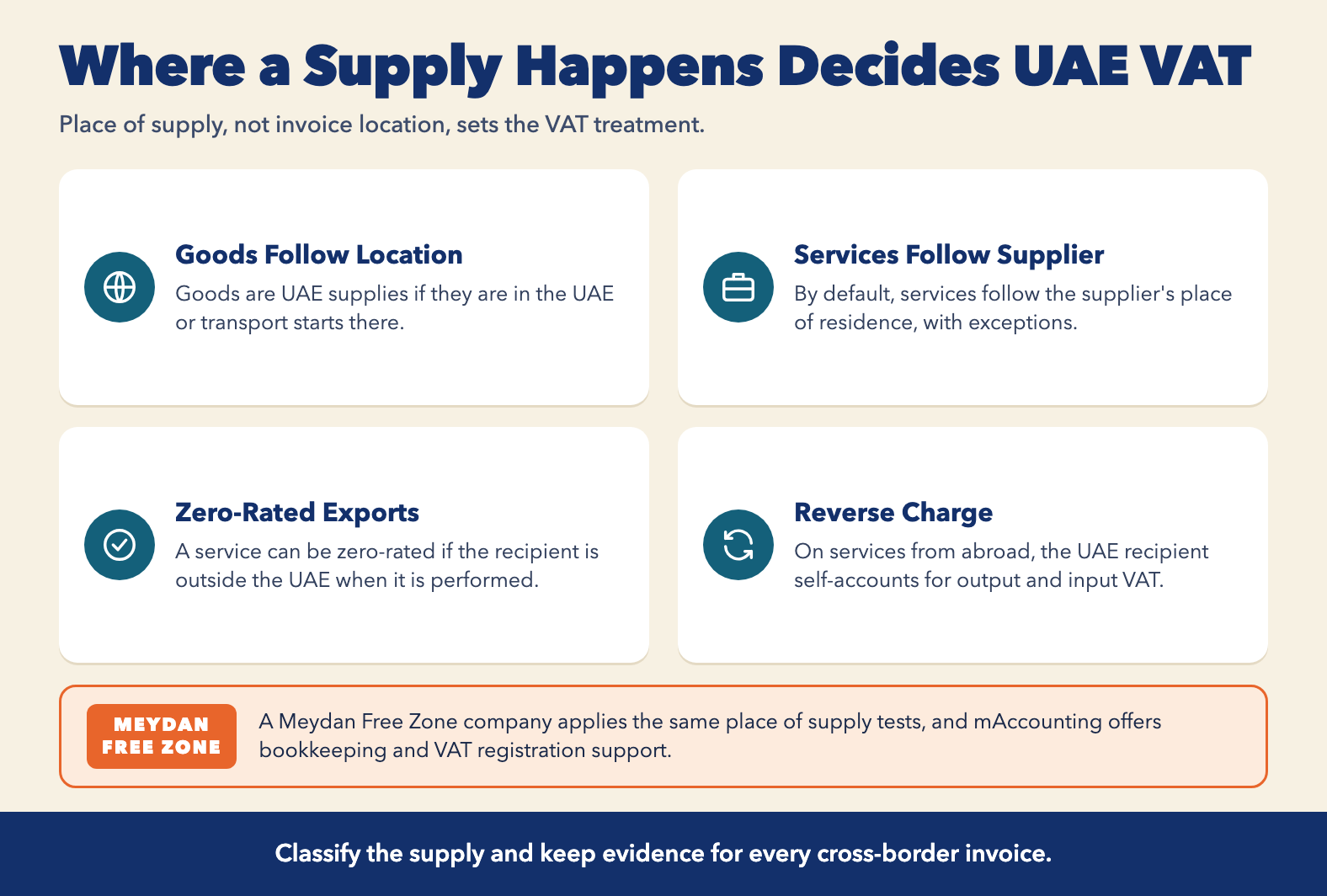
The UAE decides place of supply by supply type. Goods follow their physical location at the time of supply, or the movement of the goods. Services follow the supplier's place of residence by default, with exceptions for land-related, transport, telecommunications and certain B2B services.
Classify first. Mixed supplies follow the principal element, so a hardware device sold with a software license is judged on which part dominates. Digital products are generally treated as services.
- Supplier location is the default for many services.
- Recipient location matters for imported services and for zero-rating exports.
- Place of actual use applies to certain services, such as telecommunications.
Keep evidence: signed contracts, tax invoices, proof of the client's overseas establishment, and shipping and customs documents for goods. Records must be retained for five years under UAE tax law.
Place of Supply Rules for Goods in the UAE
For goods, the place of supply is the UAE if the goods are in the UAE when supplied without transport, or when transport starts in the UAE. Exports outside the UAE and GCC Implementing States can qualify for zero-rating if evidence conditions are met. Goods are usually the easier half of the topic.
Domestic Supplies and Goods Moved Within the UAE
A Dubai wholesaler selling stationery to an Abu Dhabi retailer makes a UAE supply. Moving goods between emirates does not change that. The 5% rate applies unless a zero-rate or exemption is available.
VAT Treatment by Supply Type and Client Location
| Supply Scenario | Typical UAE VAT Outcome |
|---|---|
| Goods sold and delivered within the UAE | Place of supply is the UAE; 5% output VAT charged. |
| Goods exported outside the GCC with proof of export | Zero-rated at 0%, supported by export and customs documents. |
| B2B service to an overseas client meeting zero-rating conditions | Zero-rated where the recipient has no UAE residence and is outside the UAE when the service is performed. |
| Service received from a non-resident supplier (reverse charge) | You self-account for 5% output VAT and claim input VAT if entitled. |
| Land-related service connected to property in another country | Place of supply is where the property sits, so outside UAE scope. |
Exports, Imports and Designated Zones
A trader shipping goods from Dubai to a buyer in India keeps the bill of lading and customs export declaration as proof. VAT on imports is paid at customs or, for VAT-registered importers, accounted for on the VAT return. Designated Zones are treated as outside the UAE for certain goods supplies, under conditions.
Goods Moving to Other GCC States
Treatment differs between GCC Implementing States and non-Implementing States. A UAE supplier delivering to Saudi Arabia should check the current list on the FTA website before invoicing.
Place of Supply for Services Across Borders
For services, the default place of supply is the supplier's place of residence. Specific rules override this for land-related, transport, telecommunications and certain B2B services. A UAE supplier's service to an overseas client therefore usually stays a UAE supply, but it can be zero-rated as an export if conditions are met. The detailed tests sit in the Decree-Law and its Executive Regulation.
B2B Services to Overseas Clients
Say a Dubai marketing consultancy bills a UK company for a campaign plan. Zero-rating generally needs a recipient with no place of residence in the UAE who is outside the UAE when the service is performed. From 1 October 2026, a visit of under 30 days that is not connected with the supply does not change this. Keep the contract and proof of the client's establishment.
A UAE engineering firm advising on a building in Oman is different. That is land-related, so the property location decides the outcome.
Services Received From Abroad
A UAE company paying a foreign software provider for annual services may need to self-account through the reverse charge. The UAE VAT reverse charge records both output and input tax on the return, subject to recovery rules.
Steps to Work Out the Place of Supply
To determine place of supply, classify the supply, identify the supplier and recipient locations, apply the relevant rule, decide the VAT treatment, and record evidence.
- Classify the supply. Goods, services or mixed. A subscription bundled with a device follows its principal element.
- Establish where each party is. A client with offices in Dubai and London needs the establishment actually receiving the service.
- Apply the rule and set treatment. A transport service starting in the UAE and ending abroad has its own test.
- Record and report. Issue a compliant tax invoice and separate zero-rated exports from standard-rated sales on the return.
Reverse Charge and Recording Cross-Border Supplies
The reverse charge shifts VAT accounting to the UAE recipient when taxable goods or services come from a non-resident supplier. You report output VAT and, where entitled, claim matching input VAT on the same return. For fully taxable businesses the net cash effect is often nil. This is where place of supply meets your VAT return.
As an illustration, not an official figure: an AED 10,000 imported service produces AED 500 output VAT and AED 500 input VAT. A UAE trading company buying consulting from a US firm is a typical case.
Common mistakes:
- Treating foreign invoices as VAT-free.
- Claiming input tax without a valid basis.
- Reporting a foreign subscription as out of scope.
What This Means for a Meydan Free Zone Company
A Meydan Free Zone company follows the same federal VAT rules as any UAE business, so it applies the place of supply tests to each sale and purchase. Designated Zone treatment applies only to listed zones and certain goods supplies. Meydan Free Zone's mAccounting, part of Meydan Plus, offers bookkeeping and VAT registration support.
Registration is mandatory above AED 375,000 of taxable supplies a year. Designated Zone treatment applies to specific goods, not services. See the UAE VAT registration guide for the thresholds in detail.
A Meydan Free Zone consultant billing UAE and overseas clients will see each treated differently. Set up invoice templates by supply type at launch, so each sale carries the right treatment from the first invoice.
Free Business Setup Cost Calculator
Calculate NowConclusion
Place of supply comes down to execution: classify the supply, locate the parties, apply the specific rule and keep evidence for the treatment you chose. Map your expected supplies by type and client location, then confirm which need standard-rating, zero-rating or the reverse charge. With Meydan Free Zone, VAT registration support is available through mAccounting once your taxable supplies pass the threshold.
Ready to Launch Your Business in Dubai?
Let's Connect