





Table of Contents
Frequently Asked Questions
What is the sewerage fee on a DEWA bill?
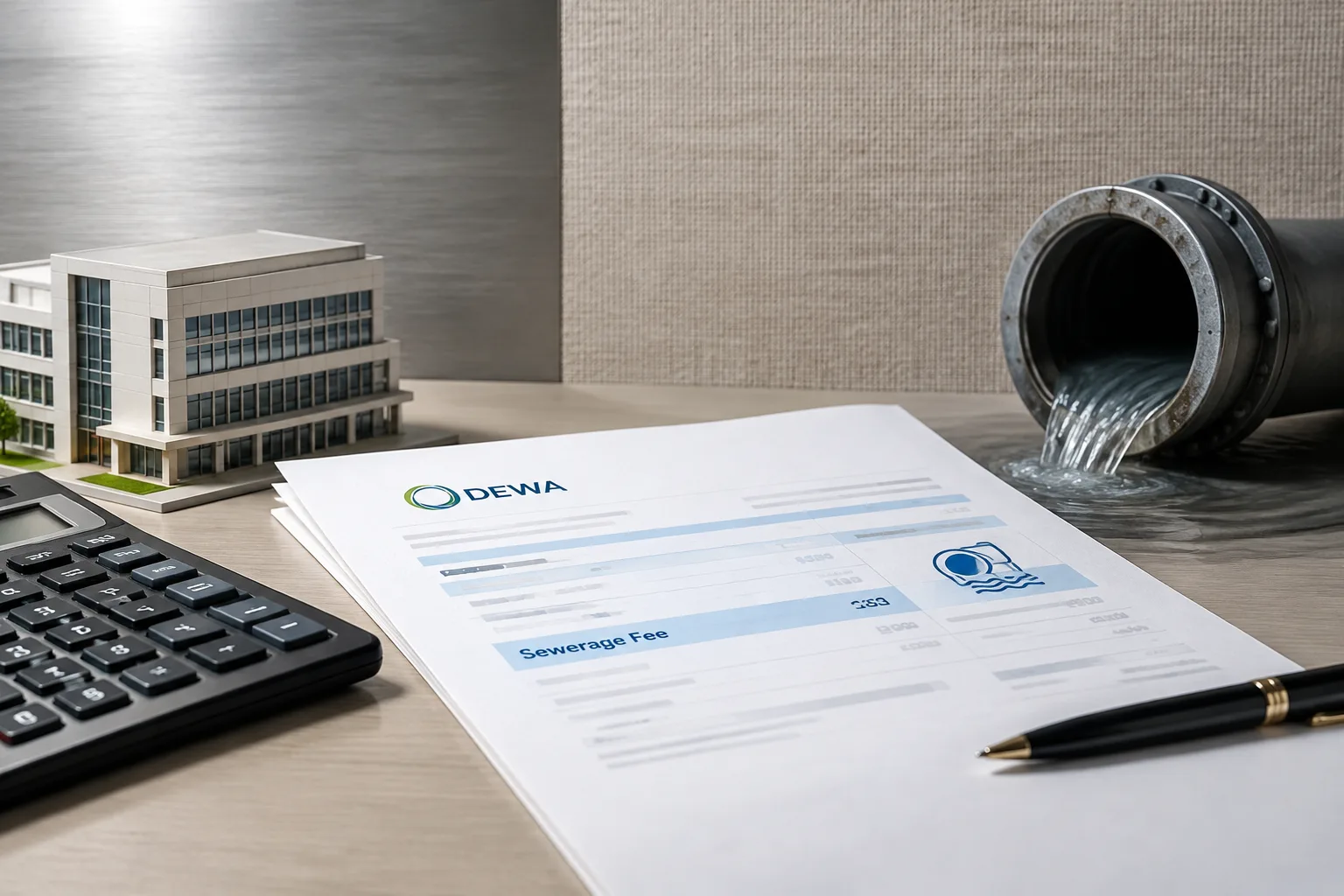
The sewerage fee is a Dubai Municipality charge for wastewater services, shown as a separate line on your commercial DEWA bill. DEWA collects it on the municipality’s behalf alongside electricity and water. Check your latest bill to see how the line is labelled and how it compares with your water use.
How much is the sewerage fee on a DEWA bill?
The fee is charged per gallon of water your premises consume, at 2 fils per gallon in 2026, rising to 2.8 fils in 2027. Your monthly charge therefore depends on how much water you use. The sewerage fee is not subject to VAT, so check that your bill shows VAT only on electricity and water.
How often is the sewerage fee charged?
The fee is not a one-off charge. It appears on every billing cycle, usually monthly, once your commercial DEWA account is active. If you dispute a charge, resolution time varies by case. Contact DEWA customer support early, keep your bills ready and track your query reference until it closes.
What are the requirements for paying the sewerage fee?
You need an active commercial DEWA account linked to your premises, since the fee is billed automatically through it. Your tenancy or ownership details and trade license information should be accurate. Review your account details with DEWA to make sure the premises and billing information are correct.
What are the benefits of the sewerage fee?
The fee funds wastewater collection and treatment, supporting reliable sanitation for commercial premises. Paying through one DEWA bill also simplifies administration, because you handle utilities in a single payment. Understanding each line helps you forecast costs accurately, so review your bill monthly and flag anything that looks inconsistent.
Is it worth checking the sewerage fee on your DEWA bill?
Yes. The fee is mandatory, but checking the line helps you catch billing errors and estimated readings early. Compare each bill with your water consumption, and raise any discrepancy with DEWA promptly to protect your cash flow.
Topic Summary
What Is Sewerage Fee DEWA and Why It Matters
The sewerage fee on a DEWA bill is a charge for wastewater collection and treatment in Dubai. Dubai Municipality owns the service, and DEWA collects the fee on its behalf through the combined utility bill. Commercial customers see it as a separate line next to electricity and water.
Where the Sewerage Fee Appears on Your DEWA Bill
Where the Sewerage Fee Appears on Your DEWA Bill
How VAT Applies to Sewerage Charges on Commercial Bills
Commercial utility bills in the UAE generally carry 5% VAT. VAT-registered businesses can usually recover it as input VAT with a valid tax invoice. Confirm how the sewerage line is treated with the Federal Tax Authority (FTA), UAE .
Steps to Check, Budget for, and Query Your Sewerage Fee DEWA Charge
Find the line, compare it with earlier months, confirm who holds the account, set a monthly allowance and query anything odd. The Dubai Municipality sewerage fee is only predictable if you track it. Keep meter readings and correspondence for any dispute.
Budgeting for Sewerage Fee DEWA When You Set Up a Business
When you set up a business in Dubai, budget for utilities, including the sewerage fee on DEWA bills, alongside license, visa and office costs. These recurring items are easy to miss. Ask for recent bills, estimate monthly use and add a buffer before you commit to a lease.
Common Mistakes With Sewerage Charges on Commercial Bills
The usual errors are ignoring the sewerage line, assuming the landlord pays, missing VAT recovery and delaying disputes. Review each itemised bill, document responsibility in the lease and raise queries in writing.
Final Thoughts
The sewerage fee DEWA line is small but recurring. It reflects the Dubai Municipality sewerage fee, carries VAT and can shift with use. Review your latest commercial DEWA bill today, confirm the figures with DEWA or Dubai Municipality, and speak to Meydan Free Zone about the full cost of setting up your business in Dubai.
Dubai Municipality Sewerage Fee on Commercial DEWA Bills Explained
The sewerage fee on a commercial DEWA bill is easy to overlook, but it grows with every gallon of water your business uses. Dubai Municipality charges 2 fils per gallon in 2026, rising to 2.8 fils in 2027, so the line on your bill will keep getting bigger [1]. This guide is for entrepreneurs who want to read, budget for and query the Dubai Municipality sewerage fee with confidence, from how it’s calculated to who pays it under your lease.
What Is Sewerage Fee DEWA and Why It Matters
The sewerage fee on a DEWA bill is a charge for wastewater collection and treatment in Dubai. Dubai Municipality owns the service, and DEWA collects the fee on its behalf through the combined utility bill. Commercial customers see it as a separate line next to electricity and water.
How the Dubai Municipality Sewerage Fee Works
Dubai Municipality runs the sewerage and drainage networks. The Dubai Municipality sewerage fee helps fund collection, pumping and treatment of commercial wastewater. It sits apart from your electricity and water consumption lines. The fee is charged per gallon of water your premises consume. Dubai Municipality is raising it in phases, from 1.5 fils per gallon in 2025 to 2 fils in 2026 and 2.8 fils in 2027, the first increase since 2015.
Picture a small office tenant. One DEWA bill arrives, but it holds three kinds of charge, and the sewerage line is easy to miss.
Quick Guide to Reading the Sewerage Line on a Commercial DEWA Bill
| Bill Element | What to Check |
|---|---|
| Charge label and billing period | The line is labelled as sewerage and matches the dates of your water reading. |
| Account holder and premise number | The name and premise number match your lease and your actual unit. |
| Amount versus prior months | Compare three to six months and look for sudden jumps or estimated readings. |
| VAT treatment | The sewerage line should show no VAT. VAT applies to DEWA’s electricity and water charges only. |
| Who to contact for a query | Start with DEWA, and escalate to Dubai Municipality if the charge basis is disputed. |
Who Pays the Charge
- The account holder named on the DEWA premise account is liable.
- Tenants and owners should settle responsibility in the lease.
- It generally applies to commercial and industrial premises. Confirm scope for mixed-use units.
Take a retail shop where the landlord holds the account. The landlord pays DEWA, then recharges the tenant. That's fine, if the lease says so.
Where the Sewerage Fee Appears on Your DEWA Bill

On a commercial bill, the sewerage fee appears as its own charge line, usually near water charges. It's listed apart from electricity and water. Check the itemised view in the DEWA app or online account for the exact label and amount.
Reading the Bill Breakdown
Identify the electricity, water, sewerage and other lines. Then match each one to the billing period and meter. A restaurant owner who compares two months side by side will spot a change in the sewerage line quickly.
Why the Charge Can Change Month to Month
- The fee is calculated on water consumption, so higher water use means a higher sewerage line.
- Seasonal trade and fit-out work shift consumption.
- Estimated readings can distort a single month.
A café with summer tourist peaks will see this clearly. Busy months push water use up, and the sewerage line can follow.
How VAT Applies to Sewerage Charges on Commercial Bills
The sewerage fee is not subject to VAT. DEWA collects it on behalf of Dubai Municipality, and VAT applies only to DEWA’s own electricity and water consumption charges. VAT-registered businesses can still recover the input VAT on those consumption lines with a valid tax invoice, so reconcile each bill line by line rather than claiming VAT on the full total.
Keep every bill for the period FTA rules require, and reconcile utility lines with your bookkeeping each month. It takes minutes, and it saves a scramble during an audit.
Steps to Check, Budget for, and Query Your Sewerage Fee DEWA Charge
Find the line, compare it with earlier months, confirm who holds the account, set a monthly allowance and query anything odd. The Dubai Municipality sewerage fee is only predictable if you track it. Keep meter readings and correspondence for any dispute.
Step 1: Find the Sewerage Line in Your Itemised Bill
- Log in to your DEWA account or app.
- Download the detailed bill, not the summary.
- Note the exact label of the sewerage line.
Step 2: Compare Three to Six Months of Charges
- Look for spikes tied to water use or estimated readings.
- Note the premise type and size.
- Log each month in a simple sheet.
Step 3: Confirm Account Ownership and Lease Terms
- Check whether the landlord or tenant holds the account.
- Review the utility recharge clauses.
- Get any verbal agreement confirmed in writing.
Step 4: Raise a Query With DEWA or Dubai Municipality
- Provide the bill number, premise number and meter readings.
- Ask for a written explanation of the calculation basis.
- Escalate to the municipality if the basis stays disputed.
A warehouse tenant who sees a sharp one-month jump should follow exactly this order and request a recheck.
Budgeting for Sewerage Fee DEWA When You Set Up a Business
When you set up a business in Dubai, budget for utilities, including the sewerage fee on DEWA bills, alongside license, visa and office costs. These recurring items are easy to miss. Ask for recent bills, estimate monthly use and add a buffer before you commit to a lease.
Recurring Costs Beyond the License Fee
For Meydan Free Zone companies, the flexi-desk included with every license is shared workspace, and dedicated offices at the Meydan Business Centre include utilities. A separate DEWA bill, and its sewerage line, becomes a budget item once you lease your own premises elsewhere.
Questions to Ask Before Signing a Lease
- Are utilities included in rent or billed separately?
- Who holds the DEWA account?
- Can you see the last six months of bills?
Water-Intensive Activities and Higher Exposure
Food service, laundry, cleaning and pool maintenance use more water, so expect a bigger sewerage line. If your plans involve wastewater itself, read about setting up a water sewage irrigation engineering business or how to start a sewage water transport business in Dubai.
Common Mistakes With Sewerage Charges on Commercial Bills
The usual errors are ignoring the sewerage line, assuming the landlord pays, missing VAT recovery and delaying disputes. Review each itemised bill, document responsibility in the lease and raise queries in writing.
Assuming the Landlord Covers It
Leases vary on utilities. A tenant can be surprised by recharged charges at renewal. Get the clause in writing.
Paying Without Checking Readings
- Estimated readings can inflate a bill.
- Dispute early, with meter photos as evidence.
- Raise the query in writing.
Final Thoughts
The sewerage line on your DEWA bill is small but recurring. It’s charged per gallon of water consumed, carries no VAT and is rising in phases through 2027. Review your latest commercial DEWA bill today, check the sewerage line against your water use, and speak to Meydan Free Zone about the full cost of setting up your business in Dubai.
References