
Table of Contents
Frequently Asked Questions
What details must appear on a tax invoice in the UAE?
A full tax invoice must show the words "Tax Invoice", the supplier's name, address and Tax Registration Number (TRN), and the customer's name, address and TRN where registered. It also needs a sequential invoice number, the issue date, the supply date if different, and a description of each item. Each line shows quantity, unit price, VAT rate and VAT amount, with the total payable and total VAT in AED.
Can a business without a TRN issue a tax invoice?
No. Only VAT-registered businesses can issue tax invoices or charge VAT. A business below the registration threshold that has not registered can issue a standard commercial invoice without a VAT line. Registration is mandatory above AED 375,000 in annual taxable supplies and voluntary from AED 187,500.
How soon after a sale must a tax invoice be issued?
A VAT-registered supplier must issue a tax invoice within 14 days of the date of supply. Where payment arrives before delivery, the date of supply can be the payment date, so the 14 days may start earlier. Late issue can delay your customer's input tax recovery.
When can a simplified tax invoice replace a full one?
A supplier can issue a simplified tax invoice when the customer is not VAT-registered, or when a registered customer's invoice does not exceed AED 10,000. It omits the customer's TRN and separate VAT per line. Retail receipts are a common example. For registered business customers, a full tax invoice is the safer default.
Does a tax invoice have to show amounts in dirhams?
Tax amounts must be shown in AED. If you invoice in another currency, show the VAT total in AED and state the exchange rate used. This keeps the invoice consistent with the VAT return and supports your customer's input tax claim.
What should a supplier do if an invoice contains a mistake?
Issue a tax credit note rather than editing or overwriting the original invoice. The credit note references the original invoice and shows the VAT adjustment. If needed, issue a corrected tax invoice afterwards. Credit notes also cover returns and price reductions after the supply.
How long must tax invoices be kept in the UAE?
Businesses must keep tax invoices, credit notes and related VAT records for at least five years. Certain real estate records must be kept longer. Records should be retrievable on request, as the Federal Tax Authority can review them during an audit.
Do free zone companies follow the same tax invoice rules?
Yes, for VAT-registered suppliers. Invoice content is set by federal VAT law and its Executive Regulation, and the Federal Tax Authority enforces it. A Meydan Free Zone company therefore uses the same fields as a mainland supplier. Designated Zone treatment can affect VAT on certain goods, but not the required invoice details.
Topic Summary
What a Tax Invoice Is and When You Must Issue One
A tax invoice is the document a VAT-registered supplier issues for a taxable supply of goods or services in the UAE. It records the VAT charged and lets a registered customer reclaim it as input tax. You must issue it within 14 days of the supply. Every tax invoice has to work for both purposes.
Who Sets the Rules for a Tax Invoice in the UAE
The rules come from Federal Decree-Law No. 8 of 2017 on VAT, as amended, and its Executive Regulation, Cabinet Decision No. 52 of 2017. Cabinet Decision No. 100 of 2025 amended that regulation for e-invoicing. The FTA administers and enforces them. They apply federally, so the same content rules cover Dubai mainland and free zone suppliers.
Required Details for a Tax Invoice Format in the UAE
A full tax invoice must show the words Tax Invoice, the supplier's and customer's names, addresses and TRNs, a sequential invoice number, the issue date and the supply date if different. It also needs item descriptions, unit prices and quantities, the VAT rate and amount per line, any discounts, and the total payable and VAT total in AED. Our guide to UAE tax invoice requirements expands on each field.
Full and Simplified Tax Invoice Formats Compared
A simplified tax invoice can be issued when the customer is not VAT-registered, or when a registered customer's invoice does not exceed AED 10,000. It needs fewer details, such as no customer TRN and no separate line VAT. A full tax invoice suits registered business customers and larger values.
Credit Notes, Corrections and Record Keeping
When a price falls, goods are returned or an invoice contains an error, you issue a tax credit note instead of editing the invoice. Businesses must keep tax invoices and credit notes for at least five years, and longer for certain real estate records. Invoicing rules are also moving towards e-invoicing.
How Meydan Free Zone Companies Keep Invoices Compliant
Meydan Free Zone offers mAccounting, part of Meydan Plus, covering bookkeeping, VAT registration support and Corporate Tax support. A VAT-registered company can use the bookkeeping service to keep invoice records in order. Meydan Free Zone does not approve individual invoices, and the service does not guarantee compliance.
Conclusion
A UAE tax invoice follows a short, fixed checklist. Most problems come from skipped fields, not complex law. Build a template that carries every required detail, use credit notes for corrections and keep records for five years. For a Meydan Free Zone company the content rules match the mainland, and mAccounting bookkeeping can keep those invoices tied to your records from the first sale.
Tax Invoice Requirements in the UAE: Rules and Required Details
Most founders in the UAE treat the invoice as a billing document. They learn otherwise when a client rejects it or the Federal Tax Authority (FTA) queries an input tax claim. A missing Tax Registration Number (TRN) can cost your customer their VAT recovery, and that becomes your commercial problem. This guide explains which details the law requires, how full and simplified formats differ, and how to handle corrections and records.
What a Tax Invoice Is and When You Must Issue One
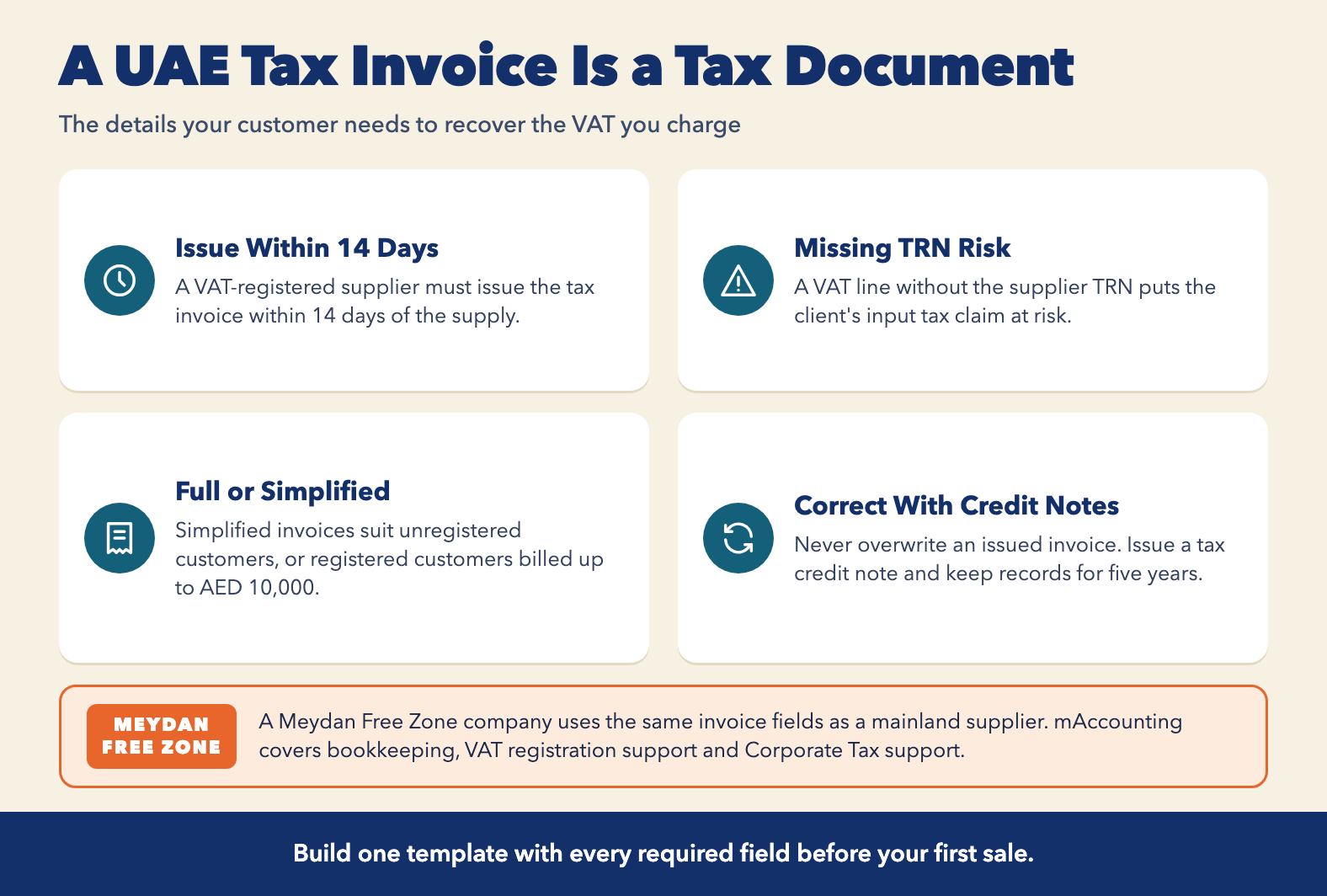
A tax invoice is the document a VAT-registered supplier issues for a taxable supply of goods or services in the UAE. It records the VAT charged and lets a registered customer reclaim it as input tax. You must issue it within 14 days of the supply. Every tax invoice has to work for both purposes.
Tax Invoice Versus Commercial Invoice
A commercial invoice asks for payment. A tax invoice also evidences VAT, so your customer can support an input tax claim. Many founders assume any invoice with a VAT line qualifies. It doesn't.
Say a consulting firm bills a client with a VAT line but no supplier TRN. The client's input tax claim is at risk, and the client will ask you to reissue it.
Who Must Issue Tax Invoices
Only VAT-registered businesses issue tax invoices. Registration is mandatory above AED 375,000 in annual taxable supplies and voluntary from AED 187,500. A trading start-up that crosses AED 375,000 must begin issuing tax invoices once registered. Our UAE VAT registration guide covers the registration route.
Who Sets the Rules for a Tax Invoice in the UAE
The rules come from Federal Decree-Law No. 8 of 2017 on VAT, as amended, and its Executive Regulation, Cabinet Decision No. 52 of 2017. Cabinet Decision No. 100 of 2025 amended that regulation for e-invoicing. The FTA administers and enforces them. They apply federally, so the same content rules cover Dubai mainland and free zone suppliers.
Federal Law and the Federal Tax Authority
Invoice content is set by the Executive Regulation, not by a free zone authority. The FTA audits invoices and enforces penalties. A typical audit samples invoices to test whether input tax claims are supported. For wider context, read VAT in the UAE: all the details.
How This Applies to a Meydan Free Zone Company
A free zone license does not change invoice content rules for a VAT-registered supplier. A Meydan Free Zone services company uses the same invoice fields as a mainland supplier. Designated Zone treatment affects VAT on certain goods, so confirm the treatment for your activity with the FTA. Meydan Free Zone does not issue or approve your invoices.
Required Details for a Tax Invoice Format in the UAE
A full tax invoice must show the words Tax Invoice, the supplier's and customer's names, addresses and TRNs, a sequential invoice number, the issue date and the supply date if different. It also needs item descriptions, unit prices and quantities, the VAT rate and amount per line, any discounts, and the total payable and VAT total in AED. Our guide to UAE tax invoice requirements expands on each field.
Supplier and Customer Details
- The words Tax Invoice, displayed clearly.
- Supplier name, address and TRN.
- Customer name and address.
- Customer TRN, where the customer is VAT-registered.
A template that pulls the TRN from the VAT certificate avoids typing errors.
Invoice Identifiers and Dates
- A unique, sequential invoice number.
- The date of issue.
- The date of supply, where it differs.
A deposit invoiced in one month for a delivery in the next needs both dates.
Line Items, Amounts and Currency
- Description, quantity, unit price, VAT rate and VAT amount per line.
- Any discounts, shown clearly.
- Total payable and total VAT in AED.
- For other currencies, the VAT amount in AED and the exchange rate used.
- Reverse charge wording where the customer accounts for the VAT.
A USD invoice to a UAE customer still shows the VAT total in AED, with the rate applied.
Full and Simplified Tax Invoice Formats Compared
A simplified tax invoice can be issued when the customer is not VAT-registered, or when a registered customer's invoice does not exceed AED 10,000. It needs fewer details, such as no customer TRN and no separate line VAT. A full tax invoice suits registered business customers and larger values.
| Feature | Full Tax Invoice | Simplified Tax Invoice |
|---|---|---|
| When it applies | VAT-registered business customers and values above AED 10,000 | Customer not VAT-registered, or value up to AED 10,000 |
| Customer name, address and TRN | Shown in full, with the TRN where the customer is registered | Not required |
| Line-level VAT rate and amount | Shown on every line | No separate line VAT; total VAT amount shown |
| Sequential invoice number and date | Unique sequential number, issue date and supply date if different | Date required; a till receipt reference is common |
| Typical use case | B2B services and trading with registered customers | Retail and walk-in consumer sales |
When a Simplified Invoice Is Allowed
Retail and walk-in sales are the usual case. A shop issuing a till receipt to a consumer is issuing a simplified tax invoice. Supplier details, date, description and totals are still required.
Choosing the Right Format for B2B Work
A registered business customer expects a full tax invoice for clean input tax recovery. Using the full format by default reduces rework. A freelancer invoicing a registered agency should issue a full tax invoice even for an AED 4,000 job.
Credit Notes, Corrections and Record Keeping
When a price falls, goods are returned or an invoice contains an error, you issue a tax credit note instead of editing the invoice. Businesses must keep tax invoices and credit notes for at least five years, and longer for certain real estate records. Invoicing rules are also moving towards e-invoicing.
Issuing a Tax Credit Note
A credit note references the original invoice and shows the VAT adjustment. Never overwrite an issued invoice. If a client returns half an order, issue a credit note for that part only.
Retention and the Move to E-Invoicing
Archive invoices in accounting software so records are retrievable in an FTA review. The e-invoicing framework issued by the Ministry of Finance in 2025 brings businesses in by phase and changes the invoice and credit note rules for those in scope. Read e-invoicing in the UAE before your template is locked in.
How Meydan Free Zone Companies Keep Invoices Compliant
Meydan Free Zone offers mAccounting, part of Meydan Plus, covering bookkeeping, VAT registration support and Corporate Tax support. A VAT-registered company can use the bookkeeping service to keep invoice records in order. Meydan Free Zone does not approve individual invoices, and the service does not guarantee compliance.
Bookkeeping and VAT Support Through mAccounting
Consistent numbering supports return preparation. A founder with ten monthly invoices can reconcile them to the VAT return through bookkeeping, which makes each invoice easier to defend.
Setting Up Your Invoice Template Early
- Build the template once your TRN is issued.
- Include every required field before the first sale.
- Test it against the required-fields list before invoicing your first client.
Free Business Setup Cost Calculator
Calculate NowConclusion
A UAE tax invoice follows a short, fixed checklist. Most problems come from skipped fields, not complex law. Build a template that carries every required detail, use credit notes for corrections and keep records for five years. For a Meydan Free Zone company the content rules match the mainland, and mAccounting bookkeeping can keep those invoices tied to your records from the first sale.
Ready to Launch Your Business in Dubai?
Let's ConnectReferences
- Federal Tax Authority (FTA), UAE: VAT guidance and tax invoice requirements, 2026.
- Federal Tax Authority (FTA), UAE: Federal Decree-Law No. 8 of 2017 on Value Added Tax.
- Federal Tax Authority (FTA), UAE: Cabinet Decision No. 52 of 2017, Executive Regulation of the VAT law.