Table of Contents
Frequently Asked Questions
1. What is team DNA?
Team DNA refers to the combination of communication, trust, shared goals, accountability, and culture that defines how a team works together. It's what determines whether team members collaborate effectively or work in isolation.
2. Why is communication so important for team success?
Without clear communication, rumours develop and team morale suffers. Open communication empowers team members to share ideas, while clear information flow between leadership and the team prevents productivity losses.
3. How do clear goals contribute to teamwork?
Clear goals give a team direction, engagement, and inspiration. Goals should be challenging enough to motivate but not so ambitious they demoralise the team. Meaningful incentives reinforce the effort.
4. What role does mutual respect play in a team?
Mutual respect is foundational. When team members value each other's skills, experience, and personalities, they function as a unified group. Trust and loyalty, both highly valued in UAE business culture, follow naturally.
5. How can businesses avoid a blame culture?
Accountability is essential, but blame cultures are toxic. Leaders should treat mistakes as learning opportunities rather than punishments. When people fear being blamed, problems get hidden instead of solved early.
6. Why does training and learning matter for team building?
Ongoing training opportunities prevent demotivation and help team members progress. Peer mentoring also strengthens team culture, as experienced members guide newer ones in both skills and team norms.
7. How can Dubai businesses find the right team members?
Recruitment is harder than it looks. Research suggests up to 46% of new hires don't work out, making cultural fit as important as aptitude. Clear communication with recruitment partners and well-defined role requirements improve success rates.
Topic Summary
1. Embracing Diversity in Talent and Personality
Dubai’s economic growth of 6.3% since mid-2021 has attracted a diverse influx of professionals from around the globe. This melting pot of cultures, skills, and personalities forms a rich pool of potential recruits, enabling businesses to craft teams with varied perspectives and creative problem-solving capabilities.
2. Prioritising Cultural Fit Alongside Aptitude
While technical aptitude remains crucial, successful teamwork hinges on selecting individuals whose values and working styles align with the organisation’s ethos. Assessing cultural fit helps create cohesive teams that communicate effectively, fostering a collaborative environment conducive to success.
3. Enhancing Interpersonal Skills for Synergistic Collaboration
Effective teamwork requires more than just individual competence; interpersonal skills such as empathy, communication, and conflict resolution are essential components of the team DNA. Harnessing these competencies ensures that diverse team members can harmonise their efforts towards common goals.
4. Leveraging Dubai’s Expanding Talent Landscape
The city’s rapid economic expansion means businesses have unprecedented access to talented professionals eager to advance their careers. By strategically recruiting with an emphasis on complementary skills and personalities, organisations can build agile teams capable of adapting to evolving market demands.
5. Fostering Continuous Development and Shared Vision
Sustaining successful teamwork involves ongoing investment in professional development and cultivating a shared vision. Encouraging learning and aligning individual ambitions with organisational objectives reinforces the team DNA, driving long-term performance and innovation.
Team DNA – the key to successful teamwork
Hiring the right people is one challenge. Building them into a team that actually works together is another.
According to the Ministry of Human Resources and Emiratisation¹, the UAE labour market grew 8.9 percent by Q3 2025, with a 6.6 percent rise in the number of operating establishments. Talent is flowing into the country across every sector. The Ministry of Human Resources and Emiratisation¹ also reports that the Wage Protection System now covers 98.8 percent of private sector employees, reinforcing confidence in the UAE as a destination for skilled professionals. The talent pool is wider, deeper, and more protected than ever.
Dubai's workforce diversity gives founders genuine breadth when building team DNA.
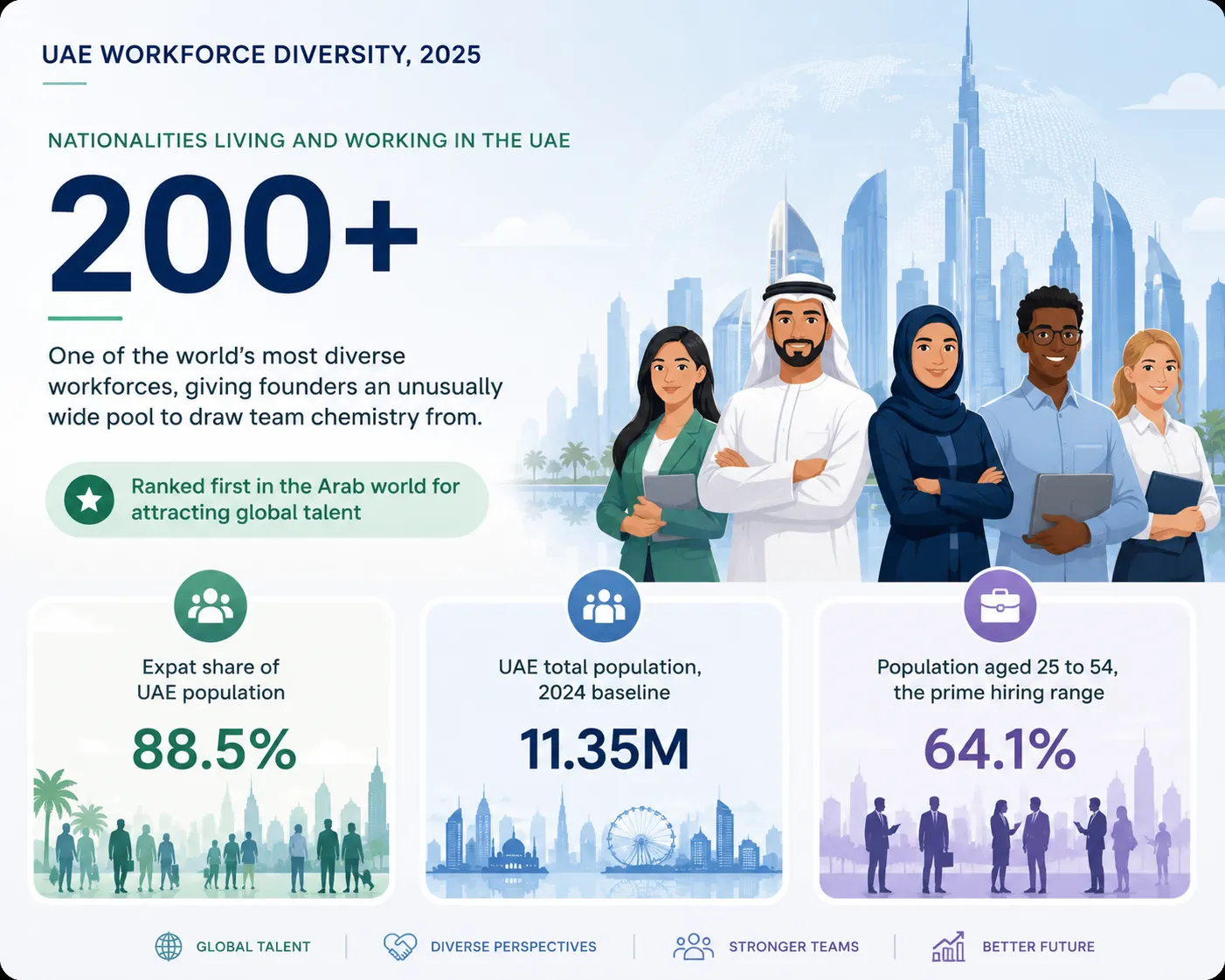
Source: UAE Ministry of Foreign Affairs, citing Federal Competitiveness and Statistics Authority population data and IMD World Talent Ranking.
But recruitment is not just about a person's aptitude for the job, even though that is very important, especially in skilled roles. It is also about how they will fit in with existing members of the organisation and work within a team. In other words, it's all about team DNA.
Teamwork can be the difference between a business achieving its potential and failing. But what goes into the DNA of the right team to ensure that goals can be achieved?
While every team is unique, some facets are common to successful teams, no matter what sector they are in.
Communication: The Lifeline of Every High-Functioning Team
In any successful business, communication is key, whether taking your message out to customers or outlining the company’s vision to your employees.
If employees have incomplete information regarding the health of the business, its direction or goals, rumours can develop, or the sense that management does not respect its workforce. Either way, it can adversely impact productivity and team morale.
Within teams, clear communication is crucial. For instance, there should be a single line of communication, with team leaders funnelling feedback from the team to the management and disseminating information from senior management to the team.
Open communication is also essential. Team members should be empowered to speak their minds and have their opinions valued, without fear of negative repercussions.
Regular opportunities to air views should include:
- In-person meetings
- Videoconferencing
- Group chat
- Online workflow management tools
Respect and Trust: The Foundation of Team Culture
Clear and regular communication is also a sign of respect, which is a fundamental part of the DNA of the right team.
In Dubai and the wider UAE, business etiquette is largely based on respect, whether internally or when meeting customers, suppliers, and other external players. Hence, meetings often involve small talk and socialising, which is regarded as a form of respect and acceptance.
While respect for the hierarchy is important in UAE business culture, managers need to earn the respect and trust of their teams to ensure they can work to the best of their ability. The best leaders inspire their teams to achieve what they didn't think was possible.
In the UAE, respect, trust, and loyalty are greatly valued in business, and the same is true within teams:
| Trait | How It Shows Up in a Team |
|---|---|
| Respect | Team members value each other's skills, experience, and personalities, functioning as an effective unit |
| Trust | When a team member commits to a task, they do what they promise and meet deadlines |
| Loyalty | Members focus on their own roles without worrying about covering for others or picking up their slack |
Clear Goals Turn Direction Into Momentum
A team should be given clear goals and defined timelines in which to achieve them. Without clear goals, a team will lack direction, engagement and inspiration. These goals should be challenging – modest ones tend not to be motivational – but not so ambitious that they demoralise the team.
There also must be incentives for the team to achieve their goals. Incentives can be:
| Incentive Type | Examples |
|---|---|
| Material | Cash bonuses or shared rewards such as a trip to a sporting event |
| Intrinsic | Job satisfaction or making a difference to others' lives |
Building Ownership and Accountability Across the Team
Ownership is a vital part of successful teams’ DNA. This is where each team member feels they belong to the wider team and takes ownership of individual tasks. When a person’s role is clear, they understand their responsibilities and how their job fits into the wider team and business picture. This also helps team members feel valued, which aids motivation and productivity.
Allied to this is accountability, where each employee knows they are accountable to their team and the management for what they are doing. Good team members will also not want to let their colleagues down.
However, this attitude should not stray into the trap of blaming people when things go wrong or a target is not met. Blame cultures are detrimental to a team and can become toxic – nobody will want to take responsibility if they think they will be punished for it, and this can lead to problems being hidden rather than addressed in a timely manner.
Why Training and Learning Keep Teams Competitive
Research has found that a supportive environment is key to building a team and ensuring its success.
Whatever happens, an ‘us versus them’ feeling should never be allowed to develop between management and team members. This pitfall has been identified as a corrosive influence on a team and should be avoided. Team members should all feel they are pulling in the same direction, with no individual agendas influencing the overall goal of the team. Team members also need to feel that managers ‘have their back’ and will support them in any conflicts.
Teams also require material support, such as the resources to perform the job efficiently (technical equipment, for example).
Training and learning
Training is allied to support and is another crucial part of the DNA of a successful team. Opportunities for training and upskilling should always be available for team members to progress within their team and in their careers. Lack of such opportunities can become a demotivational factor.
Team members also learn from each other. All teams have members with differing levels of experience and skills, and when they collaborate on a project, they can learn together. In addition, more experienced members can mentor the younger ones, not only in what to do but in the culture of the team and business, helping to reinforce good practices and maintain any team ethic that has developed.
Finding the Right People: Where Most Teams Get It Wrong
Finding the right people for the team is always a key factor, but recruitment is difficult. According to Leadership IQ research², up to 46 percent of new hires fail within 18 months, with the pattern holding at all levels, from executive to entry-level. Hiring failure carries real costs:
- Going through another hiring process
- Loss in productivity
- Employing temporary staff to cover
- Impact on team morale
Many businesses delegate recruitment to specialist recruitment firms, which can be productive. However, as with teamwork, clear communication and well-defined goals are key to ensuring the best chances of success.
In Conclusion
If you can find people with the DNA that fits the culture of your business, the chances of being successful and profitable are enhanced. Teamwork brings significant benefits to a company, including the bottom line.
Dubai attracts people from all over the world with a multitude of skills and personal attributes, so there is no shortage of people to choose from. But square pegs can never be made to fit into round holes, so intelligent recruitment methods are vital.
Likewise, team cultures need to be driven from the top downwards and carefully fostered throughout – good teams don’t just happen and, like any effective partnership in any walk of life, they require constant work and refinement to ensure they continue to be productive and successful.
If the DNA is right within a team, it can provide the motivation and innovation that is the key to the success of a business.
Citations
¹ Ministry of Human Resources and Emiratisation via Gulf News, "UAE labour market sees 8.9% workforce growth by Q3 2025," 6 December 2025.
² Leadership IQ, "Why New Hires Fail (Emotional Intelligence Vs. Skills)," Leadership IQ Research.