
Table of Contents
Frequently Asked Questions
What documents do investors ask for when reviewing a UAE company?
Investors usually ask for the Business License, Certificate of Formation, Share Register and Memorandum and Articles of Association. They also request any shareholders' agreement, tax registration records and recent bank statements. Meydan Free Zone issues the first four documents digitally after registration, so they are to hand for a data request.
Do investors prefer a free zone company or a mainland company in the UAE?
Investors generally prefer the structure that fits where the company earns its revenue. A free zone company often suits export, services and international contracts, while a mainland company suits direct trade with local customers. A mismatch between the jurisdiction and the customer base is what raises concern, not the jurisdiction itself.
Can a foreign investor own 100% of a UAE company?
Generally yes. Free zone companies, including those licensed by Meydan Free Zone, allow 100% foreign ownership. On the mainland, federal law also permits full foreign ownership for many activities, except those classed as having strategic impact. Ownership should be recorded accurately in the Share Register and match the cap table, because investors check both during due diligence.
How does a shareholders' agreement affect investor confidence?
A shareholders' agreement shows how decisions are made, how deadlocks are resolved and what happens when a founder leaves. Investors look for reserved matters, transfer rules and exit terms that align with the Memorandum and Articles of Association. Gaps or conflicts between the two documents often slow funding.
Does a UAE free zone company need to register for Corporate Tax?
Yes. Free zone companies must register for Corporate Tax with the Federal Tax Authority. Qualifying Free Zone Person treatment depends on meeting set conditions, and investors usually ask which income qualifies and how the company assessed its position.
When must a UAE company register for VAT?
VAT registration is mandatory when taxable supplies exceed AED 375,000 a year, according to the Federal Tax Authority. Investors check whether the company has registered on time and whether its filings are current. Late registration or filing can lead to penalties that reduce the company's value.
Why do investors ask for a UAE bank account before closing a deal?
A working bank account in the company's name shows the entity can receive funds and operate. Investors also compare transactions with contracts and invoices to confirm that company and personal funds are kept separate. A license alone does not guarantee account approval, because banks apply their own compliance review.
Topic Summary
What Investors Expect From UAE Business Structures
Investors expect a UAE company structure to show clear ownership, defined decision-making authority, a license matching real activities, tax compliance and working banking. They use it to judge legal risk, control and exit options before assessing the business. A well-organised structure can shorten due diligence.
Ownership and Governance Investors Examine
Investors check who holds shares, whether ownership is documented and who can bind the company. They review the Share Register, the Memorandum and Articles of Association and any shareholders' agreement. Clear voting rights and transfer rules reduce the risk of post-funding disputes.
Licensing, Activities and Jurisdiction Fit
Investors confirm the license covers the activities the company performs. They also check that the jurisdiction suits the customer base, since free zone and mainland entities have different trading permissions. A mismatch between license and revenue can delay funding.
Seven Checks Investors Run Before Committing Capital
Investor checks vary, but seven are common: ownership records, license scope, governance documents, tax registration, banking access, contract holding and exit terms. Each tests whether the entity can receive funds, operate lawfully and return value. Completing them early strengthens your position.
Tax Registration and Compliance Investors Verify
Investors confirm registration for Corporate Tax and, where required, VAT with the Federal Tax Authority (FTA). VAT registration is mandatory above AED 375,000 a year in taxable supplies, according to the FTA. Late filings can signal weak controls and create penalties that reduce value.
Banking Access and Financial Transparency
Investors want a functioning UAE bank account in the company's name, with transactions matching contracts and invoices. Banks run their own compliance review under Central Bank of the UAE rules. A license alone never guarantees account approval.
How Meydan Free Zone Supports Investor-Ready Structures
Meydan Free Zone digitally issues the Business License, Certificate of Formation, Share Register and Memorandum and Articles of Association after registration. These are among the first documents investors request. Meydan Plus (mPlus) adds mCore, mResidency and mAccounting where relevant to your structure. Investment and bank approval decisions remain with investors and banks.
What Investors Look for in a UAE Company Structure Before Investing
Many founders assume an investor's first question is about revenue. In practice, investors often start with the company structure, because it decides who owns what, who can sign and how money leaves the company. Founders often choose a license for speed, then find they need to restructure when an investor arrives. This guide shows what investors examine and how to prepare.
What Investors Expect From UAE Business Structures
Investors expect a UAE company structure to show clear ownership, defined decision-making authority, a license matching real activities, tax compliance and working banking. They use it to judge legal risk, control and exit options before assessing the business. A well-organised structure can shorten due diligence.
Why Structure Comes Before Financials
Structure decides enforceable ownership and cash flow rights. Say a founder holds shares through a nominee with no written agreement. A strong product can still lose weeks while lawyers document the arrangement.
How Investors Read a Company Structure
The first data request usually asks for the Certificate of Formation, Share Register and Memorandum and Articles of Association. Investors want one clear legal entity, or a logical group, holding the contracts and assets. Investors range from private backers to institutions such as the Emirates Investment Authority, which manages the UAE's sovereign wealth. This guide is general information, not legal or investment advice.
Ownership and Governance Investors Examine
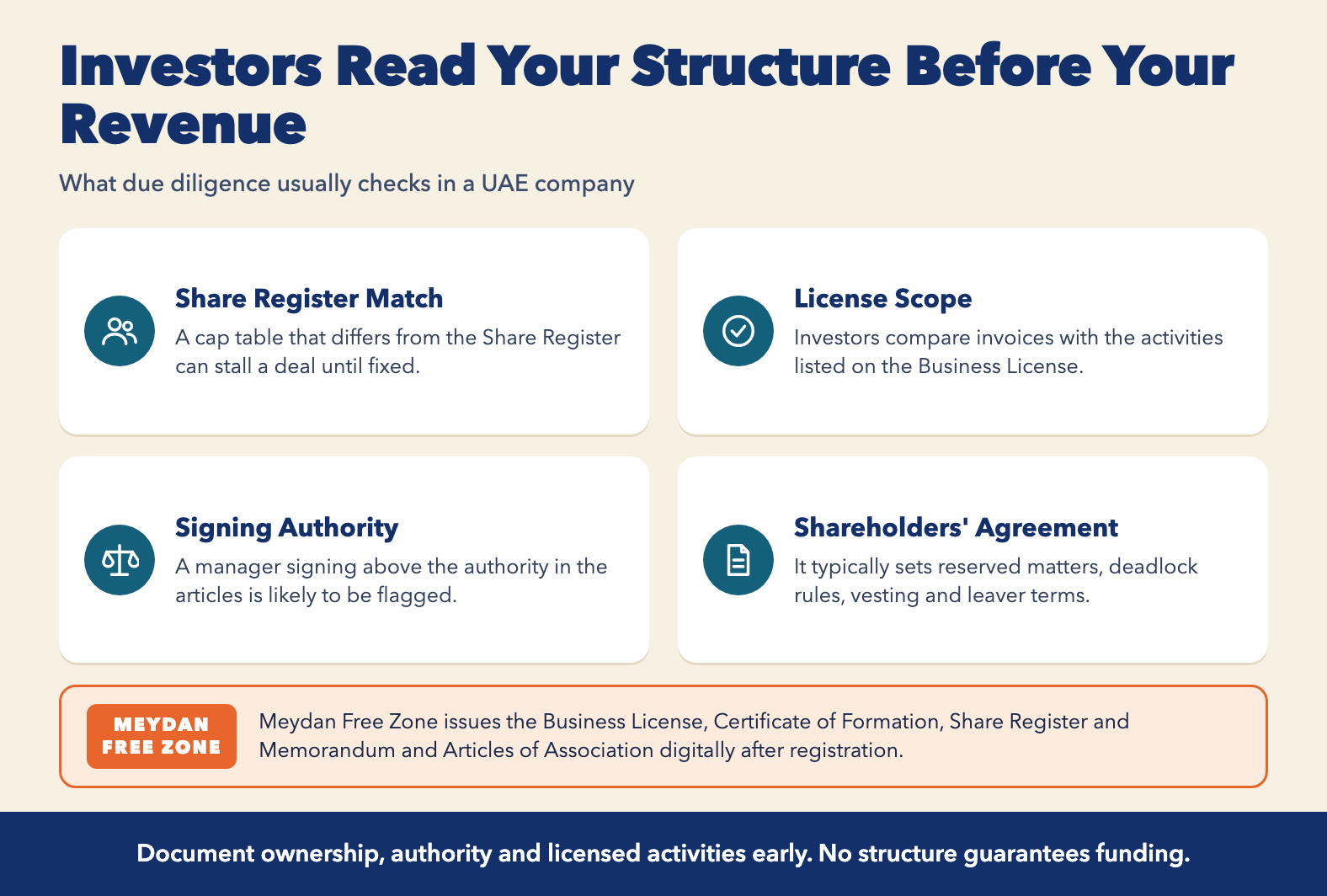
Investors check who holds shares, whether ownership is documented and who can bind the company. They review the Share Register, the Memorandum and Articles of Association and any shareholders' agreement. Clear voting rights and transfer rules reduce the risk of post-funding disputes.
Share Register and Cap Table Clarity
- The register should match the cap table exactly.
- A cap table showing 40% for a co-founder against 30% on the register can stall the deal until fixed.
- Unrecorded side arrangements can delay due diligence.
Shareholders' Agreement and Decision Rights
A shareholders' agreement typically sets reserved matters, deadlock rules, vesting and leaver terms. If two founders disagree on a hire, reserved matters can decide who has the final say. The agreement should also align with the articles.
Authorised Signatories and Manager Powers
Investors confirm who can sign contracts and open accounts, and the limits on borrowing and asset sales. A manager who signs a supplier contract above the authority in the articles is likely to be flagged.
Licensing, Activities and Jurisdiction Fit
Investors confirm the license covers the activities the company performs. They also check that the jurisdiction suits the customer base, since free zone and mainland entities have different trading permissions. A mismatch between license and revenue can delay funding.
License Activities Versus Real Revenue
Investors compare invoices with the license scope. A consultancy invoicing software resale not listed on its license may be asked to amend it before closing. Add any missing activities early.
Investor Checks and the Documents That Answer Them
| Area | Investor Check | Document or Evidence |
|---|---|---|
| Ownership | Shareholdings match the cap table | Share Register and signed cap table |
| License scope | Invoices fall within licensed activities | Business License and activity list |
| Governance | Manager powers and transfer rules are clear | Memorandum and Articles of Association |
| Tax status | Registered where required, filings current | Corporate Tax and VAT registration records |
| Banking | Receipts match contracts and invoices | Operating account statements |
Free Zone or Mainland for Investor Comfort
A free zone company can be 100% foreign-owned and often suits export, services and international contracts. Mainland access matters when clients are local government or retail. A trading business serving overseas buyers may keep a free zone entity, while one serving local retailers should review mainland versus free zone formation. Choose by where revenue is earned. The rules also differ. Mainland companies follow the federal Commercial Companies Law and, in Dubai, license through the Dubai Department of Economy and Tourism (DET). A Meydan Free Zone company follows Meydan Free Zone's Companies and Licensing Regulations.
Seven Checks Investors Run Before Committing Capital
Investor checks vary, but seven are common: ownership records, license scope, governance documents, tax registration, banking access, contract holding and exit terms. Each tests whether the entity can receive funds, operate lawfully and return value. Completing them early strengthens your position.
Checks 1 to 4: Entity, Ownership, Tax and Bank
- Valid license and formation documents.
- Share Register matches the cap table.
- Corporate Tax and, where required, VAT registration.
- Operating bank account in the company's name.
Investors often request the tax certificate and latest bank statement in the same week.
Checks 5 to 7: Contracts, Governance and Exit
- Key contracts held by the company, not individuals.
- Shareholders' agreement and manager authority.
- Clear exit, transfer and dilution terms.
A client contract signed in a founder's personal name must be assigned to the company first.
Tax Registration and Compliance Investors Verify
Investors confirm registration for Corporate Tax and, where required, VAT with the Federal Tax Authority (FTA). VAT registration is mandatory above AED 375,000 a year in taxable supplies, according to the FTA. Late filings can signal weak controls and create penalties that reduce value.
Corporate Tax and Qualifying Free Zone Status
Free zone companies still register for Corporate Tax. Qualifying Free Zone Person (QFZP) treatment depends on meeting set conditions, so investors ask which income qualifies. If a free zone company earns some mainland income, expect questions on how the position was assessed.
Accounting Records and Filing History
Books should be current and reconcile to bank statements. A company with six months of unreconciled books can delay its closing. mAccounting covers bookkeeping, VAT registration support and Corporate Tax support.
Banking Access and Financial Transparency
Investors want a functioning UAE bank account in the company's name, with transactions matching contracts and invoices. Banks run their own compliance review under Central Bank of the UAE rules. A license alone never guarantees account approval.
Why Banks and Investors Read the Same Documents
Both review ownership, activities and source of funds. A holding structure with unclear beneficial owners faces the same questions from both. A free zone structure built for bank opening can help with both conversations, though neither approval is guaranteed.
Separating Personal and Company Funds
- Document founder loans.
- Keep records of personal expenses paid for the company.
- Reclassify supplier payments made from personal accounts before valuation.
How Meydan Free Zone Supports Investor-Ready Structures
Meydan Free Zone digitally issues the Business License, Certificate of Formation, Share Register and Memorandum and Articles of Association after registration. These are among the first documents investors request. Meydan Plus (mPlus) adds mCore, mResidency and mAccounting where relevant to your structure. Investment and bank approval decisions remain with investors and banks.
Documents Issued Digitally After Registration
- Four core documents are available in digital form.
- These can be shared when a data request arrives.
- Check that details match across license and formation papers.
Meydan Plus Services Relevant to Investors
- mCore: business bank account support and company stamps.
- mAccounting: bookkeeping, VAT registration support and Corporate Tax support.
- mResidency: residency visas and Emirates ID.
Free Business Setup Cost Calculator
Calculate NowConclusion
Investors judge company structures on clarity, documentation and compliance before they judge growth. Settle ownership, license scope, tax and banking early to reduce the risk of costly restructuring. No structure guarantees funding, so review your records against the seven checks. With Meydan Free Zone, the Share Register is issued digitally, ready to compare against your cap table.
Ready to Launch Your Business in Dubai?
Let's Connect