Table of Contents
Frequently Asked Questions
How can a business collect recurring payments straight from a customer's bank account in the UAE?
The business asks its bank whether it offers direct debit to corporate clients. Once terms are agreed, the business issues mandates to customers. After a customer approves a mandate through their bank, the business submits collection instructions through its own bank, and the funds are collected without a new transfer each time.
Who regulates direct debit payments in the UAE?
The Central Bank of the UAE operates the UAE Direct Debit System and sets its rules. Banks take part as the creditor bank or the debtor bank. Businesses access the service through their bank rather than directly.
Does a customer have to approve a direct debit before a business can collect?
Yes. The customer authorises a mandate through their bank, and it records who may collect, how often and up to what amount. The debtor bank checks each collection against that mandate before releasing funds.
Can a free zone company use direct debit to collect payments?
A free zone company can use direct debit if it holds a UAE corporate bank account and its bank offers the service. Free zone status does not change the bank's eligibility rules. For a Meydan Free Zone company, mCore provides business bank account support, but it does not guarantee approval.
What happens when a direct debit collection is rejected?
The debtor bank returns the collection with a reason, such as insufficient funds or a mandate issue. The business should act on that reason before resubmitting. It helps to define in the customer contract what follows a failed collection.
Is direct debit better than a card gateway for subscriptions?
It depends on the billing pattern. Direct debit suits predictable recurring charges such as retainers, rent and instalments, and suits customers who prefer not to store card details. Card gateways suit online checkout and one-off sales.
What records should a business keep for direct debit collections?
Keep the signed mandate, the customer contract and the invoice history together. Match each collection to an invoice reference. These records resolve disputes and support audits, and they feed into bookkeeping and VAT records.
Can a customer cancel a direct debit mandate?
Cancellation terms should be explained to the customer when the mandate is issued and aligned with the customer agreement. Consent sits with the customer and their bank. Cancelling a mandate does not end the commercial contract, so the business should state what happens to the outstanding balance.
Topic Summary
What Is the UAE Direct Debit System (UAEDDS)?
The UAE Direct Debit System (UAEDDS) is a national direct debit system operated by the Central Bank of the UAE (CBUAE). It lets a business collect payments directly from a customer's bank account. The customer authorises a mandate once, and the business then collects agreed amounts without a fresh transfer each time.
How the UAE Direct Debit System Processes a Collection
A collection starts with a customer mandate approved through their bank. The business, as creditor, submits a debit instruction through its own bank. The customer's bank validates it against the mandate and releases the funds. You then reconcile the payment against the invoice.
Steps to Start Collecting Through the UAE Direct Debit System
To start collecting, you first hold a UAE corporate bank account, then ask your bank whether it offers direct debit to business clients. You agree terms, issue mandates, test a first collection and set up reconciliation. Each bank decides eligibility, so confirm the process with yours.
Direct Debit Compared With Cards and Bank Transfers
Direct debit suits predictable, recurring charges collected from a customer's bank account. Card gateways suit online checkout and one-off sales. Manual transfers need no setup but depend on the customer paying on time. Your billing pattern, customer type and collection risk decide the choice.
Costs, Risks and Compliance for Direct Debit Collections
Direct debit costs depend on the bank's fee schedule, so treat any figure as indicative until the bank confirms it in AED. Key risks are rejected collections, disputed mandates and weak records. Keep signed mandates, align contracts with collection terms and retain reconciliation records.
What the UAE Direct Debit System Means for Meydan Free Zone Founders
A Meydan Free Zone company needs a corporate bank account before it can use direct debit, and the bank decides eligibility. Meydan Free Zone provides digital licensing and, through mCore, business bank account support. Settle banking and invoicing terms early, then add recurring collections.
Conclusion
The UAE Direct Debit System rewards founders who handle execution before volume: a corporate bank account, clear mandate terms and tidy reconciliation. It suits predictable recurring billing, while cards and transfers still serve other cases. Map your billing pattern and ask your bank what direct debit terms it offers business clients. For a Meydan Free Zone company, mCore offers business bank account support, though the bank makes the final decision.
UAE Direct Debit System (UAEDDS): How Businesses Collect Payments
Chasing late transfers from clients you bill every month is a steady drain on a young company's cash flow. Many founders assume recurring collection means storing card details with a gateway or sending reminders for manual transfers. The UAE Direct Debit System (UAEDDS) offers a bank-to-bank alternative, and this guide explains how it works, how to access it through your bank and when it suits your billing.
What Is the UAE Direct Debit System (UAEDDS)?
The UAE Direct Debit System (UAEDDS) is a national direct debit system operated by the Central Bank of the UAE (CBUAE). It lets a business collect payments directly from a customer's bank account. The customer authorises a mandate once, and the business then collects agreed amounts without a fresh transfer each time.
Who Regulates and Runs the Service
The CBUAE operates UAEDDS and sets its rules in the UAEDDS rulebook. Banks take part as the creditor bank (yours) or the debtor bank (your customer's). You access the service through your bank, not directly.
Say a training company wants to bill corporate clients each term. Its first step is asking its bank whether direct debit collection is offered to business clients.
Common Misconception About Direct Debit
Founders often treat it as a card alternative. It isn't. It is an account-based mechanism, and it doesn't remove the need for a signed customer agreement.
A subscription founder may expect instant activation, then find they need a bank assessment of the business first. Availability depends on the bank and your business profile.
How the UAE Direct Debit System Processes a Collection
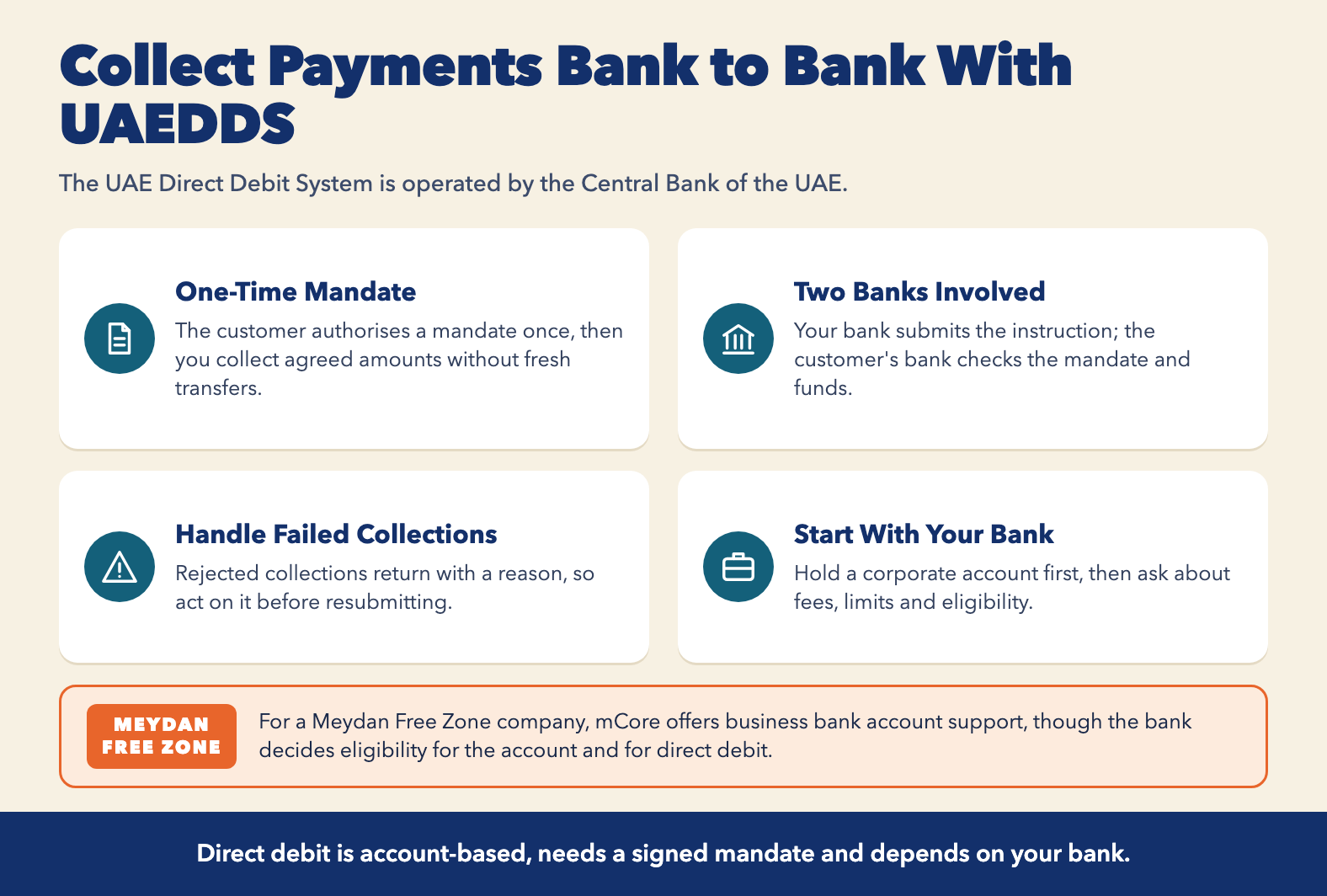
A collection starts with a customer mandate approved through their bank. The business, as creditor, submits a debit instruction through its own bank. The customer's bank validates it against the mandate and releases the funds. You then reconcile the payment against the invoice.
The Mandate and Customer Consent
The mandate records who may collect, how often and up to what amount. Consent sits with the customer and their bank. A mandate does not replace your commercial contract.
A property manager, for example, collects service charges under a mandate that sets a fixed amount and frequency.
Roles of the Creditor Bank and Debtor Bank
- Your bank submits the instruction.
- The customer's bank checks the mandate and available funds.
- Rejected collections return with a reason you must act on.
- Insufficient funds mean you follow up before resubmitting.
Reconciliation and Failed Collections
Match each collection to an invoice reference. State in your contract what happens after a failed collection. Keep mandate records for audit and dispute handling.
Steps to Start Collecting Through the UAE Direct Debit System
To start collecting, you first hold a UAE corporate bank account, then ask your bank whether it offers direct debit to business clients. You agree terms, issue mandates, test a first collection and set up reconciliation. Each bank decides eligibility, so confirm the process with yours.
Step 1: Hold a Corporate Bank Account
Direct debit runs through your bank, so the account comes first. Our guide on how to open a bank account in the UAE covers the process. mCore provides business bank account support for Meydan Free Zone companies, though it doesn't guarantee approval.
Step 2: Confirm Eligibility and Terms With Your Bank
Ask about fees, limits and onboarding requirements. Banks assess your business model and expected collection volumes. Fees are set by the bank and vary.
Direct Debit, Card Gateway and Bank Transfer Compared
| Feature | Direct Debit | Card Gateway | Bank Transfer |
|---|---|---|---|
| Best use case | Fixed retainers, rent, instalments | Online checkout, one-off sales | Occasional invoices |
| Customer action required | Sign a mandate once | Enter card details at checkout | Initiate each payment |
| Setup through | Your corporate bank | A gateway provider or bank | None beyond account details |
| Collection risk | Rejection for insufficient funds or mandate issues | Card declines and chargebacks | Late or missed payment |
| Suitability for recurring billing | High | Medium, with card-on-file | Low |
Step 3: Issue Mandates to Customers
Explain the amount, frequency and cancellation terms in plain language. Align mandate terms with the customer agreement, so both documents say the same thing.
Step 4: Test and Reconcile
- Run a small first collection to confirm the flow.
- Match results to invoices every month.
- Log every rejection reason and the action taken.
Direct Debit Compared With Cards and Bank Transfers
Direct debit suits predictable, recurring charges collected from a customer's bank account. Card gateways suit online checkout and one-off sales. Manual transfers need no setup but depend on the customer paying on time. Your billing pattern, customer type and collection risk decide the choice.
When Direct Debit Fits Best
Say a facilities company bills fixed monthly retainers to corporate clients. Direct debit fits well, and customers who prefer not to store card details are comfortable with it.
When a Payment Gateway Is the Better Tool
An e-commerce seller uses a gateway for checkout and direct debit only for service contracts. If you need both, compare providers first, starting with our guide to the top payment gateways in the UAE for startups and SMEs.
Costs, Risks and Compliance for Direct Debit Collections
Direct debit costs depend on the bank's fee schedule, so treat any figure as indicative until the bank confirms it in AED. Key risks are rejected collections, disputed mandates and weak records. Keep signed mandates, align contracts with collection terms and retain reconciliation records.
Bank Fees and a Recurring Cost
No universal rate exists. Treat collection fees as a recurring cost and build them into your pricing.
Dispute and Documentation Risks
- Keep mandate evidence and contract terms together.
- Define how disputes and refunds are handled.
- Check consumer rules where customers are individuals.
If a customer disputes a charge, the signed mandate and invoice history usually help resolve it.
Record Keeping and Reporting
Collections feed into your bookkeeping and VAT records, which the Federal Tax Authority (FTA) can review. mAccounting offers bookkeeping, VAT registration support and Corporate Tax support for Meydan Free Zone companies.
What the UAE Direct Debit System Means for Meydan Free Zone Founders
A Meydan Free Zone company needs a corporate bank account before it can use direct debit, and the bank decides eligibility. Meydan Free Zone provides digital licensing and, through mCore, business bank account support. Settle banking and invoicing terms early, then add recurring collections.
Banking First, Collections Second
Direct debit access follows bank onboarding. Free zone status doesn't change bank eligibility rules. A solo consultant licensed through Fawri, which issues a Business License in under 60 minutes, opens a business account first, then asks the bank about direct debit.
Alternatives While Waiting for Bank Approval
Payment links or gateways can cover the gap. Through Meydan Free Zone's partnership with Ziina, license holders can take QR payments, payment links and Tap to Pay on smartphones without a POS machine.
Free Business Setup Cost Calculator
Calculate NowConclusion
The UAE Direct Debit System rewards founders who handle execution before volume: a corporate bank account, clear mandate terms and tidy reconciliation. It suits predictable recurring billing, while cards and transfers still serve other cases. Map your billing pattern and ask your bank what direct debit terms it offers business clients. For a Meydan Free Zone company, mCore offers business bank account support, though the bank makes the final decision.
Ready to Launch Your Business in Dubai?
Let's Connect