

Table of Contents
Frequently Asked Questions
Which documents should a new company collect from a supplier before placing the first order?
Collect the supplier's trade license, its Tax Registration Number if it is VAT registered, and the authorised signatory's details. Add a bank letter or IBAN confirmation in the company's legal name, plus written payment and delivery terms. Keep these in one vendor file so every later payment links to a verified record.
How can a company confirm that a supplier in the UAE is VAT registered?
Ask the supplier for its Tax Registration Number and check that it appears on its tax invoices and VAT certificate. The Federal Tax Authority administers VAT registration and offers an online tool to verify a Tax Registration Number. Record the number and the date you checked it in the vendor file.
Does a Meydan Free Zone company need to check a vendor's license activity?
Yes. A vendor should hold a valid license whose activities cover the goods or services it sells to you. A trading license does not cover consulting work, for example. Checking this before the first order avoids disputes and gives your accountant a cleaner audit trail.
When must a business register for VAT in the UAE?
VAT registration is mandatory when taxable supplies and imports exceed AED 375,000 over the previous 12 months, or are expected to in the next 30 days. Registration is voluntary above AED 187,500. The Federal Tax Authority sets and administers these thresholds.
Who should approve a new supplier in a small company?
The person who adds a vendor to the system should not be the person who releases payments. In a small company, the founder can approve vendors while a second person, such as an accountant, checks bank details. This separation of duties reduces payment errors and fraud risk.
What happens if a supplier invoice has no tax details?
An invoice without the required details may not qualify as a valid tax invoice, which can put an input VAT claim at risk. Ask the supplier to reissue it with the correct information before you pay. If the supplier is not VAT registered, record that in the vendor file and expect a non-VAT invoice.
Can a new company pay vendors before its bank account is active?
In practice, vendor payments depend on an active corporate bank account, so agree payment dates only once the account is open. Meydan Free Zone's mCore service provides business bank account support, but approval rests with the bank. Build realistic payment terms around the account timeline.
How often should a company review its approved vendor list?
A monthly review suits a new company with a small number of active suppliers. Remove inactive vendors, confirm that licenses and bank details are still current, and check recurring costs. Regular reviews keep the vendor file reliable for accountants, banks and auditors.
Topic Summary
What Vendor Onboarding Means for a New Dubai Company
Vendor onboarding is the process of verifying, approving and recording a supplier before you place orders or make payments. It covers license checks, tax registration details, bank details, contract terms and internal approval, so every payment is backed by documents.
Why Vendor Onboarding Affects Cost and Compliance
Unverified suppliers can cause invalid tax invoices, payment errors and disputed deliveries. A documented process lets a new company support its expenses, recover eligible input VAT and show regulators and banks a clear record of who it pays.
Tax and Compliance Checks Before Paying a Vendor
Before paying, check the vendor's trade license and activity, its TRN if VAT registered, its legal name and its authorised signatory. Confirm the invoice format meets FTA rules. These checks are quick and help avoid disputes over tax recovery.
Vendor Onboarding Process in Five Stages
A workable vendor onboarding process has five stages: collect documents, verify the license and tax details, review contract terms, set up payment details and approve the vendor internally. Each stage produces a record, so every payment links back to a verified supplier file.
Payment Setup and Banking Controls for New Vendors
Payment setup should include verified IBAN details, a matching beneficiary name, approval limits and a record of each transfer. Open your business bank account early, because vendor payments, payroll and tax records all depend on it.
How a Meydan Free Zone Company Handles Vendor Onboarding
A Meydan Free Zone company onboards vendors under the activities on its Business License. After registration, Meydan Free Zone issues the Business License, Certificate of Formation, Share Register and Memorandum and Articles of Association digitally. Vendors and banks may ask to see these documents.
Common Vendor Onboarding Mistakes to Avoid
Common mistakes include paying before verification, skipping written terms, accepting invoices without tax details and letting one person control both vendor setup and payment. Each creates avoidable audit and cash flow risk.
Vendor Onboarding for a New Dubai Company: Key Points for New Businesses
A new Dubai company often starts paying suppliers within weeks of getting its license, usually before it has any way of checking them. Banks, auditors and the Federal Tax Authority (FTA) all look at who you pay, and an invoice from an unchecked supplier may not support an input VAT claim. This guide explains what vendor onboarding involves, which checks matter and how to build a simple process from day one.
What Vendor Onboarding Means for a New Dubai Company
Vendor onboarding is the process of verifying, approving and recording a supplier before you place orders or make payments. It covers license checks, tax registration details, bank details, contract terms and internal approval, so every payment is backed by documents.
Belief Versus Reality
Founders often believe a quote and a WhatsApp agreement are enough. Banks and auditors expect a documented supplier file. A founder who pays on a verbal quote may later be unable to support the expense in the books.
Done properly, vendor onboarding protects cash flow and tax recovery. The same checks apply whether your company is licensed on the mainland or in a free zone such as Meydan Free Zone.
Who Counts as a Vendor
- Goods suppliers and service providers.
- Freelancers, landlords and software providers.
- Recurring vendors, such as a logistics provider.
- One-off vendors, such as a design freelancer.
Why Vendor Onboarding Affects Cost and Compliance
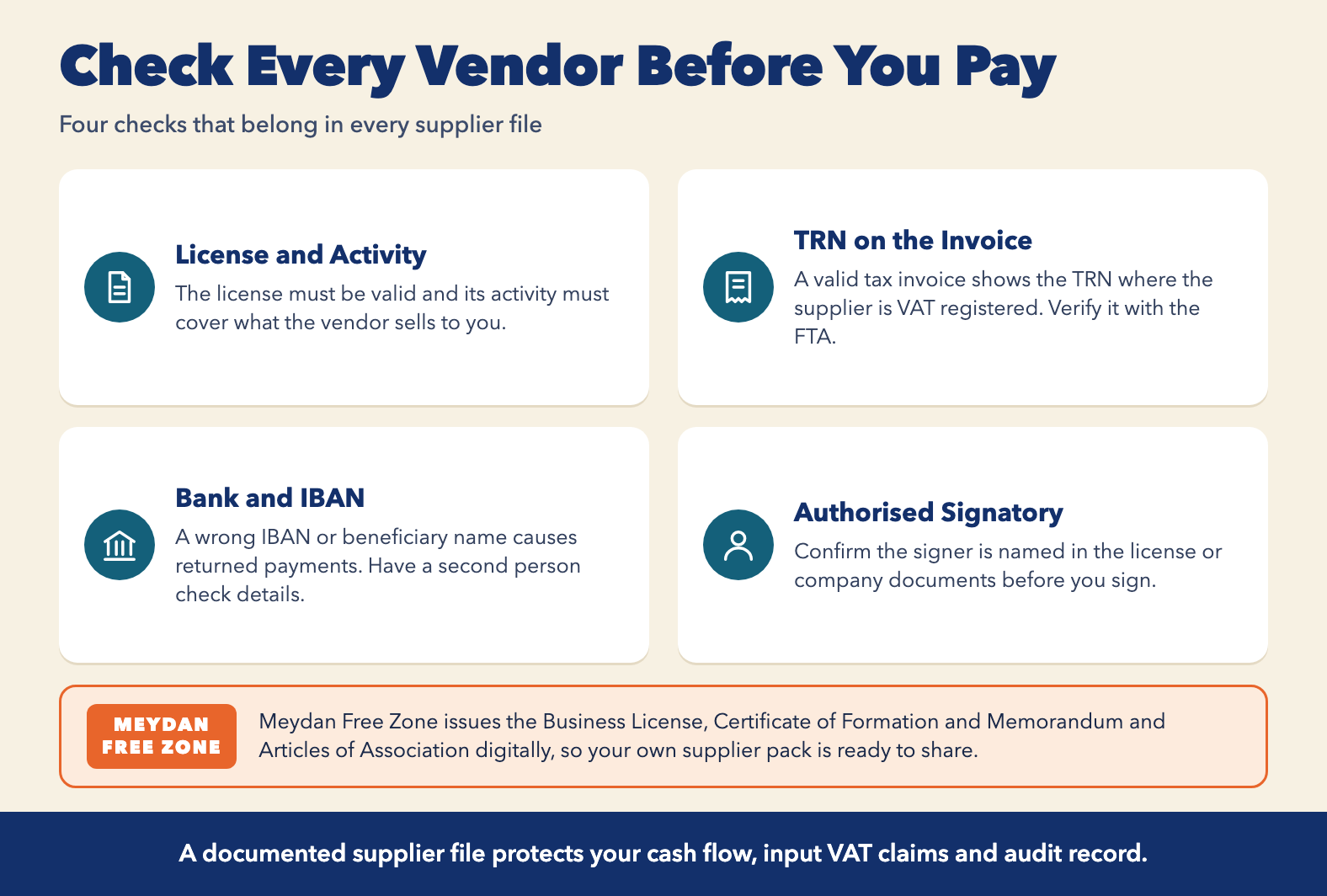
Unverified suppliers can cause invalid tax invoices, payment errors and disputed deliveries. A documented process lets a new company support its expenses, recover eligible input VAT and show regulators and banks a clear record of who it pays.
Tax Invoice Risk
A valid tax invoice needs supplier details, including the Tax Registration Number (TRN) where the supplier is VAT registered. Input VAT recovery depends on correct documents. A claim backed by an invoice missing those details can be rejected in an FTA review.
Under Federal Tax Authority rules, VAT registration is mandatory once taxable supplies and imports exceed AED 375,000 a year.
Operational and Payment Risk
- A wrong IBAN or beneficiary name causes returned payments.
- A returned transfer can delay supply.
- Unclear delivery terms lead to disputes.
- Unmanaged vendors become a recurring cost that grows quietly.
Tax and Compliance Checks Before Paying a Vendor
Before paying, check the vendor's trade license and activity, its TRN if VAT registered, its legal name and its authorised signatory. Confirm the invoice format meets FTA rules. These checks are quick and help avoid disputes over tax recovery.
License and Activity Match
The vendor's activity should cover what it sells. A trading company that invoices for consulting is working outside its license. Check that the license is valid and issued by the right authority. Mainland Dubai licenses can be checked through the Dubai Department of Economy and Tourism (DET), while free zone licenses are checked with the issuing free zone.
Vendor Onboarding Checks and Why They Matter
| Feature | Check | Purpose |
|---|---|---|
| Trade license and activity | License is valid and the activity covers the goods or services sold | Confirms the vendor can lawfully supply what you buy |
| Tax Registration Number | TRN appears on the certificate and on the invoice | Supports input VAT recovery |
| Bank and IBAN details | IBAN matches the vendor's legal name on a bank letter | Prevents returned or misdirected transfers |
| Authorised signatory | Signer is named in the license or company documents | Helps confirm the signer has authority to bind the vendor |
| Written payment terms | Terms such as Net 30 sit in a signed agreement | Gives a reference point if a payment is disputed |
VAT and Corporate Tax Details
- Record the TRN in the vendor file and check it with the FTA's online TRN verification tool.
- A supplier that is not VAT registered issues an invoice without VAT, so there is no input VAT to recover.
- mAccounting at Meydan Free Zone covers bookkeeping, VAT registration support and Corporate Tax support.
Vendor Onboarding Process in Five Stages
A workable vendor onboarding process has five stages: collect documents, verify the license and tax details, review contract terms, set up payment details and approve the vendor internally. Each stage produces a record, so every payment links back to a verified supplier file.
Stage 1: Collect Documents
- Trade license and Tax Registration certificate.
- Company contact and authorised signatory details.
- Bank letter or IBAN confirmation.
- One standard vendor form for every new supplier.
Stages 2 and 3: Verify and Agree Terms
- Verify license and tax details against the documents.
- Agree payment terms, delivery, liability and dispute handling.
- Record agreed payment terms, such as Net 30, in a signed purchase agreement.
- Keep everything in writing, so any dispute can be settled against agreed terms.
Stages 4 and 5: Set Up Payment and Approve
- Enter bank details once and have a second person check them.
- Assign an approver and a payment limit.
- Run a two-person check on the first payment.
If you are still assembling company paperwork, see the documents required to set up a Dubai company remotely.
Payment Setup and Banking Controls for New Vendors
Payment setup should include verified IBAN details, a matching beneficiary name, approval limits and a record of each transfer. Open your business bank account early, because vendor payments, payroll and tax records all depend on it.
Bank Account Readiness
Vendor payments need an active corporate account, so do not agree payment dates with suppliers until it is activated. mCore at Meydan Free Zone provides business bank account support, though approval rests with the bank. Read more on opening a corporate bank account in Dubai. Banks in the UAE are regulated by the Central Bank of the UAE.
Payment Approval Rules
- Separate the person who adds a vendor from the person who pays.
- Cap first payments until the vendor has a track record.
- Keep transfer confirmations with invoices.
How a Meydan Free Zone Company Handles Vendor Onboarding
A Meydan Free Zone company onboards vendors under the activities on its Business License. After registration, Meydan Free Zone issues the Business License, Certificate of Formation, Share Register and Memorandum and Articles of Association digitally. Vendors and banks may ask to see these documents.
Company Documents Vendors Request
Send suppliers the digital license pack during onboarding. Banks and larger suppliers may ask for the Memorandum and Articles of Association to confirm who can sign. Your suppliers may be licensed on the mainland or in a free zone, so record which applies to each. For setup background, read about how to set up a new business in Dubai.
Support Services That Help
- mCore: bank account support, company stamps and business cards.
- mAccounting: bookkeeping, VAT registration support and Corporate Tax support.
- Meydan Plus (mPlus) also offers document translation through mAssist, useful for overseas supplier agreements.
Free Business Setup Cost Calculator
Calculate NowCommon Vendor Onboarding Mistakes to Avoid
Common mistakes include paying before verification, skipping written terms, accepting invoices without tax details and letting one person control both vendor setup and payment. Each creates avoidable audit and cash flow risk.
Process Gaps
- No standard form.
- No record of approval.
- Informal terms, which leave a delivery dispute with nothing to point to.
Decision Points for Founders
Decide approval limits early. Decide who owns the vendor file. Review the vendor list monthly and remove inactive suppliers. That keeps the supplier list lean and the audit trail clean.
Conclusion
Vendor onboarding is a working control, not paperwork for its own sake. A short, consistent process protects tax recovery, payments and supplier relationships from the first order. Build a one-page vendor form and approval rule before the first purchase. With Meydan Free Zone, your Business License, Certificate of Formation and Memorandum and Articles of Association are issued digitally, so your own supplier pack is ready to share from day one.
Ready to Launch Your Business in Dubai?
Let's Connect