Table of Contents
Frequently Asked Questions
What do GCC consumers care about in sustainable products?
GCC consumers increasingly care about practical impact: less single-use plastic, durable products, recyclable packaging, ethical sourcing, and brands that make sustainability easy to understand and act on daily with confidence.
Which sectors are most affected by sustainability demand in the GCC?
Sustainability demand affects almost every sector, but the strongest shifts are visible in fashion, food and beverage, hospitality, banking, tourism, transport, packaging and consumer-facing retail services across the GCC market.
Are GCC companies keeping up with consumer sustainability expectations?
Many companies are still catching up. Consumers often focus on reuse, recycling, durability and packaging, while businesses measure production, materials and supply chains, creating a communication and strategy gap.
How do GCC regulations influence sustainable consumer behaviour?
Government policies influence behaviour by making sustainable choices more visible, practical and expected. UAE and Saudi sustainability agendas are pushing companies to adapt products, packaging, energy use and operations.
How can Meydan Free Zone support a sustainable business setup in the UAE?
Meydan Free Zone offers a fully digital business setup route with the Fawri license issued in under 60 minutes, 2,500+ business activities including Environmental Consulting (7490.10) and Environment Protection Equipment Trading (4773.a2), plus mResidency for investor visa support and Meydan Plus for ongoing compliance
Topic Summary
1. Rising Environmental Consciousness Influences Purchasing Decisions
Consumers in the GCC region are increasingly prioritising environmental impact when making purchases. This shift is driven by heightened awareness of climate change, resource depletion, and pollution, compelling companies to integrate sustainable practices across their product and service offerings.
2. Ethical and Social Responsibility Expectations Are Heightening
Modern consumers are not only seeking eco-friendly products but also demand transparency regarding ethical sourcing, fair labour practices, and corporate social responsibility. GCC companies must therefore ensure their supply chains and operations meet these rigorous social standards to maintain consumer trust.
3. Health and Wellness Trends Boost Demand for Sustainable Options
The pursuit of healthier lifestyles complements the interest in sustainability, as consumers associate organic, chemical-free, and ethically produced goods with better well-being. Companies in sectors such as food and beverages, personal care, and healthcare must innovate to meet these interconnected demands.
4. Sector-Transcending Demand Requires Cross-Industry Innovation
The increased preference for sustainable choices spans diverse industries from automotive, with a surge in electric and hybrid vehicles, to tourism, where eco-friendly travel experiences are gaining traction. GCC firms should explore cross-sector opportunities that promote sustainability while enhancing competitive advantage.
5. Regulatory and Market Forces Are Aligning With Consumer Expectations
Governments across the GCC are adopting regulations and incentives that encourage sustainable business models, reflecting and reinforcing consumer preferences. Companies that proactively align with these evolving regulatory frameworks and consumer values stand to benefit from enhanced brand reputation and market positioning.
Consumer demand for sustainable products and services what GCC companies need to know
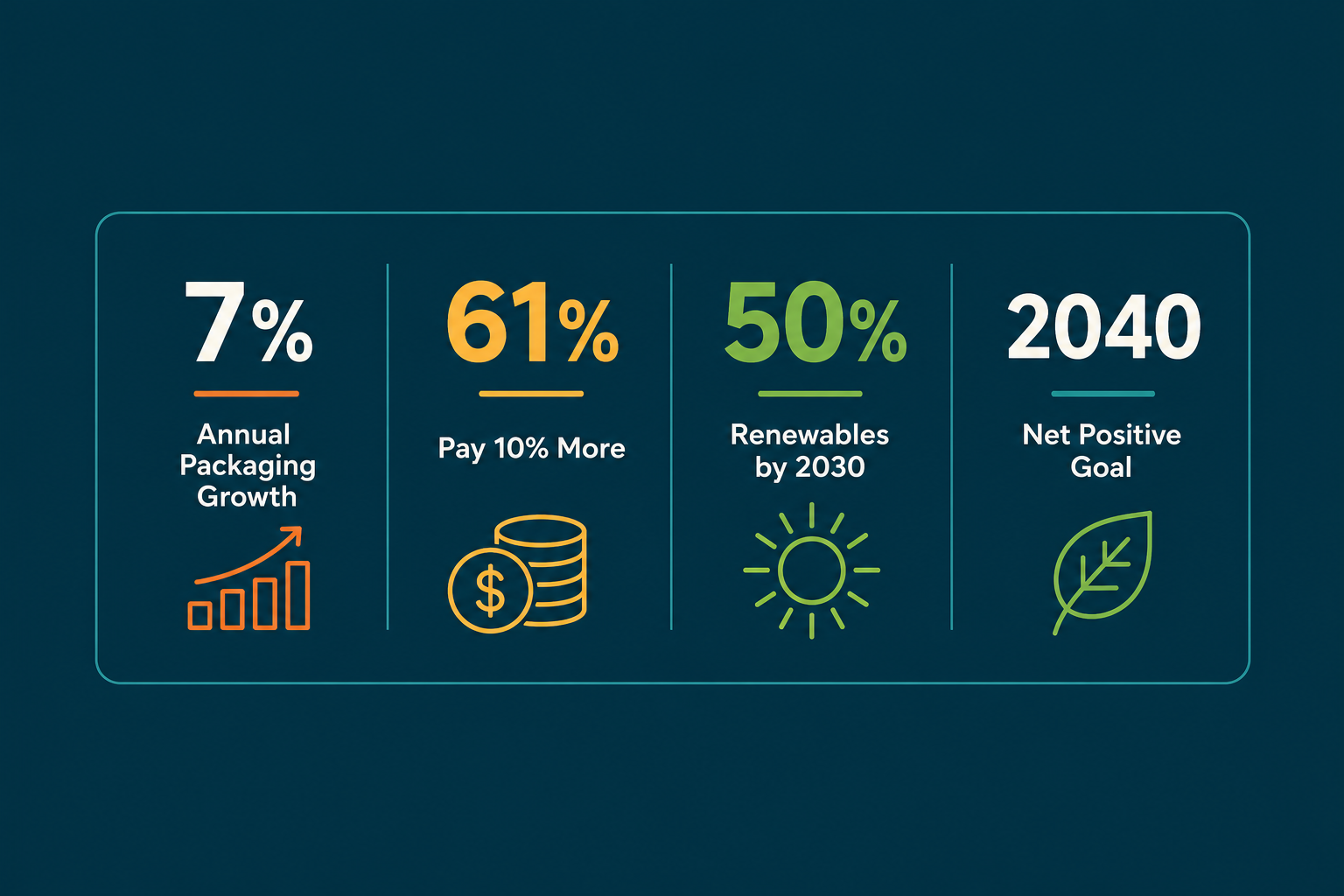
The signals all point one way. The GCC sustainable packaging market is growing at more than 7% a year through 2028 (IMARC Group, 2025). Among MENA consumers aged 18 to 35, 61% will pay at least 10% more for a product certified as sustainably made (Statista, 2024).
The UAE hosted COP28 in 2023, which pushed green issues into everyday Gulf debate. Saudi Vision 2030 pledges 50% renewable power by 2030. And green sukuk issuance in the Gulf sets fresh records year on year.
Read together, these numbers say one thing. Buyer demand for greener goods and services is reshaping how Gulf firms compete.
This article breaks down what that shift means for GCC companies. You will see what drives it, which sectors feel it most, how to answer it with proof, and what the first practical steps look like.
What This Shift Means for GCC Companies
Consumer demand for sustainable products and services in the Gulf is a real change in what people buy. Shoppers are moving toward goods and services with less harm to the planet or to people. For Gulf firms, that is a commercial signal, not a soft one. Adapt your products, your supply chain, and your claims, or lose ground.
What Counts as Sustainable in a Gulf Context
A sustainable product does less harm across its whole life. That spans raw goods, making it, shipping it, and what happens at the end. A sustainable service cuts resource use or backs social fairness. Low-carbon freight and ethical sourcing advice are clear cases.
In the Gulf, this ties straight into national policy:
- The UAE Net Zero by 2050 strategic initiative.
- Saudi Vision 2030 and its 50% renewable power target.
- Qatar National Vision 2030 and its sustainability pillars.
Meeting the rules is part of the definition. You can only market a product as sustainable if it meets standards someone can check. Take a UAE FMCG brand that reworks its packaging to meet the eco-label criteria set by the Ministry of Industry and Advanced Technology (MoIAT). That counts. Vague claims with no certificate behind them do not.
Business Activities List
Explore Over 2,500+Why This Is a Commercial Signal, Not a PR Trend
Buying teams at large Gulf groups now score suppliers on ESG. Government tenders in the UAE and Saudi Arabia ask more often for proof of green compliance. Brands that ignore this risk losing shelf space in premium retail.
- ESG terms appear in a growing share of Gulf government tenders.
- Suppliers who fall short risk losing retail listings.
- B2B and B2C pressure are now pulling the same way.
- This no longer sits with one department.
Majid Al Futtaim, one of the region's largest retail and hospitality groups, has pledged to be net positive by 2040. It now screens suppliers on green criteria as they come on board. That is not PR. It is a gate. Miss the criteria and you miss the shelf.
Why Sustainable Products Are Gaining Ground in the Gulf
Three forces are pushing the same way at once: state policy, a young buyer base, and pressure from global investors. National net-zero pledges, a digital-first millennial majority, and ESG reporting rules from abroad all build demand that firms cannot wave off.
How State Policy Shapes What Buyers Expect
National green strategies set the tone for what people expect from brands. The UAE Green Agenda 2030 feeds public education campaigns. The Saudi Green Initiative has drawn wide public attention to climate action.
The UAE Year of Sustainability in 2023, tied to COP28, lifted media coverage of green products sharply. The Saudi Green Initiative aims to plant 10 billion trees inside Saudi Arabia. When the state leads on this, buyers start to expect brands to follow.
Age Groups Driving Greener Buying
Millennials and Gen Z make up most of the Gulf buyer base. In several Gulf states the median age is under 32. These groups check a brand's green record before they buy. Digital access lets them compare global benchmarks in real time.
Expat households in the UAE bring habits shaped by tighter rules back home. A British or German buyer in Dubai expects the eco-labels she grew up with. Younger MENA consumers are far more likely than older ones to pay extra for greener goods (Statista, 2024).
Global Investor Pressure Reaching Local Markets
Investors abroad want ESG disclosure from the firms they back. That reaches Gulf subsidiaries too.
The main pressure points:
- Listed Gulf firms face rising shareholder pressure on climate risk.
- Private equity firms entering the Gulf apply ESG checks before they invest.
- Fund backers abroad shape how Gulf portfolios are built.
Several firms listed on the Abu Dhabi Securities Exchange now publish standalone green reports for investors abroad. That pressure turns into internal targets. Those targets reach product and service calls.
Which Sectors Feel the Most Pressure
Retail, food and drink, building, freight, and finance face the sharpest push in the Gulf. Each has its own weak point: packaging in retail, sourcing in food, materials in building, emissions in freight, and greenwashing risk in finance.
| Feature | Consumer-facing business | B2B or wholesale business |
|---|---|---|
| Main pressure point | Shopper demand for eco-labels at the till | ESG supplier forms in corporate and state tenders |
| First certificate to get | A MoIAT eco-label or organic mark for your lines | ISO 14001 for environmental management |
| Key channel | Packaging, in-store labels, and social media | Supplier onboarding packs and tender bids |
| Reporting framework | A short GRI-based summary for shoppers | TCFD or a full GRI report for large clients |
| Quick win | Certify your top three lines and show the label | Add a green clause to new supplier contracts |
Retail and Fast-Moving Consumer Goods
Cutting plastic packaging is the most visible fight for Gulf FMCG brands. Supermarket chains have started to set green terms for shelf listings. Organic and ethically sourced food is growing faster than the standard lines.
- The GCC organic food market is growing at double-digit annual rates (IMARC Group, 2025).
- Plastic reduction pledges from big Gulf retailers keep rising.
- Clear labels now sway what city shoppers choose.
Carrefour UAE has given eco-labelled goods their own space in several hypermarkets. That was a direct answer to shopper demand. It is also a signal to every supplier on its books.
Free Business Setup Cost Calculator
Calculate NowConstruction and Real Estate
Green building marks such as LEED and Estidama are now standard on major Gulf projects. LEED-rated buildings command higher rents in both Dubai and Riyadh (Mordor Intelligence, 2024). Abu Dhabi projects use the Estidama Pearl Rating System widely.
Expo City Dubai was built to showcase green urban design. Private developers across the UAE now point to that benchmark in their own marketing. Corporate tenants ask more often where materials come from. Energy ratings shape both compliance and appeal.
Financial Services and Islamic Finance
Green sukuk and ESG-linked bonds are growing fast in Gulf capital markets. Banks now offer green finance for homes and vehicles. The UAE issued its first sovereign green bond in 2023, which points to real state backing for green finance.
- Green sukuk issuance in the Gulf rises year on year.
- Some buyers now weigh a bank's green record when they choose.
- Greenwashing risk runs high in finance, and vague claims draw scrutiny.
Is certification worth the cost for a mid-sized GCC business?
For most mid-sized Gulf firms, yes. A certificate closes off greenwashing risk and opens buying channels that stay shut without it. ISO 14001 tends to cost between AED 15,000 and AED 40,000 depending on your size. Set that against the value of one tender it lets you bid for.
How to Build a Sustainability Strategy People Trust
Build it in six steps. Audit your impact. Set targets you can measure. Certify your products. Update your supply chain rules. Say what you are doing, openly. Then report each year against a known framework such as GRI or TCFD.
Step 1: Audit Your Footprint
Start by mapping energy use, water use, waste, and supply chain emissions. Use the GHG Protocol to count carbon. It is the global standard. Find your biggest sources first. That is where action earns the most trust.
Take a mid-sized Dubai freight firm that runs a Scope 1 and Scope 2 carbon audit. It finds that its vehicle fleet drives most of its footprint. That one insight lets it put EV fleet work ahead of everything else. An internal audit is a start. Third-party checks add the weight big buyers want.
Step 2: Set Targets Tied to National Goals
Tie your targets to UAE Net Zero 2050 or Saudi Vision 2030, based on where you trade. The Science-Based Targets initiative (SBTi) gives you a framework buyers already trust. Targets need dates. Vague pledges invite doubt from buyers and regulators alike.
- A packaging maker that pledges 50% recycled content by 2028 gives retailers a firm reason to pick it.
- Public targets create real accountability.
- Thousands of firms worldwide use SBTi as the benchmark.
Step 3: Certify and Report Openly
Third-party certificates close off greenwashing risk. ISO 14001, MoIAT eco-labels, and B Corp are the most useful routes for Gulf firms. Annual reports built on GRI Standards or TCFD build trust with large clients. Consumer brands should show their marks clearly, both in store and online.
Retailers often lean on a supplier's certificate to back their own claims. That makes open reporting a real edge in Gulf B2B markets.
Expert Financial and Tax Compliance Services in Dubai
Explore mAccountingCommon Mistakes GCC Companies Make
The usual errors are simple. Greenwashing through vague claims. Treating ESG as marketing rather than a change in how you operate. Ignoring your supply chain. Failing to measure or report. Each one costs you trust with buyers, investors, and tender teams.
Greenwashing: The Fastest Way to Lose Trust
Greenwashing means making green claims you cannot back with proof. Gulf buyers now spot loose words like "eco-friendly" when no certificate sits behind them. Regulators in the UAE and Saudi Arabia are tightening the rules on green advertising.
Take an airline that markets a flight as carbon neutral with no verified offsets behind it. The claim gets picked apart, and the story spreads fast across regional media. One unbacked claim can undo years of brand equity. In a market this connected, the damage travels fast and stays visible.
Treating It as a Marketing Job
This has to live in operations, buying, and product design. It cannot sit only in your comms. Buyers on both sides now check well past your brand messaging.
- Internal green teams need budget, authority, and board backing.
- B2B due diligence now routinely includes supplier ESG forms.
- Board-level ownership tracks with stronger outcomes worldwide.
- Marketing with no operational change is the definition of greenwashing.
Take a Gulf retail group that redesigns its green report but leaves supplier rules untouched. Investors spot the gap during due diligence, and a planned raise stalls. Substance has to come before story.
What the Numbers Show
The data points to fast growth. Research shows double-digit annual growth in green categories, a rising will to pay more among younger buyers, and more ESG terms in state and corporate buying across the Gulf.
Market Size and Growth
The GCC sustainable packaging market is growing at more than 7% a year through 2028. Retail rules and shopper preference are the main drivers (IMARC Group, 2025). Organic food sales in the UAE have grown at double-digit rates for four years running.
- Sustainable packaging: the fastest-growing sub-category in Gulf FMCG.
- Green building materials: strong projected growth through 2028.
- Green sukuk: fresh records in Gulf capital markets.
- Organic food: double-digit UAE growth for four years running.
These are not niche lines any more. They are mainstream markets moving fast.
What Buyers Will Pay Extra For
A Statista survey of MENA consumers found 61% of those aged 18 to 35 would pay at least 10% more for a certified sustainable product (Statista, 2024). That will to pay runs highest in food, personal care, and electronics. Price resistance drops when the label is visible and credible.
B2B buyers behave much the same way. Green compliance helps justify a higher contract value. A supplier with ISO 14001 can defend its price in a tender. One without it often cannot get in the room.
Practical Steps for GCC Companies
Start by auditing your product range. Certify your highest-volume lines. Update your buying rules. Brief your sales team. Publish a roadmap. Then fold ESG metrics into your annual accounts. Speed counts here, because early movers build an edge that lasts.
Quick Wins for This Quarter
- Audit the top 20% of your lines by revenue for certification.
- Add a green clause to every new supplier contract.
- Brief your sales team on how to explain your credentials to B2B buyers.
- Publish a green commitment page with firm, dated goals.
Take a Dubai B2B distributor that adds a one-page green statement to its supplier pack. Multinational clients start scoring it higher in tenders. That is a commercial return from a single quarter of work.
What should a GCC company include in its first sustainability report?
Cover four things. Your carbon baseline, measured with the GHG Protocol. Your dated targets, tied to UAE Net Zero 2050 or Saudi Vision 2030. Any marks you hold, such as ISO 14001 or a MoIAT eco-label. And your supply chain rules. Keep it under 20 pages. Put it on your website. Update it each year.
Longer-Term Positioning
Quick wins build momentum. Long-term work builds advantage. Over 12 to 24 months, focus here:
- Build lifecycle assessment into product development from the start.
- Widen your supplier base to include certified green vendors.
- Apply for green finance, as sustainability-linked loans can carry a rate discount.
- Join regional groups such as the UAE Business Council for Sustainable Development.
Take a Riyadh manufacturer that builds lifecycle assessment into its product development. It cuts the carbon in each unit over two years, and that qualifies it for a sustainability-linked loan at a lower rate. The operational change pays for itself through cheaper funding.
The Commercial Reality GCC Companies Cannot Ignore
Consumer demand for sustainable products and services in the Gulf is not a future trend. It is here now. State policy, a young buyer base, investor pressure, and buying standards all push the same way.
Firms that act now, with real proof, open reporting, and true operational change, will win the customers, contracts, and capital that flow to leaders. Firms that wait will find the gap wider each year.
The steps are clear. Audit your footprint. Set dated targets. Certify your products. Update your supply chain. Report in public. And do not let any of it live only in your marketing deck.
References
- World Bank (worldbank.org)
- IMARC Group (imarcgroup.com)
- Statista (statista.com)
- Mordor Intelligence (mordorintelligence.com)