Table of Contents
Frequently Asked Questions
What does a creative, arts and entertainment business do?
It carries out creative and cultural work, covering live performance production, individual artistic and writing activities, the operation of arts facilities, and the production of live arts events.
What activities fall under creative, arts and entertainment?
It covers live theatre, concerts, and dance productions, the work of artists and writers, the operation of concert and theatre halls, art restoration, and live event production.
Who creates demand for creative and arts work in the UAE?
A large, international, high-spending population and a culture-focused tourism economy fill venues and events, while the UAE's cultural strategy funds festivals, exhibitions, and commissioned work.
Does this activity include operating a cinema or museum?
No. The operation of cinemas and the operation of museums are classified separately. This activity covers live performance, artistic work, and the operation of arts facilities.
How is the UAE supporting creative and arts businesses?
The UAE has set explicit targets to grow its creative economy, including raising the creative industries' contribution to GDP and increasing the number of creative companies.
Start a Creative, Arts and Entertainment Business with Meydan Free Zone
Behind every concert, gallery show, stage production and published novel there is someone who made the work, and often someone else who produced and staged it. Activity code 9000.00 is the license for that work, from an artist's own practice to the production of the live events audiences turn up for.
The UAE has put this sector near the centre of its economic plans, with published targets and money behind them. This guide covers what the activity covers, what it leaves out, how to license it, and why the market is growing on purpose rather than by accident.
Key Stats at a Glance
What This License Covers
Under activity code 9000.00 you are licensed to carry out creative, arts and entertainment work, and to operate the facilities and services that meet cultural and entertainment interests. It breaks into four strands.
The first is live performance production: theatrical presentations, concerts, opera, dance and other stage productions, with or without your own venue. The second is individual artistic work, covering authors, actors, directors, musicians, painters, sculptors and independent journalists. The third is running arts facilities, meaning concert halls, theatre halls and similar venues. The fourth is the restoration of works of art, together with the work of producers of live arts events.
The boundaries are drawn tightly. Motion picture and video production, the operation of cinemas, personal theatrical and artistic agents, casting work, ticket agencies and the operation of museums all have their own codes.
So do several specialised restoration lines, including stained glass, historical musical instruments, historical buildings and furniture, along with the manufacture of statues that are not artistic originals, and sports, amusement and recreation activities.
The line is precise: produce live performances, do artistic and creative work, or run an arts venue, and you are in. Make films, run a cinema or museum, act as a casting or ticket agency, or carry out specialised restoration, and you are not.
Who Your Clients Will Be
Three kinds of founder fit this license:
- Performing arts producers: People producing live theatre, concerts, dance and other stage productions, with or without their own facilities
- Individual artists and writers: Painters, sculptors, authors, musicians, actors, directors and independent journalists
- Arts venue and event operators: Operators of concert halls, theatre halls and arts facilities, and producers of live arts events
Demand comes at you from two directions. There is audience demand, which is a large, international, high-spending population that fills concert halls, theatres, galleries and live events, backed by a tourism economy that treats culture as part of the offer.
And there is institutional demand, which is the steady flow of festivals, public art, exhibitions and commissioned work that the UAE's cultural strategy has set in motion, with public and private bodies funding creative output.
Mainland or Free Zone
Meydan Free Zone gives you 100% foreign ownership, 0% corporate tax on qualifying income, full profit repatriation and a licensing process that runs entirely online. For an artist or a small production company, that is a cheap and regulated base to work from. Mainland makes more sense if your work is aimed squarely at the local market. Let your audience decide it, not the price.
[blockCTACostCalculator]
Step by Step Setup Guide
- Step 1, book your trade name: Use the DET portal for a mainland company, or the Meydan Free Zone portal for a free zone one.
- Step 2, confirm the activity code: Check that 9000.00, Creative, Arts and Entertainment Activities, is approved where you are applying.
- Step 3, send in your documents: Passport copies for every shareholder and director, plus a short description of the creative work you intend to carry out.
- Step 4, take the license: No third-party approval is needed for this activity, so there is no separate regulator to clear before you start.
- Step 5, open a bank account: Banks want a valid trade license and your compliance paperwork in order, so allow time for onboarding.
Compliance and What You Need in Place
Third-party approval
None is needed for this business activity. That is unusual and it removes a whole stage that founders in other sectors have to work through.
Anti-money laundering
This activity is exempt from AML compliance duties, which keeps your reporting load light compared with regulated trades.
Staying inside the code
Keep the work on your license matched to what you actually do. If the business drifts into film production, cinema or museum operation, casting or ticketing, those sit under separate codes and you need to update the license rather than assume it stretches.
Market Opportunity
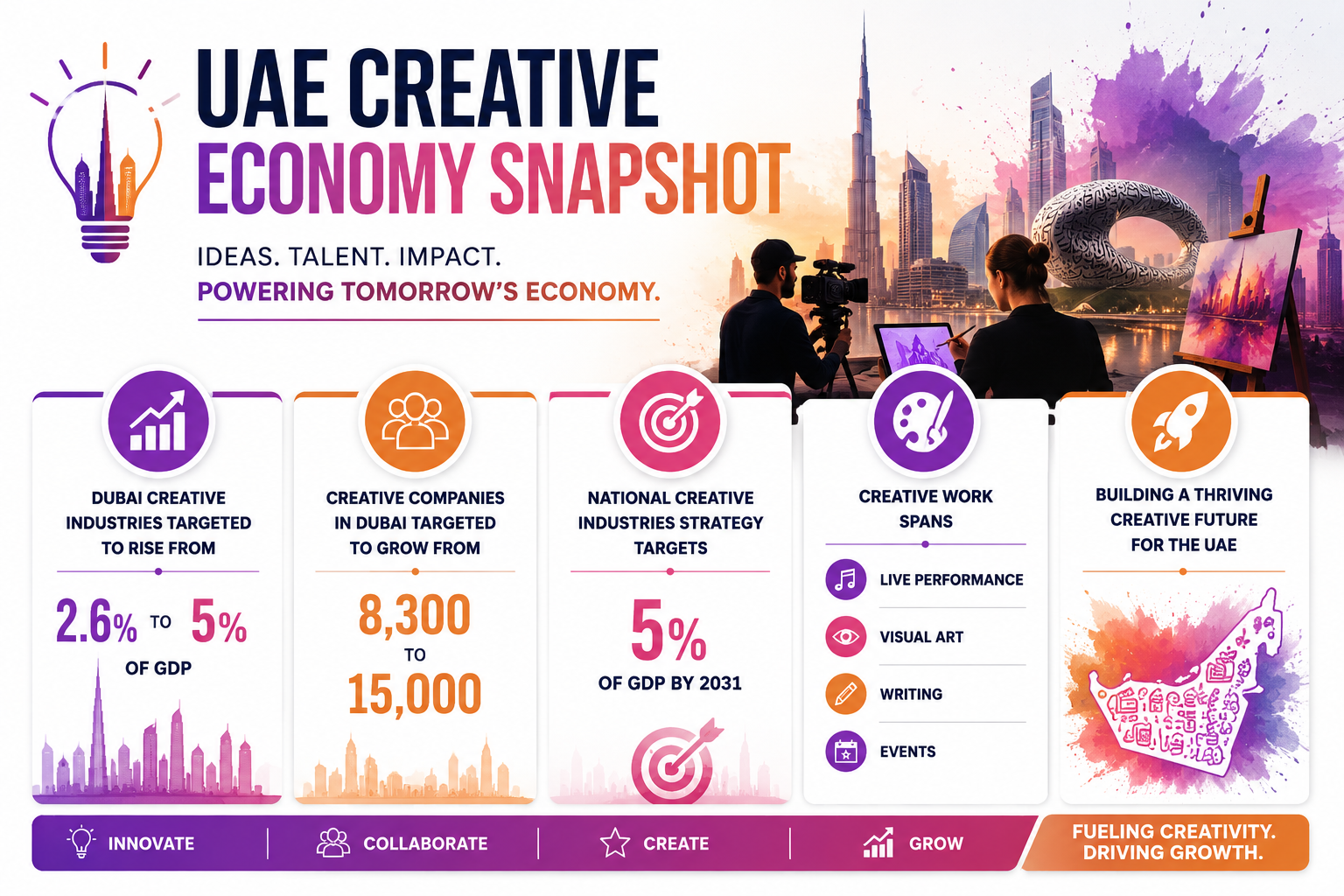
The UAE is not treating arts and culture as a side activity. The Dubai Creative Economy Strategy set out to lift the creative industries from 2.6% of Dubai's GDP in 2020 to 5%, and to more than double the number of creative companies in the emirate from 8,300 to 15,000, according to the UAE Government. At national level, the Strategy for the Cultural and Creative Industries targets a 5% share of national GDP by 2031.
Those are published targets with policy behind them, which changes what it means to start here. An artist, a producer or a venue operator is working into a market that is being grown on purpose, where both the audiences and the institutions are expanding at the same time.
The value of this activity rests almost entirely on talent and output. A gallery, a production company or an individual artist is judged on the work itself, and there is no licensing barrier standing between good work and a paying audience.
Conclusion
Creative, arts and entertainment work is one of the simplest activities to license in Dubai. There is no third-party approval, no AML burden, and no regulator to satisfy before you begin.
What you do need is clarity about which side of the line your work sits on, and a license that keeps pace as the business grows. Get that right and you are operating in an economy that has chosen, deliberately, to grow culture.
[blockCTAContact]
References
- UAE Government, Dubai Creative Economy Strategy
- UAE Government, National Strategy for the Cultural and Creative Industries
- Dubai Department of Economy and Tourism