Table of Contents
Frequently Asked Questions
Q: What does a financing broker do in the UAE?
A: A financing broker intermediates between borrowers and lenders across personal loans, SME working capital, corporate term loans, trade finance, and equipment financing, supporting bank selection, applications, and negotiation.
Q: What financing products do UAE brokers handle?
A: Personal loans, credit cards, auto loans, SME working capital, corporate term loans, trade finance facilities (LCs, bank guarantees), supply chain financing, equipment financing, and Sharia-compliant Islamic financing products.
Q: Does financing brokerage require regulatory approval?
A: Financing broker activity under this activity code does not require third-party approval. Brokers intermediate transactions without performing regulated lending activities themselves under the activity scope.
Q: How do financing brokers earn revenue?
A: Financing brokers typically earn commission-based fees from lenders on successfully completed financing transactions, with commission structures varying by product type, ticket size, and lender arrangements.
Q: What is the difference between financing brokerage and lending?
A: Financing brokerage intermediates between borrowers and licensed lenders, earning commissions. Lending involves actually providing finance to borrowers, requiring separate regulated banking or finance company licenses.
How to Start a Financing Broker Business in Dubai
Borrowers do not know which bank will say yes. Banks do not know which borrowers are worth chasing. A financing broker sits in the middle of that gap, knows who lends what on which terms, and gets paid when a deal closes.
This guide covers what activity code 6619.99 lets you do, which products you can broker, how to license it, and where the money comes from. There is no third-party approval to clear, which makes this one of the cleaner financial activities to set up in Dubai.
Key Stats at a Glance
What This License Covers
Under activity code 6619.99 you intermediate between borrowers and lenders.
You help clients pick the right bank, put the application together and negotiate the facility. What you do not do is lend. Lending means actually providing the finance, and that needs a separate regulated banking or finance company license.
The product range is wide.
It covers personal loans, credit cards and auto loans on the retail side, SME working capital and corporate term loans in the middle, and trade finance facilities such as letters of credit and bank guarantees at the corporate end.
Supply chain financing, equipment financing and Sharia-compliant Islamic products including murabaha and ijara all sit inside the same code.
There are boundaries. This activity leaves out insurance agents and brokers, which fall under activities auxiliary to insurance and pension funding, and it leaves out the management of investment funds.
Put simply, if you intermediate financing transactions for UAE retail, SME or corporate borrowers, you are in.
Who Your Clients Will Be
Most brokers pick a lane rather than covering everything:
- SME and corporate brokers, handling working capital, term loans, structured finance and equipment financing
- Trade finance and supply chain brokers, handling letters of credit, bank guarantees and project finance for corporates
- Retail and Islamic financing brokers, handling personal loans, credit cards, auto loans and Sharia-compliant products
On any given day that might mean brokering SME working capital across several banks at once, running a corporate term loan for a mid-market client, arranging letter of credit facilities for a trading company, or comparing personal loan rates across lenders for an individual buyer.
Mainland or Free Zone
Meydan Free Zone gives you full foreign ownership, no corporate tax on qualifying income and a licensing process that runs online end to end.
For a broker whose real asset is a phone full of banker contacts, the overhead saving matters more than the address. Mainland suits you better if your clients want a local entity on the paperwork.
Let your clients decide it, not the price.
[blockCTACostCalculator]
Step by Step Setup Guide
- Step 1, book your trade name: Use the DET portal for a mainland company, or the Meydan Free Zone portal for a free zone one.
- Step 2, confirm the activity code: Check that 6619.99, Financing Broker, is approved where you are applying and covers the products you plan to handle.
- Step 3, send in your documents: Passport copies for every shareholder and director, plus a short description of the brokerage work you intend to do.
- Step 4, take the license: No third-party approval is needed, so no regulator has to sign off before the license is issued.
- Step 5, open a bank account: Allow time. A brokerage sitting next to the lending market draws closer questions during onboarding than most service businesses.
- Step 6, sign your lender arrangements: Commission terms are agreed with each lender separately. Get these papered before you start introducing clients.
Compliance and What You Need in Place
Third-party approval
None is needed for this business activity. You are introducing and negotiating, not lending, and the activity is written to keep you clearly on that side.
Anti-money laundering
This activity is exempt from AML compliance duties, which keeps your reporting load lighter than a regulated lender's.
Staying out of lending
This is the line that matters. The moment you provide finance yourself rather than intermediate it, you are in regulated territory and you need a different license. Keep the separation clean in your contracts, your marketing and your money flows.
Your lender network
The business runs on relationships across conventional and Islamic lenders. A broker who only knows two banks is not a broker. Breadth is what lets you place a deal that one lender has declined.
Systems
Application processing is where brokers lose time and clients. Technology that moves a file through several lenders at once is the difference between a deal that closes and one that goes cold.
Market Opportunity
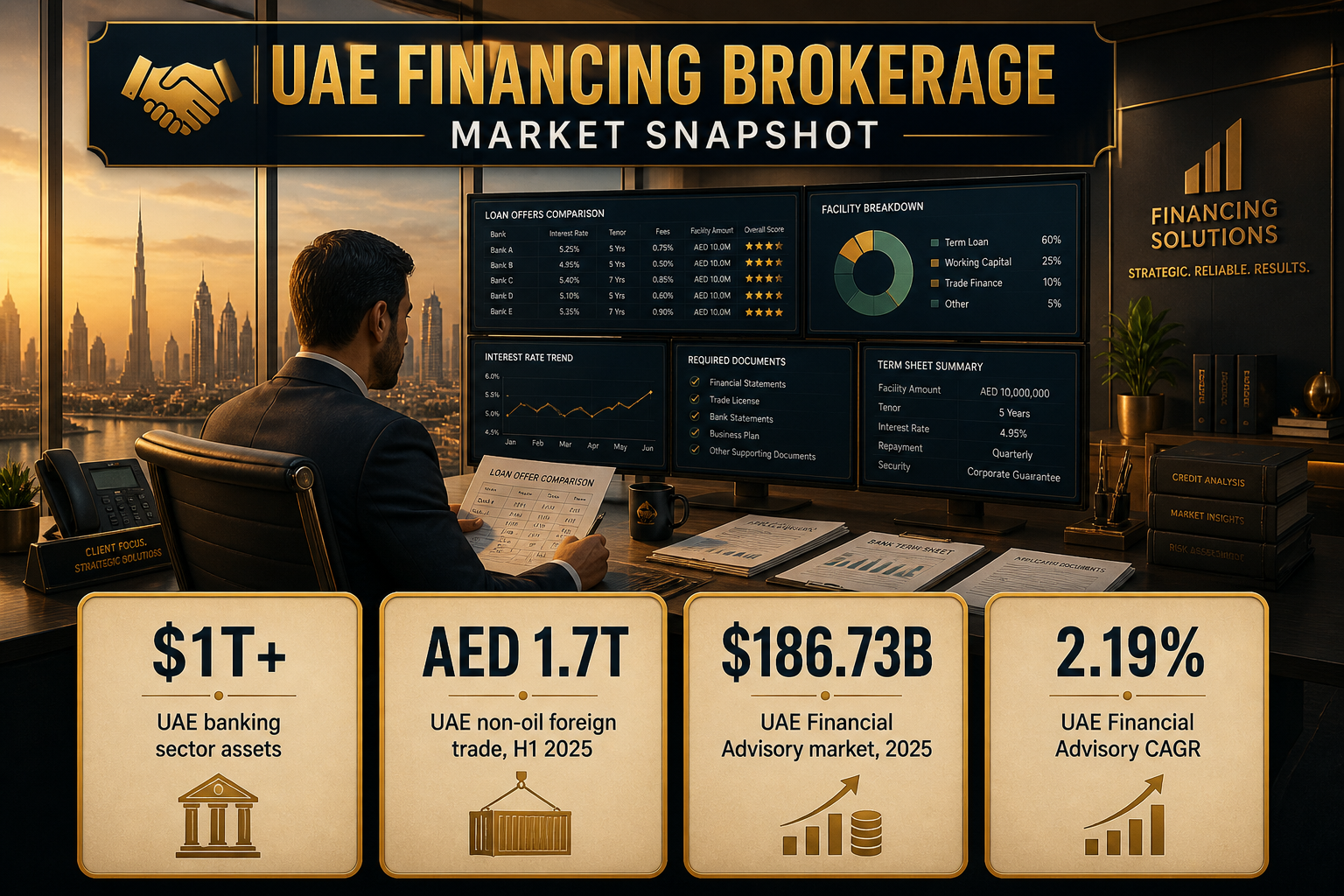
UAE banking sector assets exceed USD 1 trillion, according to the Central Bank of the UAE, and the major lenders run diverse retail, SME and corporate books. That is a lot of product for a broker to place across.
Trade finance has its own engine behind it. UAE non-oil foreign trade reached AED 1.7 trillion in H1 2025, which keeps demand for letters of credit, bank guarantees and supply chain facilities steady rather than seasonal.
For a broker who understands documentary credit, that is a durable niche.
Statista projects UAE Financial Advisory at USD 213.10 billion by 2030, up from USD 186.73 billion in 2025.
The financing market spans conventional banks, Islamic banks and finance companies, with Al Etihad Credit Bureau providing the credit information infrastructure underneath.
Brokers with strong banker networks have real room to grow inside that.
Conclusion
Financing brokerage in Dubai has a short setup path and a long ramp. The license is quick, there is no approval to chase and no AML burden, so you can be trading within weeks.
What takes time is the network. Your value to a borrower is knowing which lender will actually say yes, and your value to a lender is bringing deals that fit their appetite. Neither can be bought.
Pick a niche, whether that is SME, trade finance, consumer lending, Islamic products or project finance, and build the relationships that make you the obvious call.
[blockCTAContact]
References
- Central Bank of the UAE
- Statista, Financial Advisory United Arab Emirates
- Dubai Department of Economy and Tourism