

Table of Contents
Frequently Asked Questions
Can I move my UK limited company directly to Dubai?
No. A UK limited company stays registered with Companies House. To operate in Dubai, you either register a UAE Branch of the UK company or set up a separate LLC and move selected operations into it.
What is the difference between a Branch and an LLC in Dubai?
A Branch remains part of the UK parent, which keeps responsibility for its liabilities. An LLC is a separate UAE entity with its own contracts, assets, activities and far greater commercial independence.
Do I need to close my UK company after moving to Dubai?
No. The UK company can keep serving British clients, own the UAE LLC, hold certain assets, or become dormant. Close it only once its employees, contracts, creditors, assets and taxes are settled.
How quickly can I get a Meydan Free Zone business license?
A Regular license starts at AED 12,500 (approx. £2,534), and Fawri at AED 15,000 (approx. £3,040) can be issued in under 60 minutes. Fawri is available for LLCs only, not Branch applications.
Does a Meydan Free Zone company automatically qualify for 0% corporate tax?
No. A Meydan Free Zone LLC can access the 0% rate on qualifying income if it meets the Qualifying Free Zone Person conditions. Non-qualifying income may be taxed at 9%, and genuine UAE substance remains essential.
Topic Summary
1. Understand the Legal Limits of Company Transfer
A UK limited company’s registered office must remain in the UK; it cannot simply be relocated to Dubai. The company’s jurisdiction of incorporation binds it legally, so any move requires restructuring rather than direct transfer.
2. Consider Setting Up a New Entity in Dubai
Most founders establish a new company in Dubai, often within a free zone, where they benefit from zero personal and corporate income tax, full foreign ownership, and greater operational flexibility. This new entity serves as the regional hub for trading activities.
3. Plan the Migration of Business Assets and Operations
Once the Dubai entity is established, transferring assets, contracts, employees, and intellectual property requires careful planning and legal compliance on both sides. Due diligence ensures smooth continuation of business activities without regulatory breaches.
4. Address Taxation and Compliance Requirements
While Dubai offers a tax-friendly environment, British founders must navigate UK tax obligations linked to demerger or asset transfer, including potential capital gains or exit taxes. Engaging professional advisors in both jurisdictions is vital.
5. Maintain UK Company Compliance or Consider Closure
If the UK limited company remains active, it must comply with Companies House filing and tax obligations. Alternatively, founders may choose to strike off or dissolve the UK company following the successful establishment of the Dubai entity and transfer of business interests.
How to Move Your UK Limited Company to Dubai
More British founders than ever are building their next chapter in Dubai, drawn by a market that lets them keep more of what they earn and trade across three continents from one base.
The opportunity is real, but it starts with getting one fact right: a UK limited company cannot simply be transferred to Dubai. Its registered office must stay in the jurisdiction where it was incorporated, so moving the business means something more deliberate than a change of address.
According to Dubai Chambers, 10,334 active British companies were registered with the Dubai Chamber of Commerce by the end of March 2026, more than four times the number in 2020.¹
Over the same period, Dubai Chambers also reports that UK-Dubai non-oil trade reached AED 42.6 billion in 2025, up 91% since 2021.²
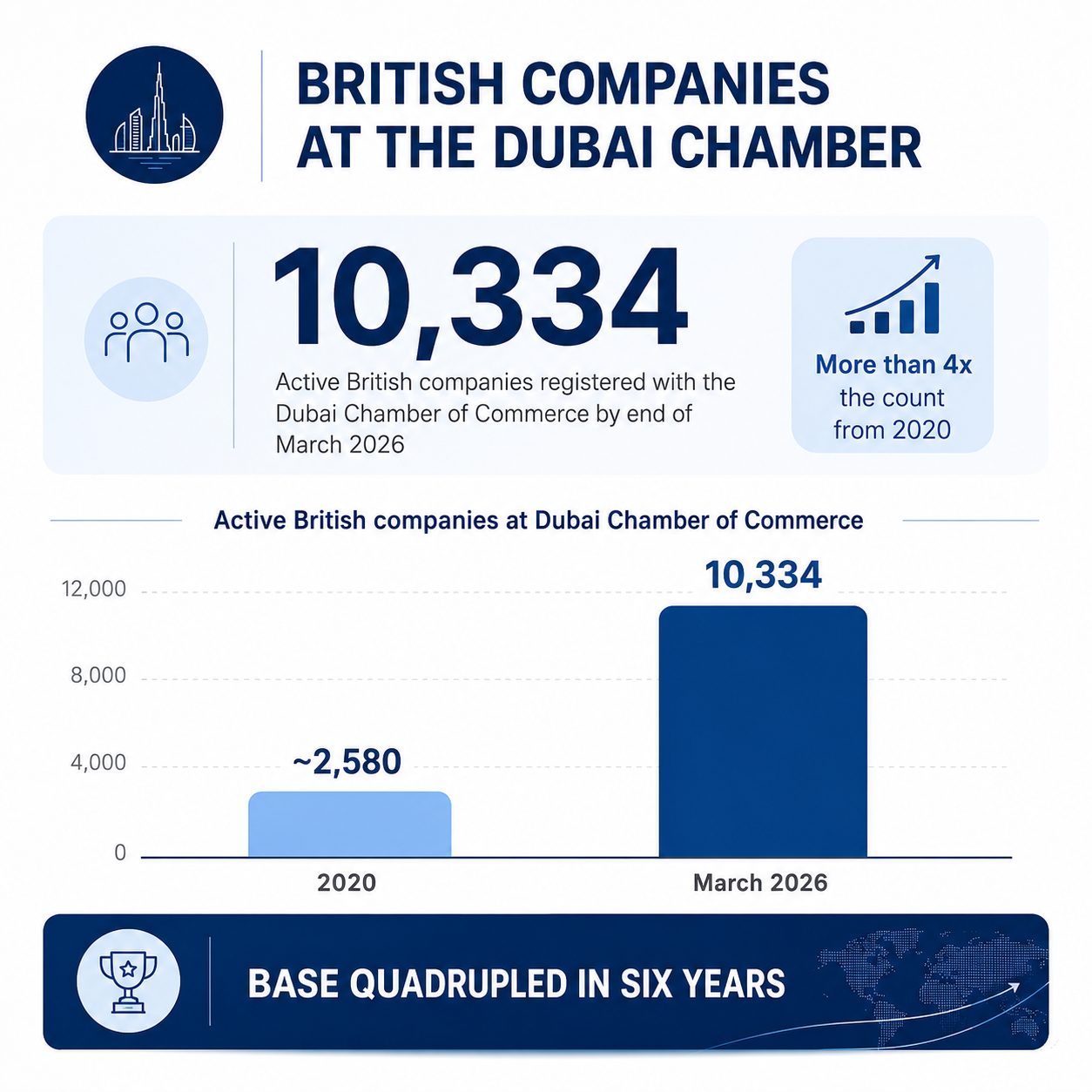
Source: Dubai Chamber of Commerce British Business Council Report Q1 2026, via Dubai Chambers
The move is best treated as an operating decision, not a filing. For a founder looking to relocate a UK business to Dubai, Meydan Free Zone offers a business license that can be issued in under 60 minutes with Fawri, and a choice between registering a Branch of the UK company or forming a new Dubai company and moving the operation into it. That choice shapes everything that follows.
Can You Move a UK Limited Company to Dubai?
Not directly.
A UK limited company remains registered with Companies House and continues as a UK legal entity unless it is formally closed or restructured. It cannot simply be re-registered as a UAE company.
Instead, the business can enter Dubai in one of two ways:
- Register a Branch of the UK company.
- Set up a new LLC.
If the UK company owns the LLC, it may be called a subsidiary. But “subsidiary” describes ownership, not the legal type. The entity is still an LLC.
The distinction matters: a Branch remains part of the UK company, while an LLC is a separate legal entity. That determines who owns the assets, who carries the liabilities, and what stays exposed to the UK business.
Branch or LLC: The Decision That Shapes the Move
The choice between a Branch and an LLC is the one that shapes everything else, ownership, liability, activities, and how independent the Dubai operation can be.
| Factor | Branch of the UK company | New LLC |
|---|---|---|
| Legal identity | Extension of the UK company | Separate UAE legal entity |
| Ownership | Part of the UK parent | Owned by the founder, the UK company, or other approved shareholders |
| Liability | Ultimately sits with the UK parent | Generally limited to the UAE company |
| Activities | Normally aligned with the parent's activities | Can select its own approved activities |
| Business name | Uses the parent company's identity | Can establish its own UAE identity |
| Contracts | Entered into through the same legal company | Entered into by the new UAE company |
| Commercial independence | Limited | Greater |
| Best suited to | Continuity and UAE market entry | Long-term UAE operations, separated from the UK business |
Which route fits comes down to one question: are you extending the same company into a new market, or building an operation that stands on its own?
→ Choose a Branch for continuity, when you want the same company, brand and trading record to carry into the UAE, and you are comfortable with liability flowing back to the parent.
→ Choose an LLC when Dubai is meant to stand on its own, a separate operating base with its own brand, activities and ring-fenced liability. It is the route for building something in the UAE, not just planting a flag there.
A Branch extends the same UK company into Dubai, so the work is mainly about establishing its UAE presence. An LLC creates a separate company, so contracts, assets, revenue and employment arrangements must be transferred or established independently.
How to Move Your UK Business to Dubai
Once you have chosen Branch or LLC, the move follows a clear sequence:
[blockAccordionSteps]
What Happens to the UK Company?
The UK company does not have to close simply because the business enters Dubai. What happens to it depends on the route and how much of the business stays British.
Under a Branch, the UK company stays the legal entity behind the UAE operation, there is no separate company to keep or close. Under an LLC, you have real choices:
- Keep it trading for existing UK clients while the Dubai company takes on regional work.
- Use it as the owner of the Dubai LLC, holding the UAE business as a subsidiary.
- Retain specific assets or contracts that are cleaner left in the UK, property, IP, or agreements that cannot easily move.
- Make it dormant if trading has shifted to Dubai but you want to keep the entity alive.
- Close it once its obligations are settled and it no longer serves a purpose.
Take a consultant with UK clients who is building a Gulf practice. She sets up a Dubai LLC for her new regional work but keeps the UK company running for her existing British clients. Both trade, each in its own market. That is often the cleanest structure, not a loose end.
One rule applies whichever path you choose: closing comes last. A UK company can only be struck off once its employees, contracts, creditors, assets and outstanding tax are settled, and anything left behind on dissolution may pass to the Crown.
The Tax Position for a Branch vs an LLC
Neither route delivers a tax result on the license alone. What you pay depends on the structure and where the business is genuinely run.
[blockTabulatorBorder1]
Where the two companies keep dealing with each other, those transactions must be priced and documented, so profit sits with the entity doing the work. To claim the UAE position or UK-UAE treaty relief, the LLC also needs a UAE Tax Residency Certificate, which mAccounting can arrange alongside corporate tax and VAT support.
In Conclusion
You cannot transfer a UK limited company to Dubai through a change of address. What you can do is extend it through a Branch, or set up a separate LLC and move the operation into it. The Branch preserves continuity and keeps everything under the UK company; the LLC creates a distinct UAE business with its own liabilities, brand and direction.
The right choice depends on what you actually want Dubai to be, an extension of the British company, or a business that stands on its own. Either way, the license is only the starting point. The move is real when your contracts, banking, people and management sit where the structure says they do.
To find the right structure for your move, book a free consultation with a setup advisor at Meydan Free Zone.
Footnotes
¹ Dubai Chambers, British companies in Dubai, 10,334 active British companies were registered with the Dubai Chamber of Commerce by the end of March 2026, more than four times the 2020 figure, 2026.
² Dubai Chambers, UK-Dubai non-oil trade, non-oil trade between Dubai and the UK reached AED 42.6 billion in 2025, up 91% since 2021, 2026.








%20Startups%20in%20Dubai%20.webp)