
Table of Contents
Frequently Asked Questions
Is healthcare better in Germany or Dubai for Germans?
It depends on the care goal. Germany usually wins for long-term continuity, chronic follow-up, and broad insured rules, while Dubai often wins for faster private appointments and easier scheduling. The best choice is the one that matches your insurance, follow-up needs, and whether you need routine care or one planned treatment.
How much does private healthcare cost in Dubai compared with Germany?
Dubai can look cheaper for some consultations, scans, or elective treatment, but headline prices rarely tell the full story. Germans should compare the complete treatment path: consultation, diagnostics, medicines, follow-up, insurance co-pays, network status, travel, and time away from work. In Germany, costs are often less visible at the point of care because insurance absorbs more of the pathway.
Do Germans need private insurance to use healthcare in Dubai?
In practice, most Germans using care in Dubai will rely on health insurance linked to approved provider networks, especially for day-to-day treatment. Access often starts with checking which clinics and hospitals are in-network, what pre-approvals are needed, and which services are excluded. That matters more than the price on a provider website.
Are wait times shorter in Dubai than in Germany?
Often, yes for private consultations, imaging, and selected planned procedures. But faster access does not automatically mean better quality. Germans should weigh speed against specialist fit, accreditation, language comfort, and whether follow-up can continue smoothly back in Germany.
Can Germans have elective treatment in Dubai and do follow-up in Germany?
Yes, that can work well for selected procedures, especially when Dubai offers faster access and Germany remains stronger for rehabilitation or long-term review. The key is to confirm the aftercare plan before booking: records, imaging, medication, review timing, and whether a German doctor is willing to continue follow-up. Without that plan, an apparently cheaper option can become costly later.
Topic Summary
Coverage vs Speed
Germany usually wins for broad insured access and long-term continuity, while Dubai often wins on fast private appointments and easier scheduling. For Germans, the right choice depends on whether you need routine follow-up, a specialist quickly, or one planned treatment.
Compare Total Costs
Do not compare consultation prices alone. Add diagnostics, medicines, follow-up, co-pays, travel, accommodation, and time off work before deciding whether treatment in Germany or Dubai is actually cheaper.
Insurance Changes Everything
In Germany, costs are often less visible at the point of care because insurance carries more of the structure. In Dubai, insurer networks, exclusions, approvals, and co-pays can change the real bill fast, so check policy conditions before you book.
Quality Is More Than Speed
A faster appointment is useful, but it is not the same as better care. Compare accreditation, specialist depth, language comfort, aftercare, and whether follow-up can continue smoothly in Germany once treatment in Dubai is done.
Procedures That Matter Most
The biggest decision-shifters for Germans are diagnostics, orthopedics, eye care, dental work, maternity planning, and chronic-condition management. These are the areas where waiting times, out-of-pocket costs, and follow-up needs differ most between Germany and Dubai.
Use a Simple Decision Framework
Start with one care scenario: routine, urgent, elective, or specialist-led. Then compare the full treatment path, verify insurance network rules, shortlist providers side by side, and choose the location that gives the best cost, quality, and continuity for that exact need.
Healthcare in Germany vs Dubai: Costs, Quality and Procedures for Germans
Germany and Dubai both deliver excellent healthcare. They fund it in completely different ways. Germany runs an income-based contribution system. Dubai runs a mandatory private insurance market, where a comprehensive individual plan often lands between AED 700 and AED 8,500 per year, which is €161 to €1,955.
This guide compares the two systems on cost, coverage and quality. It also covers the medical steps that come with a Dubai residence visa, so the practical side is clear before you move.
Key Facts at a Glance
Two Different Models
The German model spreads cost across income. Everyone contributes a percentage of earnings, and cover is the same regardless of what you pay.
The Dubai model prices by risk. Premiums reflect age, medical history and the level of cover chosen, not what you earn. Health insurance is mandatory for every resident under Dubai Law No. 11 of 2013, and since 1 January 2025 the requirement extends across all seven emirates.
One practical consequence matters for founders. In Germany, a rising income raises contributions. In Dubai, a rising income does not change the premium at all.
What Healthcare Costs in Germany
The 2026 figures are set and public.
- The general statutory contribution rate is 14.6% of gross income
- The average supplementary contribution rose to 2.9%, giving an average total of 17.5%
- The contribution ceiling sits at €5,812.50 per month, or €69,750 per year
- The maximum monthly statutory contribution is therefore €1,017.19
- Employees and employers each carry half, at €508.60
- Long-term care insurance adds 3.6%, or 4.2% for those over 23 without children
Self-employed founders carry both halves themselves. At the ceiling, that is the full €1,017.19 per month, or around €12,206 per year.
Above the insurance threshold of €77,400 per year, switching to private cover becomes an option.
What Healthcare Costs in Dubai
Dubai premiums are annual and paid per person.
- The standardised UAE basic package costs around AED 320 per year, which is €73
- The DHA Essential Benefits Plan starts at roughly AED 635 per year, which is €146
- Individual plans for a healthy 35-year-old typically run AED 700 to AED 8,500, which is €161 to €1,955
- Comprehensive worldwide cover can reach AED 12,000 or more, which is €2,760
Every plan must meet DHA minimums. The floor is an annual aggregate claims limit of AED 150,000, which is €34,500, covering inpatient and outpatient treatment, emergency care, surgery, diagnostics and medication. A minimum dental benefit of AED 500 applies, and organ transplantation is covered at a minimum of AED 100,000.
The Essential Benefits Plan itself is designed for residents earning AED 4,000 or less monthly. Higher earners buy broader plans that meet the same DHA standards. Employers must provide cover for employees and cannot deduct premiums from salaries.
Costs Side by Side
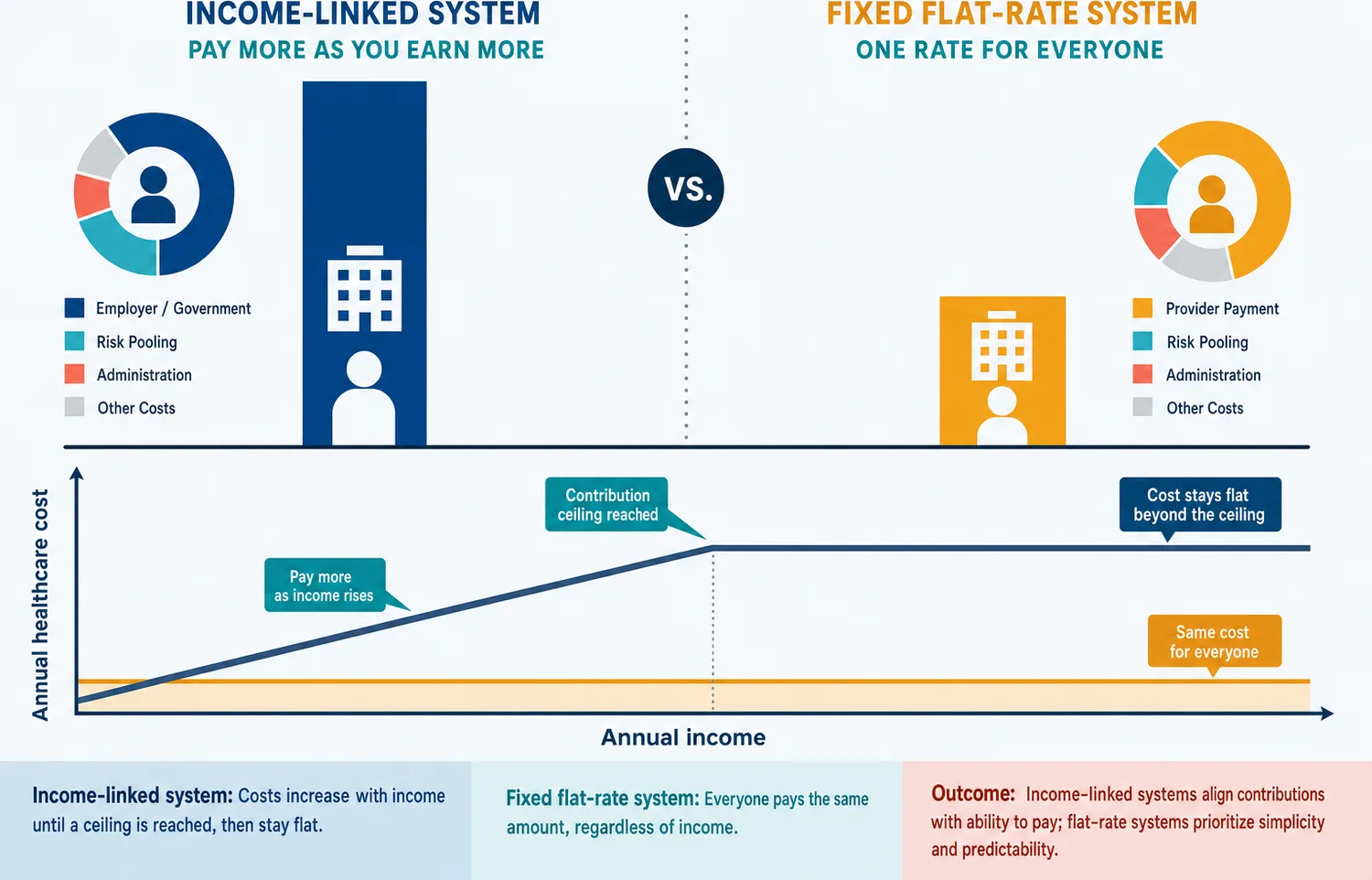
The comparison below uses annual figures for a self-employed founder.
Two honest points sit behind the numbers. German contributions cover dependants in many cases, while Dubai policies are per person, so a family of four multiplies the premium. And German pricing ignores medical history entirely, which Dubai pricing does not.
[blockCTACostCalculator]
Quality and Access
Both cities offer high standards, delivered differently.
Dubai has a substantial private hospital sector alongside public hospitals, all regulated by the DHA. Well-known private names include American Hospital Dubai and Mediclinic, while Rashid, Dubai and Latifa hospitals serve the public side. Many clinicians are internationally trained, and English is standard throughout the system. German-speaking doctors are available across several private clinics.
Insurance networks matter more here than in Germany. Plans operate on approved provider networks, so treatment inside the network is covered and treatment outside it usually is not, except in emergencies. Choosing a plan with the right network is the practical decision to get right.
The Medical Steps in Your Move
Two medical touchpoints come with the residence visa, and both are straightforward.
- The medical fitness test, taken in Dubai, involving a blood test and a chest X-ray.
- Health insurance, which must be active before the residence visa is issued or renewed.
mResidency handles this alongside the investor visa, the Emirates ID and biometrics, with processing running about 5 to 7 working days. Transport to appointments can be arranged, which simplifies a first visit. Dependant visas for a spouse and children follow the same route.
German founders keeping ties to Germany should speak to their existing insurer before leaving. Statutory and private cover each have their own rules on interruption and return, and those conversations are easier to have early.
Bringing It Together
Germany funds healthcare through income. Dubai funds it through mandatory private insurance with a regulated minimum. For a self-employed founder at the German contribution ceiling, the annual difference is substantial, and it does not grow as the business does.
Quality is strong in both places. The Dubai system rewards a little care in choosing the right plan and network. To plan the residency side that sits alongside it, contact the Meydan Free Zone team.
[blockCTAContact]