
Table of Contents
Frequently Asked Questions
1. How does UAE residency through company formation work for German business owners?
UAE residency through company formation works by setting up a UAE business, obtaining a Trade License, opening an Immigration File, and then having the business sponsor the owner’s residence permit. The sequence matters: no Trade License means no sponsorship, and no Immigration File means the visa steps cannot proceed.
2. Should German founders choose a Free Zone or Mainland company?
For most German consultants, traders, and tech founders with international clients, a Free Zone is usually the simpler option because it offers 100% foreign ownership and lower setup overhead. A Mainland company is better if you want to trade directly in the local UAE market, bid for government work, and operate from any location in the UAE.
3. How long does the company setup and residency process take in Dubai?
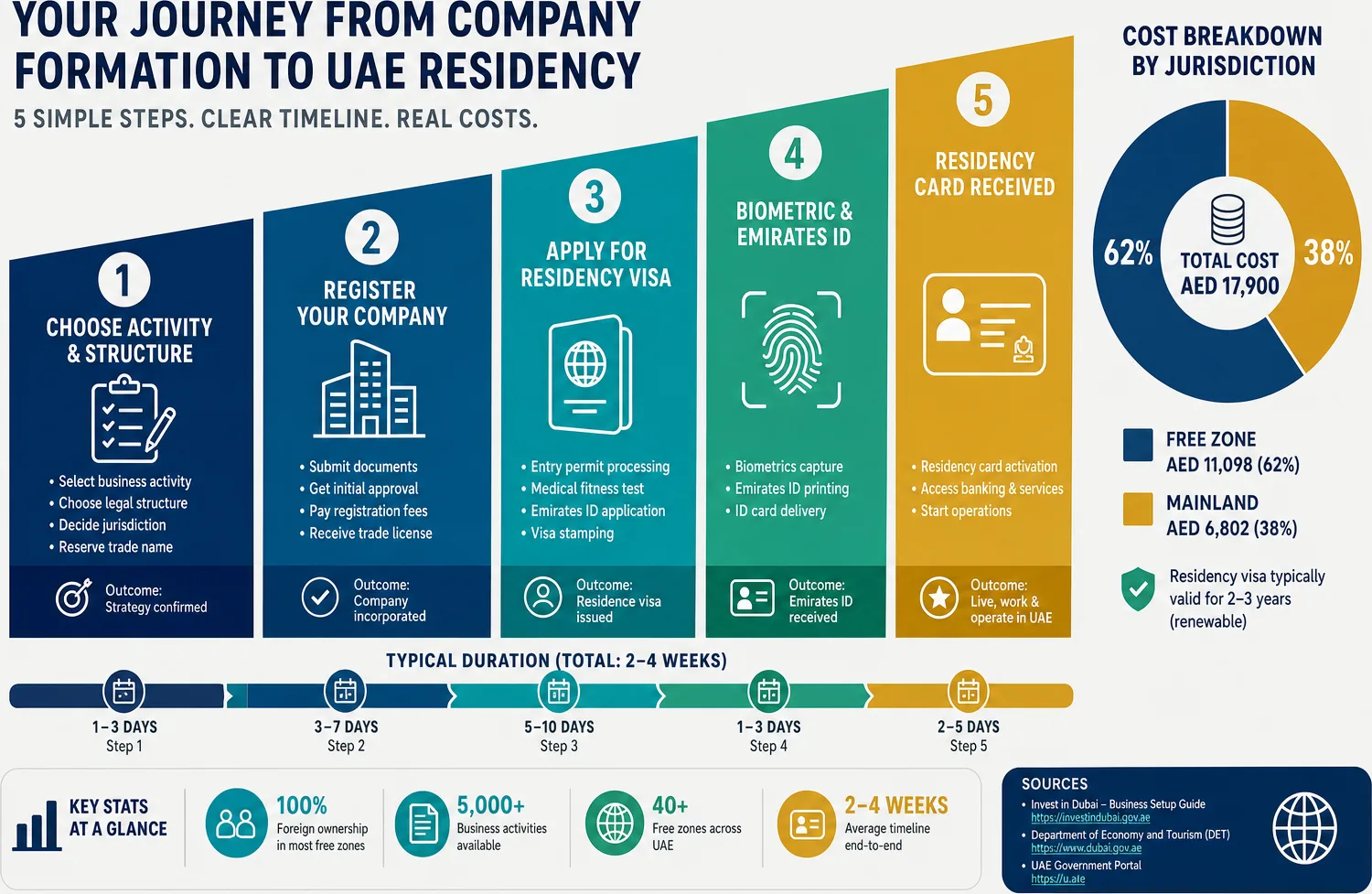
A typical UAE residency through company formation timeline runs from two to six weeks for setup, licensing, entry approval, and in-country residency steps. Opening a corporate bank account often takes longer and can add another two to four weeks, so banking should be treated as a separate planning item from day one.
4. Do German business owners need to end German tax residency before relying on UAE residency?
Yes. Setting up a UAE company and getting a residence permit does not automatically end German tax residency, so German founders should address tax exit obligations with the relevant tax authority before assuming a new tax position. Seeking specialist cross-border advice is essential because getting this wrong can create back-tax exposure and personal liability.
5. What happens during the in-country stage after the Entry Permit is issued?
After entering the UAE, the founder completes the medical fitness test, biometrics, and Emirates ID steps before the residence permit is placed inside the passport. Physical attendance is required for key appointments, and the passport is often retained briefly during final processing, so travel should not be scheduled too tightly.
6. What do German founders commonly discover too late in this process?
Most discover too late that banking needs real preparation, not just a Trade License, and that health insurance is required for smooth renewals. Another common mistake is missing the Entry Permit validity window or delaying German tax exit planning, both of which can create extra cost, delays, or legal exposure.
Topic Summary
1. Choose Jurisdiction First
Start by deciding between Free Zone or Mainland, because this choice shapes cost, visa allocation, and where you can legally trade. For most German founders serving international clients, a Free Zone setup is the simpler, faster route.
2. Prepare the Right Basics
Have your passport with at least six months’ validity, a clear, colour copy, a professional email, phone number ready, and a summary of your projected annual revenue. Getting these basics organised early avoids preventable delays at the registration stage.
3. Secure the Trade License
Your business must be registered before anything else, because the Trade License is the legal foundation for residency sponsorship. Once the name is reserved, forms are submitted, and fees are paid, the company is officially ready to move to the next step.
4. Open the Immigration File
After the Trade License is issued, the company opens its Immigration File and can then request the Entry Permit for the owner. This is the step many founders underestimate, and missing it can stall the whole timeline for weeks.
5. Complete UAE Residency Steps
Inside the UAE, you’ll move through the medical fitness test, biometrics, Emirates ID process, and final passport stamping. When handled efficiently, German founders often complete these residency steps within a few business days.
6. Watch the Common Mistakes
Most expats discover too late that banking needs real preparation, Entry Permit validity is strict, and health insurance is essential for renewals. The biggest legal risk is ignoring German tax exit planning, which can create personal liability even after relocating.
Getting a UAE Residency Through Company Formation for German Business Owners
In essence, your own business provides the legal basis for you to live and work in the UAE. You register a UAE entity, obtain a Trade License, open an Immigration File, and the company can apply for your residence visa, typically valid for two years. The mechanics are logical and checkpoint-driven: Trade License first, Immigration File second, Entry Permit third, then in-country residency steps.
Without a valid Trade License, no company exists and no visa process can proceed, this is the non-negotiable foundation. A German management consultant sets up a Free Zone company, with the Trade License in hand, and the company can apply for the owner's residence visa within days of the Immigration File being opened.
Why German Founders Choose This Route
Germany taxes worldwide income for residents; UAE residency through company formation unlocks a legally distinct tax position, but only once German tax residency is formally exited. Dividends drawn from your UAE company are yours to keep at the federal level, subject to corporate obligations. According to the World Bank Group's Doing Business 2020 report, the UAE ranked among the top 20 globally for ease of corporate setup, a data point that reflects processing speed German founders actually experience.
Identity Requirements and Document Preparation
- Your passport (with at least six months' validity) and a clear, colour copy of it
- A high-quality digital photograph with a white background
- Your current address, professional email, and phone number ready
A summary of your projected annual revenue is essential to assess Free Zone versus Mainland fit and understand VAT registration thresholds from day one.
Time and Budget Planning
Plan two to six weeks for the full sequence from company setup to stamped passport, corporate bank account opening can add another two to four weeks. Factor in recurring fees from year one: annual Trade License renewal, visa renewal every two years, and health insurance as a required condition. A simple Free Zone setup with one visa costs between AED 15,000 and AED 30,000 in year one; however, more complex setup requirements can run from AED 50,000 upward.
| Setup type | Year-one cost estimate |
|---|---|
| Simple Free Zone setup (one visa) | AED 15,000 – AED 30,000 |
| Complex setup requirements | AED 50,000 upward |
| Corporate bank account opening (additional time) | 2 – 4 weeks |
Free Zone: The Right Fit for Most German Entrepreneurs
A Free Zone is often the ideal structure for German entrepreneurs entering the UAE. It allows 100% foreign ownership, offers packages tailored to consultants and tech entrepreneurs, and comes with flexible office arrangements - typically a virtual desk or flexi-desk - that keep overhead low during the early stages.
Free Zones such as Meydan Free Zone are digital-first, meaning the entire setup can be completed remotely. This suits German founders who want to incorporate their company, open a corporate bank account, and begin operating before physically relocating to the UAE.
The core difference between a Free Zone and a Mainland structure comes down to market access. Free Zone companies are geared towards activities with international clients and cannot trade directly within the local UAE market without appointing a licensed distributor. A Hamburg logistics consultant who invoices European clients from a Dubai base - advising German manufacturers on Gulf supply chains or serving cross-border B2B accounts - will find a Free Zone setup more than sufficient, and significantly cheaper to maintain than a Mainland licence.
Mainland: When a Mainland Company Is the Appropriate Structure
A Mainland company is the appropriate structure when you want to trade directly within the local UAE market, take on government contracts, or operate from any location without the geographic restrictions of a Free Zone. Mainland companies are regulated by the Department of Economic Development (DED) and come with higher setup costs and mandatory physical office space requirements, evidenced by a registered Ejari tenancy contract.
The more complex setup requirements mean Mainland is not the default choice for most German founders initially. However, for a German retail business owner who wants to open a physical store in Dubai Mall, a restaurateur planning branches across the emirates, or a contractor bidding on public-sector projects, a Mainland company is the appropriate structure - a Free Zone setup simply will not permit that activity.
| Factor | Free Zone | Mainland |
|---|---|---|
| Foreign ownership | 100% | 100% (since 2021 reforms, most activities) |
| Local UAE market trading | Not directly (requires licensed distributor) | Yes |
| Government contracts | No | Yes |
| Office requirement | Virtual desk or flexi-desk available | Mandatory physical office (Ejari required) |
| Setup cost | Lower | Higher |
| Remote setup possible | Yes (e.g. Meydan Free Zone) | No |
The Registration Steps in Sequence
Reserve proposed company names with the chosen authority, most Free Zones confirm availability within one business day. Submit the application form covering: business activity you choose, visa allocation, office requirements, and shareholder details. And pay fees to get the Trade License issued; the jurisdiction's fees vary significantly based on activity and visa allocation.
A Düsseldorf-based founder who completes the Meydan Free Zone online process in under 48 hours receives their Trade License and Certificate of Incorporation, these are proof that the company is legally formed and has its official permit to operate.
What You Should See at This Stage
Your Trade License is the foundational corporate document. Without it, no company exists and no visa process can proceed. The Certificate of Incorporation and Memorandum of Association. These are proof that the company is legally formed and registered with the relevant authority.
Standard processing runs from three to ten business days for most Free Zones, express services can reduce this, but factor in the additional cost.
Opening the Immigration File
The Immigration File, also known as the Establishment Card stage, is opened once the Trade License is approved. This is a critical milestone that bridges the gap between company formation and the residency process. Without this file, the company cannot sponsor anyone, not for the owner, not for employees.
Fees for opening the Immigration File run from AED 2,000 to AED 5,000 depending on the Free Zone. A Stuttgart entrepreneur who assumes the Trade License alone unlocks visa processes will find the entire sequence stalls, the Immigration File is the prerequisite.
Applying for the Entry Permit
With the Immigration File opened and functional, the company can apply for the owner's Entry the remaining residency steps. Once issued, the Entry Permit is valid for a defined period, you must enter the UAE within that window or it lapses.
German nationals currently outside the UAE will use this Entry Permit to travel to Dubai and proceed with the in-country residency steps. A Munich founder who receives their Entry Permit by email, books a flight, and enters the UAE to complete the medical fitness test and Emirates ID process within the validity window, that's the sequence working correctly.
Medical Fitness Test and Biometrics
The in-country residency steps involve a medical fitness test, which screens for communicable diseases, results are typically returned within one to three business days. Biometrics (fingerprints and photograph) are taken at an ICP service centre. Physical attendance is required, this cannot be completed remotely.
Track each milestone: submission date, approval date, and insurance start date, keeping a one-line tracker avoids chasing paperwork unnecessarily. A German founder who books their medical fitness test appointment on arrival day and completes biometrics the following morning keeps the overall timeline on track.
Visa Stamping and Emirates ID Issuance
Visa Stamping: Your passport is submitted for the final visa sticker, the residence visa is stamped inside your passport, typically valid for two years from the stamping date. Your passport is retained on submission, leaving you without a valid travel document for one to three business days, plan alternative transport for that window.
Your physical Emirates ID card is collected at an ICP service centre. Physical attendance is required at Emirates ID collection, not Emirates ID collection. Plan around that short gap before Emirates ID delivery. A German founder who completes all four in-country steps in five business days and collects their Emirates ID, the UAE residency through company formation process is complete at this point.
German Tax Exit Obligations
UAE residency through company formation does not eliminate German tax obligations automatically, you must address your German tax exit obligations formally, notifying the German tax authority and filing final returns. Germany uses a residency-based tax system; until you're formally no longer a German tax resident, worldwide income remains subject to German tax.
Seeking specialist advice from a cross-border German-UAE tax professional is essential before you proceed, the consequences of getting this wrong can run from years of back-tax assessments to criminal exposure in Germany.
Corporate Tax and VAT Reporting Obligations
As of June 2023, a federal Corporate Tax rate of 9% applies to taxable profits above AED 375,000 annually (Gov.ae, 2023), startups below this threshold benefit from a 0% rate. Businesses with annual revenues over AED 375,000 must register for VAT at 5% and file returns with the Federal Tax Authority, this is required for qualifying businesses, not optional.
| Tax | Rate | Threshold |
|---|---|---|
| Corporate Tax | 0% | Taxable profits up to AED 375,000 |
| Corporate Tax | 9% | Taxable profits above AED 375,000 |
| VAT | 5% | Annual revenues over AED 375,000 (mandatory registration) |
Your business is compliant when you register for taxes if required from day one, obligations from day one are easier to manage than retrospective registration, which attracts penalties.
Maintaining Residency Without Interruption
Maintain health insurance as a condition of active residency, without it, the residence visa renewal process stalls and you risk a gap in legal visa. Factor in recurring fees to maintain your residency: annual Trade License renewal, visa renewal every two years, and health insurance renewal (annual).
A Frankfurt founder who sets a calendar reminder 90, 60, and 30 days before each renewal date keeps all five active elements current without last-minute pressure.
UAE Banks Require More Than a Trade License
Opening a corporate bank account requires careful preparation. Due to strict anti-money laundering (AML) compliance, UAE banks need a real business story, account for legitimate expected revenue, key clients, and banking relationships before approaching any bank. Having a professional online presence, a summary of your projected annual revenue, and documented business activity helps immensely.
Corporate bank account opening can add another two to four weeks, sometimes just a few days. However, incomplete preparation means rejection, and reapplying resets the clock. A German founder who presents a Trade License and a blank business plan to a UAE bank faces rejection within a week.
Consequence Statements: What Goes Wrong Without Preparation
If the Entry Permit lapses before you enter the UAE, the company must reapply, creating additional fees and a delay of one to three weeks. Without active health insurance, visa renewal is rejected entirely, leaving you without legal residency visa until insurance is reinstated and the renewal resubmitted.
A German founder who is personally liable for German tax on UAE-sourced income because the tax exit was not formally completed before the company began trading faces consequences that can run from significant back-tax assessments to criminal exposure in Germany.
Checklist: All Five Active Elements
Your corporate bank account is opened and functional, the UAE residency through company formation process is fully established in the UAE and ready to operate once all five active elements are confirmed. A German founder who collects their Emirates ID on day 28 of the process, a realistic timeline when all prerequisites are in order.
Immediate Next Actions
Define your business activity and choose jurisdiction (Free Zone or Mainland), this is the decision that determines cost, visa allocation, and scope of business. Do this in week one. Contact a specialist who can provide a detailed, itemised proposal covering the jurisdiction's fees, Immigration File costs, visa allocation, and ongoing compliance obligations.
Find the Meydan Free Zone Setup Cost Calculator to get a clear cost projection before you proceed, use it as a clarity tool, not a commitment. A German founder who defines their business activity, confirms their Free Zone or Mainland fit, gathers their documents, and reserves the company name in week one is well on the way to making the UAE a reality within six to eight weeks.