
Table of Contents
Frequently Asked Questions
Where do most French entrepreneurs live in Dubai?
There is no single area, but Business Bay, Dubai Marina, JLT and the Meydan district are popular with founders for central access, networking and proximity to business hubs, while JVC and Arjan attract those prioritising value.
What is the best value area for a founder in Dubai?
Jumeirah Village Circle and Arjan offer the most space per dirham, keeping rent low so more capital stays in the business. The trade-off is a longer commute to the central districts.
Do I need to live near my Meydan Free Zone business address?
No. Your business address is the flexi desk included in your license, separate from your home. You can live anywhere and choose your neighbourhood on commute, cost and lifestyle.
How does mResidency help with my visa?
mResidency coordinates the whole investor visa process after your license is issued: the application, medical fitness test, Emirates ID, insurance and dependant visas, typically in five to seven working days.
Do I need residency before renting a home in Dubai?
Generally yes. You need a residence visa and Emirates ID to sign a tenancy and register Ejari. These are arranged through mResidency once your Meydan Free Zone company is set up.
Topic Summary
Business Bay: Central Access for Client-Facing Founders
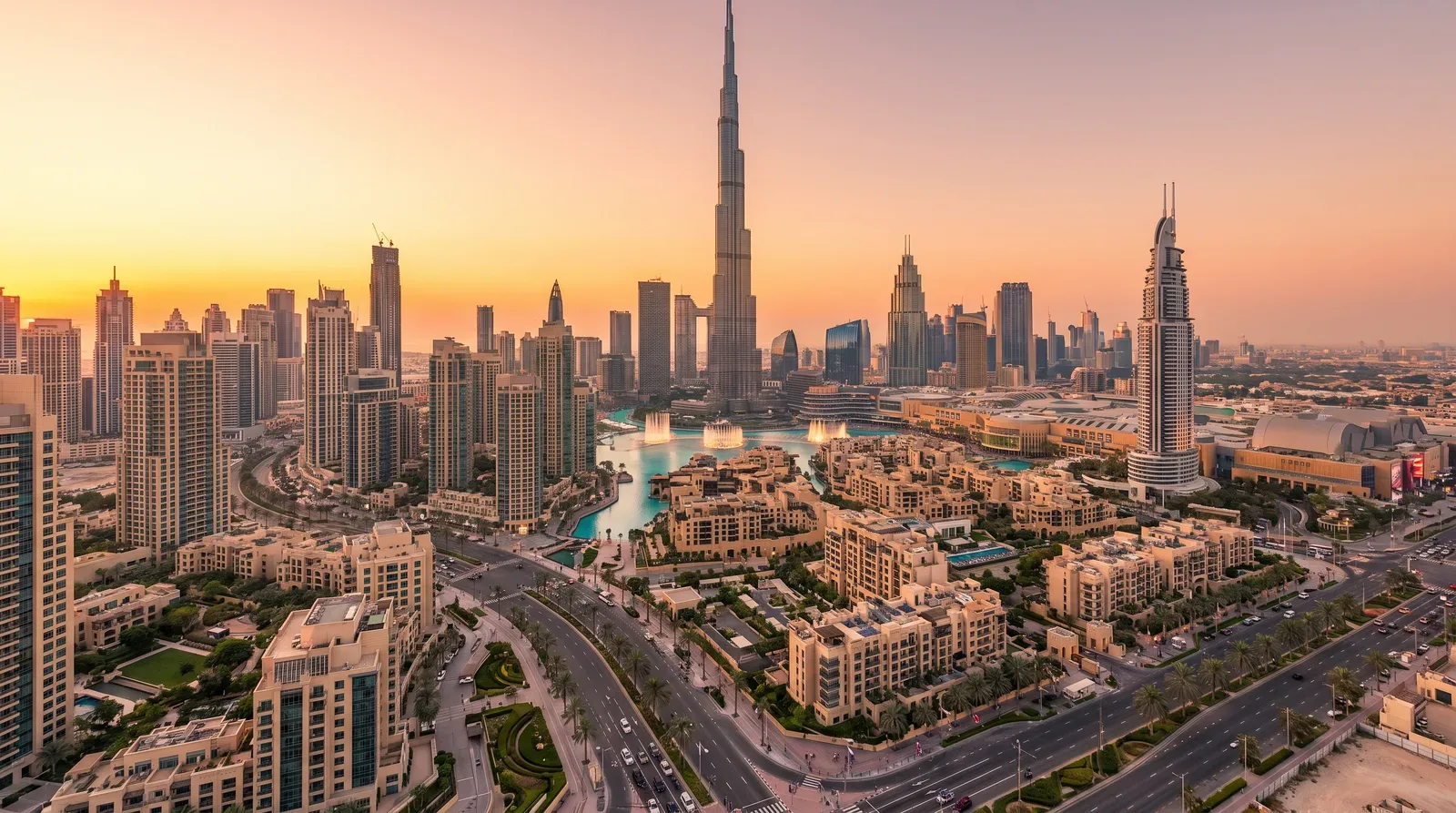
Business Bay delivers Red Line metro access, walking distance to DIFC, and the highest density of SME founders in Dubai. French founders running premium service businesses find the professional network and proximity to government authorities reduce operational friction significantly.
Downtown Dubai: Prestige Address, Strong Passive Yields
Downtown suits founders whose brand benefits from a premium postcode. Passive rental yields run 5–7% annually, metro access is direct, and airport proximity keeps international client schedules manageable. Rent ranges from AED 14,000–25,000 per month for a one-bedroom.
Dubai Marina: Community, Connectivity, and Passive Income
Marina offers dual transport access via the Red Line and Dubai Tram, a vibrant French expat social scene, and solid passive income returns averaging 6–7% annually. It suits community-driven founders managing distributed teams or building Gulf client relationships.
Jumeirah Village Circle: Capital-Efficient Base for Early-Stage Founders
JVC delivers the best areas to live in Dubai for founders prioritising capital efficiency. One-bedroom apartments run AED 7,000–10,000 per month. Road access to Sheikh Zayed Road keeps government authority visits manageable, and passive income yields remain competitive at 7%.
Jumeirah: Villa Living for Families with French School Proximity
Jumeirah concentrates the highest density of French families in Dubai, sitting close to both Lycée Français campuses. Founders relocating with children choose Jumeirah to access French-curriculum schooling without disrupting academic continuity, accepting higher rent as the trade-off.
Transport and Commute Shape Operational Efficiency
Business Bay, Downtown, and Marina sit on the RTA Red Line, linking directly to DIFC and Dubai International Airport in under 35 minutes. JVC and Jumeirah are car-dependent — a consideration French founders from Paris public-transport culture should weigh carefully before signing a lease.
Meydan Free Zone Sits Centrally, Accessible from All Five Areas
Unlike remote free zones, Meydan Free Zone sits in Nad Al Sheba, reachable via Sheikh Zayed Road from every recommended neighbourhood. A Dubai Trade License from AED 12,500 covers the registered address, flexi desk, and access to over 2,500 business activities — with the full setup completed remotely from France.
Best Residential Areas to Live in Dubai, UAE for French Entrepreneurs
A French entrepreneur chooses a Dubai neighbourhood differently from a tourist or a salaried expat. The questions are not only about lifestyle. They are about how close you are to clients and your business hub, how much rent ties up capital you could reinvest, and whether the area supports the way you actually work. The best areas in Dubai for French entrepreneurs balance all three.
The good news is that Dubai gives you room to optimise. The city registered 1.38 million tenancy contracts worth AED 126.4 billion in 2025, according to the Dubai Land Department,¹ a deep and competitive rental market with genuine choice at every price point. And you would be in good company: an estimated 35,000 French nationals live in the UAE, one of the largest French communities in the Gulf, per France Diplomatie.²
One thing worth separating early: where you live is not where your company is registered. Your business address comes from the flexi desk included in a Meydan Free Zone license, while your home is a separate residential lease. Your residence visa, arranged through mResidency, is what lets you sign that lease and register its Ejari.
What a French Entrepreneur Should Weigh
Before picking an area, weigh these against each other:
- Commute: How far to your clients, your coworking space or the districts you meet in most.
- Rent vs reinvestment: Every dirham saved on rent is a dirham left for the business in its early months.
- Network: Some areas put you among other founders and the international business crowd.
- French schools: If you have children, proximity to a French lycée may outweigh everything else.
- Cheque flexibility: Areas with newer supply often offer more forgiving payment schedules.
The Best Areas, by Priority
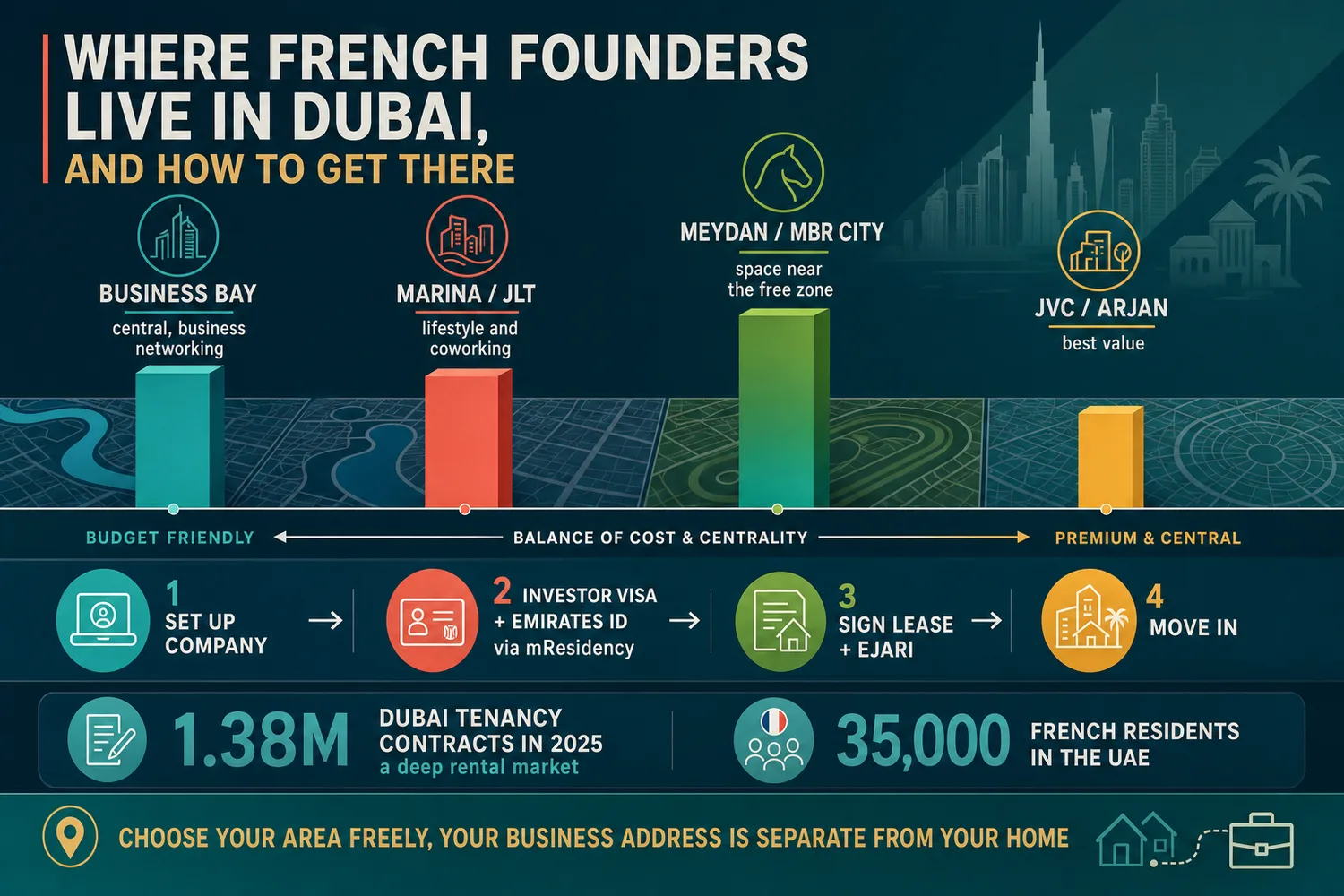
Here is how the main options compare for a founder:
A few notes on the top picks:
- Business Bay is the natural home for a founder who values a central, credible address and easy access to Downtown and DIFC. You pay for the location, but you save it back in commute time and networking.
- Dubai Marina and JLT suit consultants and digital founders who want lifestyle, coworking spaces and a dense international crowd. JLT offers much of the Marina lifestyle at a lower rent.
- Meydan and MBR City appeal to founders who want newer villas and apartments with more space, in an area close to the Meydan Free Zone district, useful if you later take a dedicated office at the Meydan Business Centre.
- Jumeirah Village Circle and Arjan are the value play: more space for your money, which keeps rent low and frees capital for the business, at the cost of a longer drive to the centre.
If You Have Children
For founders relocating with a family, school proximity often decides the area. Dubai's main French lycées sit around Oud Metha, Al Quoz, Meydan and, from 2026, Mudon, so neighbourhoods with a reasonable commute to an AEFE-accredited French school, including parts of Meydan, Mirdif and the Jumeirah corridor, tend to work best. A short school run matters more day to day than a fashionable postcode.
How Your Home Fits Your Setup
It helps to keep the sequence clear. Your company and its flexi-desk business address can be arranged remotely from France, before you travel. Once you have your residence visa and Emirates ID through mResidency, you sign your residential lease and register its Ejari. Only then does your chosen neighbourhood become home.
Because the business address is handled by the license, you are free to choose where you live purely on its own merits, commute, cost and lifestyle, rather than trying to make one address serve both roles. If you want home and business base in the same area, the Meydan district lets you do that, with the option of a dedicated office at the Meydan Business Centre as you grow.
How mResidency Handles the Founder's Visa Process
Your residence visa is what turns a company on paper into a base you can live and bank from. It is applied for after your license is issued, not required to form the company, and for a founder sponsored through a Meydan Free Zone company, mResidency coordinates the whole process, much of it digital and completed in days rather than weeks.
The main stages:
- Visa application: Once your license is active and visa allocation confirmed (a license can carry up to six), the investor visa is applied for, starting with an entry permit if you are still in France, or a status change if you are already in Dubai. The online application can take as little as five minutes.
- Medical fitness test: A mandatory blood test and chest X-ray at a government-approved centre. mResidency books the appointment, and can arrange transport to and from it.
- Emirates ID: mResidency manages the application and biometrics. The Emirates ID is your official UAE identity, needed for banking, telecom, utilities and your tenancy. Residency is now fully digital, with the visa issued electronically and accessible via the ICP UAE Smart app.
- Medical insurance: It helps arrange the Category A cover UAE residency requires.
- Dependants: Once your own residency is active, mResidency processes visas for your spouse and children.
Full processing typically takes five to seven working days once documents are submitted. Instead of dealing separately with the immigration authority, a medical centre, the Emirates ID centre and an insurer, you move through one coordinated process, which is what lets banking, your lease and your family's visas follow without delays.
In Conclusion
For a French entrepreneur, the best Dubai neighbourhood is the one that fits how you work and what you want to keep for the business. Business Bay and Downtown buy central access and prestige; Marina and JLT bring lifestyle and network; Meydan offers space near the free zone; and JVC and Arjan keep costs low so more stays in the company.
Sort the company and residency first, then choose your home freely around them. To set up the company and coordinate your residency, book a free consultation with a setup advisor at Meydan Free Zone.
Footnotes
¹ Dubai Land Department, via Gulf News, Dubai rental contracts reach Dh126 billion in 2025, Dubai registered 1.38 million tenancy contracts worth AED 126.4 billion in 2025, 2026.
² France Diplomatie, France and the United Arab Emirates, an estimated 35,000 French nationals live in the UAE, 2026.