
Table of Contents
Frequently Asked Questions
How long does a transfer from France to Dubai take?
A bank SWIFT transfer typically takes one to three business days, while specialist platforms are often faster. Transfers started late in the week can take longer, since UAE and European weekends do not fully align.
What is the cheapest way to send money from France to Dubai?
Compare the amount that arrives, not the fee. The exchange margin usually costs more than the transfer fee, so a low-fee provider with a wide spread can work out more expensive overall.
Can I hold euros in a UAE bank account?
Yes. Multi-currency accounts through Meydan Free Zone's partner banks support EUR alongside AED and USD, with SWIFT and SEPA access, so you can hold euros and convert when it suits you.
Are there limits on transferring money to or from the UAE?
The UAE does not impose exchange controls on legitimate funds, though banks and exchange houses apply their own operational limits and standard anti-money-laundering checks.
Do I need a business account for client payments?
Yes. Business income should go to your company account, supported by invoices matching your licensed activities. Routing client payments through a personal account creates compliance and accounting problems.
Topic Summary
Choose Your Transfer Channel Carefully
A traditional French bank wiring €20,000 to a UAE account typically nets around AED 76,200 after fees. The same transfer through a regulated fintech platform like Wise Business or Airwallex nets roughly AED 78,500 — a difference of AED 2,300. The channel you choose is the single biggest cost lever you control.
Understand How EUR-to-AED Conversion Works
The AED is pegged at 3.6725 per USD by the Central Bank of the UAE, so EUR/AED rates track EUR/USD in real time. Legacy French banks add a currency spread of 1.5–2.5% on top of fixed SWIFT fees. Regulated fintech platforms price the same corridor at 0.3–0.7% all-in, with no correspondent bank deductions mid-chain.
Activate Your UAE Corporate Account Before Transferring
A dormant or unverified account will reject inbound wires outright. Your Trade License, memorandum of association, and passport copies must be submitted and KYC fully complete before your first money transfer France to Dubai. Attempting to send funds before account activation is the most common cause of returned wires and AED 150–300 in return fees.
Match the Beneficiary Name Exactly to Your Trade License
A mismatch between the company name on the wire and the exact wording on your Trade License — even a hyphen difference between 'FZ LLC' and 'FZ-LLC' — triggers an automatic return. This is the leading cause of delayed international transfers to UAE accounts. Always verify the beneficiary name before submitting.
Prepare Source-of-Funds Documentation for Transfers Above €10,000
France requires Tracfin reporting on cash movements above €10,000. UAE receiving banks run their own KYC on large inbound transfers and may place a compliance hold without supporting documentation. For capital injections above AED 50,000, attach a share certificate and board resolution confirming the transfer purpose before funds move.
Plan Around Settlement Timelines and Public Holidays
Fintech platforms settle EUR-to-AED transfers in one to two working days; traditional SWIFT wires via French banks run three to five days. UAE public holidays — Eid, National Day — can pause processing for two to four days. French bank SWIFT cut-off times typically fall at 15:00–16:00 CET, so Thursday afternoon transfers may not clear until Monday in Dubai.
Retain the MT103 Confirmation for Every Transfer
The SWIFT MT103 reference is your legal proof of transfer and the document both your French accountant and UAE corporate service provider need for reconciliation. French tax authorities can audit foreign transfers retrospectively for up to six years, and UAE corporate tax filings require a clean documented framework. Keep every MT103 confirmation on file from the first transaction.
France to Dubai Money Transfers: 2026 Costs & Guide
Every French founder in Dubai moves money in two directions. Capital goes out to fund the setup, then payments come back in from clients, and out again to suppliers and staff. It happens continuously, and each transfer costs something.
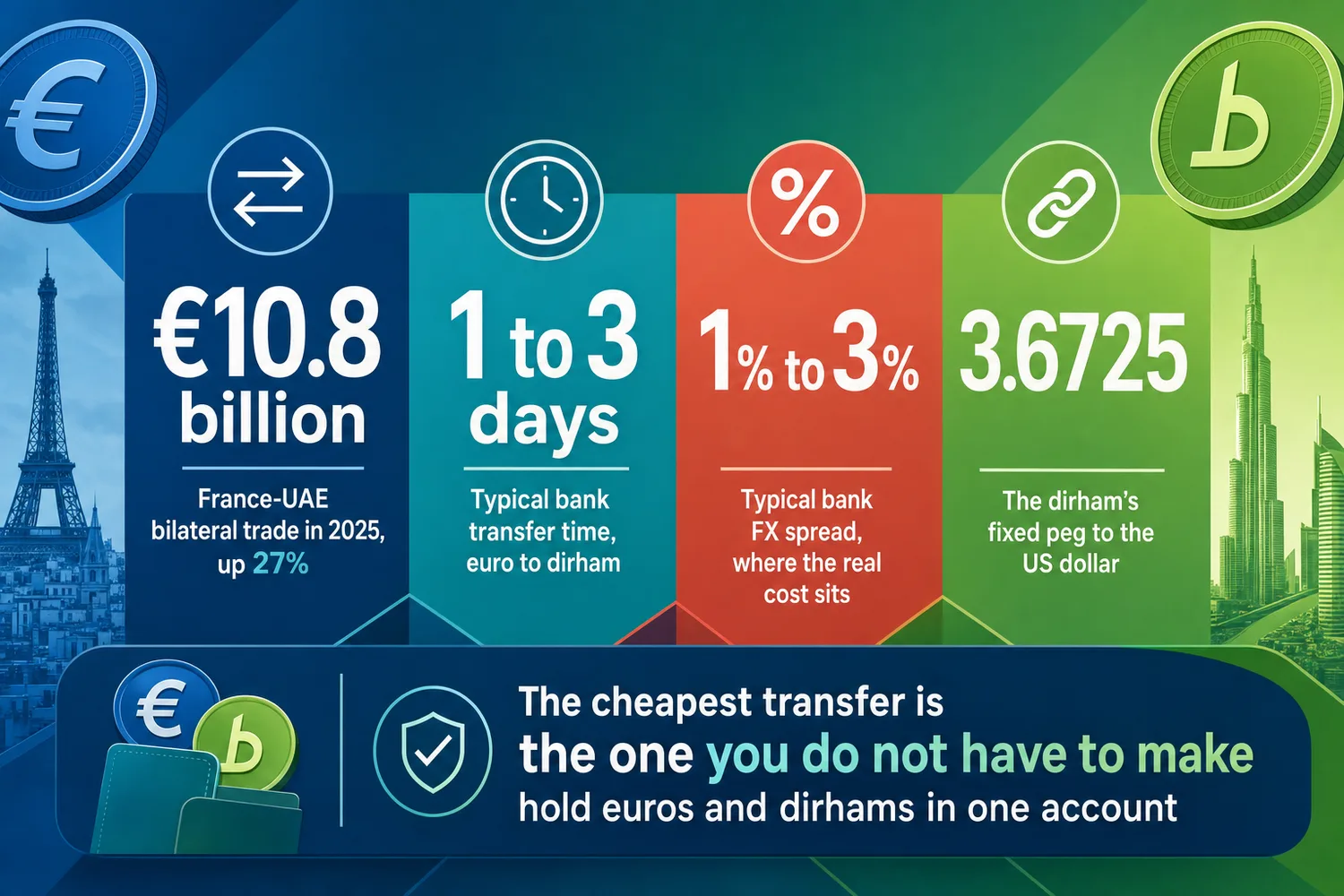
The corridor itself is busy. Bilateral trade between France and the UAE reached €10.8 billion in 2025, a 27% increase on the year, according to Business France,¹ and the UAE now represents France's second-largest trade surplus in the world at €8.6 billion, up from €4.5 billion in 2024, per France Diplomatie.² Money moves between these two countries constantly and without restriction.
What is less obvious is where it goes along the way. The advertised transfer fee is rarely the real cost, and the difference over a year of transactions is significant.
This guide covers what transfers actually cost, how long they take, and how to structure them properly. Much of it comes down to the account you hold, and a Meydan Free Zone license gives you access to a guaranteed IBAN through its partner banks, with multi-currency accounts covering EUR, SWIFT and SEPA.
Why the France-Dubai Corridor Is Straightforward
Moving money between France and Dubai is simpler than moving it between many pairs of countries, because three structural factors happen to line up in your favour:
- No exchange controls in the UAE: Money can move in and out freely, provided it comes from legitimate sources and clears standard anti-money-laundering checks. There is no approval process to navigate.
- France sits in the SEPA zone: Euro transfers within Europe are fast and cheap, which means part of your transfer chain is already efficient before the dirham leg begins.
- The dirham is pegged to the US dollar at a fixed rate of 3.6725. It does not float against the euro independently, so EUR to AED moves with EUR to USD. Predictable, though not fixed.
The Real Cost of An International Transfer
Most people compare transfer fees. The fee is rarely where the money goes.
There are three components:
- The transfer fee: Visible, usually modest, and the one everybody checks.
- The exchange rate margin: This is the real cost. Providers quote a rate slightly worse than the mid-market rate, and the difference is their margin. On a large transfer, a fraction of a percent matters far more than the fee.
- Intermediary and receiving charges: On SWIFT routes, correspondent banks can deduct fees along the way. Ask whether charges are marked OUR, SHA or BEN, this determines who pays and whether the full amount arrives.
The practical rule: compare the amount that lands in the destination account, not the fee quoted at the start.
How Much Transfers Cost and How Long They Take
The route you choose changes both the price and the speed, sometimes considerably. Here is how the main options compare:
| Route | Typical Speed | Indicative Cost |
|---|---|---|
| SEPA transfer, euro to a euro account | Same or next business day | Often free to a few euros, with no FX cost if the money stays in euro |
| Bank SWIFT transfer, euro to dirham | One to three business days | Wire fee typically EUR 15 to 40, plus an FX spread commonly 1% to 3% |
| Specialist transfer platform | Often same day to two days | Transparent fixed fee, with a spread commonly under 1% |
| UAE exchange house | Minutes to same day | Spread varies by provider and branch, often competitive on smaller amounts |
Put that on a real transfer and the gap becomes clear. Take a French consultant invoicing a client EUR 20,000, with the money landing in a UAE account:
- Through a high-street bank: a EUR 30 wire fee plus a 2% FX spread costs around EUR 430.
- Through a specialist platform: a EUR 20 fee plus a 0.5% spread costs around EUR 120.
- Into a multi-currency account in euros: no conversion at that moment, so the cost is the SEPA fee alone.
Same transfer, roughly EUR 300 between the first two options, almost all of it in the exchange margin rather than the fee either provider advertises. Repeat it monthly and the gap runs to thousands a year.
How to Keep Transfer Costs Down
A few habits make a real difference over a year of transactions:
- Compare the landed amount, not the fee, since what matters is the figure that actually arrives.
- Hold a multi-currency account so you can keep euros and dirhams side by side and convert when the rate suits you.
- Send fewer, larger transfers, because fixed fees take a bigger bite out of small, frequent ones.
- Use licensed providers, not airport or hotel counters, where the convenience is priced into a poor spread.
- Keep documentation ready, invoices, contracts and source-of-funds evidence, as banks will ask and it prevents delays.
- Keep business money out of personal accounts, which avoids both compliance questions and accounting mess.
Business Money vs Personal Money
Personal transfers, living costs, family support, a property purchase, are straightforward. Business transfers need more care.
Payments coming into your UAE company account should match your licensed activity and be supported by an invoice or contract in the company's name. Payments going out, to suppliers, contractors or as salary, need the same clarity. Banks review this, particularly in the first months of a new account.
The most common problem is a mismatch: money arriving for work that does not obviously fall within the company's licensed activities. It is worth checking your activity selection covers everything you actually invoice for.
How Meydan Free Zone Helps With Banking
Most of the friction in cross-border transfers comes from having the wrong account. The fix is structural rather than tactical: hold an account that lets you keep both currencies and reach both payment rails.
A Meydan Free Zonetrade license gives you access to a guaranteed IBAN through a network of 26+ partner banks. What that means in practice for a French founder:
- Multi-currency accounts covering EUR, USD and AED, so you can hold euros rather than converting every incoming payment.
- SWIFT and SEPA access, which means the European leg of your transfers runs on the cheaper rail.
- Remote opening: Partner banks including CBI support digital KYC, so the account can be opened from France without a branch visit.
The application itself is where most international founders lose time, and it is handled rather than left to you:
- Your file goes to multiple banks, not one at a time. Rather than applying, waiting, being declined and starting again, your application is presented across the partner network so you are matched to a bank likely to accept your profile.
- Documents are pre-checked before submission. Incomplete or mismatched paperwork is the single most common cause of rejection, and it is caught before the bank sees it.
- Appointments with bank representatives are coordinated where a meeting or verification call is required, rather than you chasing a relationship manager from another country.
- Progress is followed up with the bank directly, so an application does not sit unattended.
Holding euros and dirhams in the same account removes a conversion from every transaction. Getting that account open in weeks rather than months is what makes the difference in the first year.
In Conclusion
The France-Dubai corridor is one of the easier ones to operate. There are no exchange controls, the euro leg runs on SEPA, and the dirham's dollar peg keeps the rate predictable.
The cost is almost always in the exchange margin rather than the visible fee, so compare what lands rather than what is quoted. And the single biggest structural improvement is a multi-currency account that lets you hold euros and convert on your own terms.
To set up the company and banking together, book a free consultation with a setup advisor at Meydan Free Zone.
Footnotes
¹ Business France, via Gulf News, UAE and France deepen strategic economic partnership, bilateral trade between France and the UAE reached €10.8 billion in 2025, a 27% increase on the year, 2026.
² France Diplomatie, Economic relations between France and the United Arab Emirates, the UAE represented France's second-largest trade surplus worldwide at €8.6 billion in 2025, up from €4.5 billion in 2024, 2026.