Table of Contents
Frequently Asked Questions
1. How large is the Indian onion market in Dubai?
The UAE imports approximately 403,000 metric tonnes of Indian onions annually - India's second-largest onion export destination. Demand is spread across retail, HORECA, and re-export into the wider GCC.
2. Does CEPA benefit Indian onion exporters in the UAE?
Yes. The India-UAE CEPA, in force since 1 May 2022, eliminated duties on over 97% of Indian tariff lines entering the UAE. Combined with the removal of India's 20% onion export duty from April 2025, the landed cost position for onion distribution business Dubai is as competitive as it has ever been.
3. What does a commission agent actually cost an exporter?
Agents typically charge 5 to 8% of sale value plus handling and storage. More significantly, they prevent direct access to retail and HORECA buyers who require a UAE-registered supplier invoicing in AED. That margin gap - not the commission percentage alone - is the real cost.
4. Why does Dubai make sense as a distribution hub rather than exporting directly to each GCC country?
A single UAE trading entity handles import clearance at Jebel Ali and re-exports onward into Saudi Arabia, Oman, Qatar, Kuwait, and Bahrain. That consolidates five separate customs and documentation relationships into one operational base.
5. What is the risk of operating only as an origin-side exporter?
India imposed a complete export ban on onions from December 2023 to May 2024. Without UAE-side buffer stock and a licensed distribution entity, policy interventions like this collapse buyer relationships that take months to rebuild.
6. What does a UAE distribution entity need to supply supermarket chains?
Supermarkets like Lulu and Carrefour require FIRS registration, a valid UAE trading license, AED invoicing capability, and consistent grading. A UAE-registered entity with a functional bank account satisfies these. An Indian exporter transacting through an agent typically does not.
7. What corporate tax applies to a UAE free zone trading company?
Free zone companies qualify for 0% corporate tax on qualifying income under the QFZP framework. There is no personal income tax. VAT is 5% on UAE domestic sales; re-exports are typically zero-rated.
8. How long does it take to set up a trading entity in Meydan Free Zone?
The Fawri license issues digitally in under 60 minutes. The standard license route completes within one working day once documentation is submitted. Both include access to a guaranteed IBAN pathway through partner banks.
Topic Summary
1. Efficient Logistics and Timely Clearance
Ensuring the timely clearance of shipments at key entry points such as Jebel Ali Port is critical. Indian exporters must coordinate closely with freight forwarders and customs agents to clear consignments, like Nashik red onions, within a minimal timeframe to maintain freshness and meet delivery deadlines.
2. Strict Quality Control and Accurate Grading
Maintaining stringent quality standards and grading protocols directly impacts customer satisfaction and buyer trust. Onions must be graded accurately according to buyer specifications to ensure repeat business and minimize disputes.
3. Establishing Reliable Commission Agents
Exporters often work through commission agents who facilitate sales within the local market. Selecting trustworthy agents who maintain transparent accounting practices and possess strong relationships with buyers such as supermarket chains is essential for smooth operations.
4. Negotiating Distribution Margins
Understanding the distribution margin structure is vital. Exporters typically receive around 60 to 65 percent of the revenue when selling through intermediaries. Strategically negotiating these margins and payment terms protects the exporter’s profitability.
5. Timely Payment and Cash Flow Management
As commission agents often remit payments a month or more after sale, exporters must implement effective financial planning to manage cash flows. This includes monitoring receivables closely and possibly establishing credit arrangements to sustain business operations without disruption.
Indian Onion Exporters: How To Build a Distribution Business in Dubai, UAE
An Indian exporter ships 20 tonnes of Nashik red onions to Dubai. They clear Jebel Ali in four days, graded correctly, exactly what was ordered. The exporter invoices their commission agent. The agent sells to a supermarket chain, pockets the distribution margin, and remits the exporter's share a month later. The exporter nets roughly 60 to 65% of what the same consignment would have earned sold directly.
Same product. Same transit. Same buyer at the end of the chain. The gap is not quality or logistics. It is who holds the commercial relationship at the destination.
Most Indian onion exporters in the Dubai corridor are still functioning as origin-side suppliers. They ship, they wait, and they let someone else control the margin between Indian farmgate and UAE end-buyer price. APEDA ranks the UAE among India's top six onion export destinations for FY 2024-25, alongside Bangladesh, Malaysia, and Sri Lanka.¹ Building an onion distribution business Dubai-side means changing which side of that transaction you sit on.
This guide breaks down how the Dubai onion distribution market works, where the margin actually sits, and what commercial structure gives Indian exporters direct access to it.
Why The UAE Is Not Just Another Export Market For Onions
Statista, citing APEDA, reports the UAE imported approximately 403,000 metric tonnes of Indian onions in FY 2023, making it India's second-largest onion export destination after Bangladesh.² That number matters, but the reason behind it matters more.
The UAE does not grow onions. World Bank data shows agriculture, forestry, and fishing contribute approximately 0.7% of UAE GDP.³ Every onion on a retail shelf in a Lulu hypermarket, in a hotel buffet line, or in a household kitchen arrived through an import channel. That dependency does not change with the weather or shift with a government subsidy programme.
Under the India-UAE Comprehensive Economic Partnership Agreement, in force since 1 May 2022, duties were eliminated on over 97% of Indian tariff lines entering the UAE. Indian onions land in Dubai at a cost advantage that Egyptian, Jordanian, and Chinese competitors cannot match.
Per a Press Information Bureau release, the Government of India removed the 20% export duty on onions from 1 April 2025,⁴ and India is projected to export between 1.8 and 2.2 million metric tonnes in FY 2025-26, up from approximately 1.5 million tonnes the year before.
Sea freight from Nhava Sheva or Mundra to Jebel Ali takes 3 to 5 days. That transit window is shorter than Egypt, dramatically shorter than the Netherlands or China. For a perishable commodity where days lost in transit mean shelf life lost at destination, that advantage is not just operational. It directly affects what a buyer will pay and whether they will reject a consignment on arrival.
The corridor is as favourable as it has ever been for an onion distribution business Dubai. The question is where in it you are positioned.
The Four Channels - and Why Most Exporters Are in the Wrong One
Dubai's onion market is not one market. It is four distinct channels, each with a different margin profile and a different entry requirement. Understanding which channel you are currently in - and which you are not - is the starting point for any serious distribution strategy for onion distribution business Dubai.
| Channel | Buyer type | Pricing basis | Entry requirement |
|---|---|---|---|
| Wholesale market (Al Aweer) | Traders at the Central Fruit & Vegetable Market | Spot, per-kg, negotiated on arrival | None for importers; trading license to sell directly |
| Modern retail | Carrefour, Lulu, Spinneys, Union Co-op | Contracted, AED-denominated, graded specs | UAE-registered supplier; FIRS registration; consistent grading |
| HORECA | Hotels, catering companies, restaurant groups | Volume contracts, weekly delivery, AED invoicing | Licensed UAE entity; local invoicing capability |
| Re-export | Wholesale traders supplying Saudi Arabia, Oman, Qatar, Kuwait, Bahrain | FOB or CIF pricing, documentation-heavy | UAE trading license; MoFA-recognised commercial documentation |
The wholesale market is where most Indian exporters currently land. And it makes sense as a starting point; it is the lowest-friction entry and the fastest way to move volume. But it is also the lowest-margin outcome. Onions sold into the spot market are priced by whoever else shows up that morning with competing stock. There is no contract, no price floor, and no ongoing buyer relationship to protect.
Contrast that with modern retail. Lulu and Carrefour run centralised procurement with approved vendor lists, grading specifications, and AED-denominated invoicing requirements. A procurement manager at a hotel group placing weekly orders across a 52-week year does not want to renegotiate every consignment.
They want a licensed supplier who invoices in local currency, delivers on time, and maintains consistency across grades. That kind of relationship requires a UAE-registered entity. Without one, you access it through an intermediary, and the intermediary takes a margin you can never recover.
Then there is re-export. Mordor Intelligence values the GCC fresh produce market at approximately USD 16.75 billion,⁵ and Dubai is the redistribution hub that feeds much of it. Indian onions clearing Jebel Ali move onward into Saudi Arabia, Oman, Qatar, Kuwait, and Bahrain through a single import clearance point: one entity, one customs regime, one documentation standard.
The UAE does not just consume what it imports, it redistributes it across the region, and the numbers behind that role have just hit a record.
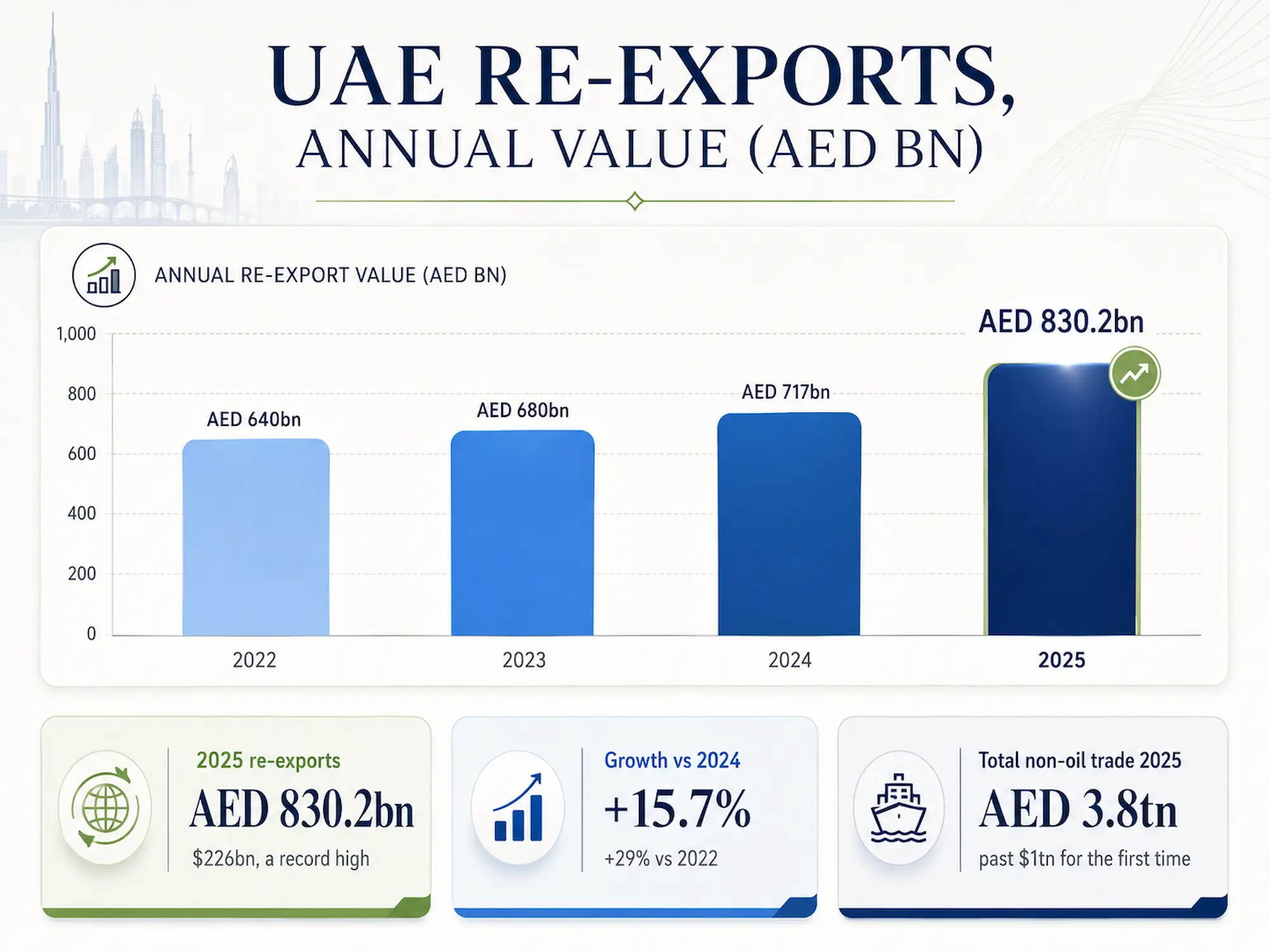
Source: UAE non-oil foreign trade surpasses $1trln for the first time, WAM via Zawya, Feb 2026. 2022 to 2024 values derived from official year-on-year growth rates.
DP World trade flow data shows onion imports at Jebel Ali rise approximately 35% ahead of Ramadan as regional retailers start building inventory 6 to 8 weeks in advance.⁶ If you have supply committed and a licensed entity in place, that seasonal surge is a contract. If you do not, someone else takes it.
[blockCTATradeLicense]
What You Are Actually Paying Your Agent
The commission agent model is operationally convenient. It is also structurally expensive, and most onion distribution business Dubai exporters underestimate the full cost of it.
A typical arrangement: the Indian exporter ships on consignment. The agent charges 5 to 8% commission on sale value, plus cold storage handling, plus distribution margins on the UAE side. The exporter invoices in USD or INR, waits 30 to 45 days for remittance, and has no visibility into what the buyer actually paid at the destination.
Here is the concrete version. Say you are exporting 3 containers a month - roughly 60 tonnes. Your agent is netting AED 900 per tonne at the destination. You are receiving the equivalent of AED 600. That AED 300 per tonne gap, across 60 tonnes a month and 12 months a year, is AED 216,000 annually that your agent earns on your product. At better volume, the number is larger.
That gap is not the agent's commission alone. It includes the price discount applied because you are not the credentialed supplier, and the settlement delay that creates its own cash flow cost on the Indian side. The arrangement makes sense when you have no UAE presence. It stops making sense the moment that path exists.
The Export Policy Risk That Never Goes Away
There is another reason to build a Dubai-side distribution entity, and it has nothing to do with margins.
India's recent onion export policy has shifted three times in under two years:
- August 2023: a 40% export duty was applied.
- December 2023: a complete ban on onion exports was imposed.
- May 2024: the Press Information Bureau confirms the ban was lifted.⁷
These were not market corrections. They were domestic price management decisions that landed overnight, with no advance notice.
An origin-side exporter carries that risk entirely. When the ban lands, shipments stop and buyer relationships built over months break in a week. A UAE-registered distribution entity with buffer stock absorbs that disruption without defaulting on buyers sourcing from Egypt or the Netherlands while Indian supply is constrained, maintaining the buyer relationship because it is the supplier of record.
That buffer is not just logistics infrastructure. It is the commercial credibility that separates a transactional buyer from a contracted one who’s running a successful onion distribution business Dubai.
Building the Commercial Foundation with Meydan Free Zone
To access retail and HORECA channels, re-export into the GCC, and invoice in AED directly, you need a UAE-registered trading entity with 100% foreign ownership. Setting that up runs as a three-stage process.
[blockAccordionSteps]
In Conclusion
The India-to-Dubai onion corridor is supported by structural demand, preferential tariff treatment under CEPA, 3 to 5 day transit, and a re-export network that extends access across the entire GCC. The export duty removal from April 2025 has lowered the cost floor for Indian exporters further.
But the onion distribution business Dubai-side is not built by shipping more product. It is built by controlling where in the value chain the margin is captured. Origin-side exporters capture farmgate-to-FOB. Distribution-side entities capture FOB-to-end-buyer. Those are different businesses with different margin profiles, different buyer relationships, and different resilience to Indian export policy risk.
Structure determines what you earn. Volume determines how much.
Ready to set up your UAE trading entity? Visit our business activities list page, identify the specific trading activities applicable to fresh produce distribution, and contact Meydan Free Zone to set up your UAE business today.
[blockCTABizActivityList]
Citations
¹ APEDA, "Fresh Onions," accessed 2026.
² Statista, "Volume of Fresh Onions Exported from India in Financial Year 2023, by Leading Destination," December 4, 2024
³ UAE Ministry of Economy and Tourism, "India-UAE CEPA," accessed 2026.
⁴ Press Information Bureau, Government of India, "Centre Withdraws 20% Duty on Onion Export Effective from April 1st, 2025," April 2025.
⁵ Mordor Intelligence, "Analysis of the Fruits and Vegetables Sector in GCC Countries," accessed 2026.
⁶ DP World trade flow data, as reported by Ours Abroad News, "Imports Rise 35% Ahead of Ramadan in UAE," February 11, 2026.
⁷ Press Information Bureau, Government of India, "2.60 Lakh Tons of Onion Exported in 2024-25, till 31st July, 2024," August 2024.