Table of Contents
Frequently Asked Questions
1. What is the minimum salary required to sponsor a domestic worker in Dubai?
MOHRE requires a minimum monthly salary of AED 6,000 to sponsor one domestic worker in Dubai. Higher thresholds apply if you wish to sponsor additional staff. Your salary certificate or trade license serves as proof of meeting this threshold.
2. How long does the nanny visa Dubai process take from application to visa stamping?
Expect 4–8 weeks from submitting your MOHRE application to the worker's visa stamping, assuming documents are complete. The in-country phase, medical fitness test, biometrics, & Emirates ID, adds approximately 5–15 business days after the worker arrives.
3. What is the difference between hiring through a Tadbeer centre & direct MOHRE sponsorship?
Tadbeer centres manage the visa, salary, & compliance on your behalf at AED 3,500–5,500 per month, reducing your direct legal liability. Direct MOHRE sponsorship has higher upfront costs but lower monthly outlay, with direct sponsorship becoming more cost-effective beyond 12–18 months.
4. Can a Russian expat on a dependent visa sponsor a nanny or housekeeper in Dubai?
No, only the primary visa holder qualifies as a sponsor. The investor or employment visa holder in the family must be the sponsoring party. Dependent visa holders cannot independently sponsor domestic workers under MOHRE regulations.
5. What happens to a domestic worker's visa if the sponsoring family leaves Dubai?
If the sponsor's visa status changes or the family departs, the domestic worker's visa must be transferred or cancelled within 30 days to avoid ongoing liability. Early termination also triggers gratuity payments & repatriation flight obligations, factor these costs into your planning.
Topic Summary
1. Confirm Sponsorship Eligibility First
Before hiring house help in Dubai, verify your UAE residence visa qualifies for domestic worker sponsorship. Investor & employment visa holders typically qualify; you'll also need an Ejari-registered tenancy contract & proof of meeting the AED 6,000 minimum monthly salary threshold set by MOHRE.
2. Understand the Nanny Visa Dubai Process
The nanny visa Dubai process runs through MOHRE & GDRFA, you submit an entry permit application, the worker completes a medical fitness test, & a two-year residence visa is stamped. As sponsor, you become the legal employer of record with full obligations under Federal Law No. 10 of 2017.
3. Match the Role to the Right Occupation Code
When hiring house help in Dubai, the visa occupation code must precisely match actual duties performed. A nanny who also cleans is still classified as a nanny, misclassification creates compliance risk & can invalidate the visa entirely.
4. Budget Realistically for Year-One Costs
Hiring house help in Dubai costs between AED 15,000 & AED 35,000 in the first year, covering agency fees, MOHRE application fees, medical fitness test, & visa stamping. Budget separately for monthly salary, mandatory medical insurance, & the annual return flight, a contractual obligation.
5. Consider Tadbeer for First-Time Employers
Tadbeer centers offer a managed staffing model where the center handles the visa & acts as employer of record, reducing direct compliance burden. Costs run AED 3,500–5,500 monthly, making direct sponsorship more cost-effective beyond the 18-month mark.
6. Stay Compliant After the Visa Is Issued
Ongoing obligations include paying salary on time through the Wage Protection System, maintaining active medical insurance, & renewing the residence visa before expiry. Overstay fines accumulate at AED 25 per day & non-compliance risks a MOHRE hiring ban.
7. Prioritise Language & Sponsor Visa Stability
Russian expat families hiring house help in Dubai should confirm language compatibility for childcare roles & ensure the sponsoring family member holds a stable visa, investor visa holders have stronger sponsorship continuity than those on single-employer employment visas.
Hiring Nannies, Drivers, and House Help in Dubai, UAE as a Russian Expat Family
Russian expat families arriving in Dubai often underestimate how structured the domestic staffing system is. Hiring house help in Dubai isn't a gray market where you call an agency and hand over cash. It runs through a formal legal framework governed by the UAE Ministry of Human Resources & Emiratisation (MOHRE), and getting it wrong carries real financial and legal consequences, fines of AED 10,000 or more, hiring bans, and personal liability for worker welfare.
This guide covers what you need to know as a Russian expat family: sponsorship eligibility, visa categories, cost structures, agency versus direct hire, and the compliance obligations that follow.
What You Need Before You Start
- Valid UAE residence visa (investor, employment, or verified freelance permit)
- Ejari-registered tenancy contract confirming adequate housing
- Minimum monthly salary of AED 6,000 recognised by MOHRE
- Emirates ID for all household members
- Passport copies for the sponsor and dependants
- Salary certificate or Trade License as proof of income
How the Domestic Worker Visa System Works in Dubai
The nanny visa Dubai process is managed jointly by MOHRE and the General Directorate of Residency & Foreigners Affairs (GDRFA). Domestic workers in the UAE fall under Federal Law No. 10 of 2017, which governs their rights, working hours (maximum 9 hours per day), leave entitlement, and end-of-service gratuity.
The sponsor, the family head holding the qualifying residence visa, is the legal employer of record. Once the visa is stamped, you cannot transfer legal responsibility to an agency. You're obligated to provide accommodation, meals or a meal allowance, medical insurance, and one paid return flight per year to the worker's home country.
MOHRE's Tadbeer centers offer a managed alternative. The worker is technically employed by Tadbeer rather than the family directly, which reduces your direct compliance exposure, worth considering if you're new to UAE labor law.
Visa Categories for Nannies, Drivers, and Housekeepers
Domestic worker visas are issued under specific occupation codes: housekeeper, nanny (childcare worker), personal driver, cook, and gardener are the most common. Each occupation code has approved source countries, not all nationalities are permitted for all roles. Check MOHRE's current approved list before recruiting anyone.
The nanny visa Dubai process requires the worker to enter on an employment entry permit, complete a medical fitness test at an approved center, and then proceed to visa stamping. Two-year visa validity is standard. For drivers, note that a valid UAE driving license is a separate requirement from the visa, home country licenses must be converted, and not all nationalities qualify for direct conversion.
Agency Hire versus Direct Recruitment
Licensed recruitment agencies in Dubai handle candidate sourcing, screening, and document preparation. Fees range from AED 5,000 to AED 12,000 depending on nationality and role. Direct recruitment from the worker's home country is permitted but requires you to manage all documentation independently through MOHRE's online portal.
Russian-speaking families should confirm whether the agency has experience placing staff with non-Arabic, non-English primary households. Several Dubai agencies specialize in placements for Russian-speaking families and maintain candidate databases with relevant language skills, ask agencies directly about this capability before signing any agreement.
Tadbeer centers are worth considering for first-time employers. The managed model reduces administrative burden significantly, though the monthly cost is higher than direct sponsorship over the long term.
The Application & Entry Permit Process
Submit your domestic worker recruitment application through the MOHRE portal at mohre.gov.ae. You'll need the sponsor's Emirates ID, passport copy, Ejari contract, salary certificate, and the proposed worker's passport copy. Application fees run approximately AED 2,000–AED 3,500 depending on worker nationality and processing speed.
Once approved, GDRFA issues an entry permit, the worker cannot travel to the UAE without this document. Expect 5–10 business days for processing if your documents are complete. Incomplete submissions (missing Ejari or an outdated salary certificate) result in rejection and restart the clock by 2–3 weeks.
Before applying, check your MOHRE employer profile for any flagged violations. An open complaint from a previous employee, even if resolved, can block the application until formally closed.
The In-Country Visa Process
Once the worker arrives in Dubai on the entry permit, they must complete a medical fitness test at a MOHRE-approved health center. The test screens for communicable diseases including tuberculosis and hepatitis. Results are typically available within 3–5 business days. A failed medical test means the worker must depart the UAE, and the sponsor bears the repatriation cost.
After medical clearance, biometric enrollment for the Emirates ID is done at an ICA-approved typing center. Visa stamping fees total approximately AED 3,000–AED 4,500 including the Emirates ID fee. The full in-country process takes 5–15 business days. Book the medical appointment within the first week of arrival, the entry permit has a validity window, and delays risk requiring a new permit.
Cost Breakdown for Hiring House Help in Dubai
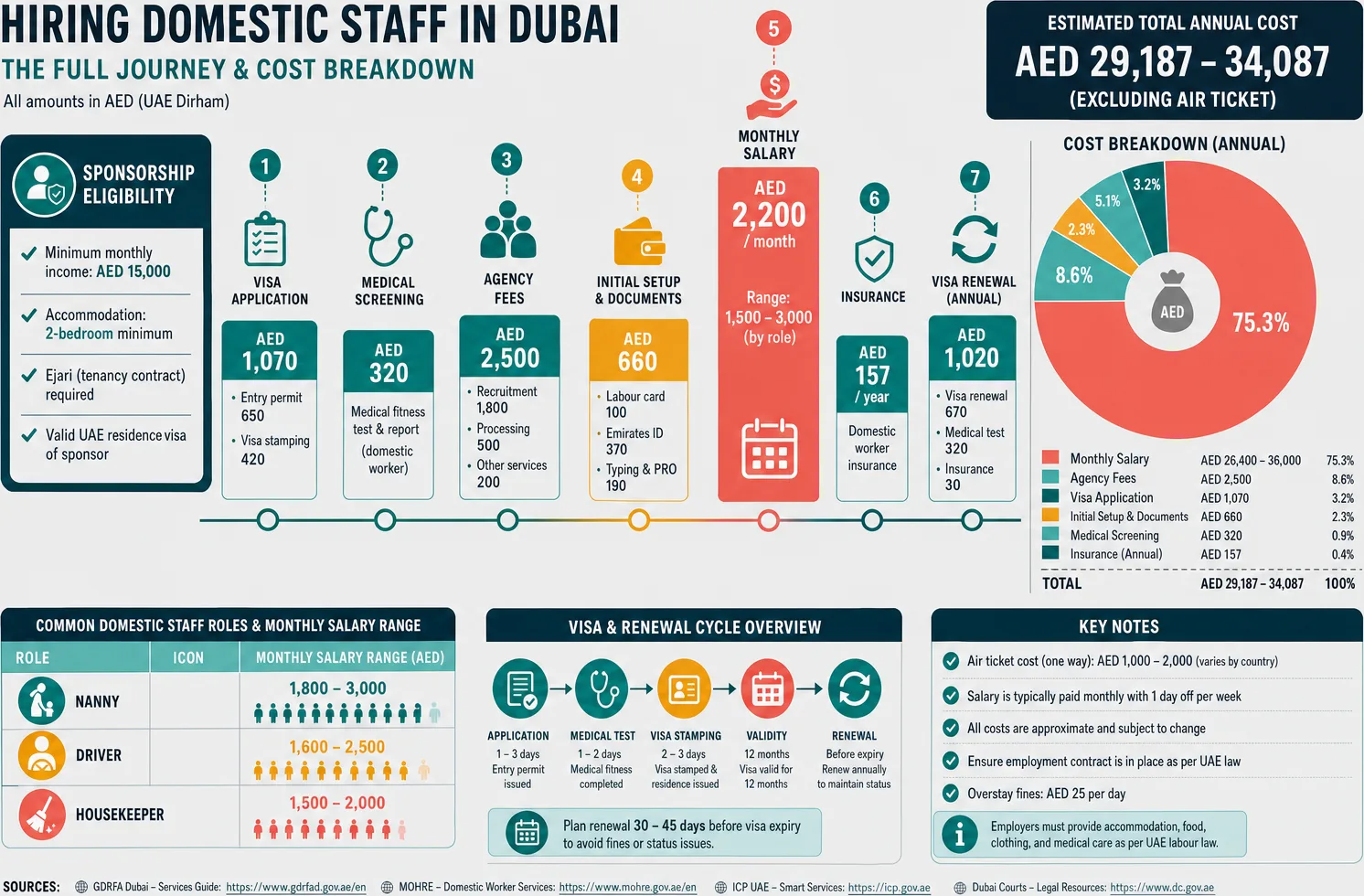
Tadbeer managed staffing costs AED 3,500–AED 5,500 per month, higher monthly outlay but lower administrative risk. Families planning to stay in Dubai for three or more years will generally find direct sponsorship more cost-effective beyond the 18-month mark.
Compliance Obligations After Hiring
Domestic workers are now covered under a version of the Wage Protection System (WPS). Late or withheld salary payments are reportable to MOHRE, and complaints trigger an inspection process. Always pay salary by bank transfer, cash payments leave no compliance trail if a worker files a non-payment complaint.
Residence visas must be renewed before expiry. Overstay fines run AED 25 per day and accumulate against the sponsor's record. Medical insurance must remain active throughout the visa period, a lapse is a MOHRE violation even if unintentional. Set calendar reminders 90 days before visa expiry to initiate renewal. If the worker leaves employment before expiry, cancel the visa within 30 days to avoid ongoing liability.
Practical Considerations for Russian Expat Families
Language compatibility matters, particularly for childcare roles. Filipino, Ukrainian, and some Eastern European nannies are commonly placed with Russian expat families in Dubai due to language proximity or prior experience with Russian-speaking households. For drivers, focus on UAE license validity and a clean record rather than language.
Sponsorship stability is critical. Russian nationals holding investor visas through a UAE company have more continuity than those on employment visas tied to a single employer. If your visa status changes, job loss, company closure, the domestic worker's visa is directly affected and must be transferred or canceled. Families on multi-year assignments should align domestic worker contract lengths with their own residency renewal cycles.
Three errors to avoid: allowing a worker to begin work before visa stamping is complete; using an agency without a valid MOHRE recruitment license; and signing a contract with the worker that differs from the MOHRE-registered version. The MOHRE contract is the legally binding document, full stop.
Final Thoughts
Hiring house help in Dubai as a Russian expat family is a structured, predictable process when you approach it correctly. Confirm your sponsorship eligibility first, define the role precisely, use a MOHRE-licensed agency or apply directly through the portal, complete the in-country visa process in sequence, and stay on top of ongoing compliance, salary protection, medical insurance, and visa renewal are legal obligations, not optional extras.
Start by confirming your eligibility at mohre.gov.ae, then request itemized proposals from at least two MOHRE-licensed recruitment agencies before committing to any placement.