

Table of Contents
Frequently Asked Questions
What can I trade with a general trading license in Dubai?
Most general goods, including electronics, apparel, homeware and auto parts. Restricted categories like food, supplements and medical devices need extra approvals. Prohibited items cannot be traded under any license.
Can I sell across the Gulf from a UAE trading company?
Yes. This is Dubai's biggest advantage. The UAE shares a customs union with the other Gulf states, so from one UAE entity you can import, sell locally, and re-export across the region using Dubai's logistics hubs.
Do I need anything besides the license to import goods?
Yes. You register separately with UAE Customs for a client code to clear shipments. You also need correct 12-digit product codes, and restricted goods need their own permits before they ship.
Do US export rules apply if I trade from Dubai?
They can. US export controls follow US-origin goods even when re-exported from the UAE. If you handle US-made products, especially tech, check US rules alongside UAE ones before you ship.
Do I still pay US taxes on a Dubai trading business?
Yes. The US taxes citizens on worldwide income, so you keep filing a US return wherever you live. Dubai's 0% personal income tax is a local benefit, not a break from US filing. Seek US tax advice.
General Trading Business for American Entrepreneurs in Dubai, UAE
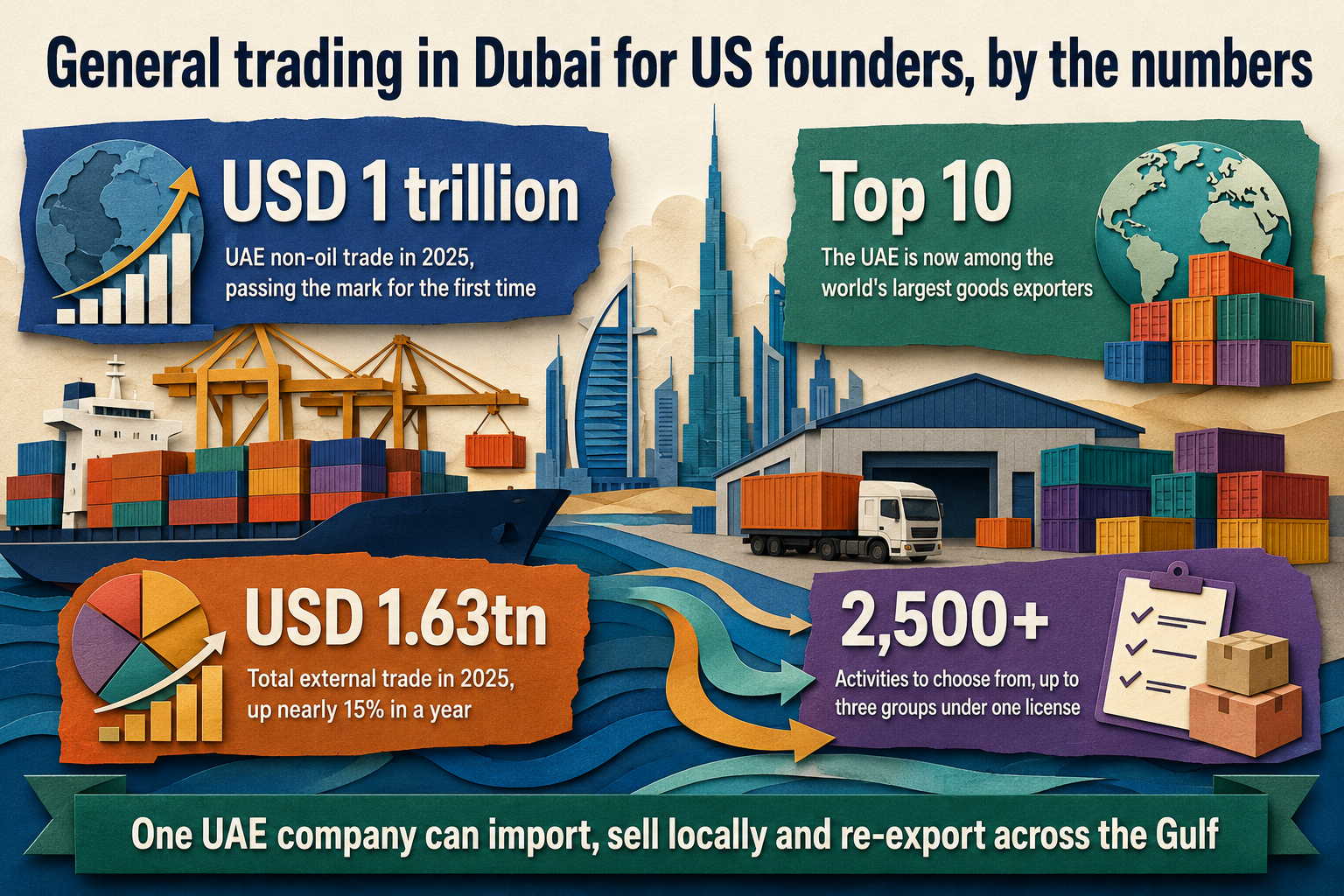
Most American traders think in one market: buy, then sell to US customers. Dubai works differently. It is a re-export hub, so a general trading company here does not just sell into the UAE, it moves goods onward to the Gulf, Africa and South Asia. In 2025, the UAE passed USD 1 trillion in non-oil trade for the first time, and became a top-ten global goods exporter. For a US founder, that reach is the real prize.
This guide is about how trade actually flows through Dubai, and how an American plugs into it with a general trading license. It covers what you can trade, how goods move, and the compliance points a US trader has to get right.
Key Facts at a Glance
What You Can Actually Trade
A general trading license covers a wide range of physical goods under one company. In practice, that means most consumer and commercial products.
- Freely traded: Electronics, apparel, homeware, furniture, sporting goods, cosmetics, auto parts and most general merchandise.
- Restricted, needs extra approvals: Food, health supplements, medical devices, some electronics with radio parts, chemicals and tobacco.
- Prohibited, no license covers these: Narcotics, counterfeit goods, and items barred under UAE law.
The takeaway is simple. Most everyday products trade freely, but check your category before you source anything, since a restricted item needs its own permit.
How the Trade Flows Through Dubai
This is where Dubai earns its reputation. A single UAE company can run the whole cycle, from sourcing to onward sale.
[blockCTACostCalculator]
Why One UAE Company Reaches a Whole Region
For a US trader, this is the part that does not exist back home. Selling from the US usually means selling to the US. From Dubai, one entity can serve a whole region.
The UAE shares a customs union with the other Gulf states, so goods can move onward with far less friction than shipping from the US. Dubai's ports and airports are among the busiest in the world, and the city is built around re-export. That means you can land a shipment once, then supply buyers in several countries from the same base. A single setup turns into regional reach.
Three Things US Traders Must Get Right
Trading across borders from Dubai is straightforward, but a few points catch American founders in particular. Getting these right before you order stock saves real money.
- US export rules follow US goods: If you re-export US-origin products from the UAE, US export controls can still apply. Check them alongside the UAE rules, especially for tech and electronics.
- Restricted goods need permits: Food, supplements, medical devices and similar categories need approvals beyond your trade license. Sort these before the goods ship.
- Product codes must be exact: The UAE now uses 12-digit product codes. A wrong code can hold your shipment at the border and trigger fines.
None of these are dealbreakers. They are just the details that decide whether your first shipment clears smoothly or sits at the port.
When a Specific Activity Beats General Trading
General trading is not always the smart default. If you sell one clear category, a specific activity often serves you better, because it keeps your banking and tax simple.
Take a US founder importing car parts to sell in the UAE. General trading feels like the safe pick, but the real model is narrow: auto parts, sold to local buyers. An auto parts trading activity captures that exactly, and a bank can read it as a clean, predictable business. A broad general trading scope does the opposite, it signals many unrelated product lines, which usually means more questions when you open an account.
A simple way to decide:
- One or two clear product categories: use specific trading activities.
- A genuinely mixed, multi-category operation: general trading earns its place.
Either way, you are not boxed in. With up to three activity groups under one license, a focused setup still lets you add related lines as you grow.
Setting Up Your Trading Company
The setup itself is quick and runs online. You do not need to be in the UAE to begin, and you can have a company before you book a flight. Here is what the process involves:
- Pick your activities: Choose your trading activities from over 2,500 options, with up to three activity groups under one license. You can combine, say, an auto parts activity and an e-commerce activity without a second license.
- Get your license: A Meydan Free Zone trade license can be issued in under 60 minutes through Fawri, fully online.
- Register for a customs code: You apply separately with UAE Customs for the client code that clears your shipments at the border.
- Open your bank account: A guaranteed corporate IBAN gives you a business account that can hold and move funds in several currencies, useful when you buy in US dollars and sell in dirhams.
- Sort residency. Your license makes you eligible for a residence visa, and mResidency handles the medical, Emirates ID and any dependant visas.
- Add support as you grow. mAccounting can handle your corporate tax, VAT and bookkeeping once you are trading, keeping your records clean from the start.
Conclusion
For an American, a general trading business in Dubai is not just a local venture. It is a base for regional trade. You can source globally, sell into the UAE, and re-export across the Gulf from a single company, in a market that just crossed USD 1 trillion in non-oil trade.
Get your license, your customs code and your compliance right, and the rest is logistics. To set up your trading company and choose the right activities, book a free consultation with a setup advisor at Meydan Free Zone.
[blockCTAContact]